
Good Foundations Aren’t Always Cheerful
I have some bad news for my progressive allies.
Bigotry is really popular.
And we have to adapt to that reality to build better tactics.
Because that’s kind of the opposite of the way I think most of us imagine that social change works.
When people say, “the arc of justice bends long”, it often implies that change that empowers more people is inexorable.
That kind of thinking interlaces with the ideas Jesus presents on the Sermon on the Mount. “The arc of justice bends long” is real close to “the meek shall inherit the Earth”.
It feels good to think that the universe is primed for justice and fairness.
We all know it ain’t so.
In reality, we can look at the history of policies in the United States and see several things.
When people fight for healthcare access it is a battle.
When people fight for equal rights it is a battle.
The people who oppose those things are not confused or kidding: they actually do not want everyone to have the same rights. They don’t want strangers to be able to waltz into a hospital and get any care they need without crippling debt.
They do want to crack jokes about old people who got attacked with a hammer while they were sleeping at home.
“In a pattern that has become commonplace, a parade of Republicans — helped along by right-wing media personalities including Fox News host Tucker Carlson, and prominent people including newly installed Twitter owner Elon Musk, the world’s wealthiest man — had already abetted the viral spread of lies about the attack, distorting the account of what happened before facts could get in the way. Finding life on far-right websites and the so-called dark web, conspiracy theories and falsehoods leapt from the fringes to the mainstream.
Although many Republican leaders denounced the violence and some, including former Vice President Mike Pence, expressed sympathy for the Pelosis, none of them publicly condemned the falsehoods their colleagues were elevating or did anything to push back. That left others to fill the void.
“Just produce the police bodycam — why is that so hard?” Carlson demanded on his show Wednesday night. Addressing those criticizing the conspiracy theorizing, he added: “We’re not the crazy people; you’re the liars. There’s nothing wrong with asking questions, period.”
They do want to sell t-shirts and stickers celebrating when someone falls.
The same people selling those t-shirts and making those jokes think the hospital should be able to turn you away if you can’t afford to pay for care.
That is the world we have been building. So we have to find tactics that acknowledge this reality: some people like to see other people get hurt.
And the foundation we can build here is this: what if the hurt person was you?
A person either understands that they are mortal and might need care or they think it’s all a big joke.
I see a lot of comments about superhero films and just out of boredom one day, I began watching Greenland. In it, Gerard Butler is not a superhero. He’s just a regular guy.
It’s interesting to see the repetition of disaster films in our culture. When I was in my twenties I saw Deep Impact and Armageddon, two films about the Earth being threatened by space objects.
Watching Greenland, the most terrible moment was at the beginning, when Gerard Butler’s family gets a Presidential Alert, and their friends and neighbors do not.
The America we are making is that one. In Deep Impact, Elijah Wood’s family gets a spot in the bunker, and he takes Leelee Sobieski along with him. Tasha Yar and her dad are on their own, but eventually they also hand their newborn over to the teenager.
In Greenland, the neighbors beg Gerard Butler’s family to take their daughter. She is maybe 10. And they don’t. They ask, very rationally, what they are supposed to do when they won’t let her go with them, and then they’ll have to abandon her, alone, at an airforce base.
At the beginning of Deep Impact, we see the Treasury Secretary resigning. The journalists following him think he is only having an affair.
He is interviewed loading his boat with survival equipment.
They think a dude would resign over an affair.
He is interviewed loading his boat with survival equipment.
He says, “look, I know you’re just a reporter, but you used to be a person, right?”
“I wanted to be with my family.”
He is interviewed loading his boat with survival equipment.
We were supposed to keep going to work.
“I always thought the truth was in the nation’s best interest,” says Téa Leoni.
But we were supposed to keep going to work.
We don’t even make movies where they save everybody.
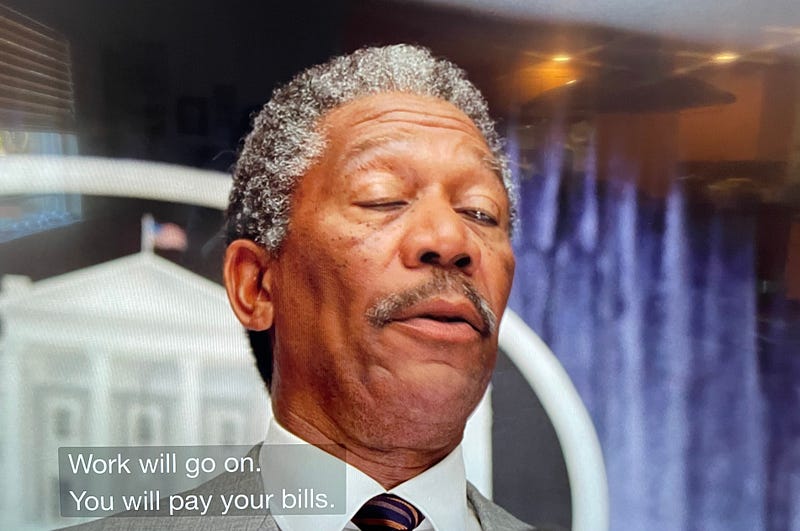
But we could.
What is the purpose of these movies?
A few moments later, President Beck says he is freezing all wages and prices. As if it would be wrong to pay people more before the apocalypse. Or charge them less.
He does not say he is freezing the stock market.
In the 20 years between Deep Impact and Greenland, we have actually done some of the things that were science fiction in 1998:
This was just in September:
We are getting the country we want to build.
“The incongruity between support for the space agency and its climate warnings stems from a “crucial tension in conservative attitudes towards climate change, according to John Cook, a research assistant professor at the Center for Climate Change Communication at George Mason University.
“On the one hand, there is respect for scientific institutions like NASA,” Cook wrote by email. “On the other hand, acceptance of human-caused global warming is low.”
And I think the guy who wrote that Vulture review is right. What if we don’t have a reporter who figures out what is happening?
“The first indications in this movie that something is amiss are a glimpse of a distant armada of jets in the sky and an automated phone call received in the middle of a supermarket run. That may not sound like much, but I kept thinking, This is how it would happen.”
I don’t think they could really keep it a secret. Everybody has telescopes now, and a lot of them have software that lets you track objects yourself.
But what would that mean?
It’s not like climate change is a secret either. We just collectively value the economy and our way of life more highly than the future for everyone.
That’s the foundation that underpins our bigotries.
The assumption that your family would somehow be on the “OK” list.
Even against all odds.
In reality, space travel is pretty expensive and dangerous.
In the tense exchange that followed between Brooks and Bolden, the NASA boss explained that the plan to scrap the shuttle program was crafted following the recommendation of federal officials investigating the breakup of the Shuttle Columbia during the Bush administration. He then added, “I was the one who recommended to the president that we phase the shuttle out.”
And so is building a bunker under the ocean.
While I was watching Greenland, my kids wandered in and out, and caught a couple minutes of it. And my son could not wrap his head around the idea that there wasn’t enough room for everyone. It was just inconceivable.
I want to live in a world run by people like that.
I already know what this one is like.
“What we allow will continue.
What continues will escalate.“


