
Gold — A Store of Value or an Example of Human Folly?
The Story of Gold and the Future of Bitcoin
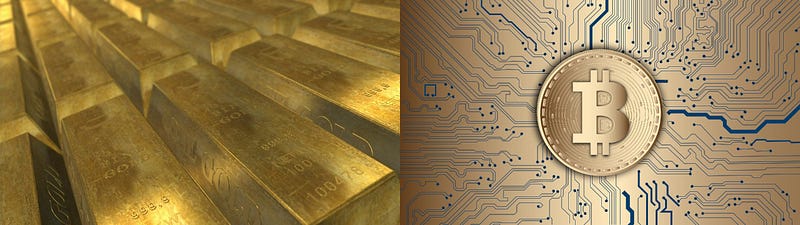
By Medium standards, this is a long piece. Perhaps it is sometimes worth proceeding as Shakespeare advised:
“Wisely and slow. They stumble that run fast.” (Shakespeare)
A Champion Metal
Despite humanity’s furious mining and search for Gold, stretching back 4,000 years ago, there is not much Gold on earth. The science writer Theodore Grey writes in his superb book, ‘The Elements — A Visual exploration of every known atom in the Universe,’ “All the Gold ever mined in the history of the human race would fit into a cube about 21 meters on edge.” (This figure has been updated for production up to 2020)
In addition to shining brightly, Gold retains its brilliant color for millennia, is malleable, resistant to acids, does not rust, and easily conducts electricity. It easily forms alloys with silver, copper, platinum, and palladium. Gold is used in jewelry, coins, dental fillings (yes you can still get a Golden smile), electronic devices, satellites, other space equipment, and in Indian temples as an offering to the gods.
Theodore Grey writes, “You can find a piece of Gold lying on the ground where it has been for a million years, pick it up, dust it off, and it will shine for you as it’s been waiting the whole time for this moment. Billions of years from now, when aliens come to the earth before our sun explodes, Gold will be just as shiny as it is today.” It is thus Gold, not diamonds, that is truly forever.
Gold has also played a significant role in savings. Historically, when governments mismanaged economies and debased their currencies, it was the Gold that had been hidden under mattresses and saved that helped the ordinary person get through tough times. It is no surprise that since antiquity, individual savers have often turned to Gold as a store of value.
Jewelry and Coinage
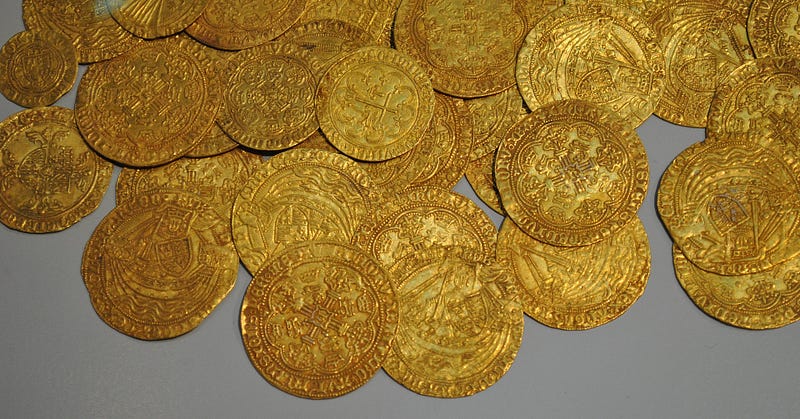
In 2016 archaeologists in Bulgaria found what they believe to be the world’s oldest Gold artifact. This is a small Gold bead weighing 15 centigrams and dating back to 4,500 BCE. Yavor Boyadzhiev, associated professor at the Bulgarian Academy of Science, said, “It’s a really important discovery. It is a tiny piece of Gold but big enough to find its place in history.”
Even today most of the Gold that is mined (80%) goes into making jewelry. Jewelry acts as an adornment as well as an investment that can be pawned or sold in times of distress. India and China dominate this market and together make up close to 75% of the Gold jewelry consumption. However, it is the London market that is still the center of the Gold trade, making up 70% of global notional trading volumes.
Herodotus writes that it was in Lydia (present-day western Turkey) around 600 BCE that the first Gold coins were used. The “Lydian Lion” is the oldest coin still extant. It is made of an alloy of Gold and silver (called electrum) and stamped with the head of a lion.
The use of Gold in coins spread rapidly. The Golden Rule, “He who has the gold makes the rules,” was demonstrated by Alexander the Great (330 BCE) who used Gold coins with a stamp of his head to pay his troops. In the East, the Chinese invented the “Ying Yuan” Gold coin. The Romans and Indians continued this trend, and Gold, usually in combination with silver or other metals became one of the most sought-after coins.
Gold’s Cousins
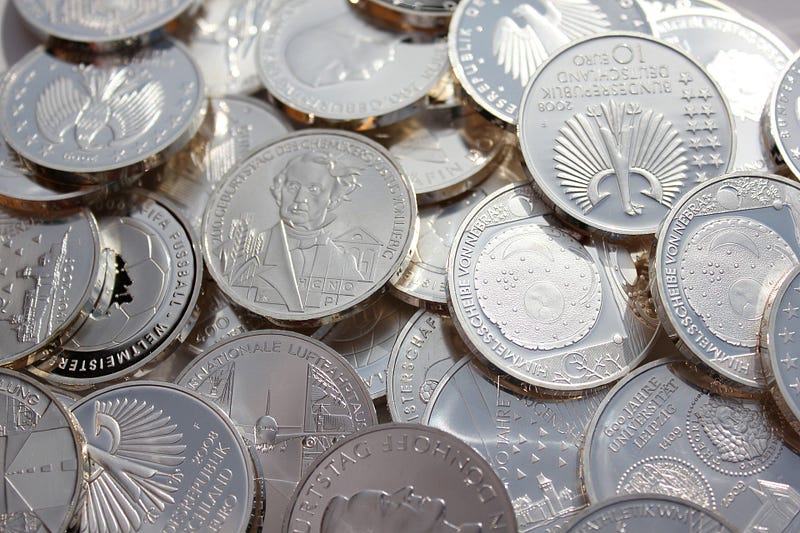
Silver is much more abundant than Gold. For example, in 2019, 27,000 metric tons of silver were produced compared to 3,300 metric tons of Gold. Thus, silver was often a more popular currency. Spanish dollars were minted in silver, and the discovery of a major silver mine in Peru (1545) led to a surge in inflation in Europe via Spain. In modern times, some countries continued the use of silver. Swiss coins were minted in silver until 1968. Copper and Bronze (an alloy of copper and tin) coins were also widely available.
Despite a wide range of coins made up of different metals, Gold’s rarity and luster has made it the preferred long-term store of value.
Paper Currencies and the Fall of the Gold Standard
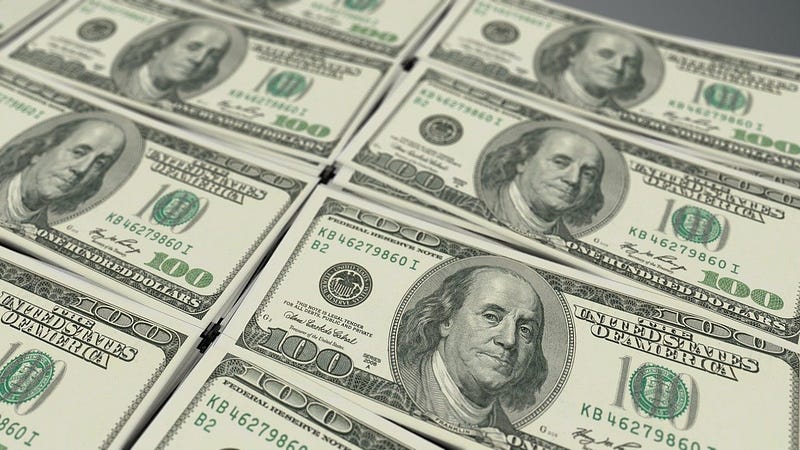
A dramatic new invention was created in China during the Song Dynasty (AD 960–1279). This was the first paper currency. The paper note promised to pay the holder a certain amount of copper or gold coins. It is important to note that these paper notes had attached a “promissory” aspect to them. They promised to pay the holder of the note a certain amount of metal, often gold.
The history of paper currencies has since had a long and eventful history. Still, this promissory part remained mostly intact for those regimes and countries that wished to protect their currencies’ strength. In theory, a person with a promissory paper currency note could go to the government and demand the appropriate amount of gold. Those countries that experimented and abandoned this promise were at the mercy of their government’s excesses. Who was to stop a government from just printing as much paper currency as it wanted for purposes of war, personal political aggrandizement, or greed, thus leading eventually to inflation?
Moving close to the present, European countries and then in the last century, the US demonstrated their political and economic strength by linking their currencies to gold. In the twentieth century, the linkage between the US dollar and gold was the basis of the Gold Standard. The world based its trade on the US dollar, and the US dollar was backed by gold reserves, held literally in Fort Knox.
It took almost 50 years from World War I to the oil shock of the 1970s for the Gold Standard to get dismantled. A skeptic may say that politicians were hamstrung by the chains between the US dollar and gold. It allowed for less flexibility to spend money freely. Thus, breaking the shackles with which paper money was attached to gold benefited politicians who wanted to spend more and more.
There are also economic arguments against the Gold Standard. John Maynard Keynes called the Gold Standard a “barbarous relic.” In times of crisis, the Gold Standard prevented governments from loosening their purse strings and helping the poorest get through. For Keynes, abolishing the Gold Standard would still enable governments to provide “stability of prices and the adequacy of internal credit for the requirements of trade and industry.” Inflation was a risk, but so was unemployment. A wise government would, thought Keynes, navigate past Scylla (inflation) and Charybdis (unemployment) but only if the Gold Standard was dismantled.
In 1971 President Nixon no longer allowed the US Federal Reserve to exchange dollars for gold and the Gold Standard that stood behind the US dollar was completely abandoned in 1976. Peter Bernstein, in his excellent book, ‘The Power of Gold — The History of an Obsession,’ writes that, “Discretionary management is the system that the world has chosen to replace the constraint of gold. All world countries now function with monetary systems convertible into nothing except from one nation’s money into another nation’s money, all of which is costlessly produced with the touch of a computer’s keyboard. We no longer have money that can be tested with a touchstone to determine whether it is the “real stuff.”
A new phrase was invented, “Fiat money.” This is the currency that governments and central banks manufacture at will, backed by nothing other than trust. Trust is the key to making this system of fiat paper currencies work. People need to trust that the currency will hold its value. When trust is broken, as in Zimbabwe, inflation can decimate societies. In Zimbabwe, inflation peaked at 500% in 2019, and in January 2021, inflation was still at an annual rate of 385%. Zimbabwe’s currency may be worth less than the paper it is printed on.
Why Does Gold Retain its Value?
It is in situations such as in Zimbabwe that Gold shines brightest. Those who have saved in Gold can survive, at least for a certain amount of time. But why does Gold retain its store of value? There are two sets of reasons.
- The first collection of reasons includes the fact that Gold is not abundant and retains its physical form over millennia. Also, governments cannot debase the metal. Everyone may not be like Archimedes, who showed us an easy method to find out Gold’s amount in an object, even while sitting in a bathtub. However, many jewelry and Gold merchants will conduct accurate measurements and tell you the purity of Gold you have in your bar or coin.

- The second and perhaps primary reason gold retains its value is that enough people believe it maintains its value! This is an example of George Soros’ reflectivity theory. Soros said that “if investors believe that markets are efficient, then that belief will change the way they invest, and that in turn will change the nature of the markets they are observing.”
- There is a cost for mining and producing gold that could be seen as a floor to its price. Today the total cost of production varies between USD 1,000 to USD 1,200 an ounce. However, there have been times when the price of gold has gone below the cost of production (as occurred in the 1990s and again in 2013). Thus, these historic price charts for gold demonstrate that its value depends on having enough people believing it has value.
- It is precisely because people from all parts of the world and over millennia have valued the possession of gold that it has remained a universal currency. Gold has retained its value over thousands of years and has been successfully used as an instrument of saving and a hedge against inflation.
Do We Still Need Gold?
In recent decades many investors have abandoned gold as a key part of their portfolio of savings. Gold, unlike many other forms of savings, provides no nominal yield. A bond gives one interest. An equity share can provide dividends and capital appreciation. Gold provides neither. Thus, equity and debt instruments, real estate, and other commodities play a much more critical role. Not only do many of these instruments provide a yield, but inflation has been very low. The role of gold as a significant portion of one’s savings seems to have diminished. However, two reasons why historically gold was such a good store of value remain true today:
- Wars and geopolitical conflicts

Since World War I, the US, the preeminent global power, is facing its first serious rival in China. Napoleon is purported to have said about China, “There lies a sleeping giant. Let him sleep! For when he wakes, he will shake the world.” China has no experience as a world power. Which way will it grow, and will the US and China, with two dramatically different systems, be able to co-exist peacefully?
The US dollar, so universally a currency of choice for investors over the last seventy years, may no longer retain its strength. What type of dynamics will we experience between the US Dollar and the Chinese Yuan? In any period of extreme uncertainty, where should we turn to safeguard our savings?
We need a neutral store of value that remains intact amid conflicts.
- Government borrowings, deficits, and inflation
We are often sanguine about risks until we face a crash head-on. The extent of government borrowings since the sub-prime crises and exacerbated by the covid pandemic is genuinely historic. Massive government borrowings are not limited to the US. It is a worldwide phenomenon, but as the world’s largest economy, consider the facts.
At the end of 2020, the US government debt was US 20.3 trillion dollars, and its deficit is estimated to be around US 3.3 trillion dollars. In comparison, the total US GDP in 2020 was around US 20.6 trillion dollars. While government debt is measured at the end of the year and GDP accumulated over the entire year, it is still meaningful to take the debt to GDP ratio. Doing so shows that the US has borrowed almost as much as it is making over an entire year. The US is paying its interest and debt obligations by issuing more paper money. We are assured that this is OK. The experts will manage the situation, and we will get back to a more “normal” condition in due course. Governments are betting that interest costs will remain as low as they are today. Will this be the case in the future? Today’s politicians will be long gone if there is a time of future reckoning.
We need at least some hedge against the possibility that the experts are misguided. We need a store of value independent of governments that maintains its worth in times of inflation.
Bernstein quotes Robert Mundell, a Nobel prize-winning economist, as saying, “The main thing we miss today is universal money, a standard of value, a link between the past and the future and the cement linking remote parts of the human race to one another. Gold will [remain] part of the international monetary system in the twentieth century.”
The New Kid on the Block — Bitcoin

Bernstein’s book was published in 2000. In 2008/9, Satoshi Nakamoto, an unknown (and still unknown!) person/s, invented Bitcoin. Readers can find extensive explanations on Bitcoin, but for our purposes, the following key features are important.
Gold and Bitcoin are similar:
- Both are independent of governments. Bitcoin is based on blockchain, a technology where a record of who owns what amount of bitcoins is kept in a public ledger distributed across millions of computers
- Neither provides any interest payments or dividends (although there is an active gold loan market)
- Both are mined. Bitcoin is mined via the solving of increasingly difficult computational puzzles
- Neither are convenient means of payment. You can’t buy coffee with a small piece of gold, and paying in Bitcoin is expensive and impractical
- Its price relative to fiat currencies varies with demand and supply
- Production and storage costs for both are relatively high. Mining Bitcoin requires increasingly powerful, electricity-consuming computers, and storage in data centers is not free.
The differences between Gold and Bitcoin are:
- Unlike gold, you cannot hold Bitcoins in your hand. You cannot be sure you have it under your mattress or in a vault. Thus, you might feel more secure having gold. On the other hand, gold is often held in a dematerialized form, such as gold accounts, certificates, and ETFs. Thus gold can be confiscated by governments by force or more easily stolen. Bitcoins’ presence is based on it being distributed widely around the world and so perhaps less easy for governments to take away in a time of crisis. (As long as you remember your password and codes. There is an amusing story of someone who lost a USD 220 million Bitcoin fortune because he forgot his password)
- Gold has a theoretically larger supply. Gold mines are still being discovered. The Bitcoin system is set up to have only 21 million Bitcoins mined.
- Bitcoin, say critics has rivals such as Ethereum. But then gold has silver and other precious metals as rivals to be compared to.
- Gold has dual uses (in products and as jewelry) and a long history of prices that can be used as a reference point. Data on gold price volatility can be used to mathematically build efficient portfolios. Will Bitcoin develop its own track record of data that sophisticated investors can use in building a portfolio? Might Bitcoin develop a reputation of being like the Dutch Tulips of 1637? Tulipmania ended with ruined lives and lost fortunes. If enough people believe that Bitcoin is a modern Tulip, it will turn out very different from gold.
- Bitcoin might face some amount of competition from digital currencies manufactured by Central Banks. However, the whole point of gold and Bitcoin is that they are independent of political interference and so this may not be that much of a concern.
Is it possible that as we get used to the idea of Bitcoin, that Bitcoin joins gold as its modern twin? The two working in tandem as a store of value and a hedge for the uncertainties of life?
What Do We Really Want?
Whatever the answers to the above questions, we would do well to remember Bernstein’s advice. Bernstein reminds us of the story of King Midas from Greek mythology. Midas was given a wish by the god Dionysus and chose to have everything he touched turn into Gold. When all his loved ones and all his food became Gold, Midas learned the hard way the folly of his greed and lust for Gold.

Bernstein writes, “Gold as an end in itself is meaningless. Hoarding does not create wealth. Gold makes sense as a means to an end: to beautify, to adorn, to exchange for what we need and want.” Bernstein’s wisdom applies to Bitcoin or any financial or physical asset as it does to gold. We need to make a living and retain safe investments that mitigate government excess and private greed. However, we will all benefit by keeping in mind that these are only means to a healthy life full of creative work and friendships.
Many thanks to Rajeev De Mello, a great investor and good friend, for his deep insights and advice on this topic. Any errors in the article are, of course, mine.


