
Selected stories on ILLUMINATION-Curated
Going into Rooms and Out of Rooms
Selected stories by Øivind H. Solheim hosted on ILLUMINATION-Curated
Distributed to #Writing #History #Life
In this interview from 2008 I talk about why and how I came to write and publish a 368 pages long novel where the main ‘character’ is an old carbide factory in a distant small town in the western parts of Norway. In this novel, published in 2008, there are groups of people, human characters who strive to live their lives in narrow and challenging social, economic and human surroundings.
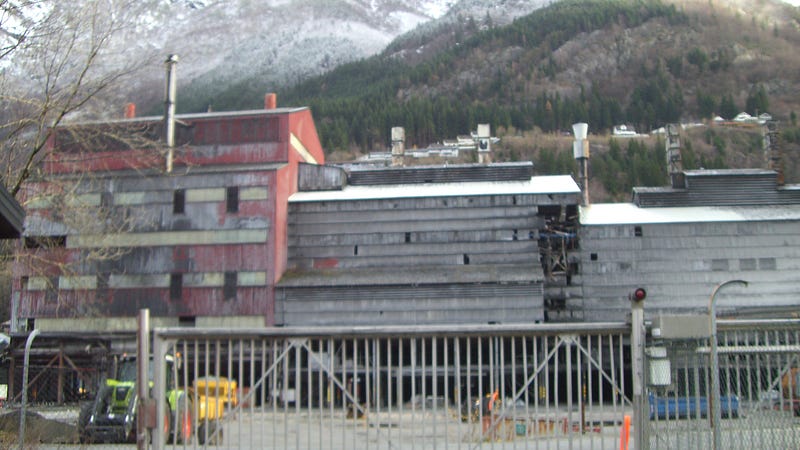
An interview with the author of Fabrikken — “The Factory, a Novel”
— Why do you write?
— It has to do first and foremost with pleasure. To be able to enjoy what is written down as text, what should be on the book page.
— In what way?
— It’s connected to the content. I enjoy imagining what happens, I love using the language to describe places, make visible things and give life to characters. And not least it’s the linguistic side: when what is written, when the text is good, then I experience joy when I read it.
— What is so special about writing fiction?
— Among other things, it is a great freedom. The freedom to create this particular universe, to create spaces where I myself and the reader can enter. The reader can go into and out of rooms where there are people, characters — human beings who are there for the reader, when he or she wants to enter those rooms.
— So for you, that’s the novel? Spaces where you showcase people, characters, incidents, life?
— Yes, meeting people and the environment, and getting close to people who could have lived.
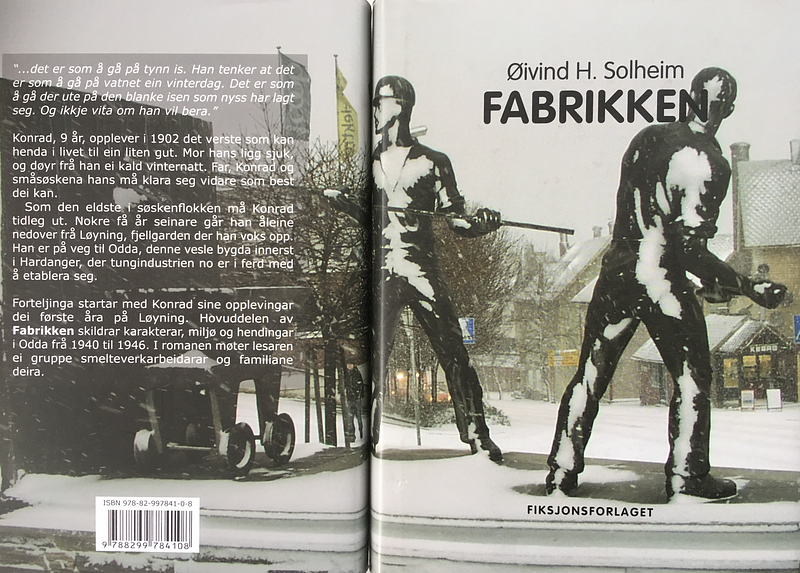
— You write in Fabrikken about people in Odda before and during the Second World War. Why did you write this book?
— It is a need I have had for a long time, without it actually being particularly conscious in me until just the last few years. About two years ago I started writing. I did it in my spare time, kept on and wrote the book in the afternoons and evenings during a period of almost two years, while I also worked 100 percent as a teacher, as I had done for the last 30 years.
— What subjects did you teach?
— I taught French and German as foreign languages, and Norwegian language and literature. And then writing, of course. Learning to write is an important part of learning a foreign language, and especially when learning Norwegian as a mother tongue.
— So while you were a teacher, you wrote a novel of over 360 pages!
— Yes. And it went unexpectedly well!
— You mean — the writing?
— Yes, thinking about characters, thinking about the environment, events in the time period that I was interested in.
— So it was mostly joy, enjoyment, writing the novel?
— Yes, mostly that. But also hard work, many more difficult moments when I doubted, when I was looking for answers and solutions, and when I experienced that I was in trouble.
— But why do you write about this particular period, the Second World War, and the decades before the war?
— Yes, you can ask that. That’s before I was born. So maybe that’s why.
— How come?
— Well, maybe the fact that I have wanted to explore that time, this period, in Odda and the area around the city, Hardanger. How it was then, in the time when my parents and grandparents lived.
— Are you telling about real events?
— Yes, in a sense it is real. It could have happened. But the events have not happened, of course. Not exactly like in the novel. The events that the novel depicts inside the factory, in Odda and elsewhere — these are fictitious events.
— And the characters — some of the types?
— They are fictional, all as one. Fictional characters, who could have lived.
— But the environment, you have a plethora of concrete descriptions of places in Odda, both inside the smelter and in the village of Odda?
— I have deliberately gone in to portray as realistically as possible. It gave me a kind of joy to write the characters into the physical framework.
— What do you think about Odda today?
— Lots of things! But perhaps first and foremost that it was a good place to grow up. Even though I did not exactly think like that when I was in the middle of it, that is, when I was young and living in Odda.
— What about the future?
— I do not want to predict it. But I think it’s a little sad that people in Odda seem to be repeating mistakes they have made in the past. Certainly the old
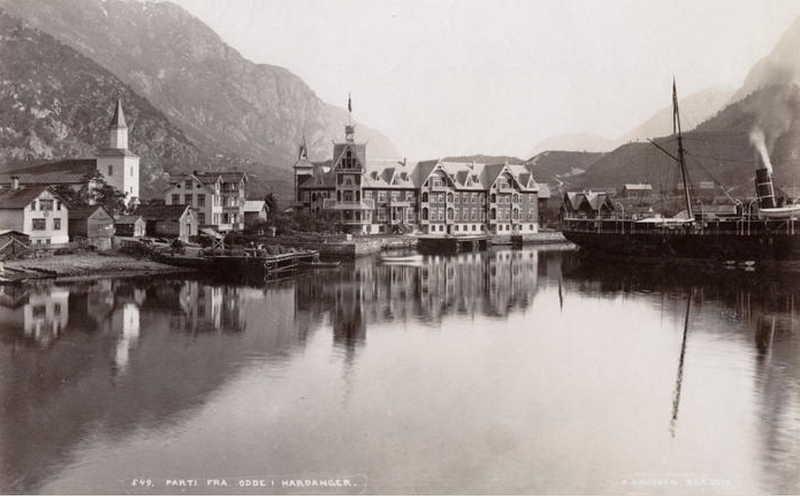
town hall (Hotel Hardanger, the largest wooden building in Northern Europe) was dilapidated and unappealing to look at in the time (1976) before they demolished the building. But they could have taken better care of it! It’s hard to understand, that they just tore it down.
—But the smelter today?
— Yes, that’s right, there’s a lot of junk and clutter in there. But those who decide should take up the matter itself, which in my view is very complex. An important aspect in this case is what the smelter has been and what it has meant for people in Odda and for the Odda community for almost a hundred years.
— So you go for the protection of the smelter?
— I do not know the details of the case well enough, so I can not go into that much concrete. But I think it is important for the Odda community that one takes care of this part of Odda’s history, and that one uses the possibilities that lie in what is now left of the smelter. It will be a great pity for Odda if the city misses the status on UNESCO’s World Heritage List that may have been on the trail for Odda.
— Is it too late?
— It’s never too late!
— Is it not?
— Of course, if you have the wrong, negative attitudes. Then it can often be too late. But now I want to end this interview with a motto. It’s in English, and it sounds like this: NEVER SAY NO. — SAY YES, I CAN!
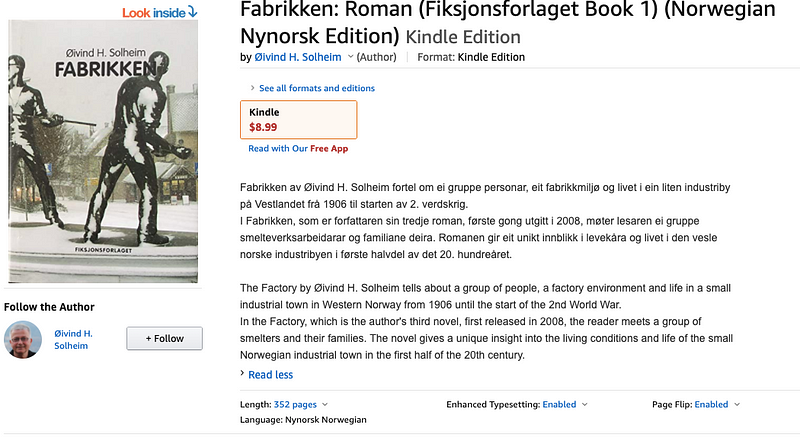
The Factory (Fabrikken)— a novel about
- people and events at the smelter and in the village - the work and the environment in the smelter - longing and betrayal, truth and lies, jealousy and gossip
BACK COVER TEXT
“… It’s like walking on thin ice. He thinks it’s like walking on the lake one winter day. It’s like walking out there on the shiny ice that has just settled. And I don’t know if it will carry me.” (from The Factory, Chapter 1)
Konrad, 9 years old, experiences in 1902 the worst that can happen in the life of a little boy. His mother is ill and dies on a cold winter night. Father, Konrad and his younger siblings must manage as best they can.
As the oldest of the siblings, Konrad has to leave early. A few years later he walks alone down from Løyning, the mountain farm where he grew up. He is on his way to Odda, this village in the heart of Hardanger, where the heavy industry is about to establish itself.
The story begins with Konrad’s experiences in the first years at Løyning. The main part of the Factory depicts characters, the environment and events in Odda from 1940 to 1946. In the novel, the reader meets a group of smelter workers and their families.
All rights reserved. © Øivind H. Solheim, author of novels, poetry, articles, essays, short fiction and experimental writings. Contact: [email protected].