
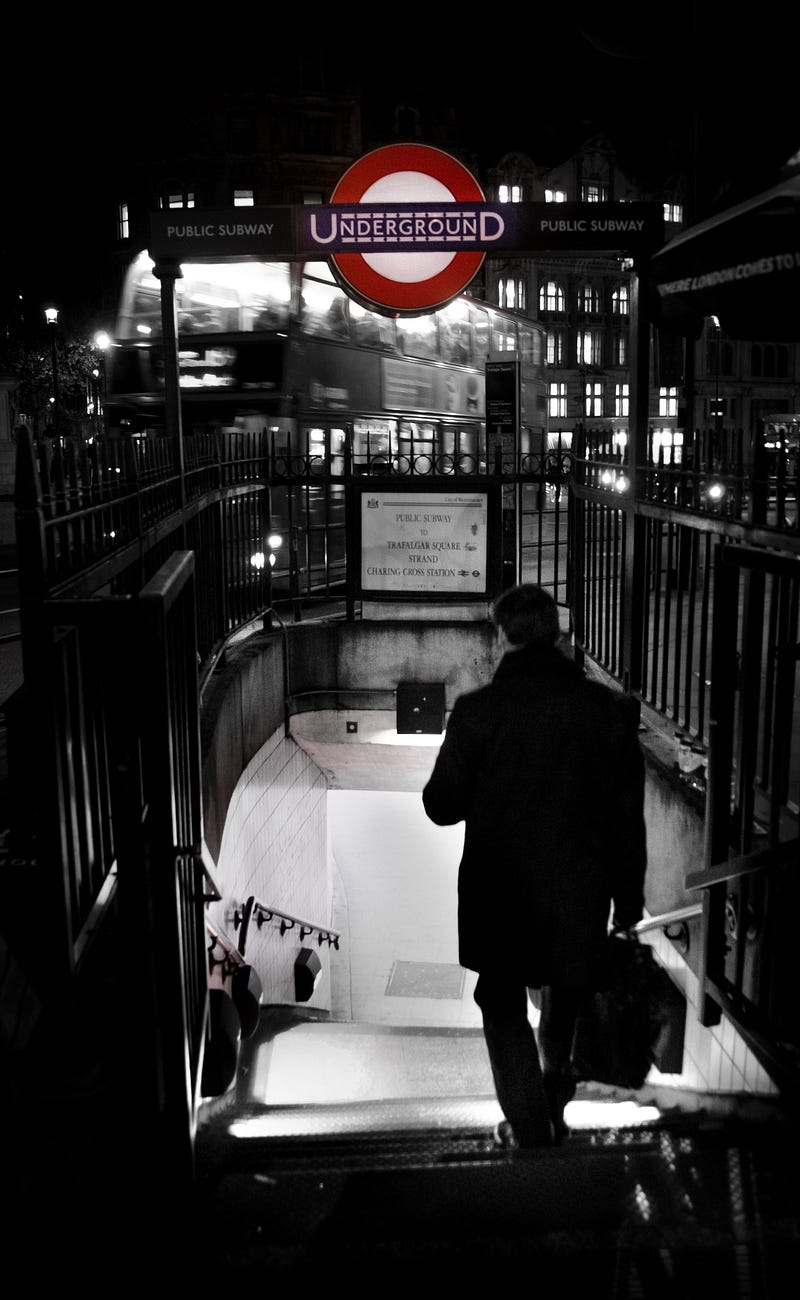
Going Down: driving towards English sadness
Last week, instead of taking the train, I decided to risk the evening traffic and drive across London with a friend. She is the one and only person I know here who is also from Southern California, a writer, like me, who left America in her mid-twenties to marry an Englishman and replant herself in northern soil. We met a decade ago, and have been helping each other in our Californian in England life ever since.
My friend and I had gone together to a literary event in North London. We live south and west: one of the rare journeys where driving in the city made sense. Cars are good places to talk, and we had a lot to say to each other. We tried to avoid touching on the gloomy national disaster. On the way up, we covered husbands and children. On the way back, at first, we talked about the event.
We had been listening to Sarah Moss discuss her book, Ghost Wall. It’s a story about a father and daughter whose participation in an Iron Age re-enactment takes a sinister turn; it examines the dangerous nostalgia for a Britain “free from foreigners” and how a certain kind of man tries to control the story of the past in order to gain purchase on the future. In Ghost Wall, the characters drift toward a disaster, one that starts out as unthinkable and slowly, surely, becomes inevitable.
Soon, our conversation drifted, too. Hands carefully on the wheel, I admitted I had not been sleeping well, having been spending too much time on the screen. As paths away from crashing out of the EU close off one by one, I have wasted hours scanning the latest posts, looking for signs of hope.
My friend is a much calmer person than I am. She told me she tries to avoid social media of all kinds. She’s got a sharp, analytical brain, and as I started to flap, she turned our attention to the big picture, the root causes.
It is easy to find philosophical perspective in a car. The world is close, but far enough away, and it passes like a story — this, then that, then something else. The scene outside our glass was lit up by sulphur orange street lamps — shops, streets, blocks of darkened flats. We knew these streets, and we did not know them.
At first, we searched for the opening of the story — was it our city’s unhealthy dominance of the rest of the country, rooted as far back as the Normans or Romans? Or the way the wealth generated here, a “national piggy bank” as my friend put it, brewed resentment, how the rest of the country felt neglected and shut out? We talked about austerity and inequality — how the poorest have paid the price for the global technocratic meltdown and how bankers have sailed through untouched— and will sail through, again.
In our dissection of causes, we did not neglect our own state. We touched on Thomas Piketty (my friend is probably one of the few people I know who has actually read Capital), and the tax revolt that started in 1979 with Proposition 13 in California, which once had the best public schools and libraries in the country and now has some of the worst.
Then we gave up on thinking, and sank into our feelings.
We got to the Great West Way and waited in silence for the light to change. We turned right into the stream of traffic.
My friend said, “I just feel like England has become a much happier place in the time I have lived here. I don’t want to go back to that sadness.”
Yes, sadness. I remembered it.
“So I didn’t imagine it.”
“No, you didn’t. Remember?”
We traded memories of the country that greeted us when we arrived: the houses split into damp apartments, the scary pubs full of masculine smoke and anger, the B&B’s with their faded chintz and storage heaters and sheets that felt wet when you slipped into them, the crumbling infrastructure underground and overground, the rough sleepers in the streets, the customer-unfriendly monopolistic retailers, the cabbages and potatoes, the way the whole world seemed like an over-steeped cup of mid-brown tea.
Long ago, we Californian girls had pledged ourselves to a country that we found alien and often alienating. England had felt like a place overburdened by its heavy past; at times the weight of history almost suffocating to someone born in the land of the new. Then we watched it change.
Over the last twenty years England seemed to become a different country — more vibrant, dynamic, youthful, flexible, confident, multicultural — a country of immigrants as well as natives. In London, the green parrots invaded and brought their noise and flash and colour, and it looked like England and California were not so far apart. At times, on visits back to America I could feel we were even moving ahead of the old New World — part of a new Old World, with its multilateral, borderless future.
As we got closer to Earl’s Court — Earl’s Court, once one of the saddest pockets of the sad old city of London — we understood. We had lavished not just years on our adopted country, but love. Like many other immigrants we had pledged ourselves to a vision of a common future — one that included people like us. Then our civic partner had betrayed our trust.
In the grief following the vote, we felt shock, disbelief and anger. We had tried to bargain, too. Now as we drove through London carefully, slowly, the country around us careened like a runaway truck toward an event very few of the millions of our people living and sleeping and breathing around us chose. We’re heading for a destination half the country resisted, although you’d never know that from the way politicians enshrine “the will of the people.”
My Californian friend and I will have to learn to accept what has happened — and will happen. Our lives are here now. Meanwhile, an ugly truth has been revealed, an ugly truth that cannot be put back in its box, no matter what happens next. Some of our fellow citizens will risk everything we have built up together in order to wrest control of the narrative, to return to an idea of England before we immigrants arrived. Acceptance of that seems impossible to imagine. But the sadness is already here. Maybe it never really left.