
Going Beyond Victim and Perpetrator
What if we spent more time on conflict resolution skills?
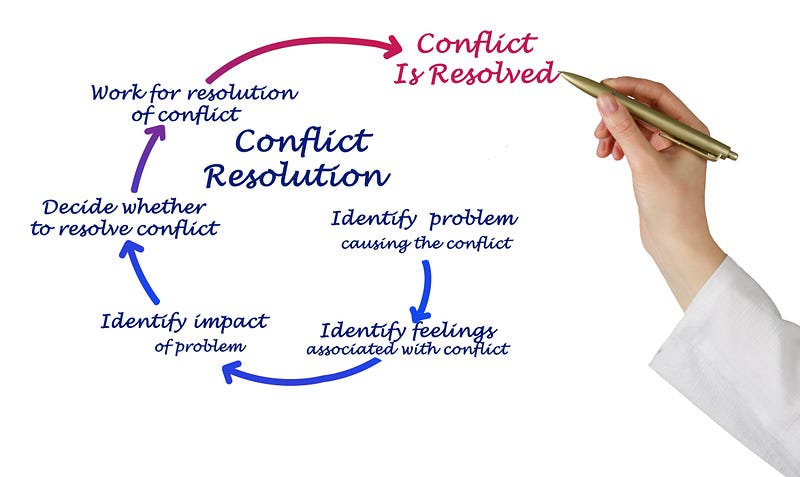
Who is the perpetrator? Who is the victim? Who is bad and who is good? These binary perceptions of what happens during an interpersonal conflict loom large in the public imagination. Perhaps this is due to the zero-sum nature of living in a dominance hierarchy culture where in order for someone to be the winner and the other person has to be the loser? Or maybe it’s because this is the sort of paradigm that is most often portrayed in movies and television — a reductive one with White hat characters and Black hat characters whose conflicts are most often left up to the police or some other third party to be litigated.
Immediately deciding who is “at fault” allows for situations that are often a lot more nuanced than perpetrator and victim to continue. Perhaps imminent harm is sometimes interrupted, but without any method for self-reflection, mutual accountability, and negotiation, violence may ultimately escalate or continue in an endless cycle. Too often, someone needing support is left unhelped, and at times, someone who has been attacked ends up being pointed to as the villain.
Naturally, there are instances where someone is truly at fault and the other person is a blameless victim of abuse or violence, but without any widespread mechanisms for conflict resolution, where the state is often asked to mediate via the police, we don’t always get it right or end up improving the larger dynamics. Without getting to the roots of violence, or noting how sometimes mutual conflict can escalate, we’re only putting icing over mud.
In the US (and most of the West) we live in a culture based on a patriarchal dominance hierarchy. Not only is there a long-standing history of men having more rights, power, and control over women, but there is also a long-standing history of other types of social stratification as well. Power is acquired and then maintained by Might Makes Right, with relatively few elites at the top of the pyramid having the most power and influence. For example, for the first hundred years of the United States, only white men who owned land could vote. Despite being male, other men did not have the same rights and privileges as those considered to be at the top of the societal “pecking order.” This continues to some extent in other ways even today, where having privilege in some areas does not necessarily preclude oppression or disadvantage in others.
Although the pyramid is not nearly as clearly delineated as it was just a few decades ago when women and Black people were second-class citizens by law, there are still remnants of this hierarchy that remain in the cultural subconscious. In addition, our culture is still deeply bought into a zero-sum pecking order, where in order to “win” someone else has to “lose.”
We constantly compare ourselves to those around us and, in fact, are encouraged to do so, because it drives consumer culture. Is your car as nice as his? Who has a better designer bag? Who looks better on Instagram? This dominance hierarchy win/lose dynamic is also a large part of the paradigm for determining a good person and a bad person in any interpersonal conflict (or societal dynamic). There is little room for acknowledging situations where flawed human beings are more complex than simply all good or all bad and there is even less room for acknowledging that sometimes, both people in a conflict bear some responsibility.
Let’s look at some more historical social context. In the 1950s, New York penal law required that a woman claiming to have been sexually assaulted need to provide some sort of corroborating evidence. Her word alone was not enough. Additionally, violence that took place within the home “behind closed doors” was widely considered to be private business. If it got sufficiently noisy or disruptive, the police might be called, perhaps to allow the parties to “cool off” but there was no widespread idea that violence in the home was socially unacceptable.
Fast forward to a modern world with more diverse family configurations and a greater sense of third-person responsibility to intervene in what we now call sexual or domestic violence, the police are often ill-equipped to determine who is right and who is wrong. Old tropes about family violence (which aren’t always correct anyhow — men can be abused by women) aren’t a good way to determine culpability. For example, if two male partners are battering each other, which one is the abuser and which one is the victim?
The National Coalition of Anti-Violence Programs’ 2014 report on LGBTQI Intimate Partner Abuse noted that “in 2013 the police mis-arrested the survivor as the perpetrator of violence” in over half of all queer domestic abuse arrests. There are particular dangers in misidentifying the perpetrator in same-sex relationships. The one who is butch, of color, not a mother, not a citizen, is from another culture, or HIV-positive can be falsely construed as the assailant. In all cases, the perpetrator may get control of the Abuse discourse as a denial, defense, or deflection of their own behavior.
Schulman, Sarah. Conflict Is Not Abuse (p. 75). Arsenal Pulp Press. Kindle Edition.
The reality is, it may not be readily apparent who the actual abuser is or there may not be one person who is solely at fault and another who is entirely blameless. Sarah Schulman gives an example of two male partners who were both addicted to meth. Their fights and subsequent accusations for who was to blame were fueled by their addiction. Not looking beneath the surface of what was actually taking place in their conflicts resulted in both partners obtaining restraining orders against each other — a completely ineffective method for keeping anyone safe when they got high, reunited, and began the cycle once again.
In that case, both men manipulated the mechanisms for determining who was being abused and who was the abuser as smokescreens to avoid dealing with the real issue, which was their addiction. By relying solely on state-sponsored administration of a system not equipped to get to the root of the violence, and using it as a way to evade any personal responsibility, the dysfunctional dynamic simply continued unabated.
Aside from the fact that the police often don’t have the wherewithal to look at what is really going on in a violent situation, the police themselves have often maintained and upheld cultural systems of violence and discrimination. American policing comes out of a long-standing system of protecting wealthy whites from others who might cause them harm. As Schulman notes (pg. 85–85):
- Some of us are able to use the police to help resist violence and domination.
- Some of us continue to experience violence and domination despite the police.
- Some of us experience the police themselves as the source of violence and domination.
- Some of us call on the police because we don’t know how to solve problems.
- Some of us use the rhetoric of violence and domination to avoid the discomfort of facing our own aggressions.
- Some of us use the police to reinforce our own unjust social power.
Expecting the police to create a “thin blue line” that keeps all Americans safe from violence and chaos is a misguided prospect — particularly within the highly nuanced realm of a domestic disturbance, but also in the greater societal context as well. Not only is violence often an outcropping of the dominance hierarchy itself including male domination, racism, poverty, and class stratification, but it may well be infused with other interpersonal issues.
These could be a reluctance to admit any wrongdoing for fear that in such a binary system, you will be labeled as the abuser, and not only will you be vilified, but your own concerns and needs will not be addressed. If we create a dynamic where only blameless victims deserve help, then almost nobody gets fully seen or supported. Few victims are spotless, and quite often that is used as a weapon against them by both an aggressor and by society at large.
In fact, victim-blaming becomes a major deflection technique — and we can see that this does, in fact, happen frequently in our culture. The narrative pivots toward demonizing the person who has most been hurt — something that optimizes the perpetrator/abused model to its own ends to evade responsibility by setting up a binary. An example of this is Kobe Bryant, a beloved basketball star who also publicly apologized to a woman whom he had assaulted. For those who couldn’t accept that their star was flawed and human, the woman became the focus of hate and verbal abuse.
Bryant himself tried to prevent this from happening by saying, “I also want to make it clear that I do not question the motives of this young woman. No money has been paid to this woman. She has agreed that this statement will not be used against me in the civil case. Although I truly believe this encounter between us was consensual, I recognize now that she did not and does not view this incident the same way I did.” However, even this did not stop the tirade of shaming and vitriol that was directed toward the acknowledged victim because somebody had to “lose” and certain people didn’t want it to be Bryant.
If someone is not a “perfect” White Hat, then perhaps they are actually the one who is the Black hat.
Is Prince Harry a White Hat or a Black Hat?
Is Johnny Depp a Black Hat or a White Hat?
Most people have definite opinions, but what if it’s a lot more complex and nuanced than that? What if fundamentally human people can do things that aren’t so good and that often there was ample room for everyone in the situation to have done a better job if they’d had better skills for communicating, negotiating, being vulnerable, and being self-responsible?
Additionally, if we stop defaulting to deciding who is good and who is bad there is more room to notice when someone who has been determined to be good, such as Bill Cosby, is using that designation in the public’s mind as a cover for getting away with things that are harmful and unacceptable. We’re more likely to believe someone who says that they’ve been harmed if we don’t have to evaluate that assertion in a binary dominance hierarchy world. Even beloved stars can do unacceptable things, and even church leaders and priests can use their aura of power and goodness to hurt others. If we hadn’t gone and stuck a white hat on them, we might be better able to notice that.
Again, there definitely are situations where someone is an abuser, and the other person has been harmed through no fault or responsibility of their own. Everyone is responsible for their words and actions and being wounded yourself or not having ever been taught how to communicate is not a free pass. I just think that rather than immediately defaulting to looking at something through a binary system of blame, it makes sense to look at the larger dynamics first and also see where conflict resolution skills might make more sense.
© Copyright Elle Beau 2023


