
Godwin’s Law and the Utility of ‘Extreme’ Examples
Some things are so terrible, they really are like the Nazis
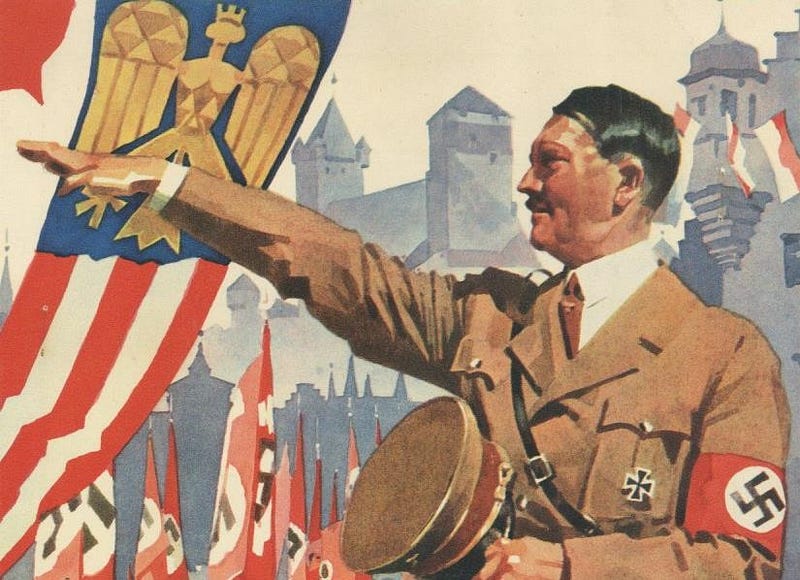

There’s a well-known Internet adage known as Godwin’s Law which asserts that the longer any online discussion carries on, the more certain the probability someone will throw out a comparison to Hitler or the Nazis.
Although recent scholarship has somewhat debunked its premise, anyone who spends any amount of time on social media or observing the antics of certain firebrand members of Congress knows it seems to hold true more often than not. And because it has become such a tired cliché, most people view it as grounds for immediate dismissal of the one who invoked it.
But is it actually fair or reasonable to dismiss such comparisons out of hand? Are Nazi analogies ever appropriate? And more broadly, is there a legitimate place for this and other such “extreme” examples within rational discourse as a whole?
Over the course of my adult life, I’ve often found myself butting heads with whoever I’m debating on any given topic — as would be expected when discussing contentious issues. But it noticeably intensifies the moment I employ an example whose relevance isn’t immediately apparent to them by dint of its distance from the center of the bell curve. This has always left me rather perplexed. For what they dismiss as irrelevant hyperbole, I tend to view as a sensible and clarifying way to define the bounds of the subject being discussed.
As the poet William Blake stated, “You never know what is enough unless you know what is more than enough.” Or as the playwright Edward Albee phrased it, “Sometimes it’s necessary to go a long distance out of the way in order to come back a short distance correctly.”
Such aphorisms feel self-evident to me. For how do you know you’re on the right road if you don’t know where the pavement ends on either side?
To better understand the utility and applicability to rhetoric of such venturing from the center, it’s helpful to first consider it in relation to another field premised in logic — science. For it’s precisely through examination of the extremes than many fields of scientific endeavor have been able to advance.
Take for example, climate change and the greenhouse effect that underlies it. Although the earliest mention of the deleterious effects on Earth’s atmosphere from burning fossil fuels dates all the way back to 1912, the issue wasn’t really on scientists’ radar until NASA sent its first missions to our neighboring planet Venus in the early sixties.
There they discovered that instead of the tropical paradise many had expected “Earth’s twin” to be, it was instead a scorched hellscape of sulfuric acid clouds with a surface pressure greater than the deepest depths of the ocean and temperatures hot enough to melt lead.
And the reason for these conditions? Too much carbon dioxide in the atmosphere leading to a runaway greenhouse effect. It was only after discovering the extreme conditions of our sister planet that scientists started contemplating what our own massive release of carbon dioxide might be doing to our home world.
The same examination of extremes is what led to the two most successful and world-changing scientific theories of all time — general relativity and quantum mechanics. For over two hundred years following Isaac Newton’s publishing of his famous Philosophiæ Naturalis Principia Mathematica, the simple principles and equations he laid out were unparalleled in their ability to accurately explains the motion of everything from falling apples to speeding bullets to that of comets and asteroids and planets.
That is, until people tried to apply them to the extremes — to objects smaller than atoms or heavier than the largest stars, to things extremely hot or extremely cold or moving near the speed of light. For at these extremes, Newtonian physics breaks down and only then do the follow-on theories truly come into their own. Without those two theories, modern technological society (including the phone I’m editing this on) would not be possible.
Even in the study of life itself, efforts by “astrobiologists” to understand the full range of life that may exist elsewhere in the universe are informed by the study of “extremophiles” — creatures who live in the blackest depths of the ocean, in the scalding waters surrounding geysers, amidst the toxic soup of industrial waste streams, or in the radiation-soaked reaches of the upper atmosphere.
It is only through studying Earth life in all its immense variety that scientists are able to make rational inferences about what we may find beneath the icy shell of Europa or in the frozen, caustic sands of Mars.
Without “extreme” examples, our understanding of the functioning of our own brains would be severely limited. For almost every advance in neuroscience has come from studying injured or diseased brains and the effects such damage has on cognition, on motor function, and on personality.
A famous case is that of Phineas Gage — a railroad construction foreman from the mid-1800’s who suffered the horrendous ordeal of having a meter long iron rod rammed clean through his skull after an accident with a blasting cap. Although it didn’t kill him, it effectively destroyed his brain’s entire left frontal lobe, leading to profound personality changes, which were then studied in depth by psychologists and anatomists. Was his case unfortunate? To say the least. Extreme? Definitely. Yet for all its horror, it proved extremely useful for the advancement of brain science.

When it comes to argument, “extreme” examples are just as enlightening and clarifying as studying the extremes of nature. The reasons for this are much the same, for they serve two useful, even essential purposes (which are apparently not very evident to many people).
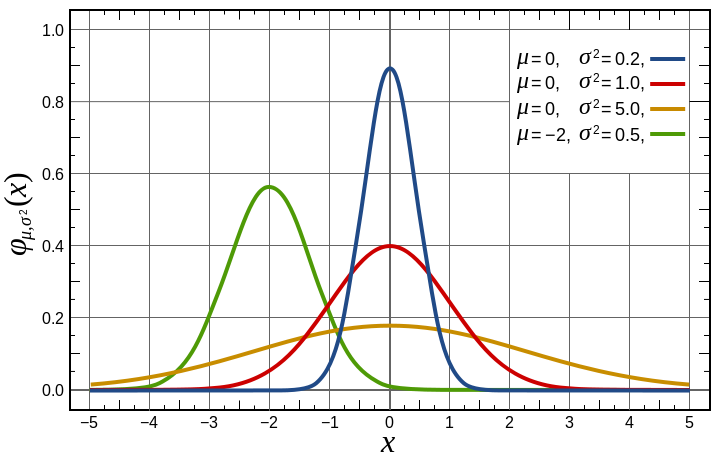
The first, is that they define boundaries which help place all further examples in proper context, thus allowing measurable or at least relative comparisons. They establish where on the bell curve you lie.
The second, is that they establish the existence of certain basic principles, and they do so in an obvious way. If someone can acknowledge the existence of a core principle in a simple, albeit “extreme” form, it’s then much easier to dial in on the subtleties of middle-of-the road examples which are otherwise intractable. It gives a starting point.
When you think about it, extrapolation to the extremes is what gives “slippery slope” arguments their validity. Although, you do have to be careful, because such arguments can easily become fallacious if you fail to demonstrate the causal chain leading from the point in question to the possible outcome being warned against. They also become fallacious if you fail to acknowledge the possibility of a middle ground between your starting point and the extreme.
But if you can establish that causal chain and acknowledge the middle ground, then it can be a powerful tool. Because all too often, disputes in the middle appear to have no answers, no means of resolution, but at the ends, everything is clearer and less muddled. Figuring out what makes it clear at the ends can help identify how to clear up the middle.
For instance, consider you’re an atheist wishing to critique religion. If you start your critique with the moderates, it can be challenging to demonstrate the harm of their beliefs when most of them are relatively happy, normal people, living happy, relatively moral lives. Yet if you look at the extremists their religions inevitably breed, the horrors are readily apparent. It’s then much easier to walk back toward the middle while demonstrating the clear logical links leading from one to the other (e.g. the actions of the extremists being based on a literal interpretation of the text of the exact same holy book shared by the moderates and extremists).
If extremists are considered simple-minded and incapable of understanding subtlety, it’s because things are simpler at the extreme. There are less extraneous variables. It’s a more basic model of a complex system. Thus, extreme examples are useful in their ability to reduce complexity to its essentials so it can be more clearly grasped when it takes on a more complicated and nuanced form.
Which brings us back to that distillation of pure evil — the Nazis.


Building on the above discussion of extreme examples, let’s return to the extremist example of all, that asserted as inevitable by Godwin’s Law — playing the Hitler card (or in technical terms, reductio ad Hitlerum).
For this example, go ahead and deal me in.
I’ve recently undergone a fairly significant change in my thinking regarding the utility (or lack thereof) of ongoing pandemic prevention measures in the wake of Omicron — spurred on by both personal and philosophical considerations. I’ve consequently written several essays which I believe thoughtfully and rationally expound my views on the matter. And they’ve garnered a fair number of views here as well as some eloquently expressed commentary.
Where it’s all gone south though, is when I’ve tried to share them on social media to expand their reach to a broader audience. For there I’ve met with a very predictable blowback from those on the far left who’ve adopted a “till death do us unmask” mindset. (You know the type. They can be spotted in the wild wearing masks alone in their car or out on a paddleboard.)
The other day, during one such exchange, I was told (emphasis my own) that:
Selfishness, fear, disbelief, ignorance and intolerance are the reasons that the window for containment has closed. And screaming your fears and frustrations, denouncing the will to fight, only stokes the same thought in others. This is far from over, and it is because of that mentality.
To which I replied, both factually and matter-of-factly:
Hitler used to execute anyone who spoke out against his war for the crime of ‘defeatism.’ (There. Godwin’s Law invoked.)
In true Twitter style, I was immediately unfollowed, ending the discussion. Oh my. The horror.
But all horror aside, the question remains, was I out of line? Was my comparison unfair?
I would challenge anyone unfamiliar with it to read up on Wehrkraftzersetzung — a policy of the Third Reich which roughly translates from German as “undermining military morale,” “subversion of the war effort,” or more simply, “defeatism.” To the Nazis, anyone found guilty of this was a traitor and deserving of death (which they happily administered through summary execution).
While thankfully, I was not summarily executed for it by the online mob, I was nevertheless accused of essentially the same crime, and I was certainly summarily dismissed. I’ll therefore maintain that my retort was a valid comparison, for both the accusation and response differ only in degree, not in kind.
I’m certainly not claiming that advocating for a relaxing of COVID rules is on par with speaking out against totalitarianism and genocide. Yet a knee-jerk shutting down of discourse because you’ve dared to challenge orthodox thinking is surely worthy of a historical comparison at minimum. Particularly when you consider that the same mindset that drives one drives the other. And we’ve seen where the other took things when allowed to do so.
Just as comparing Earth’s greenhouse effect to that on Venus is not intended to be taken as a literal equivalence (no one is saying anthropogenic climate change is about to turn Earth into Venus), it’s still a useful and valid way to make a point. Comparing Nazi-like actions to the actions of actual Nazis works the same way. And I sincerely hope, if not too blinded by dogma and tribalism and motivated reasoning, that through my retort, my accuser may have at least been given some food for thought (although I wouldn’t bet a ha’penny on it).
Of course, the interaction above is a rather peripheral example of Godwin’s Law. For with the election of America’s 45th president and many of his subsequent actions over the four years that followed, it’s become almost a dereliction of intellectual duty to refrain from pointing out the similarities between his methods and those of the Nazis. Just look at the “Big Lie.”
As so much has already been said on this point, rather than relitigate it all, I’ll instead just present a series of choice quotes from the infamous Nazi Reich Minister of Propaganda, Joseph Goebbels and let the reader decide for themselves the plagiaristic similarities between Trump’s style and substance and that of the deceased heroes of some of his more demented followers:
If you tell a lie big enough and keep repeating it, people will eventually come to believe it.
The most brilliant propagandist technique will yield no success unless one fundamental principle is borne in mind constantly — it must confine itself to a few points and repeat them over and over.
The rank and file are usually much more primitive than we imagine. Propaganda must therefore always be essentially simple and repetitious.
That propaganda is good which leads to success, and that is bad which fails to achieve the desired result. It is not propaganda’s task to be intelligent, its task is to lead to success.
Propaganda works best when those who are being manipulated are confident they are acting on their own free will.
The essence of propaganda consists in winning people over to an idea so sincerely, so vitally, that in the end they succumb to it utterly and can never escape from it.
Whoever can conquer the street will one day conquer the state, for every form of power politics and any dictatorship-run state has its roots in the street.
— Joseph Goebbels
The grand takeaway from all this is that if you’re going to compare something to Hitler or the Nazis, you’d better make sure it’s a valid comparison. You had better make sure the object of your displeasure is truly worthy of such a comparison, because it’s pretty much the nuclear option.
Even Mike Godwin himself said, “If you’re thoughtful about it and show some real awareness of history, go ahead and refer to Hitler when you talk about Trump, or any other politician.”
But when someone invokes that option, you shouldn’t just dismiss it out of hand. Because some things really are as evil and off-base as the Nazis were, and some people really do follow their playbook — intentionally or not. Sometimes bringing nukes to gunfight is actually the right course of action, the only way to cut through all the muddle and lay bare the truth.
As Blake presciently noted in his Proverbs of Hell, “The road of excess leads to the palace of wisdom.” And for better or worse, sometimes that excess takes the (rhetorical) form of murderous, swastika-wearing fascists.

Colby Hess is a freelance writer and photographer from Seattle, and author of the freethinker children’s book The Stranger of Wigglesworth.
If you’re just discovering Medium and you like what you see, please help support this author and others by subscribing here.
At TBI we need everyone to incite change. We support artists and creativity wherever and whenever we can. Help us put a little money in our writers’ pockets. More donations = higher $$ prizes. The more you donate the more our writers (and editors) get paid. The Dark Lord appreciates it.