
God’s queen
Black women are at the heart of the Bible
As a kid in church I loved the Queen of Sheba. This is story about the African royal who rides into Israel with camels, riches, perfume, and a mission.
She needs to talk with the wise King Solomon. Looking back, she was the only Black woman I’d noticed in our Christianity. And the only person in the Bible—besides Jesus—to ask “hard questions” of those in power.
Jesus praises her in Matthew 12:42 (cf. Lk 11:31), noting her drive to get answers sets the standard for the human race — “for she came from the ends of the earth to listen to Solomon’s wisdom…”
Ask white Christians: Is there Black women in the Bible? You might get a shrug. The answer is: she is the heart.
But I didn’t learn it from them.
In my church, we weren’t racist. We had no need to be. Everyone was white! Our pastor, Jesus and his disciples, Mary, Moses, Adam and Eve—as white as the eye could see.
To go back and ask questions about race would be so interesting. What would they say to the evidence that Evangelical Christianity was deeply involved in slavery? Even in 1913, W.E.B. De Bois called the church “the strongest seat of racial and color prejudice.”
In 1960, Martin Luther King observed that “eleven o’clock on Sunday morning is one of the most segregated hours, if not the most segregated hours, in Christian America.”
I’d ask why were were singing “Amazing Grace,” a song by a slave trader, John Newton, who wrote it to reassure himself that he’s been forgiven. To his many victims he says not a word.
I’d ask why we thought our “canon” of books in the Bible was so determined. The Ethiopian church has a different one. But white Christians just assumed that what was going on in Europe was going on in Heaven.
Mostly, I’d want to know why the Black women had been erased from the text. Until getting into Bible scholarship, I had no idea they were even there. I love them all, like the Candace of Acts 8, queen of the Ethiopians (the modern Sudan), whose wisdom is to send her eunuch servant in search of answers. She chose well. His mind is a spiritual supercomputer, processing complex texts in an instant, and knowing just what to do.
Or note the girl in the Song of Songs. She was saying it all along, though we hadn’t listened. “I am black, but comely…”
Those are the words in our Bibles. Her being ‘black’ meant she’d got some sun. She’s apologizing! She is “black, but…” She’s speaking to assure you: under all that color, she is white.
I was shocked, later, to read the scholar Marcia Falk’s translation.
“Yes, I am black! and radiant — O city women watching me — As black as Kedar’s goathair tents Or Solomon’s fine tapestries.
Will you disrobe me with your stares? The eyes of many morning suns Have pierced my skin, and now I shine Black as the light before the dawn.”
You must know: most every major English translation of the Bible says “black, but…” Scholars often say it could be translated either way, but “context” suggests “but.” Isn’t there a sun—or is that suns?
They wouldn’t even inform you of conflicting evidence. The ancient Greek translation called the Septuagint has for this passage: “I am black and beautiful.”
“Clearly the woman sees herself as both black and beautiful,” says J. Cheryl Exum. I’m left reading scholars—I only seem to notice women commenting on this subject—understanding the girl as Black.
Phillis Isabella Sheppard writes: “The Bible has offered us very little about the way black women thought of themselves or how others viewed them during ancient times. One exception is the black woman in the ‘Song of Songs.’”
I study the references. How they have been misunderstood! Lower deities in the Bible, the “Sons of God,” are “astral entities,” as Aleksander R. Michalak notes. They are seen as stars. In Job 38:7, there they are: “morning stars.” The girl is perceiving majestic beings looking at her. They’re hostile. They know she is a threat, for she is beautiful, and God is in love.
In a cosmic drama, she is “pierced” by “many morning suns” — but takes the heat, and is transformed by it. She begins to shine on her own.
The references are complex — this is an ancient sacred text! — but we might begin from the idea that, when the girl says she’s black and beautiful, she means it. And it is meaningful.
I began to understand, bit by bit, reference by reference, what white tradition of Bible scholarship has done, and why.
The girl in the Song is understood to be the image of all Christians.
They did not want her to be Black.
But this is what the first Christians had thought. “In his commentary on the Song of Songs, Origen spoke of the church as a black woman,” a scholar notes of the great 3rd century scholar.
Helen R. Jacobus, a scholar writing on sex with slaves in the Bible, tells a story. She was at a lecture in which a cleric of great reputation had declared that “Abraham’s marriage to Sarah was monogamous, and then, as an aside, he added, jokingly, ‘apart from the handmaiden.’”
She writes:
“There was some laughter, possibly out of politeness for the revered man’s joke, or embarrassment, or, who knows? But not everyone laughed. I was sitting near a young black woman, who had told me earlier that she was converting to Judaism. She and I exchanged glances, both of us feeling shocked.”
In meetings of Bible scholars there is not usually a Black woman to exchange glances with. There is only men laughing.
To read the Bible without their eyes guiding us, without their omissions and mistakes, will be to find another text. To Jewish and Christian traditions, Abraham is the great hero of the faith. To Hagar and Keturah, he is the master they are told to have sex with.
Hagar, identified as an Egyptian girl, bears him a son — then offers that she would be a better wife than Abraham’s wife, Sarah.
Hagar and Ishmael are sent away.
Story by story, we’d see blackish and Black women in the Bible where we had not before. Christianity hasn’t been eager to see Moses with his wives, both women of color. To make the hero monogamous, they pretend the references are confused, and only to one woman.
Then—as in Hollywood movies—she becomes . . . off-white?

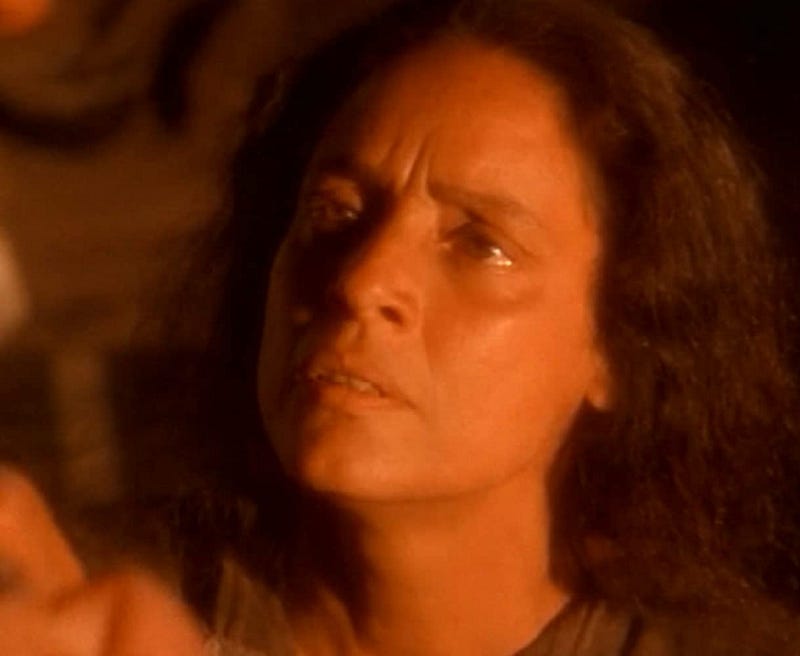
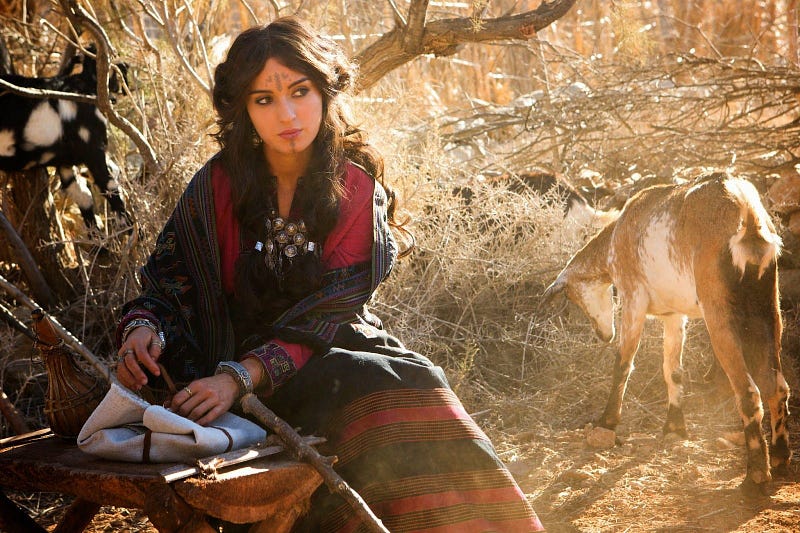
Such depictions were not always so deceiving. Here is Jacob Jordaens’ “Moses and His Ethiopian Wife Zipporah,” from 1650:
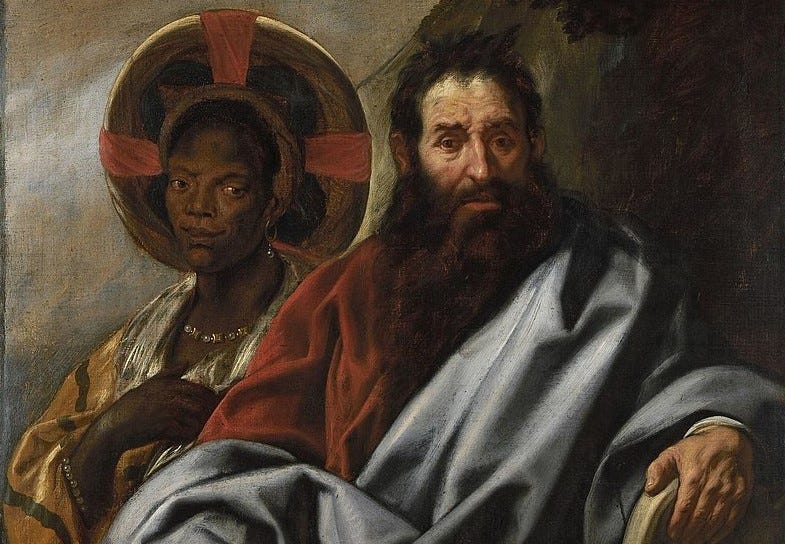
Zipporah is Midianite in the text, more like Arabic or Bedouin. Christian tradition is embarrassed by her. John Bunyan, the racist Protestant writer, in A Book For Boys and Girls (1686), says Moses was a “fair and comely man,” as Zipporah, “a swarthy Ethiopian,” hadn’t found a “way unto eternal life.”
The real story is quite different.
Moses was an exile, a man without a home, family, or people. He had no religious knowledge! He knew only one thing: people should not be abused. When a Jew is attacked, he kills the attacker, and when seeing women shepherds driven from their wells, he attacks their attackers as well.
Moses is then married to one of the shepherds, Zipporah. This is when his education in spiritual things begins. A shepherd, as Christians know, is the same word for “pastor.” He learns the divine work of caring for other beings. He is out working as a shepherd when he encounters God.
Zipporah has changed him from fighter to lover. She continues having more spiritual knowledge than he. In that “bridegroom of blood” scene in Exodus 4:24–26, where God’s power isn’t being recognized, Zipporah moves quickly to rescue Moses and their son from a violation. Susan Ackerman calls her “some sort of ritual specialist” — as some scholars call her a ‘priestess’.
God’s work with humans is never just about Jews. The flight from Egypt was multicultural, as in Exodus 12:38, where “many other people went up with them.” Moses’ second wife would be part of this company. Unnamed, she, in Numbers 12:1, is noted to be Cushite.
Cushites are often seen in the Bible. They suggest military strength in many passages. They are swift (2 Sam 18; Isa 18); they bear gifts (Ps 68; 87; Isa 11, 18; Zeph 3); they are wealthy (Job 28). This seems to be a Black people, the subject of the famous words of Jeremiah 13:23: “Can a Cushite change his skin, or a leopard its spots?”
They are connected to Sheba, with Cush seen as the grandfather of Sheba (Gen 10:7; 1 Chron 1:9).
This second marriage by Moses provokes a scene, for his sister Miriam complains the prophet is doing something wrong. God does not feel this way, and strikes Miriam with “leprosy as snow” — bleaching her.
Rodney S. Sadler Jr. puts it like this: “There is a strange irony to the story of a woman who complains against a woman identified as Cushite, implicitly dark-skinned, whose skin is then transformed, as a result of YHWH’S punishment, to be void of color.”
The lighter woman is punished with . . . full whiteness.
Sadler notices a theme I would not have. “Moses somehow by this marriage elevated himself above his siblings. Hence, it is not likely that the Cushite wife was denigrated because of her Cushite identity, perhaps just the opposite, she stood as a symbol of Moses’ status and authority.”
We don’t learn more about this wife. But we learn in Deuteronomy 34:7 that Moses died at age 120, and “his eyes were not weak nor his strength gone.”
This suggests, as Howard Eilberg-Schwartz notes, that Moses’ sexual virility was intact. This is in contrast to Abraham, who in old age had lost his mojo (Gen 18:12).
The difference might be in Moses’ choices in women.
In the Bible, ‘light’ and ‘dark’ are not good or bad — they just are. Darkness is often a rich, divine quality, and where God is to be found. In Exodus 20:21, “Moses approached the thick darkness where God was.”
In Psalm 18:11 we learn: “He made darkness his secret place…”
It might be that, in biblical figures of Black women, we are entering the secret, dark place where God is dwelling. She is our vehicle, or carries us there.
We might start to notice the many women of vague background and unusual powers. The girl in the Song of Songs is called a “Shulammite” (6:13), which may connect her to Abishag the Shunammite in 1 Kings 1:1–4. This is the story of a girl brought to be the companion of an aged King David. She will keep the king in good health. She is the force of life.
I think back to Eve, then Tamar of Genesis 38, that woman who demands justice, and will use her body to get it. Are they all Black women? Then Moses’ wives, perhaps Rahab, then the Queen of Sheba, Abishag, and the girl in the Song of Songs. A lineage of black beauties, a river of being.
The language around the Queen and Solomon drips with sexual suggestion. There’s a legend of an affair between them. When the queen leaves, Solomon’s interest in foreign women begins. He knows, now, that Israel doesn’t have all the truth, and that other peoples have spiritual ability.
In her forceful march across the world, the Queen has proven that God is knowable by all people. Solomon must investigate, as she has investigated. He must know about the world—through women.
In the Bible, that is how knowledge is acquired.
We’ve barely grazed the surface. There is the Shunammite woman in 2 Kings 4:8, a woman of wealth and wisdom who recognizes a divine being when her husband does not. Seeing the prophet Elisha, she insists on creating a dwelling for him to stay.
She is not Israelite. Her recognition of his divine status is a surprise — and her importance is “hidden” even from the prophet (4:27). As the church is said to be a “mystery hidden” in Colossians 1:26, I have to wonder if these details are connected: the Black woman is in on the secret.
To approach the Bible might be to imagine a Black girl speaking to us of her higher way of being. I am back to reading Phillis Isabella Sheppard, writing on the girl in the Song:
“Very early in a set of poems she announces to her audience, community, lover, and us, ‘I am black.’ She situates her relationship to the world around from an embodied stance. She invites the future reader to see her through her eyes. She invites us to an embodied reading.”
I think: yes, we become human through the girl, and also divine, for she is both. She leads with her body, and uses that special phrase, a name of God, “I am” — “I am black and beautiful.”
To say “I am black!” is humanity participating in divinity. And the girl in the Song points forward to Mary Magdalene, whose perfume, whose bold and forceful movements, echo the Song.
And do they not become, between them all, the Bride of Christ? She who sees the ultimate project of sexuality, which is to link with God. As we approach her, we embrace Him.