
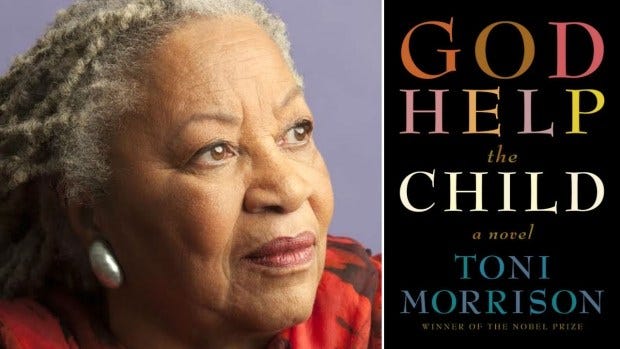
God Help the Child: Toni Morrison’s Offering of the Bitter and the Sweet
Sweetness: sugar, honey, saccharine.
On the tongue, sweetness is powerful. It tap-dances on the taste buds in a concerted effort to dismantle them. It is rich and energetic and excitable. But when juxtaposed with sour, it easily loses its prowess. It becomes an other. An afterthought. Vengeful.
It is the vengeful sweetness that we are introduced to in Toni Morrison’s last fiction novel, God Help the Child. We do not immediately get to taste the power of sweetness, instead we are launched into a battle with bitterness.
Sweetness, the name of one of the main characters, is a light skin woman whose child was born “midnight black.” She offers her child the name “Sweetness” as a replacement for “mother” or “mama”, but this offering lacks the promise that is seems to possess. Sweetness is everything but. Her child, a girl child, born the color of the dark earth, or “Sudanese Black”, was only given the promise of distance from a mother whose own skin color, described as “high-yellow”, offered her a much sweeter promise.
Sweetness is Euripides’ Medea, but instead of physically killing her daughter she causes her to die many emotional deaths throughout her childhood all because of her skin color. That daughter, Bride, soon becomes the central character who shows us just how heartbreaking life can be when raised by a mother who despises your existence.
Bride tries fiercely to escape a childhood plagued with lies, abuse, and hatred by being greatly successful and stunningly beautiful. She contrasts her dark skin with a wardrobe made of shades of white that effectively drowns her in a sea of brightness; the brightness for which her mother never offered her.
On the surface, Bride is astonishing, but inside she is tethered soil that soon sends her body into reverse puberty; straight back to the genesis of her agony. This unraveling of Bride’s life begins when her lover, Booker, leaves her by simply admonishing, “You not the woman I want.” This statement takes us into the murky waters of the past for both Booker and Bride.
Booker: a historian and jazz-lover who has, up until meeting Bride, only offered the fullness of himself to the memory of his brother’s death at the hands of a pedophile. He allowed that demon to ride him and fill him with the rage of a thousand bulls. He lived in the margins of his own life with only his trumpet as a savior.
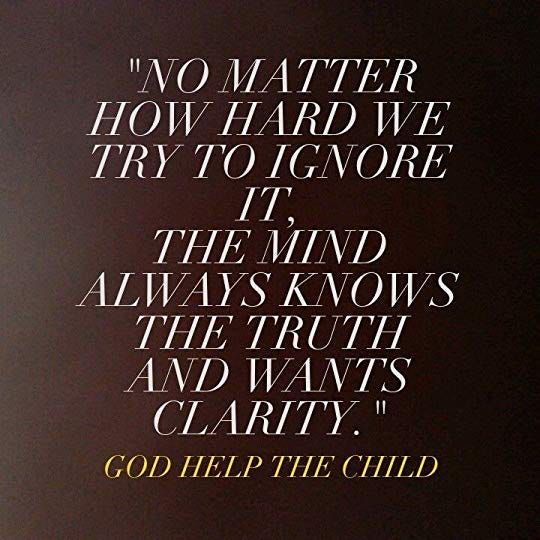
Both Booker and Bride are children on Mount Cithareon. Spikes are placed on their ankles by adults swimming in their own misery. Booker and Bride are dangled off that mountain. A promise of death lay in front of them. But does death become the sweetness needed to end suffering, or is the bitterness of life an easier bargain? These questions are asked and answered routinely throughout God Help the Child.
God Help the Child, like many of Morrison’s other works, is a showing of human strength through suffering. Morrison defends the most vulnerable beings with anecdotes that show how easily children are wounded. She especially shows how little we value the pain of children; children who grow into adults who still harbor those pains from childhood. Morrison reminds us of the inviolability of children. And even the inviolability of adults. At some point throughout each of her novels, Morrison offers the stark reminder that bitter pills become the precipice for healing.
But it is with God Help the Child that she offers us a simpler way forward: face the past, stare it down, taste its bitters, and reel back on the sweetness of what’s ahead.