
Goals Are Toxic — Here’s An Alternative
Live without them.
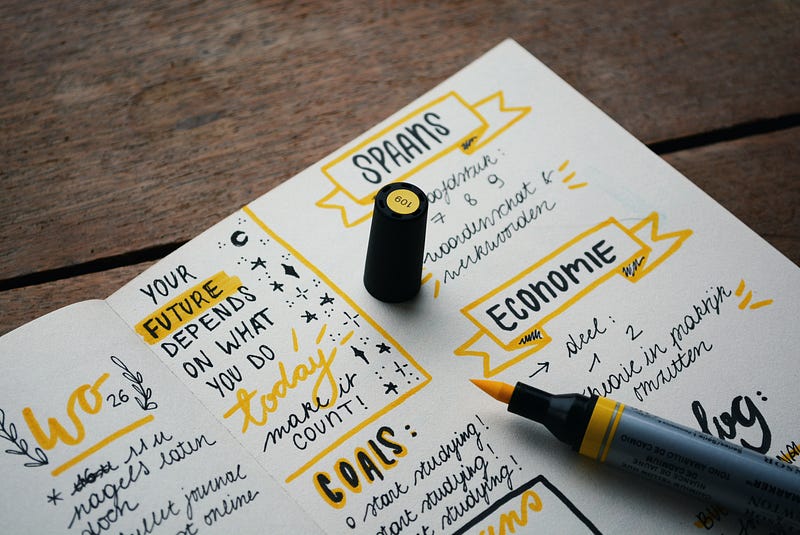
Leo Tolstoy had a diary where he meticulously set goals for himself and kept track of them throughout the year. Goals included things like: learn a new language, build a certain character virtue, achieve X push-ups per day, write Y books, so on. (You can find it online.)
Was Leo Tolstoy the happiest man alive? I doubt it.
The eye-opening truth I realized in my early twenties is this:
Setting and achieving goals doesn’t make you happier. It just makes you more productive. There is a big difference between being ‘happy’ and ‘effective.’
People tend to confuse the two.
From the point of life as a whole, it doesn’t matter what you achieve. At the end of the day, we all end up in roughly the same place. We all grow old. And then we all die.
I don’t mean to make you feel depressed. Yes, young people are all afraid to die. But so are old people. Even though you have several decades to get accustomed to the grim thought, everyone is afraid to die.
As Steve Jobs said in his brilliant commencement speech, “Nobody wants to die. Even people who want to go to heaven don’t want to die to get there.”
This means, it doesn’t matter how long you live: twenty or two hundred years, you’ll still feel the same sadness and fear.
Similarly, it doesn’t matter how many things you do or don’t do during the day. When the sun goes down and the day is gone, the quality of your day won’t be determined by the amount of work you managed to get done (no matter what your boss tells you), it’s how you feel about your day.
- The quality time and the meaningful conversations you’ve had with your friends and family.
- The enjoyment and satisfaction from doing something you love.
- The beauty of nature surrounding you or pieces of art.
- The delicious food you’ve eaten.
- The positive impact your actions made for other people.
- etc., etc., etc.
There is an infinite number of books to read. And I say infinite for a reason: the number of books published each day is more than you can possibly read in a lifetime (even if you’ve tried very hard).
This number goes up, meaning, you get exponential growth.
The same with podcasts or any other content.
Work is even worse. The more work you do, the more work appears. Work is like a hydra: you kill one of its heads, and two new ones grow in the same place.
Now, I am not saying you shouldn’t read books, listen to podcasts, or work.
All I am saying is playing a game of “catching up” is useless in today’s day and age.
I recently saw an Instagram Ad that promoted a new iPhone app with a “30-day reading challenge: 30 books in 30 days.” I can’t imagine why anybody — in their sane mind — would do such a thing.
The app branding talked about the importance of knowledge and self-development in a fast-paced world. But I never understood this thesis that “we should learn to catch up with changes.”
It’s a game we’re destined to lose. Progress is accelerating, and if we can catch up with changes and new information today, we won’t in two years.
At the same time, it doesn’t make sense. Human beings are terrible at information: let machines do it for us. Let go. Let the progress unfold, and changes accelerate into the stratosphere.
We learn to become better human beings, not outpace progress. And the best use of our time and energy is not to compete with technology; it’s to use it to do what we (humans) do best: create, connect, empathize.
Imagine two people: Sarah and Josh. Sarah lives a slow-paced life. She likes to take in each day at a time. She reads one book per month. And Josh is neurotic. He wants to be the best at everything. He’s a perfectionist, and he reads ten books per month, chasing the number he set for himself (120 books in a year!) during his annual New Year’s resolutions.
Now imagine they both die in 30 days.
Let’s take a look at their last month on this planet. Sarah enjoyed her time. She read her one book, absorbed passages, thought deeply, and took notes into her Moleskine. She enjoyed herself. Whereas Josh merely existed, trying to reach his goal.
You see, goals — just like time — don’t matter. They don’t influence the quality of our life. No matter how much time you get, you’ll still be sad when it’s over. And no matter how many goals you achieve, they won’t make you happy. If you suffer through life only to achieve your goals, you’ll end up wasting your life.
The happiest people on the planet live without goals.
“How do they get anything done?” you might ask. But that’s what every neurotic asks.
Happy, emotionally healthy people (which I am trying hard to be, but fail often) get things done not because they set themselves Big Hairy Ambitious Goals. It’s because they want to do the things they do. They don’t need goals (or discipline) to push themselves forward. They are natural, curious seekers of interesting projects to do. And as history shows us, people who focus on the process (instead of obsessing over goals) become successful more often.
Goals are toxic. Progress is the key to happiness and effectiveness.
But then, why do we obsess over not reading enough, listening to podcasts enough, having enough projects, so on?
It’s because we are social animals.
Everybody I know has some sort of FOMO (Fear-Of-Missing-Out) over something. Most often, it’s related to content.
“It feels like there’s too much to read/learn/know…I am missing out. All these people are learning new things, whereas I am procrastinating.”
When you feel like this, it’s important to realize two things:
- This feeling is irrational. You read books from the left stack and your friend from the right. You read different books, and it feels like you’re reading nothing. (Spoiler: your friend feels the same way.)
- It exists because you have other people. Again — it’s better to read just one book, but really-really enjoy the process than reading 50 books but suffering in the process.
You feel a need to catch up because you’re looking at other people. If you were on a deserted island, you wouldn’t care what everybody else is doing. You would have nobody to compare yourself to.
The solution? Cut off the noise. Or, if you like to stay on top of things, learn to detach yourself from other people.
It doesn’t matter how many books somebody else is reading or how many projects somebody else is working on.
Remember: there is always an infinite amount of content to be consumed and work to be done.
The key question is, “Are you enjoying life?”
Are you doing something that brings you pleasure?
Anything else isn’t — and can’t be — more important.
In some way, the point of life is to reach a goal-less existence. It has nothing to do with how much money you’ve got in the bank — and everything with your attitude to life.
You can only live in the moment when you don’t have goals.
The Mini Post-Grad Survival Guide
A 5-day email course with tips on budgeting, investing, and productivity for 20-somethings. Sign up for free.