
PRODUCT MARKETING
The Ultimate Guide to the Go-Market Plan
How to launch new products, enter new markets, or both
When launching a new product, entering a new market, or doing both, a Go-To-Market plan will be crucial to product and marketing success. While a company’s marketing plan is a broad document that aligns marketing initiatives with the company’s high-level business goals and objectives, a Go-To-Market plan is more niche, focused, and developed for a specific product or market. A comprehensive Go-To-Market plan will be composed of four components:
- The Product Strategy
- The Pricing and Promotion (P&P) strategy
- The Channel Strategy
- The Marketing Communications (Mar-Comms) strategy

Some Preliminary Remarks
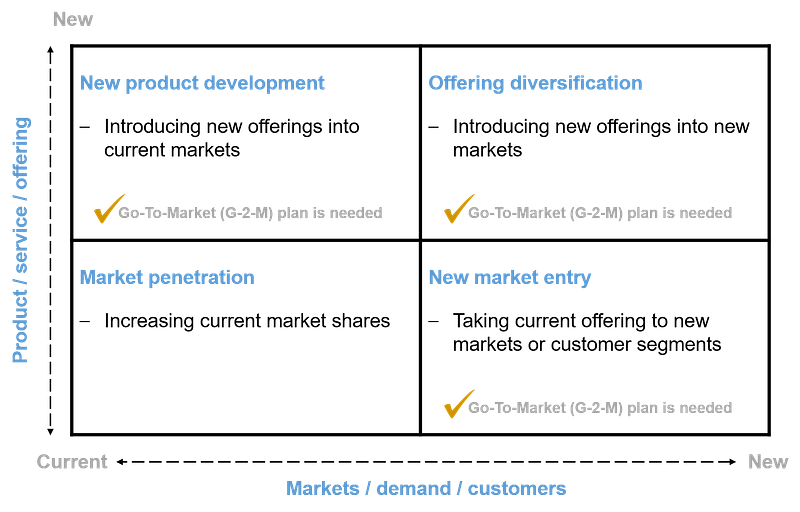
Situations in which a Go-To-Market plan is needed
- New market entry — when extending an existing offering to a new market
- New product development (NPD) — when launching a new offering in an existing market
- Offering diversification — when introducing a new product into new markets. This is rather a high-risk strategy because it entails a lot of unknowns for the company. They need to learn a whole new market and tell a new audience, who it doesn’t know very well, how the new offering will deliver value
Understand the customer
New products are born every day, and, new products fail every day, thanks to recurring problems such as:
- “The market just wasn’t ready”
- “Pricing was too high”
- “Demand forecasts were way off”
- “The product didn’t solve the right problem”
A Go-To-Market plan can help avoid these problems if it includes certain elements of research and action:
- Customer research — that probes buyer’s interest in your product, or otherwise to perform customer development
- Trend research — such as whether the company is entering a stable or growing market and how saturated the market is
- Coordinated product development — get intimate with the product by bringing product managers into the research and market testing phases
- Customer targeting — by putting together a specific profile of your early adopters, uncovering the reasons they would buy the product and, more importantly, why they would choose it over a competitor’s offering
Some questions to be asked to gauge potential customer interest levels include:
- Do customers need the product because it solves a particular problem?
- What would customers be willing to pay for the product?
- What are the current purchasing trends with the targeted customer? Are they growing, decreasing, or stagnating?
- Why would customers purchase this particular product over a competitor’s?
- Does the competition have a favorable reputation with the target customer and what’s their current performance?
The closer you can get to the customer and gather direct feedback, the more likely it is that your new product will find success.
Set strategic objectives
Some goals of a Go-To-Market plan may include:
- Product brand awareness — high awareness or being easily recognized, helps drive potential prospects and sales. For this, the plan needs to determine what channels will drive engagement and how much traffic from these sources will send a projected amount of prospects over
- Marketing to leads — leads, are qualified people who will be interested in the product. A Go-To-Market plan needs to outline ways to market to potential customers to ensure there is a customer base the product is launched
- Sales targets — this is the portion of the qualified potential prospects who will convert to a paying customer
- Product adoption — otherwise known as user scale. High adoption rates will mean higher expected sales and economic returns
- Customer satisfaction — otherwise known as defect levels (or churn or retention — different terms used in different industries). The goal would be to decrease the number of defects and dissatisfaction at the launch and post-launch stages
Product-problem fit
If I had asked people what they wanted, they would have said faster horses — Henry Ford
A critical piece of any Go-To-Market plan is defining the customers’ problems and validating the offering that addresses them. To do so, take the following steps:
- Define the pain — customers do not think in terms of solutions, they only know what their pains are. You have to think outside of the box and pick up on the silent calls for help to solve a customer’s problem. Ask people the right questions to draw out the problems they are experiencing. Interview enough customers and target users to establish problem-solving patterns, and when interviewing people, sometimes problems are unspoken and you’ll have to dig deep to draw out the real causes and drivers of customers’ pains
- The urgency of the pain — ask yourself, will customers care about this problem in the long term if it’s not solved? Are they looking for an immediate solution? Will the product answer their calling?
- The size of the pain — you will also need to think about how deep the problem runs. You’ll need to collect quantitative data that shows a large portion of the target market is asking for a solution to their problem. You’re looking for validation that shows the interviews you’ve conducted reveal only the tip of the iceberg
- Willingness to pay — you want to be sure customers will pay for the product. In other words, if you can answer positively to the urgency and market size questions, then you can move forward knowing people will be willing to make a purchase.
Segment the Market
It’s highly unlikely that one message will resonate with all customers, their characteristics, needs, and values. Segmentation is the process of dividing the audience to reflect specific characteristics that may influence purchasing decisions. Segmentation helps develop strategies that will target customers based on their needs, values, and behavioral characteristics. Factors to segment customers by include:
- Demographic factors — such as age, income, education, religion, marital status, and occupation.
- Geographic factors — urban, suburban, or rural area
- Behavioral characteristics — how relevant, consistent, and frequent their behavior is toward a particular problem
- Psychographic considerations — including activities, interests, the benefits sought, attitudes, and values
Once you’ve identified the desired market segments, you can probe into which segments you would want to target first and what approach you would take. There are three ways to determine how you would target and communicate to a segment:
- Priority — focus on the audience segment whose behavior will be the easiest to change if you’re looking for a quicker impact. Follow the technology adoption curve philosophy
- Ease of reach — consider the target segment that is the easiest to reach in the shortest amount of time, taking into account your resources
- Level of business impact — the size of the audience segment
Pinpoint your competitive advantage
To ensure you have an advantage in your market, first, create a competitor profile and gather as much data as you can. For example:
- Recorded data — obtained externally in the form of published sources such as competitors’ brochures, promotions, news articles, and annual reports
- Observed data — such as what you see when you go to a trade show and visit a competitor’s booth or the conversations you uncover through social media that customers are having about the competition
- Ability to gather plan data — or efforts to set up opportunities to learn more about the competition. For example, by conducting interviews and having discussions coordinated with different partners, suppliers, or people who have relevant knowledge of the competition such as former employees.
When data is gathered it’s important to understand how others will compete. Porter’s five forces will help you assess this:
- Barriers to entry — that prevent you or someone else from entering this market easily, such as high startup costs
- The threat of substitutes — especially if the substitute is cheaper. For example, butter vs. margarine
- Supplier bargaining power — if a supplier has the buyer power, then they can drive up the prices, reducing your company’s overall profit
- Consumer buying power — such as income levels or price sensitivity
- Competitive rivalry — and the strategies and tactics used by the competition to capture the time, attention, and purchasing intentions of your customers. Your competition is actively trying to steal your market share and profits. Knowing the competition in the market is a big part of a successful, Go-To-Market plan
Why a Go-To-Market plan
When launching a new product, entering a new market, or doing both, a Go-To-Market plan will be crucial to product and marketing success.
While a marketing plan is a broad document that aligns marketing initiatives to the company’s high-level business goals and objectives, a Go-To-Market plan is more niche, focused, and developed for a specific product or market/customer.
A marketing plan includes the annual roadmap that outlines the company’s ongoing marketing strategy for products or services currently on the market. It includes advertising, promotions, public relations, digital marketing, direct sales, and events. A marketing plan documents the goals, objectives, research, costs, strategies, and actions needed to drive business for the overall company.
The Go-To-Market plan entails the action needed to move a product or a company in a new direction by focusing on internal resources — such as salesforce — and external resources — such as distribution channels. A Go-To-Market plan fleshes out the value proposition, builds a unique experience for customers, and finds ways to be competitive in the market.
The benefits of a Go-To-Market plan include:
- Reduces the time it takes to get to the market
- Lowers risk and the cost that may be associated with failed launches
- Delivers the best experience for the customer
- Invests on the right path with better direction for internal sources and external partners
A Go-To-Market plan will have the following components:
- Product strategy — to differentiate the new offering from those of competitors, helping build sales messaging
- Promotion strategy — pricing promotions and cross-promotions at launch
- Channel strategy — channels utilized not only to sell products but also to educate and support partners and customers
- Marketing and communications strategy — entailing efforts to generate awareness with customers and employees who interact with customers for instruction, purchase, and or support

Component 1: the product strategy
Form a product strategy before the launch
The product strategy will need to capture the product’s reason for existence, reaffirming how it will solve a problem for the long haul, and the company’s motivation behind its launch. To develop the product strategy, the product development team needs to collaborate cross-functionally across departments to develop the product roadmap. Consider these pointers when developing the product strategy:
- Expand the product vision — capturing the changing landscape and customer needs over time. A limited vision will limit the product’s overall lifecycle
- Collaborate cross-functionally — a product strategy needs input from marketing, the brand team, sales, product managers, customer service, and support. Key stakeholder involvement will make getting the buy-in for the product’s success easier in the long run
- Inspire — in addition to sales goals the product vision and strategy need to inspire people toward a greater cause
- Have an elevator pitch — any business concept that needs to be explained in a long paragraph will probably fail. An elevator pitch helps make it easier to communicate the concept with customers and internal stakeholders
Crafting the product message
Product messaging can make or break a product by allowing the target customers to get to know and truly understand the product offering. Additionally, product messaging is an opportunity to stand out from the competition — if the message is well-positioned.
Some tips to consider when building a successful product message:
- Communicate value — choose value over features, because customers are only interested in the benefits and values that will be derived from using the product
- Know your audience — build your buyer personas using the market segmentation data you have gathered to build a clear picture of who you are targeting. The buyer persona is a semi-fictional representation of your potential customer
- Be specific about your value offering — by talking to prospective customers about their problems and matching your wording to their voice
- Collaborate cross-functionally with entire teams on the messaging — don’t create messaging in a vacuum. Make sure you speak with members from other teams beyond your department such as sales, R&D, product, etc.
- Use great writing — poor, confusing, long-winded, or unfocused messaging won’t entice customers, it will only drive them away. Keep messages crisp, concise, and supported with imagery
- Understand your competitor’s positioning strategy — such as their pricing, distribution, and messaging tactics. This will help you differentiate yourself in the market

Component 2: the pricing & promotion strategy
Setting your product price at launch
With detailed information on buyers and the marketplace, the pricing strategy is a direct reflection of the information you’ve gathered. Some pricing strategies to consider:
- Premium strategy, many products are priced higher than their competition, for perceived value. If so, then be sure your packaging, marketing efforts, and content are created to support a high-end product positioning (e.g. Apple’s iPhone)
- Initial low pricing for market penetration — for example when the goal is to enter the market to grab attention and take market share. Despite the challenge of making less money in the short run, the increase in awareness could result in greater profits in the long run, and over time, you can price higher to reflect new positioning in the market. This has been the strategy of many Chinese brands such as Xiaomi.
- Constant low pricing — used by companies with large sales volumes, such as the Costco-s of the world, who can keep their cost and marketing expenses down to create lower-priced products constantly
- Price skimming — meaning, charging the highest initial price at launch and then eventually lowering the cost to attract other potential buyers. This is exactly following along the technology adoption curve footprints of user adoption. This can yield high returns for new products, creating a new market trend
- Psychological pricing — creating an emotional purchase decision with the customer, such as an impulse action when a customer sees that $195 sign, rather than the $200
- Bundled pricing — a technique used to group products together at a lower price. For example, McDonald’s combined burgers, drinks, and fries in a Happy Meal — at a lower cost than those bought separately. When products are bundled, consumers feel they’re getting more value for the bundled price
The feedback loop
A crucial part of a Go-To-Market plan is preparing a feedback loop to gauge how customers feel about the new product. There are different ways to capture customer requests either directly or via other support systems that capture information.
- Customer surveys and one-on-one interviews — use surveys and conduct interviews quickly after your product launch to capture fresh thoughts and ideas from customers
- Sales feedback — through the sales team’s follow-up and field inquiries
- Customer service or support — this front-line team will hear everything from the slightly unhappy individual to the angry ranter
- Forum feedback — this is the opportunity to set up a feedback loop where customers can share their experiences with others, relying on the community as a helpful resource. This is where customer service and support teams should also actively participate
- Employee feedback — gathering feedback from employee users is a great way to hear straight from internal champions
- Social media feedback — this is unfiltered feedback in massive amounts. The trick is to understand how to capture the right data to analyze. If the response rate is high, you might want to subscribe to a media analyzer tool
Promotions at launch
Every new product launch needs to consider promotions and ways they can capture buyers with an introductory offer they can’t resist.
- Sampling the product — the idea is that once you get the consumer to try the product, they’re hooked
- Coupon offer —not just a 10% discount but a solution that helps solve their problems
- Promotional offer — bundled into a package of products that they already know and like, a promotional offer is a great way to lessen the risk by coupling with products that are tested and proved
Prepare your frontline
Customer interactions and communications are crucial to a product launch. Frontline employees include salespeople, customer service, and support teams with direct access to customers who may want to learn more about products. Since these teams interact with customers who openly share praise and complaints, a Go-To-Market plan has to manage the frontline so they want to help customers solve their problems, and share valuable customer feedback quickly.
The key to frontline product success is building customer advocacy by communicating more internally. You have to get the frontline involved and trained on every aspect of your product strategy and get them involved in development phases, gather their input, and brainstorm on how to create better customer experiences.
The best way to determine frontline product launch readiness is to include a frontline-ready checklist in the Go-To-Market plan. A frontline that’s empowered and engaged will:
- Know the target customer — their interests, needs, and values
- Fully embrace the product vision —understand how the product roadmap and attributes will benefit customers based on in-depth knowledge
- Position the product benefits effectively—compared to competitors in the market
- Believe in customer intimacy — use every interaction as a way to listen, help, and offer information as they strive to fuel customer advocacy
- Identify what makes the best customer interactions — then figure out if there is any direct increase in advocacy as a result
A frontline that’s empowered and engaged, understands the value of customer feedback. They quickly report and share information with other teams on behalf of their customers. When your frontline isn’t communicating with customers effectively and efficiently, product strategy will fall short.

Component 3: the channel strategy
Choosing the primary channels
The channel strategy sets you up to educate and sell your product in places where your customers want to purchase products from you.
The first step is finding the right channels for the new product. Take note that currently available channels may not be right for the new product. The right channels need to target the right customers and create a seamless experience. As a part of the Go-To-Market plan, you want to map out the best channels for the product at hand.
Forming a channel strategy requires you to ask and answer several questions:
- Where do the target customers make purchases? Online? Retail stores? Do they require a demo before purchase?
- Does the product fit the channel? If you’re selling a technology product, then customers may want to review, test, and be in the software environment to finalize the sales process
- What level of interaction is needed for customers to make the purchase decision? Do customers require a high level of human interaction to decide, or a quick online checkout would suffice? Is a mattress best sold online or in a store?
- Would customers purchase through a partner? If the answer is yes then the partner has to be trusted and provide the same brand experience if they purchased directly
- Where can you create an advantage over the competition? Benchmark your competitors' approaches
Managing channel performance
The channel strategy within the Go-To-Market plan includes the partners who are best suited to help drive channel performance. Relationships with these key partners aren’t just based on sales pipeline performance or the time it takes to make a sale — they’re based on trust, mutual understanding, and working together to achieve a shared goal.
As well as a framework for forming successful partnerships and business ecosystems, here are some softer tips to help drive channel performance with partners — who can feel like an extension of your company’s sales organization rather than just outsiders working for you:
- Identify potential obstacles with partners — when you select a partner it’s because their business is well suited to sell your products or services. The Go-To-Market plan should detail the pros and the cons of your collaboration, and review the potential obstacles the channel partners may face when working with prospects and customers. An open dialog will help sides align even further
- Incentivize channel partners — aligning specific incentives directly to different phases of the customer journey, makes it easier for partners to get involved at these stages and become part of the buying process. Some tactics include performance-based campaigns, big deal discounts, and rebates
- Treat channel partners as true partners rather than employees — channel partners don’t work for you and when treated as partners, as equals, and not as subordinates, they will be more cooperative. Increased cooperation = greater channel performance = more sales ($$$)
- Set and share realistic key performance indicators (KPI) with partners. KPIs will be the key metrics used to prove how you and your partners succeed together
- Celebrate any wins with partners — take the time to recognize, celebrate, and reward partners. Win their loyalty in the long run, because the market will certainly become more competitive in the coming years and you want their inventory share
- Know when to change your partners and transition to new ones — based on the agreed KPIs, evaluate partners and change partners, if their performance is under the industry average. Consider the legal steps, think about a partner exit strategy, and how you would cease working together. Additionally, preserve any of the relationships your partners may have with other areas of your organization
Interacting with customers
Customers rely on you to help them navigate channels and to educate and support them throughout their purchasing journey. Here are several ways that you can educate and support your customers.
- Create a customer-focused culture — it’s not just saying you’re customer-focused, it’s showing your customers are your priority. Answer questions and concerns quickly, handle negative product experiences with an empathetic ear, and delight them with your attentive nature
- Be positive and kind at all times throughout your channels —employ people who have a high emotional quotient — the ability to recognize emotions and incorporate others’ feelings into their thinking and behavior. This is an extension of the customer-focused culture which translates into channel etiquette in creating positive and polite experiences
- Support your customers through open communication — make it as easy as possible for customers to contact you through any of your channels. Let customers decide how they want to receive help and how they interact with you. It’s much better to have an open line of communication and to respond quickly to customer concerns
- Reward customers — offer additional ways for customers to receive perks and specials just for being a customer, such as loyalty programs, free shipping, discounts, first notice of new products, etc.
- Develop support materials and helpful tools — customers appreciate three-step-how-to-guides, interactions in forums with other customers, and reading the company blog for interesting insights. These materials and tools will help you to build customer communities and get people more connected to your business and your products
- Make your channels personal through customer insights and analytics — Amazon, Netflix, and Spotify all have the ability to make recommendations to their customers based on purchase history and how they interact through their channels. Customers appreciate a business that can recognize what they like and save them precious time by offering suggestions
Sales training and support
Your Go-To-Market plan needs to develop and deliver the best materials to educate the sales and support teams. If you give your sales and support team a selling playbook and then rush them off to market your product will probably fail. Training has to come first.
- Brand education — go beyond your new product and make sure your sales and support teams understand your brand. You want them to understand what you value and why your customers want to do business with you. Educate your team on the new market trends, and consumer buying behavior, share buyer personas to project a vivid picture of the customer, their characteristics, and their values, and share the skills required to engage with these customers
- Create a list of desired sales and support characteristics—then work on their skills development before the launch
- Reinforce your new product campaign goals and objectives — to ensure that everyone understands the overall strategic direction
All sales and support interactions with customers must be true to your brand, well informed about the product, and in keeping with your end goals in mind.
- Set up a repository of materials and tools where sales and support teams can access needed information —give sales and support teams the materials they need by asking what would help. Then you can deliver the tools including product specifications, marketing brochures, website functionality, demonstration videos, user case studies, and a wealth of information that will help your sales team to help your customers
- Employ a CRM system, and train your teams to track their interactions and outreach with customers — CRM helps your team manage and analyze relationships through data, which drives more sales and helps to retain customers longer
- Create a web-based learning platform for training and continued education. Online learning is easier for employees and can be accessed at any time of the day or night. Leverage technology through social collaboration inside your organization and allow peers to educate one another
- Employ an internal social communication system or network — to help sales and support have greater access to other individuals and teams within the organization

Component 4: the Mar-Comms strategy
This is where you need to step back and think about your product’s overall value proposition to the market, its broad market appeal, and the positioning statement which includes more of the specific reasons why someone would purchase your product.
The value proposition
The value proposition is about the product’s overall value to the market, the question of why would a customer purchase your product or service over another company’s. The value proposition differentiates a product from similar offerings.
Airbnb is a community-based online platform for listing and renting local homes. It connects hosts and travelers and facilitates the process of renting without owning any rooms itself. Moreover it cultivates a sharing-economy by allowing property owners to rent out private flats.
Here are some elements of a poorly constructed value proposition:
- The statement lacks clarity
- Too specific to your product
- No immediate benefits for the customer are communicated
- Filled with jargon and hype you can’t demonstrate
- Difficult to understand in five seconds or less
The positioning statement
Here, you refer to your market research — on your customers and your competitors. The statement needs to address the following questions:
- Who is your target audience? You need to be very specific about who your audience is and what they need.
- What is the unique value or benefits that your product can deliver? Point out what only you can deliver and no one else can provide.
- How can you show customers you’re different and why should they believe you?
Here’s a positioning statement template to use:
With our product, [product name], we help, [target audience], who need, [what they require, want, and need], which can help them to, [the solution], by doing the following, [the benefits]. Standing out from the competition, our product is, [what’s unique that no one else can offer]
Product use case scenarios
The Go-To-Market plan should also include detailed use cases for the product, helping the sales team to better understand all of the scenarios in which the product may be used. The best place to start constructing use cases is with the buyer personas, however, descriptions will need to dig deeper, revealing how within a particular group of buyers there may be different needs when it comes to product usage. If you know what buyers are thinking, wanting, and longing for, then you can create marketing messages and communication based on this information.
The use cases are also the purchasing scenarios that would entice your buyers to learn more about the product and begin their journey toward product purchase. You can create as many use cases as you like for your sales team. Breaking them out and being specific about the solution your product solves helps your team understand why a buyer would want to use your product at a specific point in time.
Tell stories
The Go-To-Market plan needs to map out communication at launch and beyond to keep audiences interested and engaged. To story-tell at launch:
- Release an official product announcement, through a news-wire service that is social media and blogger-friendly, ultimately getting your announcement into the hands of your customer
- Set up a specific landing page for your campaign. Digital and social media platforms will share your story and your launch promotions. By using your social media channels, and meaningful content with proper hashtags to support your launch, you’ll drive customers to the landing page. When they arrive, you can answer questions and encourage them to spread your message
- Create excitement about your launch. If you’re holding an event in conjunction with the launch, encourage people to attend take photos and videos and share them through social media. Create opportunities for behind-the-scenes live-streaming videos to show how your launch event played out for those who couldn’t attend
Storytelling after launch needs to keep people engaged:
- Continue with media relations and pitching of interesting story angles. Find unique ways that your product is being used or how it’s making a difference in a customer’s life
- Use social media to share relevant content that helps customers’ decision-making process and move beyond the marketing messages. For example, use print journalism to report on interesting news and information the customers would want to know and share with their friends and colleagues
- Build compelling content by invoking your influencers. Keep your brand ambassadors and customers involved throughout your entire marketing campaign. Brand champions will let you know what they like to do and how you can involve them, from the contest and promotions to your Twitter chats, quick polls, and questionnaires. A key to participation is delivering the appropriate opportunities and being there to engage in the experience with them
When you can share a compelling product story at launch and beyond, then you’re involving your buyer for the life of the product — beyond the initial introduction. The stories you tell should help your buyer and engage them at every phase of the journey with you.
Marketing programs
A marketing strategy has to be based on the ability to create messages that matter through the right channels. The key here is to reach customers and create meaningful interactions.
- Website marketing — every page of your website needs to have a call to action (CTA). Visitors should feel there’s always more to do and learn, offer online demos, free trials, and icons to social media so they can follow you there, and sign up for a newsletter subscription. Rich, relevant content on your website should also be available and easy to share with networks.
- Public relations — use public relations to build brand, credibility, and trust by building mutual relationships via storytelling about your product.
- Social media marketing campaigns — social media marketing helps create brand and product awareness, generate demand, and delight customers with rich, shareable content. You can create conversations, resulting in likes, shares, and comments, to leads and sales through your website. Use social media as a part of your marketing program to get your audience to rally around your product.
- Email marketing — what lands in someone’s email inbox has to be meaningful and from a trusted source. A strategic email campaign can be highly targeted and cost-effective. This is how LinkedIn scaled. Email marketing can be used to create brand and product awareness, and sales conversions, collect user reviews and feedback, and share vital product information with special offers.
- Search Engine Optimization and Marketing (SEO / SEM) — make sure your website, and all of your content, are search engine optimized. SEO helps your content, including product news and materials, to be found by people who use search engines. If your content is not in the first few search pages, consumers simply abandon search results.
- Paid display advertising and promotions through mobile, web, TV, radio, or magazines — here, customers can easily be inundated with too many messages and advertising choices. You need to break the ad media landscape into the most effective places to reach customers.
Internal initiatives
You can also get your employee base excited and ready to share your news, especially if you are a big organization. Employees are different, so you want to explore the channels that work best for them.
- Email push notifications
- Company newsletters
- Internal intranet web page
- Internal social media sites, such as Slack or Yammer
- Banners and posters
- Townhall meetings
- Live stream announcements

Monitoring progress and performance
Key performance indicators
A new product launch plan needs KPIs to be guided toward where it’s going and how it’ll continue in the right direction. In marketing, we call this compass a key performance indicator or KPI. KPI metrics help organizations determine the effectiveness of their current business initiatives, helping teams make more informed decisions. There are hundreds of KPIs and metrics, far too many to track, so they’ll have to be narrowed down to determine which would be more appropriate for your efforts without creating data overload.
- KPIs need to be easily translated into information that gives the leadership team a clear course of strategic action that’s in line with the organization’s business goals
- Select one or two KPIs per business goal, narrowing numbers down based on available resources
- Know the difference between KPIs and the metrics you choose to support them. KPIs center your focus on the things that matter most. KPIs can be called metrics but not every metric is a KPI. The word key in the key performance indicator is the determining factor
- Select KPIs that are easier to track and make sense for your business. Use digital KPIs and metrics so they can capture data through their websites and their social media channels
- Make your KPIs visible to other areas of your company. Have a cross-departmental KPI dashboard before moving with your marketing efforts
- Store KPI data over time, benchmark success, and spot trends at different times of the year
- Test your KPIs using the SMART approach. Specific, measurable, achievable, reliable, and timely. If they’re not, reassess them
Internal communication and alignment
When your team is aligned, you’ll deliver targeted communication to support the launch of your new product. You can use technology to enhance internal communications.
- Video conferencing, e.g. Skype
- Project management, e.g. Trello or Basecamp
- Internal communications, e.g. Slack
Continuously evolve performance measurements
In addition to building a performance measurement model using KPIs, the Go-To-Market tracking system needs to be flexible enough to understand that marketing efforts are performed in real-time — meaning you can change course and tweak your programs to accommodate your customers. You may also be adjusting your measurement based on shifting goals or team and channel performance. Here are some questions that need to be asked when assessing a performance measurement model.
- Are your company’s business objectives still the same?
- How well are the metrics capturing success?
- What is qualitative information telling you (e.g. via customer feedback)? Do you need to make adjustments?
- What tools would be more effective to measure the new product launch?
- Did your channels perform as well as you predicted?
- How well are you capturing front-line team performance?
By evaluating early and making any necessary changes, you’ll be strengthening the Go-To-Market planning and getting set up for better team performance. Be sure to listen closely to your team members on what would have worked better and how they think you can measure internal team performance more accurately. Flexibility is what helps prove the success and improve future launches.
A Go-To-Market plan is an action plan for your organization so that the entire team can be on the same page, in researching, launching, and assessing product launch or market entry efforts. Once you’ve created your go-to-market plan, take the main highlights, deliver them to your executive team, and after approval, set up schedules and focus on execution.
Hope you enjoyed reading this article! :)
If so, then:
- Follow me on Medium
- Become a Medium Member
- Subscribe to hear more
- Let’s connect on LinkedIn


