
Traditions: The Glue That Can Hold a Family Together
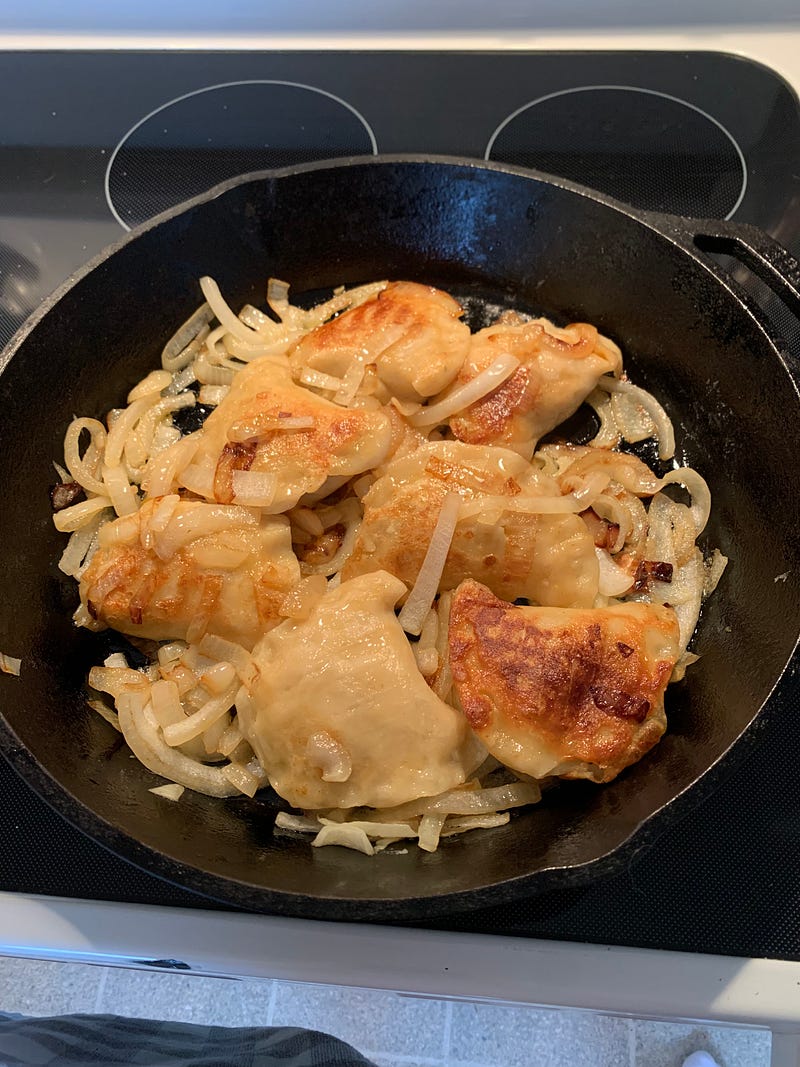
My Auntie’s homemade pierogi
Untraditional families are nothing new.
My grandmother died unexpectedly when my father was seven years old. My grandfather, Deodo, was left with nine children to raise by himself. He never remarried.
When Dad was in ninth grade, he asked Deodo for permission to play football. The answer was a crystal clear, “No.” He told Dad if he played ball, he would be thrown out of the house. Deodo wanted no sports nonsense with any of his kids. He relented and let Dad stay in school, but he wanted him to get a job to help support the family as soon as possible.
Dad was a talented athlete, and though conflicted, he chose to play both football and baseball.
Deodo kept his word, and Dad was permanently thrown out of his house for playing sports.
That’s when his sister Alice, 14 years his senior, took Dad in and raised him. The relationship between Dad and my Auntie Alice was one with deep roots, more of a mother/son relationship than a brother/sister relationship. Their bond held Dad’s side of the family together.
Although we called her auntie, in reality, my Auntie Alice was more of a grandmother than an aunt.
Gardening is soul work
In the summertime, Auntie Alice could be found outside in her vegetable garden, barefoot, pulling weeds and pruning plants, randomly tasting tomatoes as they ripened. She taught me how to pick vegetables without damaging the plants and would often have me sample basil and parsley, and mint. She would describe ways to use each herb as we tasted them. I loved to watch her tie the base of her apron to each side of her waist, creating a basket to carry all the produce she picked.
When Dad and I would leave her home, I would be covered with dirt. Mom never understood why I enjoyed getting my hands dirty, but Dad did.
Clearly, Auntie Alice was happiest in the garden though the line between her kitchen and her garden blurred. She was in and out, picking and cooking, preserving and preparing.
When she needed onions, she would go out the back door and come back with a handful of scallions. If a dish required herbs, she would choose the right combination from a long line of herbs in the garden, break leaves off the plant, and toss them in a pot.
In a good year, she would dig up her own potatoes for the pierogi.
Making pierogi was a family affair
This Eastern European carb overload decadence is often served with sautéed onions and lots of melted butter. It is a stick to your ribs, warm you right up winter delight.
Pierogi is a favorite quilt on a cold winter day. Soothing, warm, and satisfying.
The filled dough dumplings come in a variety of flavors, mashed potato, and cheese being the favorite of most folks. Other flavors include sauerkraut, cabbage, prune, and, lastly, when available, cherry or apricot pierogi.
Fruit pierogi are rare but are especially luscious. My favorite of the fruit varieties is prune, which may not sound like it is delicious; however, one taste convinces most nonbelievers. The mix of cinnamon, nutmeg, and prune filling is heaven.
Cherry and apricot pierogi are almost desserts! Similar to a Jewish cherry blintz, they manage to be simultaneously sweet and savory.
One of the difficulties associated with pierogi is its spelling.
Is it pierogi, pieroghi, perogy, or pyrohy? Its Polish and Ukrainian plural ends in i; however, it is not uncommon to see the word “pierogis” written on American menus. Pronunciation of pierogi also varies. Pier-o-he is my personal favorite, followed by peer- oh- gee. Pa-dough-gee is often the preferred pronunciation of kids.
Not only was pierogi part of my family experience, but it was also part of my teen experience. Often, my friends and I would gather after school events and hurry to get limited seating at one of the small bars that doubled as a restaurant and served pierogi. We ordered enough for an entire table of hungry teens.
In our town, the pierogi was always homemade. The dough was tender and light, and even though they were served a dozen at a time, they never felt heavy or rich. The choice was deep fried or sautéed, and I remember enormous platters of both types being served for a whole table. When the food was served, it came family style, and we all dove in together. The pierogi would disappear in no time.
A labor intensive proposition
As a preteen, I would watch my Ukrainian Auntie Alice fill her kitchen and dining room, and living room with pieces and parts as she made pierogi for the next year. White sheets covered sofas and countertops, making space for each batch.
Family members became part of the process of assembling the dumpling-like creations. If they were unwilling to be part of the process, they were told to leave the house for the day and stay out of the way! It was a production.
First was the task of making the dough.
This, alone, was challenging. Today my KitchenAid mixer has a dough hook that makes my cooking and baking life significantly easier than my Auntie Alice’s life. Though I never heard her complain, her hands, riddled with arthritis, had to hurt. She worked barefoot, always, the cool linoleum a comfort to tired feet and legs.
When we would arrive at her home, my dad would take over the kneading for his sister. It was rare that anyone else prepped the dough. Too much kneading would make the pierogi tough; too little and the dough would crack. Dad had the touch needed to discern when the dough was right. She trusted him with the task.
Once the dough was made, the next step in preparing pierogi was rolling out the dough and placing long, wide strips on all available surfaces. As kids, we would stretch out our arms, and she would lay sheets of dough over our arms. It was our job to carry each of them to a surface so the dough could rest, as potatoes, which had been peeled earlier in the day, were boiling away.
Next was the step of mashing the potatoes and mixing them with cheese.
This was Dad’s job. Done by hand, it required both muscle and stamina. Then, she would take large spoons full of potato filling and place them in long lines on the dough. When I got lucky, a spoonful or two ended up in my mouth before it hit the dough.
She would then fold the dough over, hand cut the dough pockets, and individually “pinch” each pierogi closed. There was no measuring or model for shape, yet the pierogi were almost identical in size and shape. The finished pierogi were very lightly oiled, placed in large bowls, covered, and refrigerated until it was time to cook them.
Later that evening, some of the batches would be boiled until they floated in the water, lightly sautéed in butter and onions, and served for dinner. The large majority, however, were frozen, ready for Russian Christmas Eve and holidays throughout the year.
In retrospect, I am amazed that this was a one-day job that started early in the morning and finished by the dinner hour. Though I would like to say I have made these myself, I have not. What I have done is seek others who do make them and purchase “homemade.”
Food is a family tradition.
I have mastered many homemade recipes that are labor intensive: homemade pasta, bread, bracciole, porketta, all derived from Mom’s side of the family, the Italian side.
It is only recently that I have started to look deeper into Dad’s side. I am discovering there is a lot of missing information.
When my grandmother died, Dad was seven years old. So much was lost for him and for his family. One father raising a slew of kids alone was more about survival than pleasure. There was no matrilineal line to pass on the knowledge of how to make traditional foods. My young aunts grew up fast and did their best to recreate and pass on family traditions. I’m very grateful they did.
At some point, I hope to enlist some help and make some homemade pierogi. I’m sure I will need the help of a cousin or two who may be as curious as I am, and together we can give it a go.
I have a feeling I will get up very early that day and will sleep well that night.
Michele Cambardella For 36 years, Michele Cambardella she taught high school English and loved working with young people. She retired in order to caretake both of her parents in their last days and is especially grateful for that opportunity. Although she did write and paint and cook over the years, she now can devote more time and energy to each of those practices. She deeply loves her family and friends, and id having a great tme as a new Mimi. She especially enjoys mindfulness meditation, long walks in nature, and light yoga. Thanks for reading!


