
The Relationship of Global and Local Trends in Cesar Manrique’s Home
Chapter IV.
The white paint on the floor lights up the dark corridor that leads into the next room with additional small, almost invisible openings, that let the sunlight in. The space also used to be bubble in the lava a long time ago. There is only one small circular “window” in the ceiling that allows the palm tree to grow and lets the light in. It is a social area with white, Post-modern furniture. The dominant materials are marble (circular coffee table around the tree in the middle), leather (couch along the wall) and the stone that has a thick layer of white paint up to knee-height.
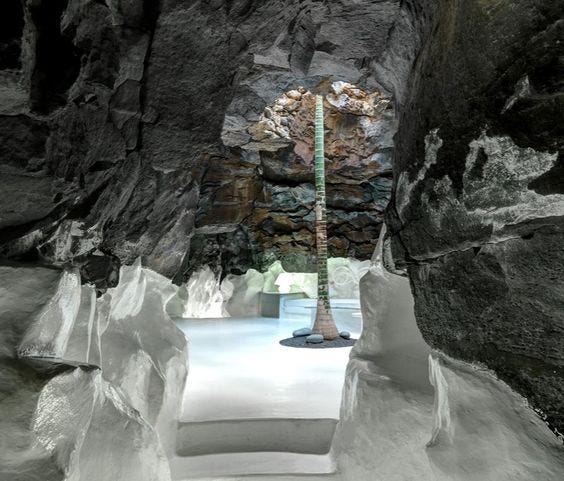
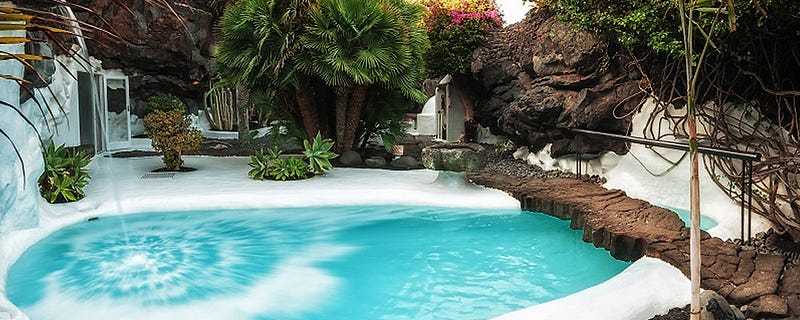
Although, it is a very surreal environment, where the aesthetic created by a mixture of tradition, natural surroundings and the marks of global trends is arguable, but it is certainly interesting and unique. The next room has the same construction but with more contrast created by the bright red furniture and a Picasso-like cubist sculpture. Picasso had a huge influence on him, Manrique even has some Picasso etchings in his collection. Continuing through the passageway the visitors pass by an open bathroom and arrive at “the garden” with trees, a pool and a summer kitchen. This place also located under ground level, however it is completely open at the top. The pool is not a geometric shape, as usual it is a hole in the ground painted white. There are traditional elements, like carpets, lamps and the kitchen mixed with the cubist sculpture and the modern fountain of the pool.
After going through one more circular social area the visitors arrive back at the main building, in a huge studio space. This was Manrique’s favourite place[1]. Everything is white here too, there is no furniture or any other disrupting factors in the space, that was made to accommodate 3 or 4 different projects at any given time. The rooms also have perfect artificial and natural lighting options. And here comes the most amazing part of the house that also symbolizes why his architecture is successful. There is a huge window with a view of the lava desert that looks like a beautiful painting at first glance. As the viewer gets closer, can see that it is the real landscape and then they will also realise that it crawls into space through the glass. This house is not built on or in the land it becomes a part of it.
[1] Miguel G. Morales. TARO, Manrique’s Echo’s (documentary movie), Spain, 2012