
Glimpses of Enslaved Life on a Cape Fear River Rice Plantation
In 1855, Fanny C. Watters was born on Clarendon, a prosperous rice plantation on the Cape Fear River in Brunswick County, NC. Near the end of her life, in 1944, she penned a book of vignettes about her childhood. The family published it as Plantation Memories of the Cape Fear River Country, and her relative George M. Stephens republished it in 1961. In the second edition, Stephens writes in a brief forward that her “words made bright pictures of childhood before the Civil War.” While Watters’ stories gloss over her family’s enslavement of other human beings, they are still valuable glimpses of life on an antebellum rice plantation in the Cape Fear region.
For example, we learn from her book that poultry is so important to the household that one enslaved woman, “Mom Venus,” is called the “poultry woman.” Watters relates that “When Mother wanted any killed she would go out in the poultry yard and say “Venus, kill that one and this…Well, I don’t want to say which to kill. Just kill two, but don’t let me know which.” (p.6) In this story, we see Watters’ mother acceding to Venus’ judgement, while at the same time seeking Venus’ help in protecting her own feelings. Watters’ mother is fond of the poultry, so she doesn’t want to say which of the birds should be killed.
The 1860 Federal Census Slave Schedule of the Town Creek area in Brunswick County, NC tabulates 69 persons enslaved by Watters’ father, putting their family among the largest enslavers in the region. Watters makes no mention of the status of the people who lived and worked at Clarendon, but stories of “the Negroes” nonetheless fill her short book, attesting to the important roles that enslaved African Americans played in the lives of the Watters family. Of the 43 vignettes that make up her book, 23 (53%) of the stories involve African Americans. Eleven of the stories (26%) mention specific African Americans by name.
The 1860 Federal Census lists members of the Watters household, including five-year-old Fanny, her siblings, and parents William and Sophie. The family’s holdings are 1600 acres. A man, 37-year-old M.W. Hilbourn, is also listed in the household as “overseer.” The overseer is never mentioned in Watters’ cheerful stories, nor does she mention any incidents of coercion or brutality that were common on plantations and that would have most likely been the domain of the overseer. Instead, the enslaved people in her childhood stories are represented as devoted servants and comic characters.
In one story, Watters relates in exaggerated dialect how the oldest enslaved person on the plantation, “Paa Mike,” decided to go to Wilmington by boat with three other men. The batto (boat) capsizes on the way home. Paa Mike holds onto a jetty in the river, and begins eating bread that happens to float by. The comical conclusion of the story comes when the narrator expresses astonishment that he is eating in that situation. Paa Mike says he would rather drown with a full belly (p. 44): “I say, ‘Paa Mike we is bout droundid, an heer yu is eatin.’ He say, ‘Boy ef I git droundid, please God, effin I git droundid, I gwinter droun wid my belly ful.”
Turning a near-death experience into a comedic episode makes light of the fact that enslaved people had little control over their lives. They were often subject to hardship and danger, both in their work and from the capricious cruelty of enslavers. In addition, deprivation of food was often used as a means of controlling enslaved people, as Frederick Douglass recalled in his later life. From this vantage point, the picture of Paa Mike grabbing and eating bread that was floating in the river loses its comical aspect. He may have eaten the wet bread compulsively, after a lifetime of food insecurity.
In the 1660s, the lands that later became Clarendon Plantation were in the area of the failed Charles Towne settlement. Initially, English colonizers abandoned the Cape Fear region and went further south to found Charleston, SC. However, Europeans returned to the region in the 1700s. The first and the largest rice plantation in the lower Cape Fear was Orton Plantation, where the rice fields were created between 1726 and 1750. Orton plantation grew the seed rice for the sought-after Carolina Gold rice variety, and so had a pivotal role in the establishment of surrounding plantations such as Clarendon, which was approximately eight miles northeast of Orton. The StarNews reported in 2010:
Clarendon Plantation passed through a number of hands…Members of the Watters family owned it in the 1800s.
An 1834 advertisement for Clarendon in the People’s Press and Wilmington Advertiser described it as consisting of 335 acres of tidal swamp, 654 acres of upland, with 229 acres in “a high state of cultivation. The advertiser claimed the property could yield 72 bushels of rice per acre. Accommodations were available for 100 hands (slaves), along with a “comfortable” overseer’s house and a grist mill.
When Clarendon and the other rice plantations were first established, enslaved people did the work of clearing the land and creating the irrigation canals for the rice fields. After that initial, back-breaking work, labor in the rice fields continued to be dangerous and unpleasant. Enslaved people worked in the wet fields surrounded by swarms of mosquitoes, which can carry diseases such as malaria, encephalitis and yellow fever. An outbreak of yellow fever killed hundreds in Wilmington, NC in 1862. In addition, Venomous snakes such as Copperheads, Cottonmouths (Water Moccasins) and Rattlesnakes are common in the woods and swamps of southeastern North Carolina. During the summers enslavers vacated their rice plantations, leaving the enslaved people to live and work in these conditions . Watters states (p.22):
On the east side of the Cape Fear River is Wilmington, NC. On the west, bordering on the river, are the plantations. The fields are flooded from the river by canals, with flood gates…They [the plantation owners] could not live in summer near the tide water, so built summer homes sixteen miles from the river, in the pine woods, and called the village Summerville. They returned to their winter homes after frost.
Enslavers expected loyalty from the people they enslaved, at times appearing to think it was normal for the enslaved people to be more loyal to the people who kept them captive than to their own spouses and family members. A previous article, Road names point to the Cape Fear region’s plantation past, for example, recounts how John Burgwin, another enslaver in the Cape Fear region, seemed confounded that an enslaved woman ran away to join her husband. Burgwin seems to believe that she must have been duped, to abandon her prior loyalty to him:
In 1798, Burgwin speculated that family ties may have influenced a mother and her son to run away from his Castle Haynes plantation. He seems to think that if Nancy was lured away by her husband, it was an aberration to her normal loyalty to Burgwin. He offers to forgive her, and he also offers a reward for someone to bring her husband Cupid to the Hermitage, although Burgwin had no apparent legal claim on the man.
“RAN away from my Overseer, at Castle Haynes Plantation, an old Negro Woman named Nancy, & her son named Harry, about 18 years old. They are the wife & son of old Cupid, in Wilmington, by whom it is supposed they are harboured or secreted; or perhaps they may be about Old Town, harboured by some of Mr. Carson’s negroes. Whoever takes up the said negroes and brings them to me, at the Hermitage, or secures them in the jail at Wilmington, so that I may have them, shall receive FIVE DOLLARS for the Woman, and TWENTY DOLLARS for Harry.
If the said Negro Woman surrenders herself within a month — as an old, and before this elopement, faithful servant she will be forgiven. And as I am convinced in my own mind, that Cupid has been the cause of this elopement, I will give to any person Two Dollars, who will deliver the said negro Cupid to me at the Hermitage.
JOHN BURGWIN.
N.B. Nancy’s face is marked with the small-pox, and she has thick lips, but speaks plain. Harry is smooth faced has a sluffish walk, but speaks plain and plausible.”
The expectation of loyalty played out in different ways. In the Watters family, one example is the story that Watters tells about “Mammy,” who doubtless had no say in leaving her family behind when she was moved to Clarendon (p.10) “Mother was left an orphan when quite young and was raised by an uncle where Mammy lived and cared for her. When she married and went to Clarendon to live Mammy went with her.”
Of course, Watters cannot be blamed for being born into a particular family, or for having a childish perspective on the happenings around her when she was a little girl. It is interesting, though, that her book gives no indication of her adult perspective on the humanity of the enslaved. While the enslaved people in her stories are mostly portrayed in a paternalistic light, at times they break through Watters’ simplistic narratives to appear as independent actors. Although Watters is silent on the topic, one wonders whether writing this story about an enslaved woman who saved her mother from a fire challenged the viewpoint that predominates in her book of simple-minded African Americans (p. 18):
“Mother loved to make ‘home made’ soap, bar and soft. The soap pot was a big iron pot set up on three stones in the back yard. She used a long, wooden paddle to stir, and while it boiled, stirred constantly.
She was so interested and intent she did not notice that the wind had risen and blown her skirts too near the fire, until Mom Judy standing near, rushed up and put out the blaze saying ‘Yu sho gwine bun yo sef up bilin sope.’”
It would be interesting indeed if we could hear Mom Judy tell this story. One imagines Mom Judy shaking her head at the impracticality of being so absorbed in a task that you don’t notice that your clothing has caught fire. Enslaved people had to be constantly aware of the dangers in their environment. While Watters’ mother could choose to do chores she liked, such as feeding the chicks and making soap, it was the enslaved women around her who made the entirety of her life possible. They were the ones who decided which birds to kill when she couldn’t face the task, and who saved her from a dangerous situation of her own making when her skirts caught fire.
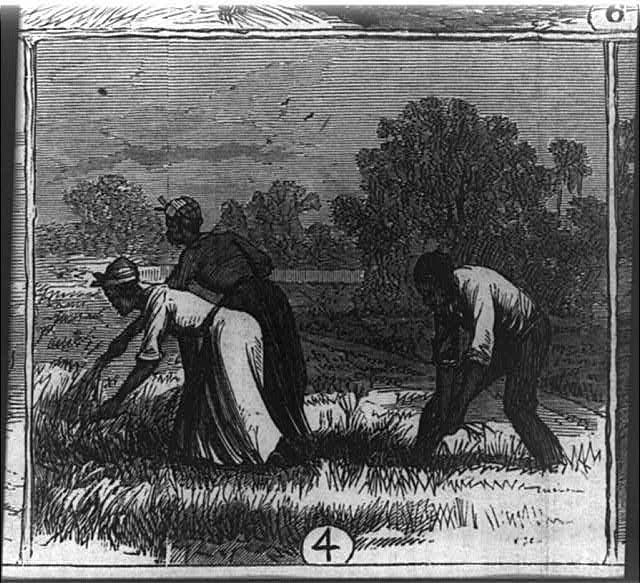
The enslaved women were tethered to the earth in a way that Watters’ mother was not. Clarendon’s rice production, and therefore the Watters’ wealth, relied on their skills. Their labor was tied to the seasons, and they did not have the chance to fly away as the Watters family did to Summerville. As Watters says, one of the tasks done by enslaved African American women on Clarendon was sowing the rice (p. 20):
“Long handle gourds were used to sow the rice. The end of the handle was cut off, and in the side of the gourd cut a small opening, large enough to pour in the rice and hold, then the women would sow the rice through the end of the handle.” They would then step the seed rice into the wet soil with their heels, and cultivate the growing plants through intensive hand labor, as their west African ancestors did.
Few records remain of the approximately 30 rice plantations that lined the Cape Fear river in antebellum days, so Watters’ small book is an important record. While rice production continued during the Civil War and (to some extent) for a few decades afterwards, as NC Pedia notes, the labor of enslaved people had been critical to the growth and success of rice plantations in the Cape Fear region:
“The emancipation of slaves in the United States was the beginning of the end for the rice plantations of North Carolina. Without the cheap labor of enslaved workers, rice would have become a very expensive crop. Growers in the state no longer had the money to raise it.
As technologies changed and made planting and harvesting rice easier and cheaper, some later attempts were made to revive the industry. But competition from established rice growers in Louisiana and other states in the Deep South caused those efforts to fail.
The final end to large-scale commercial rice production in North Carolina came in the late 1800s, when a series of large hurricanes damaged the old rice fields beyond repair. The state’s growers gave up. That ended not only one of North Carolina’s oldest farming traditions but also one of the largest African contributions to North Carolina agriculture.”
Watters relates (p. 42) that her father would have “the Negroes…come to the ‘Big House’ to get their Christmas dram.” Her father would pour small drinks of whiskey for the enslaved people and wish them a “peaceful, happy Christmas.” While doing so, he told them “This is fine whiskey, and old. One of older ones in the group said ‘Massa, considderin de age, hits berry smawl.’”
When one considers that Watters’ father was only able to purchase aged whiskey because of the back-breaking labor of enslaved people in Clarendon’s rice fields, the comment seems apt to describe African Americans’ whole return for their labor: It was very small.


