
Gliding
Bird of Prey
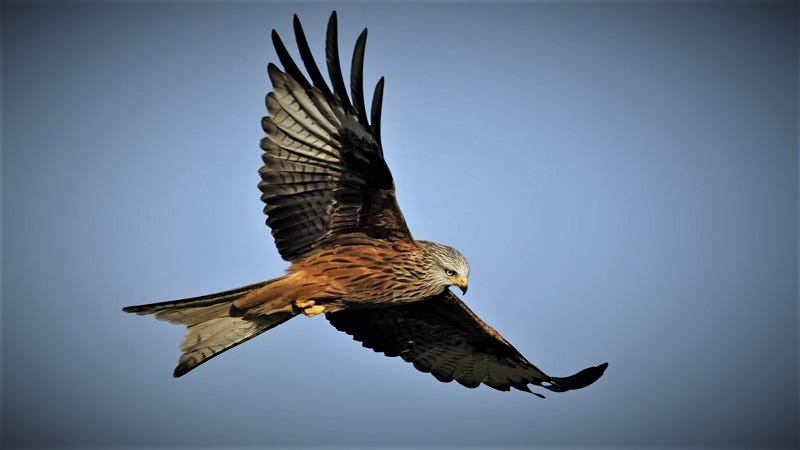
Silent through the air The hawk is made for gliding Drops of rain agree
It’s a wonderful sight, the gliding bird. The osprey.
No, he’s not a dear friend to smaller life. Yes, he’s a killer. But oh, my God, what a flier. Seeing him glide by, not a ripple of wing, still at speed and as graceful as a sleeping angel, seeing this makes my day.
And then he disappears into the light drizzle and is gone. I look around for others (there are quite a few ospreys here this time of year), but he’s the only one. I wait for him to come back, which they often do, keeping an eye out for edibles, but he’s decided not to — or found some that-a-way.
Seeing him makes me think of other gliders, specifically the king of them all, the Wandering Albatross. With a wingspan that can reach twelve feet (that’s twelve as in six plus six feet — walk it out on the ground, say four longish, i.e., three-foot steps, to get a visual — it’s enormous, almost prehistorically enormous), he is a master rider of winds.
I read somewhere that the Wandering Albatross expends less energy gliding, sailing, riding (or however he thinks of it) in the air then resting on the water.
Impossible, you say. On the surface, yes (pun intended). But nature, that fine designer of amazing survival techniques, has engineered wing-locks in this bird’s skeleton so that once spread and in position for sailing/gliding, the wings snap into place and remain there without the bird having to lift as much as a feather (so to speak) to keep them spread. The perfect glider.
Our sweet man-made gliders (I’ve always loved those) have a similar design — very long, thin wings, just like the Wanderer.
And with wings in place, now he just glides, riding the wind.
Amazingly, he knows how to use the different layers of wind to regain altitude if he’s lost some and needs to climb back up to his cruising ditto.
This is how that works. The closer to the ocean surface, the slower and weaker (relatively speaking) the wind. It stands to reason, for the water offers enough drag/resistance to slow the belly of the bottom-layer wind down a little. So, the layer closest to the surface is the weakest. How deep is this layer? you ask. Say, three to six feet, I answer. But that, in the spirit of full disclosure, is just a guess; I haven’t a clue.
Be this, however, as it may; the next layer up is in turn slowed some by the weaker layer beneath (though not as dramatically) though still stronger than its surface-bound sibling. Next layer above that is also affected by the layer below, and so, again, is a tad stronger than the layer beneath while a little weaker than the layer above it — and so on up the layers to where they cease to exist altogether and all is just roaring, layer-less wind.
Well, when the Wanderer decides that it’s time to gain some altitude, without unlocking the wings and actually flap (which takes a lot of energy, way too much), he dives with the wind (to gain maximum speed) for the surface but before he reaches water, he banks a one-eighty into the wind and lifted now by stronger and stronger layers of wind he soon regains his cruising altitude to set a new course and so keep sailing.
Brilliant technique, observed and documented by amazed explorers over a century ago.
It goes without saying (but I’m saying it anyway) that the Wandering Albatross needs the wind as much as it needs food and can only be found where strong winds live, down by and below the roaring forties.
No roaring forties here today, though. Calm. A light drizzle. And this was not a Wandering Albatross but an Osprey. Still, the gliding steals just as much of my breath.
© Wolfstuff