
Melvoin Watch
Giving A Charter School The Independence It Demanded
Palisades High School used to be part of the LAUSD. Shouldn’t breaking free of the district mean that it stands on its own financially?

“The only lingering concern about the Palisades proposal is that it could result in more segregation, as the new independent complex draws more local — primarily white — children back from private schools, and pushes out minority students now bused there.”
- Los Angeles Times 10/1/1995
The law allowing public schools to convert to privately operated charter schools was supposed to give parents the opportunity to have more control over “failing” schools. In 1989 Palisades High School was described as “an institution of high academic performance”, but just a few years later it left the LAUSD. The effort was seen as an attempt to reverse white flight from publicly funded schools by attracting affluent parents who were sending their children to private schools.
While Pali was able to successfully separate itself from the LAUSD, its community has been very active in trying to shape the policies of the district that is now its regulator. The school’s former governing board member, Allison Holdorff, was one of the candidates who ran against former board member Steve Zimmer. Today she serves the school as LAUSD Board Vice-President Nick Melvoin’s Chief Advisor & District Director. Katie Braude served as the director of the Palisades Charter School Foundation before helping to found Speak Up, an astroturf organization formed to assist in bringing Nick Melvoin to power.
A recent appearance by Melvoin at the Pacific Palisades Community Council shows how this influence has paid dividends for the charter school. In his opening remarks, the board member, who is supposed to represent public school students, bragged about supporting projects for the publicly funded private school on two separate occasions. Holdorff went further, saying that: “Nick advocated that Pali High BE THE FIRST to get air conditioning” with bond money from Measure RR.
Apparently, Pali wanted independence from the LAUSD when it came to set rules, but it still wants access to the district’s piggy bank. The school has its own sources of funding, including money that it received from the Payroll Protection Program (PPP), something the federal government did not make available to LAUSD public schools. Pali did not use this funding to prevent the threat of layoffs so why aren’t they tapping this money to pay for the air conditioning project themselves?
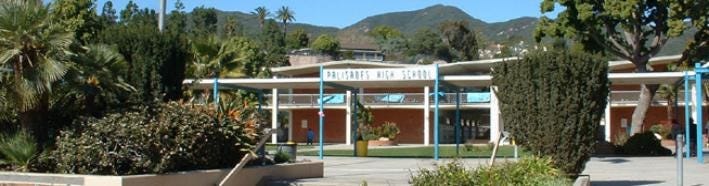
With a campus that is about a mile from the Pacific Ocean (its football stadium is called the “Stadium by the Sea”), Pali has the advantage of much cooler temperatures than schools in the Valley. With an average high temperature of 83°F, it is hard to see how lacking air conditioners in every school building presents a “matter of health and safety.” In comparison, Woodland Hills, which Melvoin also represents, has an average high temperature of 96°F.
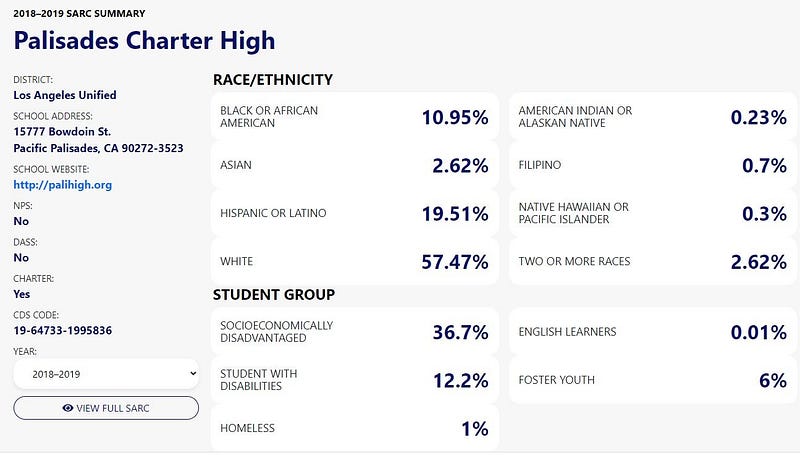
The climate is not the only difference between these two areas of Melvoin’s school board district. While 36.7% of the students at Pali are “Socioeconomically Disadvantaged,” Taft High School in Woodland Hills serves a student body where 59.5% of the students fall into this category. At the independent charter, 19.51% of the students are Hispanic or Latino. Taft’s student body is 38.7% Hispanic or Latino. Only 0.01% of the students at Pali are considered to be English Learners while Taft absorbs the cost of serving the 4.9% of their population who need the services to learn English. The prioritization for construction projects for Pali is just another example of privately run charter schools draining money from BIPOC communities in need while increasing segregation in our publicly funded schools.
The prioritization of Pali over Taft is also facilitated by the gerrymandering of Board District 4. Most of the other high schools in the area around Taft are represented by Scott Schmerelson in Board District 3. Taft is also relatively close to Schmerelson’s district offices in Lake Balboa. The majority of Melvoin’s district is on the other side of the Santa Monica mountains. To visit Taft, Melvoin has to pass by the freeway exit for Scott’s office. As a result, Taft becomes an afterthought while Melvoin describes West Los Angeles and Pacific Palisades as the “core of Board District 4.”
Next year, Melvoin will face the voters as he seeks reelection to the board. The charter school industry needs him to win to keep a majority on the board and the ability to divert public money to their privately run schools without adequate oversight. If history sets the example, they will spend a record amount of money to secure a victory. It will be Melvoin’s reward for Pali’s construction projects and for looking the other way when presented with examples of corruption and operating failures of charter schools.
_____________________________
Carl Petersen is a parent advocate for students with special education needs and public education. He is an elected member of the Northridge East Neighborhood Council and serves as the Education Chair. As a Green Party candidate in LAUSD’s District 2 School Board race, he was endorsed by Network for Public Education (NPE) Action. Dr. Diane Ravitch has called him “a valiant fighter for public schools in Los Angeles.” For links to his blogs, please visit www.ChangeTheLAUSD.com. Opinions are his own.


