
What I Wish I Had Been Taught About Art Series
Give Your Art Time To Grow
Just because it doesn’t look “right” in 15 minutes, doesn’t mean you should stop there.
For this first official installment of my What I Wish I Had Been Taught About Art series, I want to delve into one of the biggest issues I’ve had with art over the years: being patient in how long the process can take.
So many of us, especially those of us who have been deemed unartistic, have internalized the idea that if your drawing of a cat doesn’t look like “a cat” in five, ten, fifteen, or any other arbitrary number of minutes, it’s not a cat and not worth trying anymore.
That we aren’t artistic and can’t draw, paint, sculpt, create this visual art piece, if it doesn’t look “like it’s supposed to” in a certain amount of time.
Professional artists take weeks, months, even years to perfect a single piece of artwork and yet we are often taught that if it doesn’t immediately look like what we are trying to draw/ paint/ sculpt/ what have you, it’s a failure.
And the interesting thing is, we aren’t this way naturally. We are taught this.
When we are very young, as in before “official school”, we are encouraged to draw, scribble, etc. as long as we want. Granted, it may not take long for a young child to finish their drawing, but they often get to set the time on it as long as life doesn’t get in the way (i.e. our hour of art time is over and now we need to go do ‘x’).
We decide when our drawing is done. It could be three lines or scribbles across the whole page to the point we can’t see the paper underneath, but we decide.
Then, as we get older, things start to change. We start to go to school and have more strict class times, official assignments, and criticism. We are told to draw something specific in an exact time frame, usually a very short one such as 15 minutes, and then turn it in for a grade.
When we were younger, adults would nod and smile when we explained our drawings, no matter what they looked like. And then suddenly, we start getting criticism.
Our cat doesn’t really look like a cat. How were they supposed to know it’s a cat? Try again. You present another drawing that to you looks like a cat, and yet, you’re still told it doesn’t look like a cat.
And so, a well-meaning adult walks you through the “easy” way to draw a cat so someone else knows it’s a cat and quickly.
“Just draw a circle with two triangles on top for ears, two dots for eyes, another triangle for a nose, and an arc for a mouth.” These are the things you NEED to have for others to know it’s a cat. We are taught these notes to quickly draw something, get it out of the way, and pass the criticism.
Because we need to draw it fast and others need to understand what it is so that we can be graded on it. Classes are held in short periods of time: 30 minutes, 45 minutes, maybe an hour to an hour and a half if you are old enough and lucky to have a block schedule. And yet, we are often expected to “complete” an artwork within a class period.
And so, the “unartistic” kids quickly lose any chance to grow in their art skills, to learn the process of making your art look more realistic than just the minimum shapes to get your idea across to the grader.
Because it is so easy to get frustrated when you try to draw something and then are told it’s not enough. That your cat doesn’t look like a cat, your truck doesn’t look like a truck.
When an art teacher tells you to “add some shading,” but you don’t know how to do that and no one else is asking. Everyone else seems to understand and do it. Clearly, you just aren’t artistic.
And you give up on that project and soon any other art project that comes along. You do the bare minimum and lean into what they are already telling you, that you aren’t artistic and that’s okay. You don’t have to be artistic, so we will keep that in mind for your grade.
Soon, you’re old enough where you can start picking how to earn your different subject credits and if you didn’t show progress (often because you are following the “basic, easy” advice you were given on how to draw something quick but with the bare minimum of things you need to help your teacher know what it is), you’re encouraged to try another way to earn those credits.
And yes, everyone has different skills, different areas that come naturally to them or not. However, that doesn’t mean that we should just write them off as unable to do this, unable to learn and grow, because this teaches them to not try longer than the bare minimum and accept that they just can’t do it.
We continue these ideas into adulthood. We turn down “artistic” tasks, jobs, even fun get-togethers because we “can’t do it”. We relegate ourselves to stick figures.
But art takes time. It takes little, tiny changes to get it to where it wants to be. Even professional artists make changes as they go, erasing, adding shadows, taking out tracing lines, adding layers on top of layers.
Watch a timelapse of a professional artist and you will see them make changes throughout. Watch a Bob Ross video and see how the image slowly, builds, and appears. It’s not instantaneous. So, why don’t we allow ourselves the same patience and time for tinkering? Because we weren’t taught to, but we should.
I wish I had been given the opportunity to explore art without time limits, to allow myself the time to see my artwork grow over days, weeks, because it’s beautiful. And now, at 28, I’m finally learning to give myself that time. The time to enjoy the process, and forgive myself for “mistakes” because they aren’t permanent.
This all helps me enjoy the art time, which helps me continue practicing and growing my art skills instead of immediately giving up.
If you are looking for how to accept yourself, the process, and the time it takes, I recommend looking into a few different beginner, easy art sessions at home or with others.
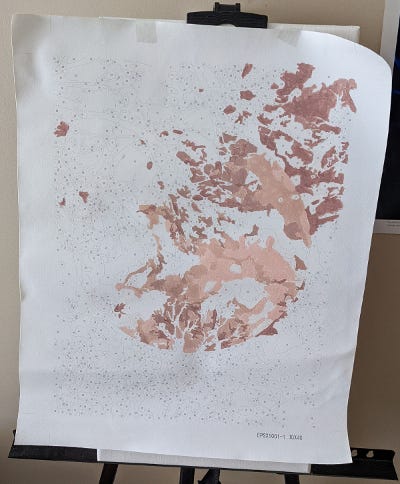
Try a paint-by-number and watch how the painting slowly but surely emerges. You probably won’t finish in one session and that’s okay! In fact, consider making sure you don’t finish in one session to help train yourself to accept taking time. Take twenty minutes on a regular basis to add to your painting. Watch the colors and shapes slowly emerge, reminding yourself that you didn’t see this in your first session, but it’s coming out later with more time.
Or consider something like fuse beads. Again, it’s okay to start with a pattern (especially in the beginning), but then take some time to ponder it and make changes. Add some more of this color. Swap out this color for a slightly different shade. Play with the edges and shapes until it creates a slightly different outcome that’s yours. Use the pattern to help you get started, but then change it before fusing the beads together. Build your skills so that you can start without a pattern, tinkering as you go.
Force yourself to look at artwork several times throughout the process. Make changes as you go. Look at a “completed” pattern, guided painting, etc, and then make it more you. This all helps you to embrace the process and slowly stretch your abilities at your speed.
Be patient with yourself and with your art.
What do you think? Were you also rushed in art or relegated to the “unartistic” group? How have you helped yourself accept your art? Do you have any tips for growing in your abilities? What are some other art projects that are easy to get started but help you have time to grow?
Follow me to keep up with this series and my other pieces. If you are not already a Medium member and enjoyed this, consider using my affiliate links to join as a member or subscribe for email updates when I publish. Using these links support my work by having a portion of your fee go directly to me while also providing access to and supporting thousands of other writers on this platform.