
Getting Kant in 8 minutes
…and understanding his connections to Cognitive Neuroscience
For the dyslexics that came here looking for advice on picking up women quickly: I have to disappoint you.
This one is about Transcendental Philosophy.
Immanuel Kant was a giant among philosophers. He is considered by many to be the single most important philosopher of modernity, perhaps the only one that can reach up to the heights and influence of Plato and Aristotle. So there are other reason for writing this article besides really wanting to make that horrible pun.
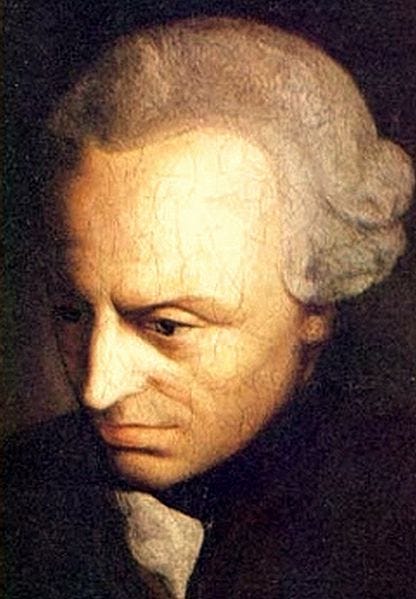
But what did Kant actually do to deserve that reverence? What ideas did he have that changed the way people would look at the world thereafter?
His three Critiques that make up his Critical Philosophy, the Kritik der Reinen Vernunft (Critique of Pure Reason), Kritik der Praktischen Vernunft (Critique of Practical Reason), and his Kritik der Urteilskraft (Critique of Judgement), try to explain and answer the four famous Kantian questions:
- What can I know?
- What do I have to do?
- What can I hope for?
- What is the human being?
He covers a lot of ground in trying to answer them, and of course goes further than a naive answering of these questions might imply. His works are infamously opaque and hard to read, full of technical vocabulary, definitions and careful proofs. Kant is a thinker of great depth and scope, and I can’t do him any justice in a couple of minutes.
Nevertheless, I am attempting here to shed some light on the idea that I believe is most important for understanding the revolutionary character of the Kantian approach to doing philosophy.
Kant himself, in his Preface to the Second Edition, talks about the Copernican revolution of Philosophy he is attempting to kick off. In this, he is referencing Prussian astronomer Copernicus, who established the heliocentric view of the solar system, dramatically changing the way mankind not only located itself in the solar system, but in the entire cosmos.
The Limits of Knowledge
Kant enters the game in the 18th century when the opposition between two different approaches to thinking about the world define the philosophical landscape: on the one hand, there ist the empiricism of England developed by Locke, Berkeley and Hume. On the other hand, the rationalism of continental Europe, most prominently represented by Descartes and Leibniz.
Their line of division can be characterized by the weight they give to sensory data when it comes to gaining an understanding of reality.
For the empiricists, there is nothing besides sense data. All knowledge we have of us and the external world only comes to us through sense data.
The rationalists, on the other hand, believe that a significant amount of insight can be gained about the world by mere reflection. Reason is able to produce knowledge and information on its own beyond that contained in the world.
Kant tries to reconcile these two strands.
Both are to be critiziced: they take things too far in different ways. One of his most famous quotes adresses the limitations he sees in the two opposing schools of thought:
“Thoughts without content are empty — intuitions without concepts are blind”
The first part of the sentence critizes the rationalist doctrine of the possibility of pure thought and pure reasoning about the world. There is something that needs to be perceived before it can be thought about.
The second one tackles the empiricist doctrine that there is nothing we can know about the world besides that which comes in through our perception of the outer world. Concepts are, so to speak, active components of perception, and without their ordering influence on sensory input, no structure can be distinguished (this point I will return to when drawing connections to cognitive neuroscience later in this article).
One way of phrasing this dividing question is by asking what constitutes a priori vs. a posteriori knowledge of the world, or, in other words:
What knowledge is independent of experience and can be gained based on reason alone, and what can we only know after having received input from the external world?
Kant heads off the discussion by posing some, in themselves, remarkable questions:
How does a comprehensible world have to appear? How is this appearance itself constrained and dictated? What are the objects of possible experience, and of possible thought?
It is the program of the Critique of Pure Reason to fully determine this structure of subjectivity. The method that Kant pursues is called the “transcendental method”. Kant’s ambition in pursuing this method is to free Metaphysics from what he calls the burden of speculation. He wants to turn philosophy into a real science by gaining real, unambiguous insights into the world.
The structure of subjectivity
To understand how a world can appear, we need to understand how it can appear to a subject. This, according to Kant, implies structures of subjectivity itself through which the world appears. Mind that these do not only hold for us humans or even for our specific universe.
The rules he lays out are proposed to hold for all forms of self-consciousness and all appearing worlds that are in principle possible.
They are even more fundamental than the laws of physics: because while the physical laws we observe could in principle be different (at least today there is parameter dependence in the models, different forces and different types of matter can be envisioned etc.), all subjectivity everywhere and forever is constrained by Kant’s laws. And as every way in which a world can appear is as a world appearing to a subject, the appearing world is necessarily constrained by the structures of subjectivity.
These structure can be determined by a priori deduction, which is reminiscent of the rationalist position.
But apart from this, nothing can be said a priori about how the world or the universe is. All insights and understanding of the outside world can only come by by observing, measuring and analyzing it. This is in its essence an empiricist position.
The method of his transcendental philosophy therefore always begins by presupposing the perspective from which all questions necessarily have to be asked.
This perspective determines how every possible world can be perceived and can present itself to a subject.
Nothing besides this can be said about the “Ding an Sich”, the “Thing in Itself”. The question of how the world would “really” look like besides our perception of it is meaningless. The objective, perspectiveless observer of Leibniz is, according to Kant, a meaningless thought experiment.
Nothing can be said about the “Ding an Sich”, and maybe one should adhere to Wittgenstein’s principle in saying that “a nothing would be just as good as something about which nothing can be said.”
How do the structures of subjectivity look like?
Kant begins by laying out the structures of time, space as necessary structures in which all possible experience appears.
Let’s consider the role of time. While time also plays an important role in physics (in relativity, it is one of the four dimensions of Minkowskian spacetime), it has a specific role in Kant’s philosophy, because Kant observes that every sensation necessarily bears the imprint of temporality. The appearance of a world can only take place in time.
Try to imagine having a thought or a sensation or a concept of the world that is completely removed from time. Kant claims that this is not possible, and that this claim is true a priori. Every conceivable experience is temporal down to its core, and imagining a timeless experience is a contradiction in itself.
The Categories
Then there are the twelve categories that form the complete set of pure, irreducible concepts of understanding. They define the principles under which understanding itself is possible.
The twelve categories split up into four times three different subcategories:
- Quantity: Unity, Plurality, Totality
- Quality: Reality, Negation, Limitation
- Relation: Inherence and Subsistence, Causality and Dependence, Reciprocity
- Modality: Possibility/Impossibility, Existence/Non-Existence, Necessity/Contingency
Going into all of these in detail would go far beyond the scope of this text (more on Categories can be found here, and a good lecture on their deduction here).
This list defines what kind of properties of objects of cognition we can inquire into in principle.
As an example, you could ask about the quantity of an object you perceive. All possible judgements would then fall into one of the three subcategories of unity, plurality or totality.
The categories are not bound to experience and do not come from experience. They are the tools of reason, and only exist within reason. They are not properties of things that really exist (which would be an ontological statement), but merely the properties of things appearing to our perspective (which is an epistemological statement).
This distinction between ontology and epistemology is critical for understanding the Kantian approach, because it paves the way for a controversy that is ongoing until today: how much of our knowledge of the world is inherently biased by our perspective on the world, and what kind of knowledge can we objectively have about the world? Can we even make statements about the existence of things, or only about what we can know of them?
This controversy is especially relevant when it comes to thinking about the best theories we have of the world right now. Interpreting Quantum Mechanics is in many ways such a difficult business because it’s so hard to distinguish between epistemology and ontology, as I talked about in detail here and here).
To end this discussion, I want to bridge the gap between Kant and modern theories of mind.
Kant and Cognitive Neuroscience

The central Kantian idea of the a priori structures of subjectivity and thinking can be given an interpretation from the framework of cognitive neuroscience.
As we are understanding more and more of how the brain works and how to build machines capable of cognition, we are also starting to figure out what the fundamental structures of systems capable of cognition have to be.
How does a system have to be structured in order to be able to give functional cognitive processes?
We can phrase this in terms of the question whether experience can itself shape the brain completely (which would go along with the view that learning in the brain is similar to unsupervised training of neural networks)- This is reminiscent of the empiricist perspective on the world, while with Kant we could ask if there doesn’t have to be a priori representational structure in the brain for cognition to take place in the first place.
As an example, one could think of Chomsky’s famous “Poverty of the Stimulus” argument, from which he derives the need for innate, pre-existing structures for language processing in children’s brains.
In the same way, one can think of the laws of computation and the laws of physics dictating certain properties as prerequisites for all possible cognitive machinery.
Deeper structural constraints could be related to those of implementing general computing machines like Turing machines (which I discuss in detail in my Non-Technical Guide to Turing Machines) that would then by necessity reflect in properties of subjective experience (assuming our brains bear some resemblance to Turing machines). The question of temporality could for instance reflect in the property of Turing machines to be forced to carry information forward in time by using a symbolic read/write memory (this is highly speculative, but I’m trying to elaborate a little bit on what this could entail).
To sum things up, I think Kant’s ideas can still be fresh and relevant and it’s always a powerful reminder to realize that we, the ever curious homo sapiens, have to be always be mindful of the fact that we face limitations in what we can know about the world which might never be resolved, as frustrating as that might be to our thirst for knowledge and understanding.


