Getting Into the Work Quickly Will Make You Better Than Following Complex Routines
Discover How the Daily Routines of 14 Famous Writers Shaped Their Success in Writing.
Routines help us get our work done without putting much mental effort into it.
That’s why systems are more important than motivation.
If you observe your daily activities, you also cultivate some routines. Such as waking up, brushing your teeth, bathing, and having breakfast — those all with a sequence. This will happen automatically without your conscious effort to do it.
In this article, I’ll share with you the most successful writer’s routines. So, you’ll learn to build your systems to get your work done effectively.
I owe my sight to Mayo Oshin, and I am thankful.
Let’s start!
Stephen King: “I try to get six pages a day”

He’s a best-selling thriller writer. He wrote over 65 novels and sold over 350 million copies.
In an interview, he revealed his fast-writing secret.
The way I work, I try to get out there and try to get six pages a day. I work three or four hours every day, and I try to get those six pages and get them fairly clean.
Stephen King’s morning routine: “I have a glass of water or a cup of tea. There’s a certain time I sit down, from 8.00 to 8.30 A.M., somewhere within that half hour every morning,” he explained. “I have my vitamin pill and my music, sit in the same seat, and the papers are all arranged in the same places. Doing these things the same way every day adds up. It seems to be a way of telling the mind, “You’re to be dreaming soon.
Haruki Murakami: “The repetition itself becomes the important thing.”

In a 2004 Paris review interview with John Wray, Murakami reveals his daily routine and habits for his writing success.
When I’m in writing mode for a novel, I get up at 4.00 A.M. and work for five to six hours. In the afternoon, run for ten kilometres or swim for fifteen hundred meters (or do both), then I read a bit and listen to some music. I go to bed at 9.00 P.M.
I keep to this routine every day without variation. The repetition itself becomes the important thing; it’s mesmerism.
I mesmerize myself to reach a deeper state of mind.
But to hold to such repetition for so long — six months to a year — requires a good amount of mental and physical strength. Writing a long novel is like survival training. Physical strength is as necessary as artistic sensitivity.
Susan Sontag: “I’ll tell people not to call in the morning.”

- Starting tomorrow — if not today.
- I will get up every morning not later than eight. (Can break this rule once a week)
- I will have lunch only with Roger [Straus] (‘No, I don’t go out for lunch.’ Can break this rule once every two weeks)
- I will write in the Notebook every day. (Model: Lichtenberg’s Waste Books)
- I will tell people not to call in the morning, or not answer the phone.
- I will try to confine my reading to the evening. (I read too much — as an escape from writing.)
- I will answer letters once a week. (Friday? — I have to go to the hospital anyway.)
Ernest Hemingway: “I write every morning.”
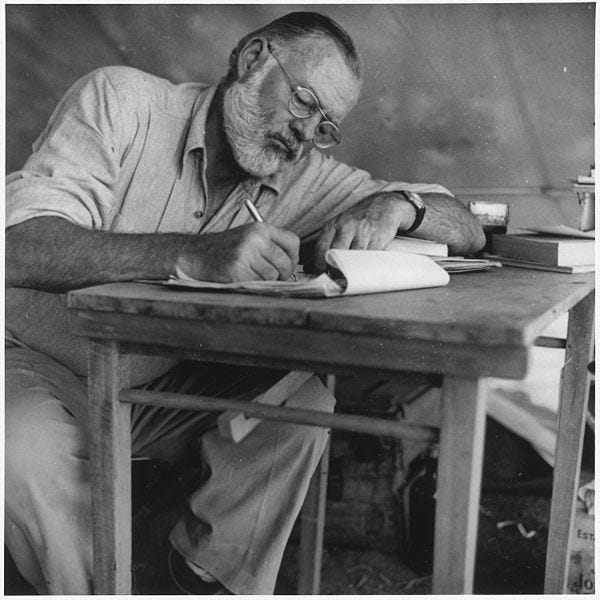
When I am working on a book or a story, I write every morning as soon after first light as possible. There is no one to disturb you and it is cool or cold and you come to your work and warm as you write.
You read what you have written and, as you always stop when you know what is going to happen next, you go on from there.
You write until you come to a place where you still have your energy and know what will happen next. Then, you stop and try to live through until the next day when you hit it again. You have started at six in the morning, say, and may go on until noon or be through before that.
When you stop, you are as empty, and at the same time never empty but filling, as when you have made love to someone you love. Nothing can hurt you, nothing can happen, nothing means anything until the next day when you do it again. It is the wait until the next day that is hard to get through.
Maya Angelou: “I try to get there around 7, and I work until 2 in the afternoon.”
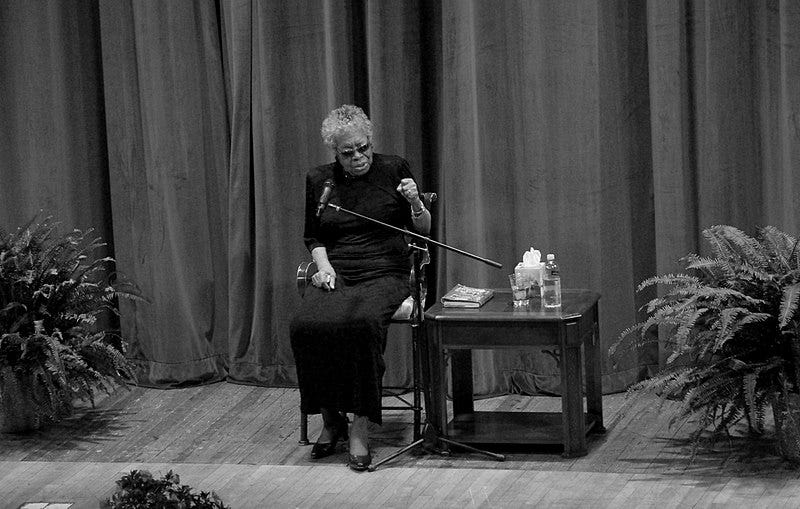
I usually get up at about 5:30, and I’m ready to have coffee by 6, usually with my husband. He goes off to his work around 6:30, and I go off to mine.
I keep a hotel room in which I do my work — a tiny, mean room with just a bed, and sometimes, if I can find it, a face basin. I keep a dictionary, a Bible, a deck of cards and a bottle of sherry in the room. I try to get there around 7, and I work until 2 in the afternoon.
If the work is going badly, I stay until 12:30. If it’s going well, I’ll stay as long as it’s going well. It’s lonely, and it’s marvelous. I edit while I’m working. When I come home at 2, I read over what I’ve written that day, and then try to put it out of my mind.
I shower, prepare dinner, so that when my husband comes home, I’m not totally absorbed in my work. We have a semblance of a normal life. We will have a drink together and have dinner. Maybe after dinner I’ll read to him what I’ve written that day. He doesn’t comment. I don’t invite comments from anyone but my editor, but hearing it aloud is good. Sometimes I hear the dissonance; then I try to straighten it out in the morning.
Kurt Vonnegut: “I do pushups and sit-ups all the time.”
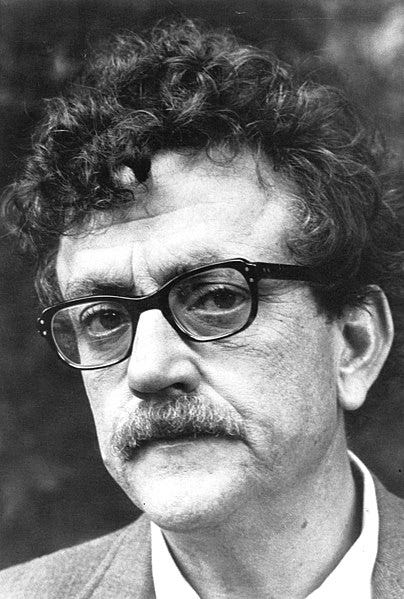
I awake at 5:30. I work until 8:00, eat breakfast at home, work until 10:00, walk into town, do errands, go to the nearby pool, and swim for 30 minutes. I return home at 11:45, read the mail, and eat lunch at noon. In the afternoon I do schoolwork, either teach or prepare.
When I get home from school at about 5:30, I numb my buzzing brain with several belts of Scotch and water. They cost $5.00 per fifth at the State Liquor store, the only liquor store in town. There are loads of bars, though.), cook supper, read and listen to jazz (lots of good music on the radio here), slip off to sleep at ten.
I do pushups and sit-ups all the time and feel as though I am getting lean and sinewy, but maybe not.
John Steinbeck: “Lose track of the 400 pages and write just one page for each day.”
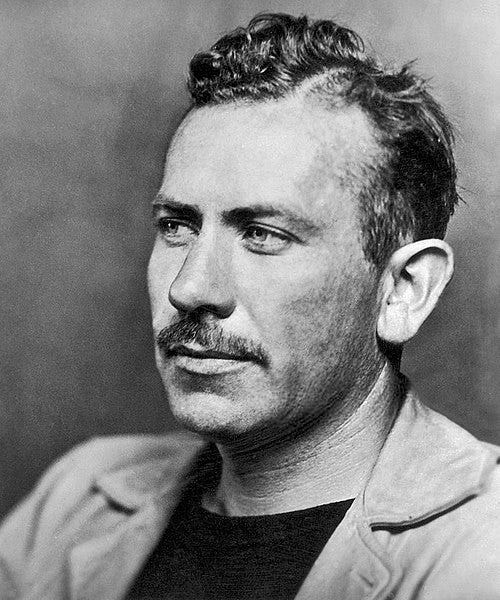
Now let me give you the benefit of my experience of facing 400 pages of blank stock — the appalling stuff that must be filled. I know that no one really wants the benefit of anyone’s experience, which is probably why it is so freely offered. But the following are some things I have had to do to keep from going nuts.
1. Abandon the idea that you are ever going to finish. Lose track of the 400 pages and write just one page for each day; it helps. Then, when it gets finished, you are always surprised.
2. Write freely and as rapidly as possible and throw the whole thing on paper. Never correct or rewrite until the whole thing is down. Rewrite in process is usually found to be an excuse for not going on. It also interferes with flow and rhythm, which can only come from a kind of unconscious association with the material.
3. Forget your generalized audience. In the first place, the nameless, faceless audience will scare you to death and in the second place, unlike the theatre, it doesn’t exist. In writing, your audience is one single reader. I have found that sometimes it helps to pick out one person — a real person, you know, or an imagined person and write to that one.
4. If a scene or a section gets the better of you and you still think you want it, bypass it and go on. When you have finished the whole, you can come back to it and then you may find that the reason it gave trouble is that it didn’t belong there.
5. Beware of a scene that becomes too dear to you, dearer than the rest. It will usually be found that it is out of drawing.
6. If you are using dialogue, say it aloud as you write it. Only then will it have the sound of speech.
— From a letter to Robert Wallsten,
February 1962
Ray Bradbury: “Write a short story every week. It’s not possible to write 52 short stories in a row…before you go to bed every night, read one short story.”
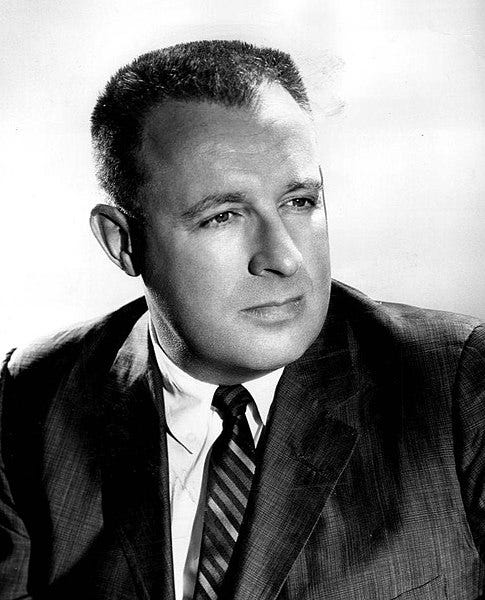
“The problem with novels is that you can spend a whole year writing one and it might not turn out well because you haven’t learned to write yet.
But the best hygiene for beginning writers or intermediate writers is to write a hell of a lot of short stories.
If you can write one short story a week. It doesn’t matter what the quality is at first. But, at least you’re practicing. At the end of the year, you have 52 short stories. And I defy you to write 52 bad ones. It can’t be done. (2.50)
“I’ll give you a programme to follow every night. Very simple programme. For the next thousand nights, before you go to bed every night, read one short story. That will take you ten minutes, fifteen minutes…for the next 1,000 nights.” (8.30)
Alice Murno: “I have a quota of pages.”

I write every morning, seven days a week. I write starting about eight o’clock and finish around eleven….I am so compulsive that I have a quota of pages. I’m also compulsive now about how much I walk every day….
Three miles every day, so if I know I’m going to miss a day, I have to make it up. I watched my father go through this same thing. You protect yourself by thinking if you have all these rituals and routines, then nothing can get you.
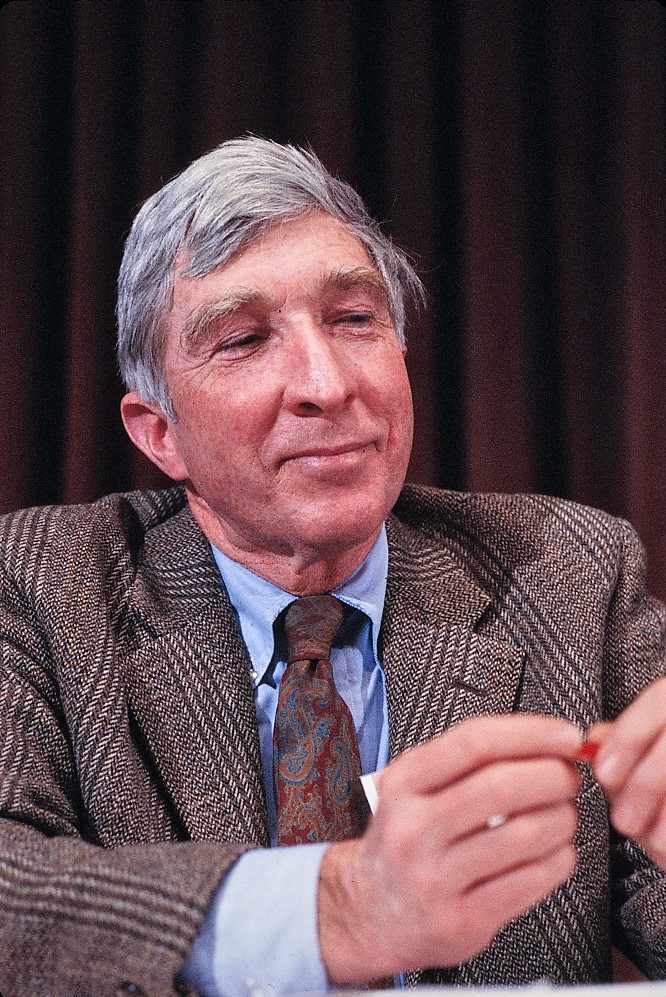
John Updike: “I try to stay with it even on dull days.”
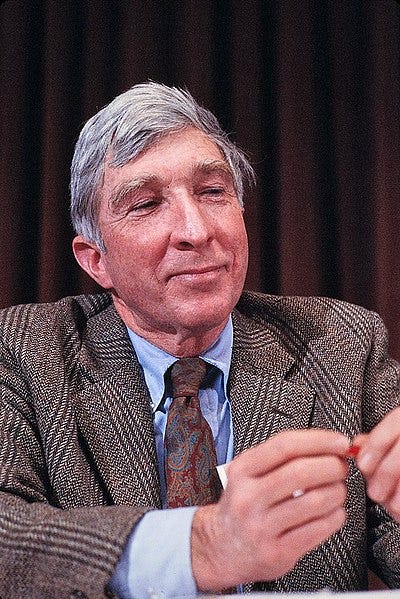
I write every weekday morning. I try to vary what I am doing, and my verse, or poetry, is a help here. Embarked on a long project, I try to stay with it even on dull days.
For every novel, however, that I’ve published, there has been one left unfinished or scrapped. Some short stories… are fragments salvaged and reshaped…. In the execution, there has to be a ‘happiness’ that can’t be willed or foreordained. It has to sing, click, something.”
Henry Miller: “When you can’t create, you can work.”
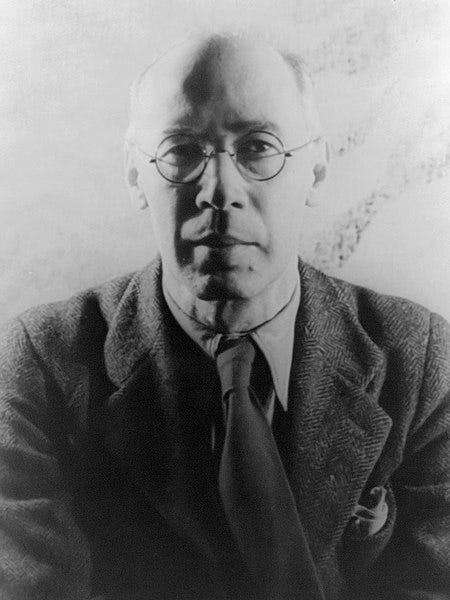
1. Work on one thing at a time until finished.
2. Start no more new books, add no more new material to “Black Spring.”
3. Don’t be nervous. Work calmly, joyously, recklessly on whatever is in hand.
4. Work according to program and not according to mood. Stop at the appointed time!
5. When you can’t create, you can work.
6. Cement a little every day, rather than add new fertilizers.
7. Keep humans! See people, go places, drink if you feel like it.
8. Don’t be a draught-horse! Work with pleasure only.
9. Discard the program when you feel like it, but go back to it the next day. Concentrate. Narrow down. Exclude.
10. Forget the books you want to write. Think only of the book you are writing.
11. Write first and always. Painting, music, friends, cinema, all these come afterwards.
(Source: Henry Miller on Writing)
Leo Tolstoy: “I must write each day without fail.”
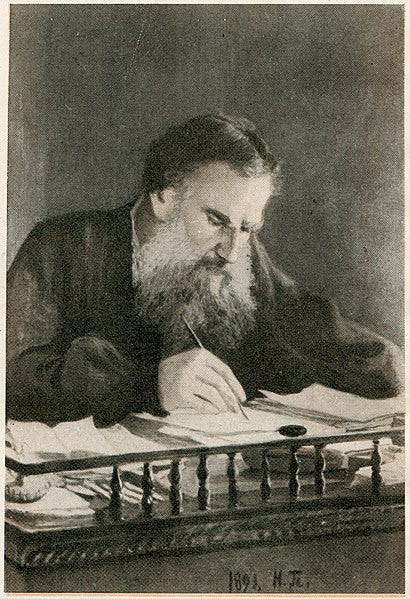
I must write each day without fail, not so much for the success of the work, as in order not to get out of my routine.”…. Then he, too, came up to have his breakfast, for which he usually ate two boiled eggs in a glass. He did not eat anything after that until five in the afternoon. Later, at the end of 1880, he began to take luncheon at two or three. He was not talkative at breakfast and soon retired to his study with a glass of tea. We hardly saw him after that until dinner.
According to Sergei, Tolstoy worked alone. No one was allowed to enter his study, and the doors to the adjoining rooms were locked. He did this to make sure that he would not be interrupted.
Anthony Trollope: “I require of myself 250 words every quarter of an hour.”
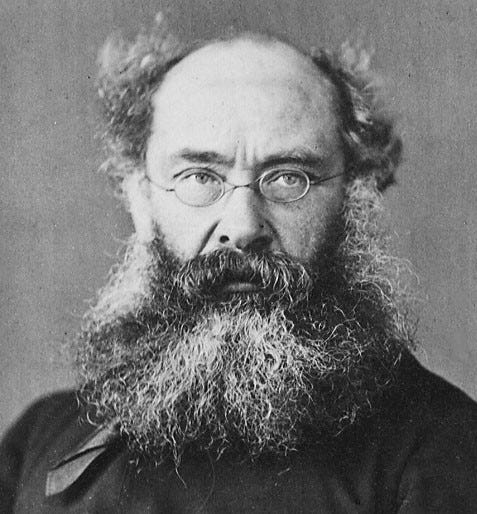
It had at this time become my custom, — and is still my custom, though of late I have become a little lenient of myself — to write with my watch before me, and to require of myself 250 words every quarter of an hour…
This division of time allowed me to produce over ten pages of an ordinary novel volume a day, and if kept up through ten months, would have given as its results three novels of three volumes each in the year…
Bernard Malamud: “Eventually everyone learns his or her own best way.”
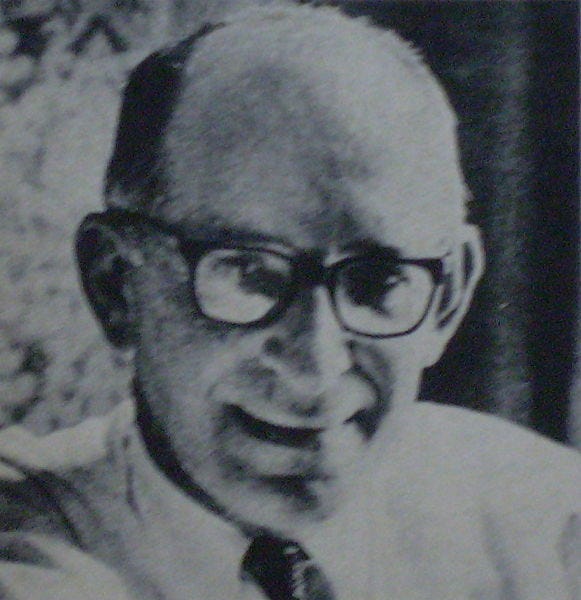
You write by sitting down and writing. There’s no particular time or place — you suit yourself, your nature… Eventually everyone learns his or her own best way.
Knowing famous writers' routines and their rituals will help us to shape our own. Isn’t it?
What next?
So, you’ve figured out what others did to finish their work.
Now, take notice of your interest and hobbies once again. Zoom in and observe at what time you feel more energized. Enthusiasm. Interest to write.
What activities improve your ability to concentrate on writing?
Reshape your routines if needed.
“You are not a terrible writer, nor are you able to improve the quality of your draft — All you need is routines.”
Read more famous writer’s routines here.
Stay tuned for more free articles — click here!
If you haven’t followed me yet, do follow for Sathishiam, and drop your thoughts in the comments. Excited to connect with you!
Have fun and keep writing! Thanks for reading.


.jpg)


.jpg)