
Should You Buy Yu-Gi-Oh Cards Individually or in Packs?
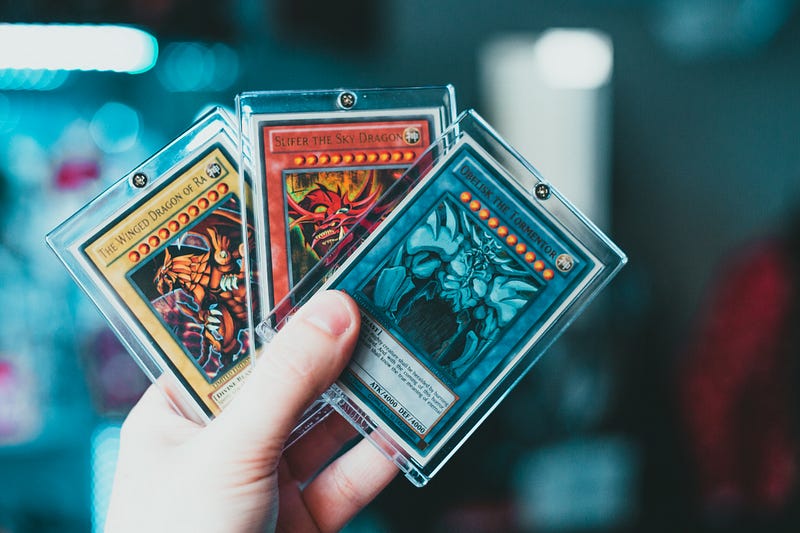
Growing up, I was always so excited when my parents would finally relent and get me a pack of trading cards (Pokémon, Yu-Gi-Oh, basketball, you name it). The suspense of flipping through each of the cards slowly, hoping for a really rare card at the end…and nothing. Oh well — I was still pretty happy I even got a pack of cards!
Fast forward 10 years, and I now have some statistics degrees under my belt — and a small Yu-Gi-Oh collection. Very small. It’s a pretty expensive hobby! Recently though, I wondered: How many booster packs do I need to buy to get every single card in a set?
There is some folk wisdom that buying a Booster Pack Case for all intents and purposes guarantees at least one of every single card in a set. A Booster Pack Case contains 12 Booster Pack Boxes which each contain 24 Booster Packs which each contain 9 cards for a grand total of 2,592 cards at a price point of at least $730! Is there a cheaper way or do you have to bite the fiscal bullet? So, if you’re a parent thinking of kickstarting your child’s collection or a collector looking to get cards, the following mathematical exploration may be interesting!

Some Fast Facts About Yu-Gi-Oh
So before we start doing some math we have to define some parameters.
- We’re going to be talking about a Booster Pack set. These are where Konami (the corporation) releases new cards, so they’re pretty exciting for collectors of all ages to get.
- The Booster Pack set I’m going to feature in this case study is Code of the Duelist (I know it’s pretty outdated now — it was released in the US in August 2017, but that’s about when I put my Yu-Gi-Oh collection on hiatus).
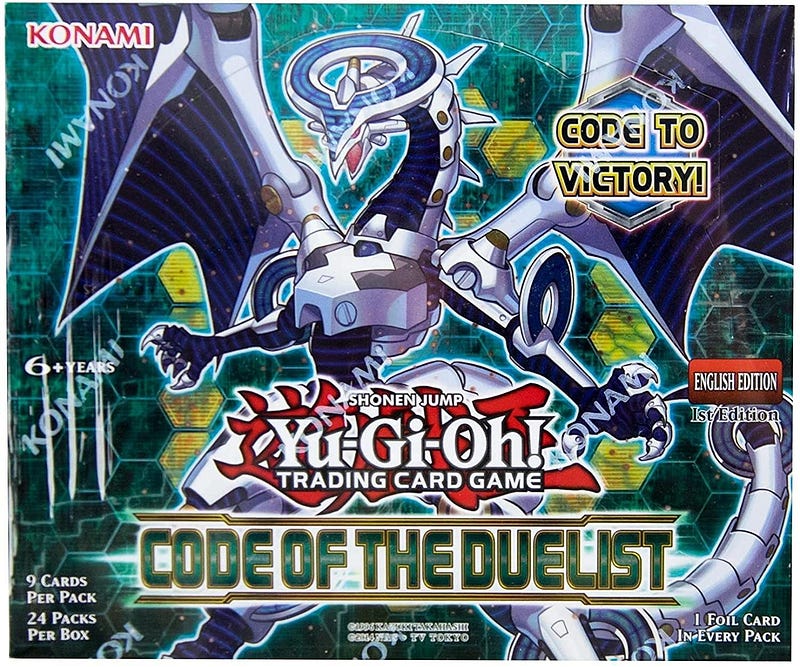
- This set contains 100 unique cards. The breakdown of these 100 cards is shown below (for what these different rarities look like, refer to this guide):
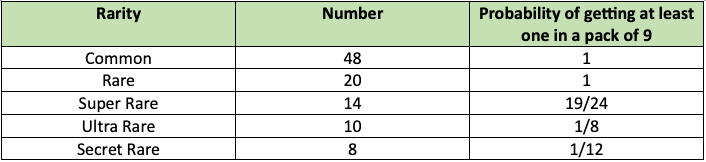
- Each Booster Pack contains 9 cards, 7 of which are guaranteed common (hence the probability of 1), 1 guaranteed rare, and the last card which can either be a super rare, ultra rare, or secret rare card.
A Primer on Geometric Distributions
OK. So how do we even begin applying probability to this? Let’s build up our intuition. What if I asked you: How many times on average do you need to roll a die until you roll a 6?
The answer turns out to be 6. In brief, this question is getting you to think about the probability distribution of the number of Bernoulli trials (random experiment with exactly two outcomes: “success” and “failure”) needed to get one success, a.k.a a geometric distribution. The expected value, or average, for the number of independent trials to get the first success is 1/p, where p is the probability of success. So, in the die example, the probability of rolling a 6 is 1/6, so the average number of rolls will be its reciprocal, 6.
Here’s the proof for this result:
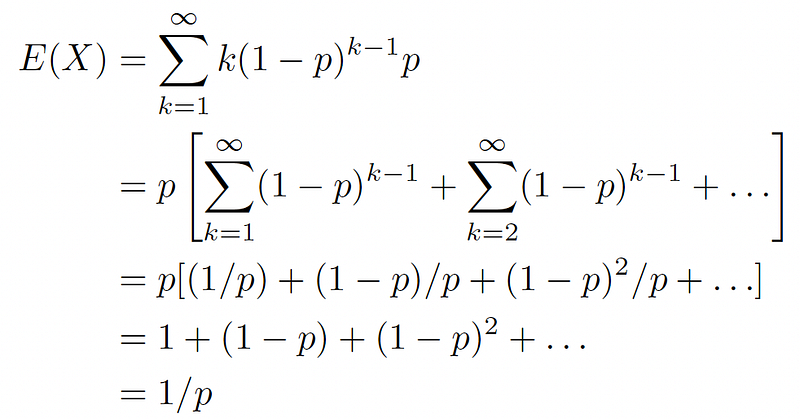
Nice, we got through that one! So bear with me because we’re going to now extend the above question to: How many times on average do you need to roll a die until you roll all 6 numbers?
We can use our new friend, m = 1/p, to solve this. So on the first roll, we succeed no matter what because we get a number. On the second roll, the chance of getting a new number is 5/6. So the average number of trials is 6/5. The number of trials for the third number is 6/4, and so on. We can then calculate:

It turns out there’s a neat trick we can apply for larger sets that we have to complete: Euler’s Approximation for Harmonic Sums [link]

Pretty neat right?

r/brandnewsentence: Geometric Distributions and Yu-Gi-Oh Is Actually Research-Worthy
So it turns out that with this foundational understanding of geometric distributions, mathematicians have done extensive research on this topic. The question, How many booster packs do I need to buy on average to get every single card in a set? given different probabilities for different types of cards is actually quite a difficult one.
To approach this problem, recall that a booster pack comes with 7 commons, 1 rare, and the last card is either a super rare, an ultra rare, or a secret rare. We can disaggregate these into the expected number of booster packs to collect:
- all 48 commons
- all 20 rares
- and all 14 super rares, 10 ultra rares, and 8 secret rares (I’ll explain in a bit why we’ve lumped these together)
Let’s mathematically annotate these expected values as S_common, S_rare, and S_veryrare respectively. There is one more piece of intuition I want to introduce — the expected number of booster packs to get all 100 cards is going to be the highest expected number between S_common, S_rare, and S_veryrare. This may make sense to you if I told you that you’d expect to have to open more packs to get all of the rarest cards, and in doing so, you’d probably collect the less rare cards along the way. This intuition is actually encoded as the Maximum-Minimums Identity (or Section 3.1 of this paper for a more intuitive explanation)
OK, now for the math!
To calculate all commons, we use the derivation for group of constant size, equal probabilities (Section 4, page 20 of this paper) because we are collecting 48 commons in groups of 7.
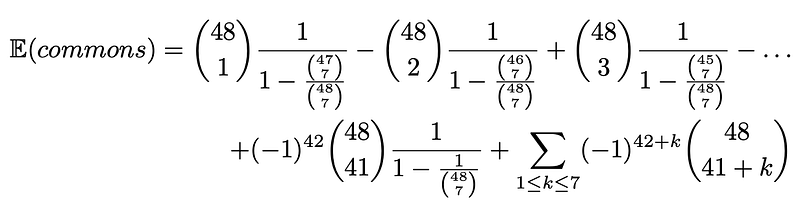
To calculate all rares, we use Euler’s Approximation for Harmonic Sums that we described above (also described in in Section 2.3 of this paper) since we’re collecting 20 rares one at a time.

To calculate the higher rarity cards, we can make the calculation easier if we treat them like one collection, but with different probabilities. So we use the Maximum-Minimums Identity derivation (Section 3.1 of this paper), where p represents the probability for each of the 14 super rares, 10 ultra rares, and 8 secret rares.

So, to wrap up, to obtain the theoretical probability, we would calculate each of these expected values, and then take the maximum.
Let’s Simulate Buying Yu-Gi-Oh Cards
Since we don’t have enough computational power to actually calculate this theoretical probability, let’s simulate instead!
We simulate 100 people all buying packs and recording at which number pack they complete the set. We then calculate the average number of packs to complete the set. We then repeat that process 100 times (imagine a 100 parallel universes) to generate our sampling distribution of average pack numbers to complete the set.
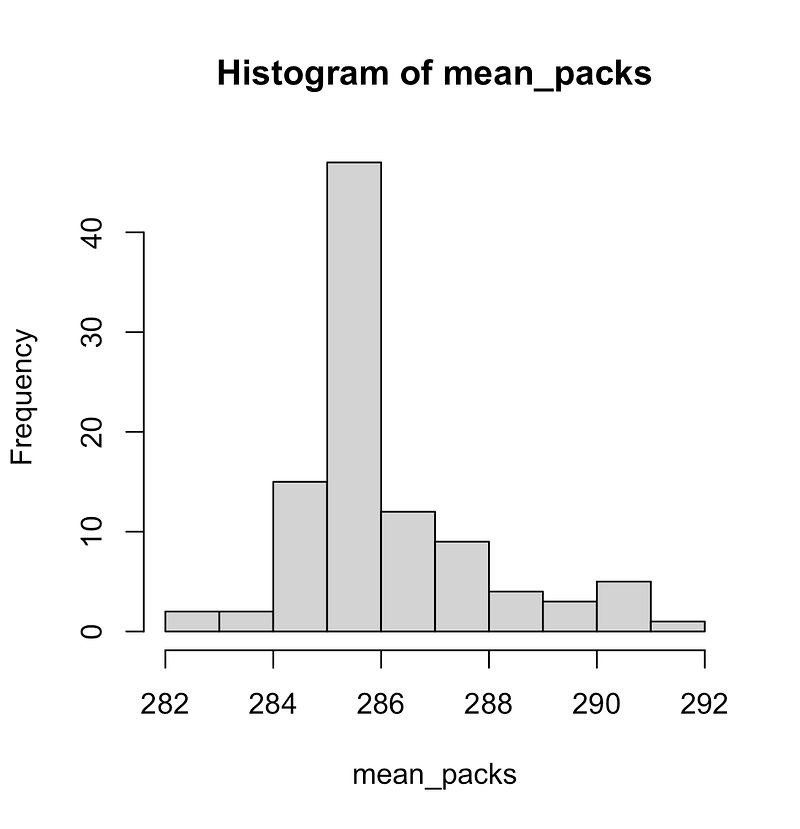
We end up with an average of 286 packs (95% CI: 284, 291) in order to get at least one of each card in the set.
Is It More Economical to Buy Individual Cards?
So 286 packs is very close to a full Booster Case (which contains 288 packs). At the time of writing this article, getting a full Booster Case (12 Booster Boxes) of The Code of the Duelist set costs $893.28, not including tax and shipping. For most people, that’s a hefty amount to pay to garner a collection of 100 unique cards.
So the next thing I set out to do was tabulate the current prices (at time of writing) of each individual card in The Code of the Duelist set and add them up. Please keep in mind the following notes:
- The set is already 6 years old, so the prices may have fluctuated from their debut price
- Yu-Gi-Oh card prices is that certain card prices may be influenced by their use in competitive play
- I’m retrieving the prices of individual cards from a third-party seller called Troll and Toad. Prices may vary by seller (e.g. Troll and Toad vs. eBay)
- I take the lowest prices whenever possible (not differentiating between card mint condition or 1st edition vs. unlimited edition)
So, after tabulating all the card prices, I get a grand total of …
$62.55 to buy one copy of each card in the set.

This is 7% of the cost for a full Booster Case. It would cost me $187.65 to buy three copies (a playset) of each card in the set. It’s important to note that these prices are probably heavily depreciated being from an older set. But even in the case of newer sets, I can’t imagine buying a case to be a better financial decision that purchasing each card individually.
If your goal is to just obtain the cards, you’re better off being a smart shopper rather than leave it up to probability. But if you like a little bit of risk and excitement of opening a pack of unknown cards and seeing what you get or you want to give that feeling to a loved one, you can buy booster packs. But, I’d hold off on buying an entire case.
Acknowledgements
Thank you to Akshay Swaminathan who helped a lot thinking through the theoretical probability solution and the coding.