
Get Bach/Get Bach/Bach to Where You Once Belonged
Some great Beatles albums not by the Beatles
Beatlemania is resurgent, revived by the recent 60th anniversary of the band’s American debut on The Ed Sullivan Show and a little help from the marketing departments at Capital Records, EMI and Apple.
It seems as though I can’t check my Facebook or Instagram accounts these days without encountering Beatles anecdotes, Beatles trivia, Beatles merchandise, and photos of John, Paul, George and Ringo in various stages of hair and apparel preference.
How many photo shoots did these guys mug or glare their way through? It’s a wonder they had time to make as many records as they did.
My small contribution to the anniversary remembrance is this appreciation of Beatles music not by the Beatles.
There is no band whose recordings are harder to interpret. I mean, how would you improve on, say, “Penny Lane” or “I Am the Walrus” in their original, unprecedented versions?
Yet many have tried just the same.
I have a four-CD set called Not the Beatles that was compiled by my longtime pal David Bianculli, of Fresh Air fame.
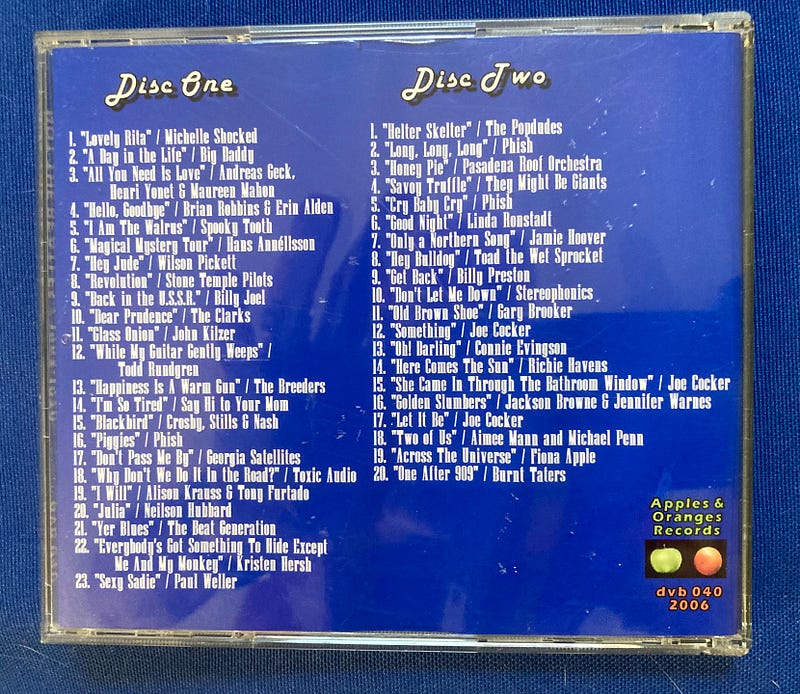
Dave has collected what he considers the best cover version of every Beatles song. They range from the well-known — Stevie Wonder’s “We Can Work It Out,” Ray Charles’s “Yesterday”— to the obscure — “Hey Bulldog” by Toad the Wet Sprocket.
Some are novelties worth one listen. Others are worthy of anyone’s playlist.
There also have been Beatles tribute albums over the years by artists as diverse Keely Smith, Ramsey Lewis and Alvin and the Chipmunks, not to mention a country salute featuring stars like Willie Nelson and Tanya Tucker and parodies like The Rutles.
My two favorite non-Beatles Beatles albums were in stores before the lads got more ambitious and experimental themselves — before they’d released “Yesterday,” much less “Eleanor Rigby” or “A Day in the Life.”
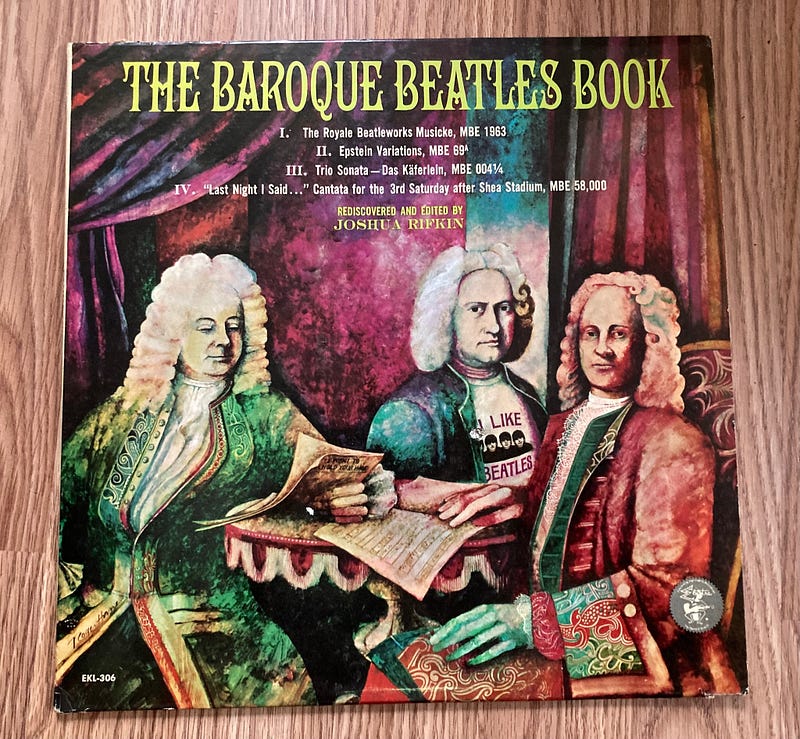
One is The Baroque Beatles Book (see illustration above). Nonesuch Records, an Elektra subsidiary beloved for its quirky classical albums, released it in December 1965, the year of the movie Help!
Baroque Beatles was conceived by Joshua Rifkin, a pianist, conductor and musicologist whose name would become better known in the 1970s when he championed and recorded the ragtime music of Scott Joplin.
Rifkin mixed and matched lyrics and melodies from assorted Beatles recordings to create little suites and cantatas that sounded like chamber music from centuries earlier — mock Bach, Handel and Brahms, “long hair” music meets the Mop Tops.
Here’s an example from the track listing on the back cover:
“Last Night I Said,” Cantata for the Third Sunday after the Shea Stadium, MBE 58,000
Chorus: “Last Night I Said” (Please Please Me) — 5:22
Tenor (Helpentenor)Recitative: “In they came jorking” & Aria: “When I Was Younger” (Help!) — 5:31
Chorale: “You know, if you break my heart” (I’ll Be Back)— 1:40
Hearing the words to “Please Please Me,” the most salacious song the Beatles ever produced, intoned by an operatic tenor never fails to make me laugh. But it’s not kitschy funny; it’s the sly fusion of ribaldry and formality that tickles.
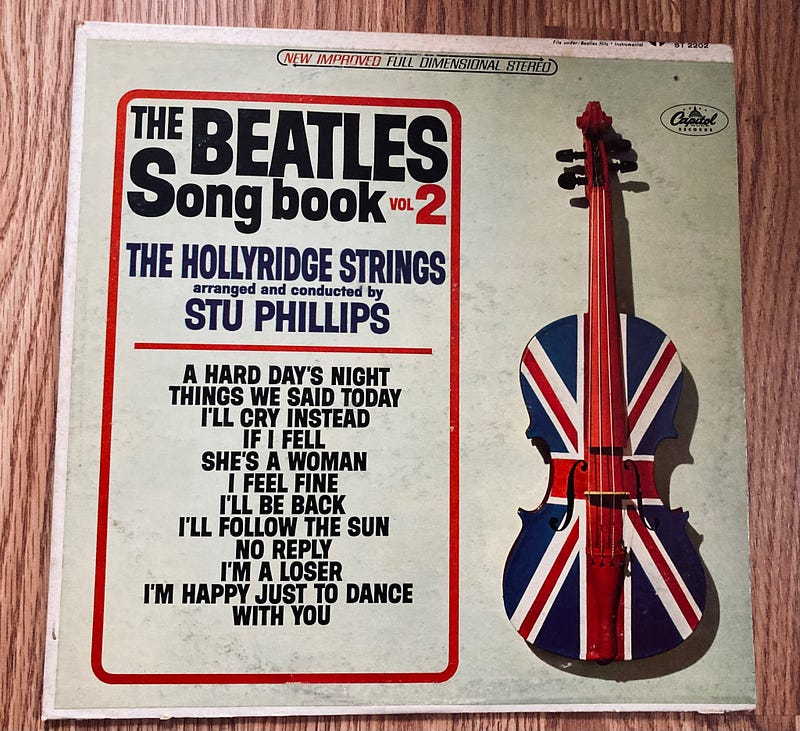
My second favorite non-Beatles Beatles is The Beatles Songbook. The first two volumes (see illustration below) hit the racks in 1964. Eventually there were four.
On the one hand, the series is an example of Capitol Records, which repeatedly pissed off the Fab Four with its repackaging and pruning the British versions of their albums, squeezing out more “product.” And there is something a Muzak-y feel to the string-centric orchestral interpretations (though I would argue that they’re closer to the lush semi-classical music of Percy Faith or Andre Kostelanetz than anything you ever heard in an elevator.
But the Songbook albums are notable nonetheless. Producer/arranger Stu Phillips recognized the melodic excellence of early Beatles songs, written and recorded before the band was widely taken seriously. And the albums foreshadowed the classical elements that the Beatles, especially Paul McCartney, would eventually incorporate into some of their most famous recordings.
The Songbook albums remind us just how melodically, harmonically and dynamically sophisticated McCartney and John Lennon were from the get-go, before they moved beyond lyrics that rhymed “rings” with “things” or “hand” with “understand.”
I have to confess I didn’t buy either of the albums pictured because I was a musical sophisticate. My brother and I were so Beatles crazy that the band couldn’t put out new music fast enough. We would grab almost anything Beatlesque we could get our hands on.
Plus, I quickly discovered girls liked them.
I was just 17. You know what I mean.


