
How to Get Abs Fast with Two Short Workouts Per Day
I dropped my waist size from 32" to 28" almost exclusively with this 2x exercise plan designed to strengthen my core.
With so many conflicting articles on the internet promising a flat tummy with radically different methods, it’s easy to get confused about what works best.
I found myself facing a similar dilemma in July 2020 when I decided to start working out at home. I wasn’t sure which training plan to follow, how many calories to restrict myself to, whether or not I should join a gym, and so on.
Then, with a lot of research and self-experimentation based on the limits of my body, time constraints, etc., I devised a simple yet effective training plan that worked wonders for me. It consisted of 30-minute home workouts and helped me lose 5 Kg in the first month. Since the results were the most noticeable around my mid-section, I decided to focus more on core-strengthening exercises.
Your core muscles connect your upper and lower body. There are multiple benefits of having strong core muscles, including enhanced balance and stability, good posture, and less chance of developing back pain.
I’ve been following this abs-training plan since August 2020. I dropped my waist size from 32 inches to 28 inches. My BMI was down from 23.4 in July to 21.5 in October. When I press my tummy with my fingertips, I can feel the ab muscles underneath. For an inherently lazy person like me, this is a huge achievement because my body never had muscles in that area before. It gives me a kick out of touching them over and over again throughout the day. There is more definition in my abs, more vascularity, and improved strength. The results inspired me to keep working on my training.
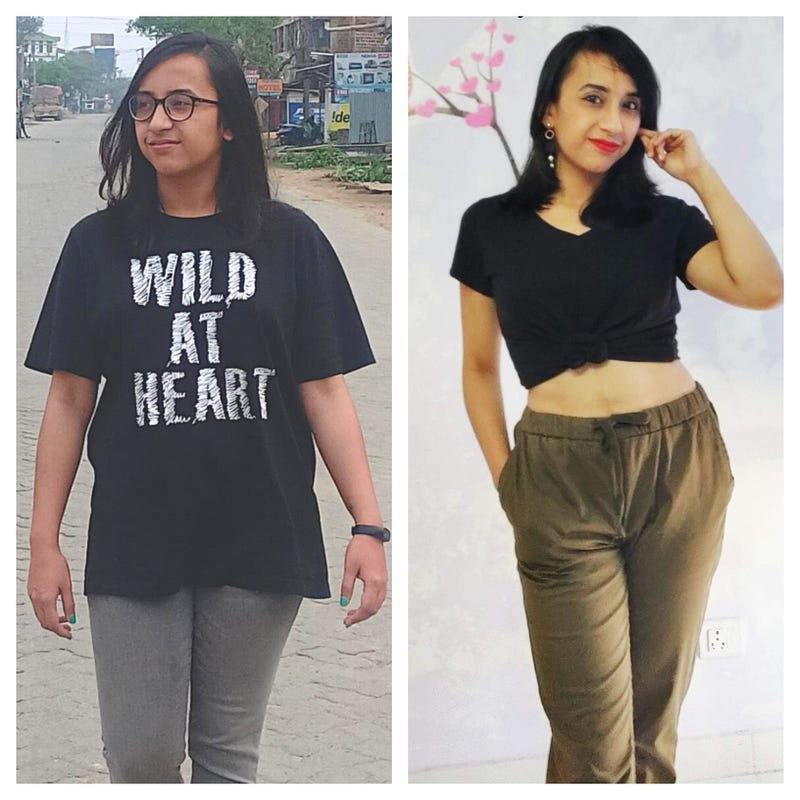
The best part about this training plan is that it doesn’t require hours of time. You only need to spend 30 minutes each day for six days a week and can do all the exercises within the confines of your room. No matter how busy a routine you have, if you are determined to lose inches around your belly, you can fit this schedule into your life without making significant sacrifices. The only equipment you’ll need is a yoga mat and you’re ready to start.
In this post, I’ll discuss the details of my training plan and outline the steps I took to achieve the results I have. This includes a breakdown of the exercises, the reps/sets/rest periods, and how I continuously keep updating my routine to include new exercises or expose my body to more intensive workouts.
Before we get started, here are some facts to set the stage.
- I am a 28-year-old able-bodied cis woman. I understand what worked for me may not work for everyone. But this post includes some basics that should show results for most people.
- These exercises helped me get a flat tummy. As for having noticeable abs, it’s important to understand that all the factors influencing whether or not you can actually see your abs aren’t under your control. For example, the ratio of body fat to lean muscle mass is impacted not only by diet and exercise but also depends on genetics. In addition, your mental state can be the deciding factor on how easy or hard it is for you to develop noticeable abs. Stress has been linked to higher levels of abdominal fat in non-overweight women.
- The path I followed was exercise-only with no significant change in calorie intake, except removing junk food from my diet and only sticking to home-cooked meals. My goal was to create a negative calorie balance by burning more calories than I consumed through increased physical activity.
- The amount of weight you can expect to lose varies from individual to individual. According to the Centers for Disease Control and Prevention (CDC), it’s one to two pounds per week. That means, on average, aiming for four to eight pounds (1.5 to three Kg) weight loss per month is a healthy goal.
- Fitness professionals are divided on whether or not ab exercises should be done every day, but according to a May 2018 meta-analysis in Sports Medicine, daily ab workouts can improve your endurance and strength.
I am not a qualified physical trainer or a professional nutritionist, but here’s what worked for me.
Working Out Twice a Day
When I started working out, I trained in a single stretch of 30 minutes each day. However, when I came across posts that suggest working out twice a day is an excellent way to increase the time you’re active so it naturally fits into your schedule, I decided to give it a try. It’s also been found to be just as effective as working out in a single session. Here are some benefits of working out twice daily:
- Twice-a-day exercise routines are often recommended by coaches for accelerated growth of muscle mass and strength.
- It reduces your sedentary time. Research has shown that a sedentary lifestyle is associated with increased rates of cardiovascular disease and diabetes.
- If you have a busy life full of social obligations or work, working out twice a day can help you become more productive and alert. Studies have established that immediately after exercise, your attention span, accuracy, and memory are improved, as is the speed with which your brain can process new information.
However, I was aware that working out too much can lead to overtraining. To avoid its health risks, I stuck to the guidelines set by the lifestyle and fitness magazine Flo for working out twice a day without damaging my body:
- I did the first session in the morning and the second late in the evening. Experts suggest a rest of at least four to six hours between workout sessions.
- I took one day off every week.
- I drank lots of water and stayed hydrated between workouts.
- I got at least seven hours of sleep each night.
- I combined other physical activities like walking and training my back and hips so I don’t injure myself.
- I started slow with basic stretches in the morning, then gradually increased the intensity to include cardio and high-intensity interval training (HIIT) sessions.
- I added meditation to my rest days.
- I listened to the signs of my body. When I felt tired, discouraged, or bored, I took a break and stopped beating myself up about being inconsistent.
- I stretched and did a short warm-up session before each stretch of working out. I followed each session with stretches to help me cool down.
Keeping these points in mind, I designed a workout plan that was interesting and not too intensive. I included exercises in sets of 30 seconds each followed by a five-second break so I didn’t exert myself. I also made sure each session had different exercises so the routine did not feel monotonous.
My workout plan for losing abdominal fat consisted of two sessions — a 10-minute session in the morning and a 15-minute session in the evening. Both sessions were preceded by two-minute warm-up stretches and a few seconds of cool-down body movements.
Morning Session Focused on Abs
I chose the morning sessions to focus on abs. Working out before breakfast is a great way to burn more fat. However, if you choose to workout in the morning, there are some dietary requirements you can keep in mind. As this post suggests, it’s important to follow a balanced diet to enhance your athletic performance and shorten the recovery time:
- Eat whole, nutritious, natural foods.
- Include healthy carbs such as fresh fruits and vegetables, whole grains, and legumes.
- Choose healthy fats, such as olive and coconut oil, ghee, and avocados.
- Protein in the form of lean meat, eggs, and low-fat dairy products.
- Nuts, seeds, and sprouts are healthy additions to your diet as are foods rich in iron such as fish, cooked beans, and green vegetables.
When I started working out in the mornings, I stuck to yoga. I did five to six Surya namaskars to start my day, and it left me energised and counteracted my early morning soreness.
After a few days, I started including pilates sessions focused on training the core muscles.
Fourteen days later, when my body was used to sweating in the morning, I started HIIT ab workouts as designed by the fitness instructor Jaclyn Wood.
Here is a detailed look at my morning routine that you can apply directly to lose belly fat and strengthen your core muscles. Note that these exercises should be performed on an empty stomach.
Day 1 to 6: Yoga
Surya namaskar or “sun salutation” is a sequence of 12 yoga poses that serve as a great cardiovascular workout. It is best performed early in the morning on an empty stomach. Here is the sequence to follow:
Step 1. Pranamasana (Prayer pose) — Stand with your feet together and shoulders relaxed. Expand your chest and keep your weight balanced equally on both feet. As you breathe in, lift both arms up from the sides, and as you exhale, fold your palms together in front of your chest.
Step 2. Hastauttanasana (Raised arms pose) — Inhale and lift your arms up and stretch them backward over your head, keeping your forearms close to your ears. Stretch the whole body up from your heels to the tips of the fingers.
Step 3. Hastapadasana (Standing forward bend) — As you exhale, bend forward at your waist, making sure to keep your spine straight. Bring your hands down to the floor beside your feet. If you can’t reach the floor, bend as low as possible without arching your back.
Step 4. Ashwa Sanchalanasana (Equestrian pose) — Inhale and stretch your right leg back as far back as possible. Touch the right knee to the floor. Stretch your neck to look up and exhale.
Step 5. Dandasana (High plank) — As you breathe in, take the left leg back at level with your right and bring the whole body in a straight line, as if you are doing a high plank.
Step 6. Ashtanga Namaskara (Salute with eight parts) — Touch your knees down to the floor and breathe out. Slide forward and rest your chest and chin on the floor. Raise your hips a little and keep your eyes fixed on the floor.
Step 7. Bhujangasana (Cobra pose) — Touch your thighs flat on the floor and arch your back to look up at the ceiling. Breathe out and breathe in, stretching your spine as much as you can.
Step 8. Adho Mukha Svanasana (Downward dog) — As you exhale, lift your hips and tailbone up to bring your body into an inverted ‘V’ pose.
Step 9. Ashwa Sanchalanasana— Same as step four, except that here you bring your right foot forwards and place it next to your hands while you inhale. The left leg lies stretched back.
Step 10. Hastapadasana — Breathe out, then bring your left foot forward and lift your hips up, bending forward the same as step three.
Step 11. Hastauttanasana — Inhale, straighten up, then arch backward, lifting your hand up and above your head as in step two.
Step 12. Tadasana (Mountain Pose) — As you exhale, straighten your body and bring the arms down to lie at your sides.
The 12 steps make up one full rep. I started out by doing two reps daily, slowly increasing the number of reps to six by the end of the first week. I also found myself adding variations to the steps, including lunges between steps three and four, or adding up and down planks between steps five and six. That is how I understood my body was ready for a more intense workout in the mornings. Moving on, I started adding pilates into my morning routine.
Day 7 to 14: Pilates
When I was a beginner in tracking my fitness, I assumed pilates was too simple — that it did not stress the body enough to leave any impact. However, when I did some research, I was surprised to learn that aside from increasing physical activity and the quality of life, pilates is a great way to reduce bone and muscle pain and improve sleep quantity in adults.
Since I was a complete beginner, I relied on guided pilates programmes by experts to kickstart my journey. Here are the two routines that I followed on alternate days:
Core Sculpting Pilates by Cassie Ho: This routine consists of six sets of precise movements that target the upper abs, lower abs, and obliques. The movements are slow and controlled but leave you sweating. There is a break of five seconds between each set.
- The hundreds: 45 seconds focused ab burn.
- Legs up crunches: 45 seconds to burn the upper abs.
- Table-top crunches: 45 seconds for focused upper ab burn.
- Single-leg jack-knife: 45 seconds on each leg with a five-second gap in between for working the whole core.
- Side seals: 45 seconds on each side with a five-second break in between. This works the obliques and builds flexibility.
- Corkscrew: 60 seconds for burning the upper abs, 30 seconds in both clockwise and counter-clockwise directions.
Morning Pilates Routine by Lottie Murphy: This is a quick routine that targets the abdomen and glutes and can be completed in less than 10 minutes. There’s a 10-second break between each set.
- Curl ups: 60 seconds for targeting the upper abs.
- Single-leg stretches: 45 seconds for targeting both the upper and lower abs.
- Table top twists: 45 seconds for targeting the obliques.
- Bicycle crunches: 45 seconds for intense upper abs and obliques burn.
- Bird dog: 30 seconds on each side with a five-second break in between. This works both the upper and lower abdominal muscles.
- Bird dog with twist: 45 seconds to work the upper abs and obliques.
- High plank: 45 seconds to work the abs. If you find it difficult to hold the plank for so long, you can drop down to your tummy and resume when you have caught your breath.
- High plank with leg lift: 45 seconds on each leg. This is a great workout for working the abs and back and improving balance.
- Superman: 45 seconds for an intense burn in the back and abs.
- Downward dog to standing up with some shoulder rolls to cool down.
Day 16 onwards: Focused abs workout
When my body felt sufficiently comfortable with pilates in the morning, I decided to turn it up a notch and look for workout routines that combined both pilates and strength training. According to this post by Healthline, a short rigorous workout in the morning can result in increased physical activity throughout the day and faster metabolism that makes it easier to burn calories all day long.
I included two ab workouts by the fitness influencer Jaclyn Wood, which I followed on alternate days. Both of these can be completed in less than 10 minutes and show incredible results.
7-Min Morning Abs Workout: An intense ab workout that consists of14 exercises for 30 seconds each with no rest time in between.
- Single-leg drop: 30 seconds on each side for an intense lower ab burn.
- Single-leg extensions: With the legs still in table-top position, straighten one leg towards the top and drop the other to the bottom without touching the floor. Alternate each time.
- Table-top leg extensions: For an intense lower lab burn.
- V-sit hold: Focused on working the upper abs.
- V-sit crunch: For an intense upper and lower ab burn.
- V-sit bicycle crunches: 30 seconds on either side.
- Slow mountain climber: Burning fat on the upper abdomen.
- Side plank: 30 seconds on either side for burning fat on the obliques.
- Push-ups with torso rotation: This helps strengthen the core and also works on the shoulders.
- Plank with toe touch
- Plank walk: This helps in advanced mind-muscle coordination and builds core strength.
Six-Pack Morning Abs Workout: This is a 10-minute routine slightly harder than the previous one. It includes 20 exercises to be performed for 30 seconds each with no rest in between.
- Butterfly crunch
- Cross-crunch with single-leg extensions: 30 seconds on each side.
- Butterfly tuck: Same as the butterfly crunch, except that when you crunch up, you tuck your elbows and knees close to each other and squeeze your core.
- Cross-crunch with single-leg extensions: 30 seconds on each side.
- Cross-body toe touch: 30 seconds on each side.
- V-sit bicycle crunches: 30 seconds on each side.
- In and out crunches
- Side plank with hip abduction: 30 seconds on either side.
- Side plank: 30 seconds on both sides.
- Pike with cross plank: 30 seconds on both sides.
Evening Session Focused on Full Body Fat Burn
When you’re intent on getting a flat stomach, it’s easy to want to stick only to ab exercises. But, as I learned in this post by BodyBuilding.com:
“If you strictly perform isolation ab exercises, you’re making a huge mistake. Compound movements like deadlifts, squats, and overhead presses engage every inch of your core. Don’t forget to include them in your training program.”
To make sure I did not commit the same mistake, I kept my evening session focused on engaging the whole body. Continuing from the workout schedule I’d devised for myself in July, I stuck to the Summer Shred Challenge by fitness trainer Chloe Ting with some modifications of my own. The exercises include two 13-minute full-body routines I performed on alternate days with warm-up and cool-down.
The exercises in both routines are beginner-friendly and require no equipment. Here is a breakdown of both.
Shred routine one
Each exercise is to be repeated for 30 seconds with 10 seconds rest in between. Total time: 12 minutes (excluding warm-up and cool-down). This is the same as the Full-body shred mentioned in this article.
- High knee jumps: Full-body burn.
- Lunges with arm crosses: Works the arms and legs.
- Curtsy lunges with toe taps: Inner and outer thighs.
- Mountain climbers: Full-body burn with focus on strengthening core.
- Squats with side twists: Works the thighs, butt, and abs.
- Burpees: Full-body burn.
- In and out crunches: Works the core.
- Push-ups with shoulder tap: Core and arms.
- Plank hop jacks: For core, arms, and legs.
- Touch hop and kick (30 seconds each for both legs): For core, legs, butt.
- Tricep dip kicks: For arms, core, and legs.
- Plank walk: Core strength.
- Curtsy lunge with sidekicks: Legs and butt.
- Jumping jacks: Core, arms, and legs.
- Groiners: Works the hips, hamstrings, and abs.
- Squats with sidekicks: Works the legs and butt.
- Low kicks: Full-body burn.
- High-knee kicks with hand raises: Works the legs, arms, and core.
Shred routine two
This routine is slightly tougher than the first one because it includes 22 exercises, each 30 seconds long with five-second breaks in between. The total duration is 13 minutes.
- Lateral high knee: Cardio for a full-body burn.
- High knee with ankle taps: Cardio for a full-body burn.
- Mountain climbers: Full-body burn with focus on strengthening the core.
- Squat jacks: Full-body with focus on glutes and thighs.
- Skaters: Full-body with focus on thighs.
- Overhead jacks: Cardio for a full-body burn.
- Burpees: Full-body burn.
- High knee jumps: Full-body burn.
- Spiderman plank: Abs and shoulders.
- Bird dog: 30 seconds on each side with a five-second break in between. This works both the upper and lower abdominal muscles.
- V-sit bicycle crunches: Works the core and thighs.
- Tricep dip reach: Full-body exercise that targets the core.
- Bear crawl: Activates the quads and the glutes.
- Flutter kicks: Burns fat on the abdomen and thighs.
- Tricep shoulder taps: Full-body burn with focus on abs and glutes.
- Plank hops: Targets the core and the obliques.
- Squat walk: Engages the glutes and thighs.
- Mountain climbers: Full-body burn with focus on strengthening the core.
- Lateral lunge to reverse lunge: Works the thighs and glutes. 30 seconds on each leg with a five-second break in between.
- Heisman: Cardio that strengthens the calves, glutes, core, and obliques.
- Jumping jacks: Core, arms, and legs.
- Bicycle crunches: Works the upper abs and obliques.
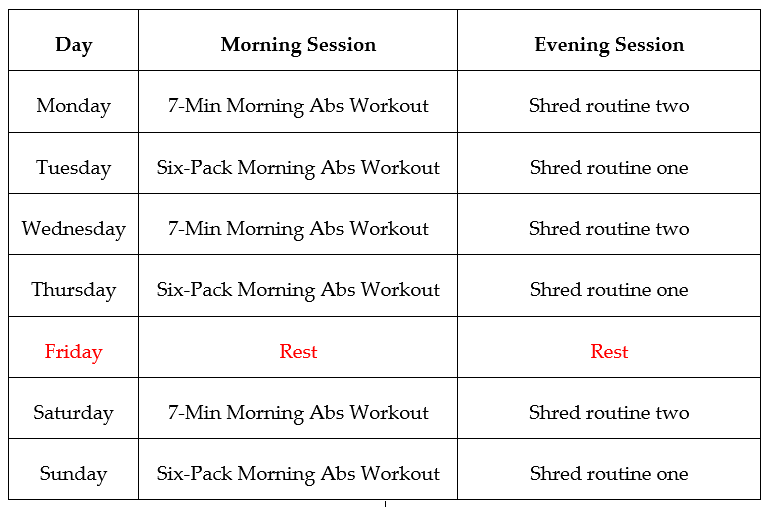
Here is a breakdown of my final weekly workout regimen:
The Results
Following this workout routine, I lost four Kg in one month and my waistline dropped four inches. I also lost noticeable amounts of fat all over my body. Most importantly, I started feeling confident in my skin. It was a wonderful feeling to fit back into the clothes from my college days I thought I’d never be able to wear again.
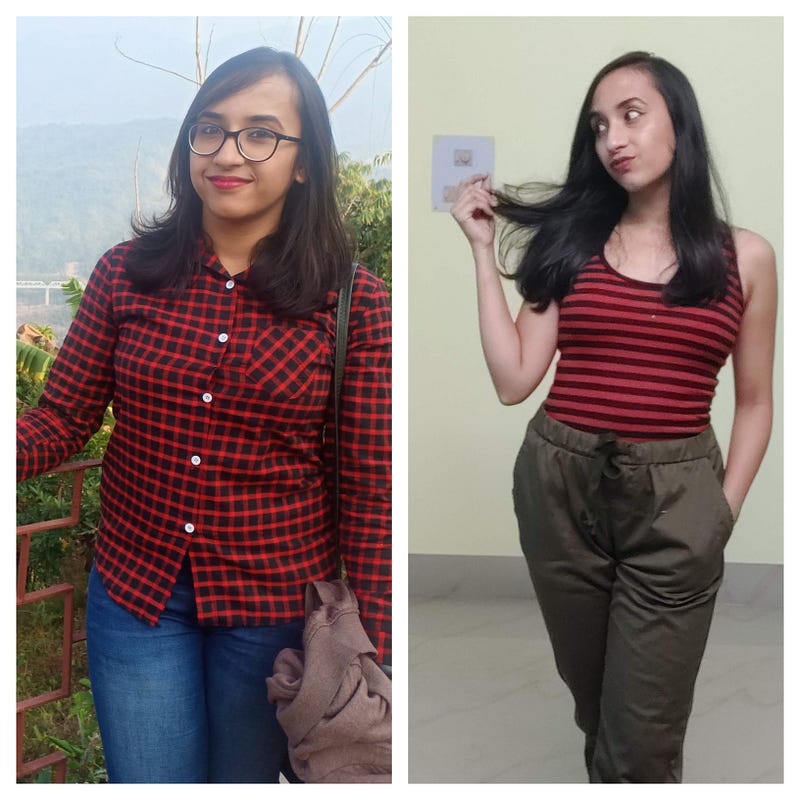
The morning routine left me feeling energetic and productive throughout the day. It’s hard to force yourself to work out first thing in the morning, but a good stretch wakes up the body and mind like nothing else. I also felt happy that I managed to stick to my promise of leading a healthier lifestyle. This happiness fueled me to set higher goals.
The evening routine was tougher because working out meant I would start sweating again and would need to shower a second time. However, I knew the satisfaction of having successfully completed the exercises would be much stronger than my excuses.
I’ve been so committed to this workout routine for so many months now that it has become a habit, almost like second nature. The best part is that I schedule the rest of the day around my workout timings, and this has helped me stay grounded. For someone who lives alone in a two-bedroom apartment, it’s easy for me to just let go and not follow any rules. The workout schedule is the only thing that helps me go to sleep and wake up on time and plan my meals accordingly.
Yes, it is hard work, but I am sure my body will thank me for this effort when I am older.
I started this core-strengthening regimen to get a flat stomach, but it has now become a lifestyle change that has made me more disciplined. It has given me a lot of confidence and the audacity to dream big and work harder. I also love my body more, not because it’s thinner, but because it can now bend itself into positions I had been physically incapable of a few months earlier.
When you get into the workout routine, have some patience and stick to it even if the initial days show no results. Your body will take time to develop strength and flexibility, and trust me, over time, you’ll realise all that sweat and pain was worth it. There’s nothing wrong with wanting to have a smaller body, but your ultimate goal should be to stay fit, not to be thin.
Your self-worth is not tied to how much you weigh. Don’t randomly start working out because the world made you feel you’re fat. Workout only when you feel you have the commitment and the determination to stick to a routine. More than a habit, daily exercise is like a way of life that will slowly ingrain itself into your routine.
If you’re determined enough to make a promise to yourself, this could be the best decision you ever take on the path to self-improvement.


