
Turkish Delight: Chapter 5
Get Shot in Turkey
Knee-deep in history
“Sorry,” I muttered, wiping away my tears with the back of my hand. “That just came out of nowhere.”
“No,” Tommy said, not letting go as I gulped away the last of the sobs. “From the heart. Makes you weep for a lad sent to die in this hell.”
He looked around the beautiful little cemetery, with its glory of a view over the blue Aegean. “Not the only one, either. There was one here only fourteen.”
From the final resting place of the boy soldier, a road took us further up the ridge. The slopes on either side drew in and to our left old trenches ran under the trees. Tommy led me by the hand into one.
“You saw the film? The front line full of soldiers ordered over the top to certain death? Well, this is the place.”
The Nek. Another sacred site. After the initial landing, the trench war was a stalemate. Neither side could advance against dug-in positions guarded by machine guns. An ambitious plan was developed to loop around the side, capture the heights above the coastal positions and make a new landing at Suvla Bay to the north.
Diversionary attacks were to draw in the Turkish reserves. Lone Pine on the southern part of the battlefield was the first and on an August evening, two thousand diggers stormed from their trenches. It was a bloodbath that night and days after, for a cost of about 9 000 casualties on both sides.
The next dawn another Australian attack was mounted here at the Nek, a narrow point in the ridgeline and a critical part of the Australian line. A bungled attack plan had 600 soldiers charge in four waves over open ground into the rising sun against Turkish machineguns. The first wave was cut down within seconds and those following knew their fate. Nearly two-thirds of the Australians were casualties.
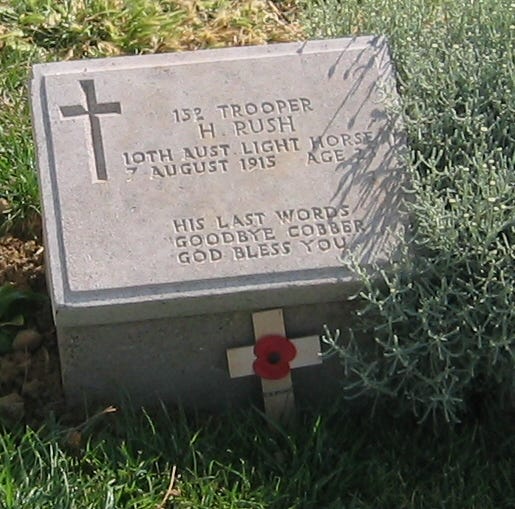
The 1981 Australian film Gallipoli had made this attack the tragic centrepiece of the drama and the scenes of the doomed soldiers preparing to leave the trenchline into what they knew was near-certain death made for harrowing viewing. Mates — “cobbers” in Aussie digger slang — said goodbye to each other in the final seconds before the whistle blew. The film had aimed the blame at the British high command and when it was released Australia took a new interest in the battle.
I followed Tommy into that fatal trench. From here the few survivors must have looked with horror at hundreds of their comrades lying dead and dying on a patch of land the size of a tennis court, calling out for help in fewer and fainter voices through a long summer’s day.
The combined forces of erosion in this exposed location and the inevitable accumulation of dirt and debris in the bottom of the abandoned trenches had halved their depth; they would have been far deeper in 1915. Deep enough to protect a tall man standing against the ever-watchful rifles. A chill went up my spine as I stood in the place that had seen fear, uncertainty, and death in horrendous amounts.
I reached out for Tommy to hold his warm, living, hand. He squeezed back.
“How could they follow such senseless orders?” I asked. “They would have known it was pointless.”
“Look over there,” he said, pointing south. A kilometre and a half away, the white marker of the memorial at Lone Pine rose above the scrub. “The boys here saw the attack go in at sunset and heard the noise all night. They knew they had to do their bit at dawn. If their mates at Lone Pine could face death, how could they hold back here?
“And don’t blame the British for those orders. They might have drawn up the dud strategy but it was our own bloody officers who worked out the attack plans. The colonel led his men in the first wave here and when he was killed, there was nobody senior enough on the spot to cancel the rest. It was an Australian staff officer who insisted the attack continue.”
I dropped to the floor of the trench and aimed my Leica along the packed earth. From this angle — one which few tourists would bother with — the trench would appear deeper, more impressive. The far end was open to the sky up here on the ridge and a sliver of blue sea hinted at the vista beyond. A heavenly place to die.
The cemetery at the Nek is a patch of green grass. You could string a net across it and play a cramped game of tennis if you didn’t mind the odd careless ball bouncing over the side and down into the gullies far below, an hour’s scramble there and back before play resumes.
Although over three hundred Anzacs are buried there, only ten headstones identify known graves. The rest were jumbled bones by the time the Australians returned four years later. War correspondent Charles Bean reported that they made a patch of pure white in the moonlight that could be seen from the Aegean far below: hundreds of skeletons lying as they had fallen years earlier.
I thought of the men beneath the lawn. Young men, cut down like blades of green grass, left to rot while the trench a few steps away was held by soldiers sickened by the stench and the horror, who dared not withdraw even a tiny bit lest the Turks push them back down the ridge and with that put the whole beachhead in peril.
No ‘Fondly remembered’, no ‘Beloved son’, no ‘Fallen serving his King’ here. If the next of kin ever sent in their 60-character epitaphs, there were no headstones to carve the words on.
I took off my hat, letting the wind ruffle my hair. The spirits of the dead swirled past me in my thoughts, and I silently acknowledged them on behalf of all the mothers, sisters, wives who never had a chance to say a last goodbye and weep over their graves.
Head bowed, I let Tommy lead me away from that quiet green place. He sat me down on the side of the road and I let the sensations of light and hearing, touch and smell bring me back.
“What do you see?” he asked. I listed the sights around me. The bushes and trees. The blue sky above, broken by a contrail drawing a line between London and Singapore. The hard edge of the ridgeline beyond the valley. The gravel of the road verge. A big square metal shape as huge as a house…
“Oh my god. Is that the water tank? How did it get way up here?”
“One thing’s for sure,” he said. “We’re fifty yards in front of the Australian trenches. The Turks brought it here. How and why, I don’t know. But there it is.”
Black magic, possibly. It would have been a titanic effort. It couldn’t go over Razor Edge, so it must gave gone down into the valley and up even steeper slopes to get here.
I got out my camera and took a few shots from various angles. There was a big square hole in the top where a hatch must have been, now gaping empty. God knows what was inside. A writhing mess of snakes, possibly. Along with skeletons of unwary tourists.
I looked in. Empty — thank goodness — apart from litter and leaves.
Tommy and I walked along the road, following the ridgeline. We came to a road junction. “All Turkish territory up there,” Tommy said, “apart from a couple spots we captured and held for a few hours. Bit of a hike, but. Maybe drive up later.”
Thankfully we turned right, following the ridge. Second Ridge, I realised.
“From here on,” Tommy said, “The road marks No Mans Land. Turks on the inland side, Anzacs facing the sea, and nobody ever stood right here in the middle unless they were dead. All the men and supplies came up goat tracks from the gully down there.”
Another scrub-filled valley, steep sides, a big ask to look at, let alone carry loads up and down in the dark. There was a bigger ask in my mind. How, and above all why, had all these men come here to the other side of the world to do something so wasteful and pointless? And why did we Australians celebrate an act of such colossal foolishness?
The Turks had been defending their homeland. Any price they paid would be worth it.
A little way on and the Turks were putting a lot into remembering. Tommy led me into a huge cemetery, a towering memorial above a neat slope of lawns, paths, and headstones, a Turkish flag flapping in proud ownership of the site. In a dusty carpark across the road, tourist coaches unloaded dozens of Turks. Family groups, old men, chattering schoolchildren.
We strolled amongst the headstones in harmony, a few curious glances going in both directions. I was glad to see that the Turkish people were remembering their history and I touched the brim of my soldier hat to a few who stood tall and looked me in the eyes.
My eyes, filling again.
“All gammon, of course,” Tommy the tour guide said in my ear. “If anyone’s buried here, it’s by pure chance; the Turks wouldn’t have a clue who they were.”
“How come?” I asked. It seemed a very grand affair to be a fake. And why wouldn’t the Turks honour their dead?
“We might have just chucked our blokes into the nearest trench and shovelled a bit of dirt on top but we knew who was in that trench and put a marker there if we could. The Turks didn’t bother. Just dumped all their guys into a gully and waited for the smell to die down.”
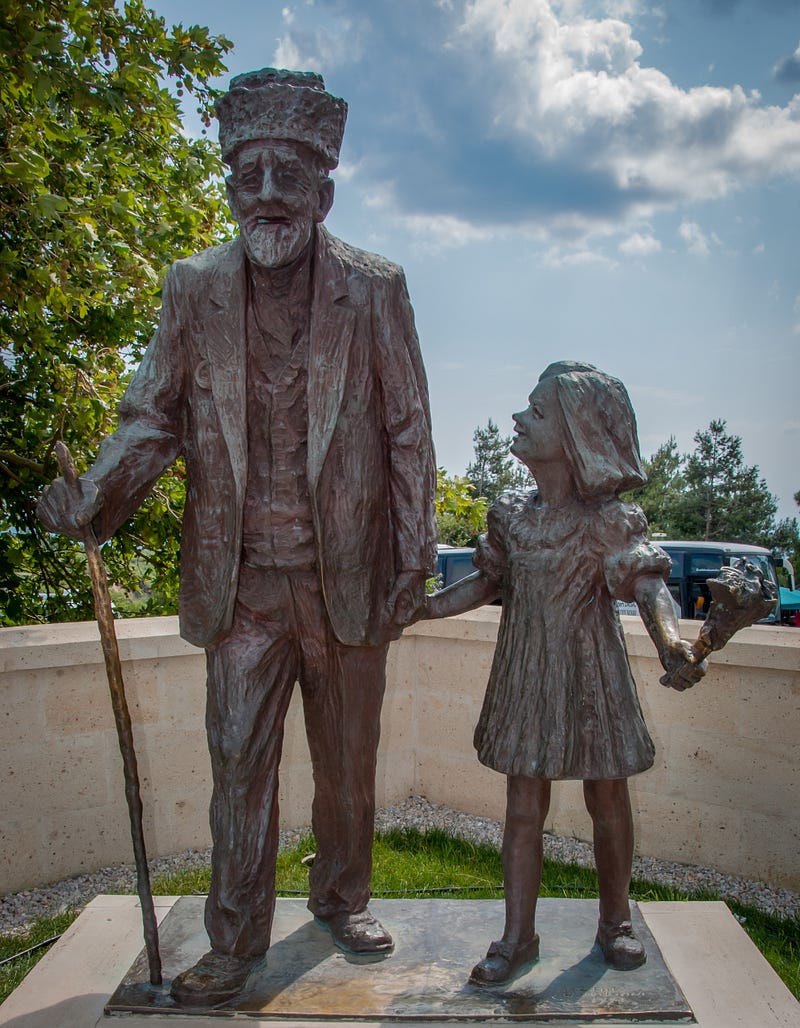
In a corner, there was a statue. An old man with a walking stick, holding the hand of a young girl.
“The last soldier on Anzac. This guy was over a hundred. Still, the grandchildren come and salute the old heroes.”
He stood up straight before the old metal man, looking him square in the eyes. He sang a few words and the nearby Turks turned to stare.
Çanakkale içinde sıra söğütler Altında yatıyor aslan yiğitler, off, gençliğim eyvah!
One elderly man came over and spoke with Tommy, who pointed to the statue and then spread his arms, encompassing grass, headstones, and monument in an airy embrace.
The man handed over his phone and I took a shot of him and Tommy, standing together, arms around each other’s shoulders, the statue of the veteran looking on with approval. He looked at my work and then the process had to be repeated, this time with me in the shot. And then one with Tommy and me.
I set up my camera and handed it over to a bystander. There are the three of us together, an unlikely group in a poignant place. Tommy in the middle, grinning at the camera, the old Turk standing stiff and tall, and me, leaning into Tommy’s shoulder.
Others pointed their phones at us and I guess I could say the Turks shot me in Gallipoli.
The fake cemetery was beautiful. Maybe the bodies were lost and gone but the memories were important. If for no other reason than never to do it again. A lesson we hadn’t learned very well, I guess.
Tommy led me back to the road. There was what looked like a fleamarket on the far side. Stalls selling souvenirs, snacks, plastic toys. He approached one stall-holder, rummaged around in his pocket, and came back with cones of ice cream.
“Turkish ice. Doesn't melt. Get it into you.”
We stood amongst the Turks, eating ice cream like children. It was odd. Cold, tasty, looked like ice cream but felt like it was half chewing gum.
“Goats milk, sugar, and some sticky flower root, all jumbled up and beaten. See.”
He stretched out his portion like rubber, looking over it with twinkling eyes at me. I might try that later. For now, the cold and the sugar was lifting my energy level on a warm day.
“Last chance for the dunny, if you need it.”
I did, and I used the facilities, along with a coin for the attendant. The water as I washed my hands was welcome but there was no way I was going to refill my water bottle from a local tap. Instead, I hunted down a stallholder and was about to hand over a note for some bottled water when Tommy said a few sharp words of Turkish and the price suddenly halved.
“Right-oh. Next stop on the special tour: where all these Turks are really buried.”
He led me back across the road, past the entrance to the “cemetery” and down the far side of the ridge. There were new-looking cement steps and a viewing platform aimed out over the valley.
“Underneath here?”
“Sort of. This is more of a listing of those buried nearby in mass graves.”
He indicated what I had taken for benches where a crowd of tourists or schoolchildren might sit, listening to a guide standing on a small platform. If anyone sat, they would be sitting on the names of the dead. Names, ages, and towns. Mostly in their twenties and thirties; men who would be married and have families, as opposed to the teenagers in the Australian ranks.
No wonder the Turks flocked here. Not only was Anzac a place of victory, it was also a place of pilgrimage where fathers and grandfathers and great-grandfathers could be remembered. Those Anzacs who never made it back home were Brother Bob and Uncle Ernest and Greatuncle Gary, one step aside from the direct line of ancestry.
My great-grandfathers had never fought here but if I went looking I’d find holes in the family tree where uncles and cousins should have been. Dozens of them by the time they reached my generation, I suppose.
Tommy glanced at me, offered a hand, and led me into the bushes, out of sight of the memorials. There were rough paths here, leading down into the gully. Tommy stopped, and I looked up at him, expecting a kiss, but he pointed under the trees.
“This is where they planted the soldiers,” he said. “Up there on the ridge is what we called the Chessboard because the trenches were so deep and close. Back here, all this area would have been their safe ground. Supply dumps, kitchens, roads, rest areas, dugouts in the side of the hill.
“After one big attack failed, they arranged a truce to bury the dead. We found our boys and dug them in where they were but the Turks carried their hundreds of bodies out of sight. Must have rolled them down the hill, because here they all are. Every now and then the rain washes the dirt away and they say hello to the world.”
There was a skull nearby. I gasped at the white object until Tommy laughed and waggled his fingers in what I had taken for eye sockets. A tortoise shell, empty, bleached. A different kind of death.
Then my eyes began picking out white fragments here and there. Bones. Human, animal? I couldn’t tell.
“Just think of how it must have been. One big pile of soldiers rotting away, covered in flies. Put you right off your tucker, it would.” Tommy held his nose and grimaced. “So much for the glory and honour of war, eh? Up there, it’s all neat and tidy, everyone lying in rows like they was on parade. Down here, not so nice.”
He walked a bit further down the path. “There he is. I come and talk with this bloke sometimes. Tell him what’s going on out there. Sing him a song, tell him he’s not alone.”
Çanakkale içinde vurdular beni Ölmeden mezara koydular beni, off, gençliğim eyvah!
Here was a skull. Someone — maybe Tommy? — had set it up in a niche between a tree and a rock, and the empty eye sockets looked out at ridges and clouds and trees.
What did they see?
I sat down and closed my own eyes, letting the mantra come, stilling my mind for a minute.
Thoughts of home, family, life, children, happiness. Who wants to think of death and decay?
Tommy wiped my tears away. He may have kissed them away after a while. I needed someone to hold my hand as we walked back out to the world of the living once more, that’s for sure.
© 2021 Britni Pepper. All rights reserved.
First Chapter: Get Lost in Turkey Second Chapter: Get Naked in Turkey Third Chapter: Get High in Turkey Fourth Chapter: Get Saved in Turkey Sixth Chapter: Get Down in Turkey Seventh Chapter: Get Lucky in Turkey
There are actually two or three of these water tanks at the Nek. No Anzac soldiers ever went past that point, apart from a few on the first day, and they carried little but rifle and a few clips of ammunition. They have a slight coating of rust but are as square and solid as the day they were built in a factory a long way off in time and space.
It is well worth taking a look at the Google Streetview images on the battlefield. They give a virtual tour of many of the high points, cemeteries, paths, and so on. Here and there some generous person has sent up a drone, made a photosphere, and added that in. Nothing like actually being there and pulling oneself up those impossible slopes through prickly scrub on a hot day — let alone under fire — but a grand way to get a feel for the place.
The Turks have history all around them. People have built cities and fought battles over them for thousands of years. They cannot help but remember the past. One certain way to get attention in Turkey is to sing a few words of the old song about the Gallipoli war, about a young man sent off to fight and die. His memories, his lost youth, alas!
Britni


