
Gerwig’s “Little Women”: Using Amy’s Voice to Highlight the Weight of Being a Woman
It may not be for you, but it most certainly is for me
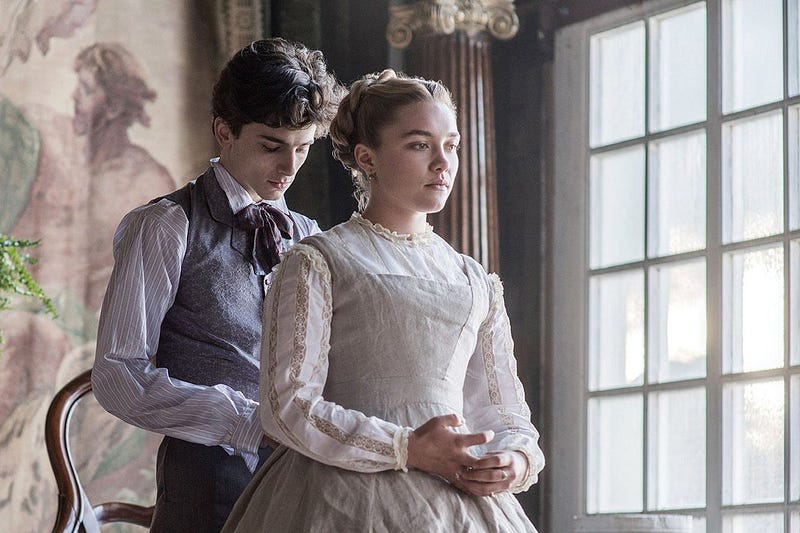
Greta Gerwig’s Little Women is the most progressive take on Louisa May Alcott’s 1868 classic. What I love about Gerwig’s adaptation, is that it captures the weight of being a woman in Alcott’s time — which is present as a pathology in Alcott’s Little Women, but not so clearly articulated. For generations of readers, Jo’s voice has spoken louder than her sisters. We follow her as the main character and love her for being so hell-bent on pursuing the status of a spinster. The voices of her sisters, especially Amy’s informed perspective on marriage, feel drowned out in comparison, which Gerwig so effectively illuminates in her film.
The idea of marriage being the only respectable option for women appears as a trope that echoes throughout the film. We see it take its shape in Mr. Dashwood’s criticism, when he tells Jo, “if the main character is a girl, make sure she’s married by the end. Or dead, either way.” We see it in Jo’s persistence: “I don’t believe I will ever marry. I’m happy as I am. And I love my liberty too well to be in any hurry to give it up”. In my opinion, the most powerful form of this trope is the way Amy highlights it as an “economic proposition”, which isn’t a part of the original book.
Amy’s attitude toward marriage is heavily influenced by Aunt March. In the film, we see Amy at a young age told she must “marry well”, to support her family, as, Aunt March so lovingly puts, “Beth is sick. Jo is a lost cause, and […] Meg has her head turned by a penniless tutor.” Amy maintains the perspective that she must marry rich throughout the film; as we watch Jo push against the notion of this trope, we watch Amy conform to it. We watch her envision Fred Vaughan as a perfect suitor; not out of love, but out of what she feels is a necessity. The trope takes the form of a weight on Amy, which burdened so many women, and still continues to.
We hear just how strongly Aunt March’s attitude has informed Amy’s perspective on marriage, when we watch her realize how powerless she is living in a male-dominated world:
I’m just a woman. And as a woman, there’s no way for me to make my own money. Not enough to earn a living, or to support my family. And if I had my own money, which I don’t, that money would belong to my husband the moment we got married. And if we had children, they would be his, not mine. They would be his property. So don’t sit there and tell me that marriage isn’t an economic proposition, because it is. It may not be for you, but it most certainly is for me.
— Amy March, Little Women, 2019
What I love about the scene in which Amy names marriage as an “economic proposition”, is the way Gerwig inverts the popular concept of “male gaze” in visual media. The term “gaze” describes how viewers interact with the film. It indirectly informs them about the film’s characters and tropes. “Male gaze” situates the women as spectacles, while the men actively circulate around the scene. In Gerwig’s adaptation, Laurie is positioned as a stationary object while Amy floats around the room. Amy is asserted as a powerful woman giving a powerful speech, despite the content of her words being so powerless.
Gerwig identifies the weight of being a woman Alcott hints at in her classic, and manifests it through Amy’s character. Literary scholars have paralleled Jo’s character with Alcott, but Gerwig’s adaptation amalgamates Amy into the resemblance. Just as Jo’s resistance is analogous with Alcott’s (Alcott never married), Amy’s compliance with Aunt March’s wishes (up until the end) is similar to Alcott’s compliance to marry Jo to Friedreich Bauer. Like herself, Alcott never wanted Jo to marry, but was pressured by her editor to give Jo the ending that was expected of women in her time. We hear Alcott’s voice in Jo’s, but in Gerwig’s adaptation, we hear it in Amy’s too.
In her cinematic masterpiece, Gerwig identifies Alcott’s frustration with marriage and voices it through Amy just as much as Jo. By doing so she makes the expectations of women in Alcott’s day lucid, and prompts us to question if we’ve progressed today.


