
Germany’s Got Funds: Investors are Going for Deals in Deutschland
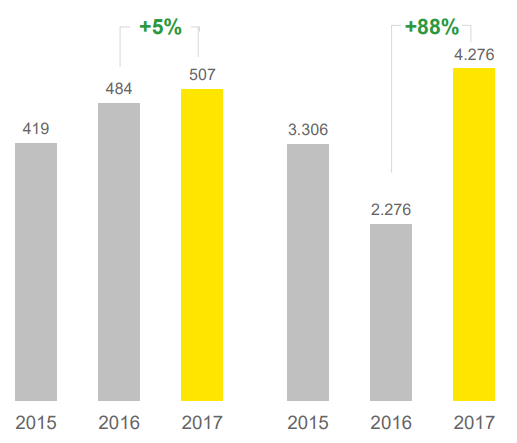
Venture Capital increased by 88% in 2017 with Berlin getting 2/3rds:
Two billion euros more venture capital funding was invested in Germany during 2017 over the previous year raising the total to €4.3 billion ($5.2 billion) according to the consultancy firm Ernst & Young. That’s 88% more than 2016 and it doesn’t look like the flow of cash will slow anytime soon.
Japan’s Softbank has just announced a huge new year’s deal investing €460 million in the Berlin based Auto1. It’s Softbank’s first investment in Germany. Last spring the used car platform raised €360 million through an IPO and debt financing ranking as one of the top five transactions of the year for Germany.
Softbank’s investment in Auto1 is being viewed as a vote of confidence in Berlin’s startup scene. It build’s on the city’s success from 2017. According to EY’s Startup Barometer Deutschland report, Berlin experienced a surge in funding along with multiple high profile initial public offerings last year.

Berlin’s the engine of Germany’s startup industry:
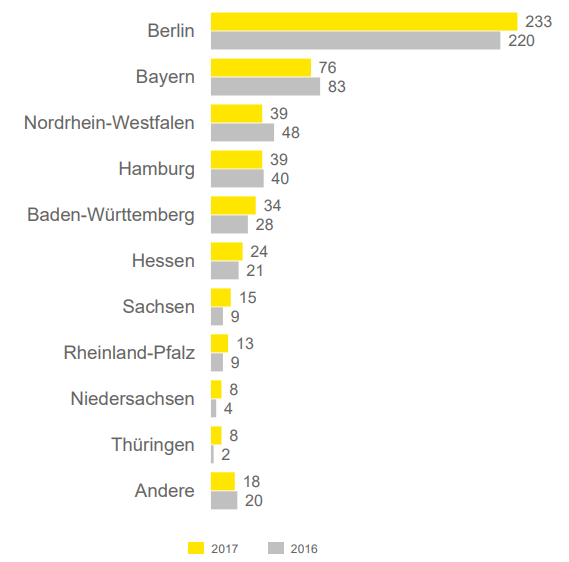
The capital city accounted for 69% of all investment and the five biggest rounds of funding. A total of 233 rounds of financing for Berlin startups raised nearly €3 billion. According to EY statistics, that’s three times as much as was raised in 2016.
Berlin held Germany’s top venture capital transactions for 2017:
- Delivery Hero: €989 million from its Inital Public Offering (IPO) and debt financing last summer. Berlin based Delivery Hero is the parent company of Foodora, Lieferheld and Pizza.de.
- Auto1: €360 million from an IPO and debt financing in May. Berlin based Auto1 is a used car platform.
- HelloFresh: €268 million from its IPO in November. Berlin based HelloFresh is a meal delivery service that spun-out of Rocket Internet.
- Soundcloud: €143 million in emergency funds raised in August after laying-off 40% of its staff the month before. Berlin based Soundcloud is an online music service.
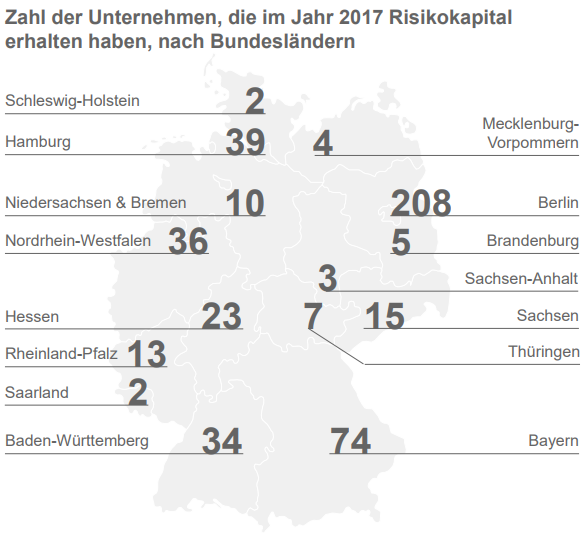
In addition to collecting the lion’s share of venture capital investment in Germany, Berlin’s resources for entrepreneurs are exploding. Berlin Partner for Business and Technology is an official organization that helps grow business and its data for the ecosystem shows: * About 60 accelerators are operational in Berlin. * Around 100 coworking spaces are open in Berlin. * Approximately 500 startups are created each year in Berlin.
Startups in Germany’s capital city are also diverse. Startup Genome’s Global Startup Ecosystem Report 2017 found that Berlin’s startups overall have more of an international market focus over London. The report found 28% of customers at Berlin-based startups come from outside the European continent. Meanwhile the report also discovered that figure for London’s startups is just 19%.
At the same time Startup Genome found that Berlin has the world’s second highest percentage of immigrant founders ranking only behind Silicon Valley. Forty-three percent of the city’s founders are foreign born.
Top regions in Germany by raised venture capital in 2017:
1. Berlin: €2.969 billion — an increase from €1.102 billion in 2016.
2.Bavaria: €407 million — a decrease of almost 25% from 2016.
3. Hamburg: €230 million — an increase of 80% from 2016.
Unicorn horns are sprouting around Germany:
Germany has given birth to a few unicorns — these are startups with a valuation of more than $1 billion (USD).
- Auto1: Used car platform valued at €2.9 billion — Berlin based.
- Curevac: Biopharmaceutical company valued at €1.35 billion — headquartered in Tübingen.
- HelloFresh: Food subscription company valued at €2.09 billion — Berlin based.
- Zalando: Online fashion retailer worth close to €10 billion — Berlin based.
These unicorns are important. They are not only role models to earlier stage startups but they’re also helping finance them.
Unicorns Zalando and HelloFresh were both launched by the Berlin-based company incubator Rocket Internet. Rocket’s co-founder and CEO Oliver Samwer is the first German investor to make €1 billion of capital available.
Meanwhile, Zalando founders Robert Gentz and David Schneider also invest in smaller startups helping to create an ecosystem in Germany that is slowly becoming more self-sufficient.
Other sources of capital within Germany comes from entrepreneurial families that already run long-established companies. For example Siemens, the largest industrial manufacturing company in Europe founded by Werner von Siemens in 1847, is involved with La Famiglia — a venture capital fund that describes itself as a family of entrepreneurs, business angels and family businesses who invest smart capital via ‘old money’ into fresh startups.
Another example is one of Germany’s largest venture capital investors, HV Holtzbrinck Ventures, which was launched by the successful German publisher Holtzbrinck Publishing Group about 20 years ago. In 2010 it became an independent venture fund fully owned by the General Partners. HV Holtzbrinck Ventures has over €1 billion euros under management and it’s invested in over 160 startups including Zalando, HelloFresh and Flixbus.
Germany’s startup ecosystem has room, and potential, for growth:
Even with the gains experienced during 2017, when Germany is compared to other international startup hubs, it’s still modest. Silicon Valley is home to about a quarter of the world’s approximately 200 unicorns while Germany only holds a handful.
Criticisms for why Germany isn’t keeping up with Silicon Valley include:
- Not enough venture capital available.
- The local market is too small — the population of Germany is 83 million people vs 323 million in the USA.
- Germany has been a culture that innovates in small steps, rather than through fast experiments and quick evolutions.
- Good German programmers accept jobs that relocate them to America.
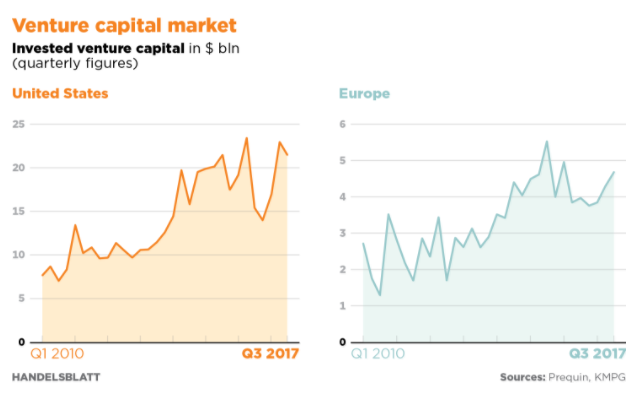
Venture Capital investment in Germany remains a tiny fraction compared to US capital. Over the first nine months of 2017, US startups received $54.8 billion in funding according to market researcher CB Insights. Further a ranking of the world’s top 100 largest venture capital funds only highlighted one German investor. Rocket Internet placed 93rd according to research firm Prequin.
The disparity can be partially explained by some cultural differences. German investors are in general risk-adverse and haven’t jumped on the venture capital trend with the same enthusiasm of American investors.
Further, most major financing rounds in Germany happen only when there is heavy participation from foreign investors. Some view this as problematic because many foreign investors want their holdings located close to them and they require the startup to relocate. The worry around this is that if moves happen too frequently, German ideas leave and become successful abroad.
Reasons for increased venture capital funding in Germany:
With that said, EY believes the major reason for the jump in venture capital investment in Germany is due to a number of big deals totaling over €100 million. This is in contrast to the 2016 numbers which show smaller deals added up to total the €2.3 billion raised.
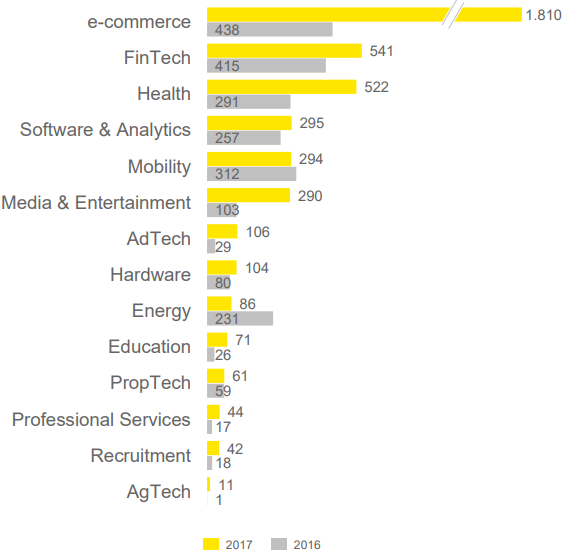
Another factor for the increase, according to EY, may be low interest rates. Low returns have been pushing investors to make more risky investments in startups. Plus large companies are showing more interest in German startups, especially in the B2B area. EY’s data shows Germany’s biggest magnet for venture capital in 2017 was e-commerce.
And finally, Brexit many also be a contributing factor to the increase. British Prime Minister Theresa May says she will take the UK out of the European Union and its desirable single market on Friday the 29th of March 2019 at 23:00. Businesses believe her and they are already making arrangements for the UK’s exit.
In fact company registrations in Berlin increased by 30% in the year after the Brexit vote according to Berlin Partner. For those startups that need to remain inside the single market, they could be focusing on Berlin for the future instead of London and pulling investors in along with them.
The sky is the limit:
Many believe Berlin has not reached its full potential yet — meaning the city is racing towards a bright and successful future. At the same time, Germany’s startup ecosystem is not as centralized as other European countries like the UK or France. Successful startups can be found springing-up in every German state. Watch this space to see what develops during 2018!
You can read more about Berlin’s startup scene in my Medium article “Berlin’s Got Talent: 5 Startups to Watch in 2018”.
Follow me on Medium and Twitter @CambridgeTricia Visit me at www.ShowMeMyCustomers.com Cambridge MBA | Marketing Consultant | Speaker | Author | Ghostwriter


