
Quantity with Quality
German Automobile Manufacturer’s Best-Selling Product is Simply the Wurst
Why Volkswagen produces more sausages than automobiles

This is my next story in a series of articles responding to Dr Mehmet Yildiz’s challenge to produce a short quality article with three take home points each day for thirty days.
I have chosen to use Wikipedia’s main page as inspiration, choosing one topic from their “Did You Know” section as topical encouragement.
Volkswagen products are literally flying off the shelves, but who imagined that their most-produced item was a sausage rather than an automobile or even a specific car part?
Produced in the Wolfsburg Volkswagen Plant by a team of 30 people, and even given their own part number — 199 398 500 A — the currywurst sausage is the best-selling product for the carmaker.
Volkswagen started making sausages at their Wolfsburg plant in 1973, continuing a tradition of producing food at the plant for workers due to the plant’s remote location. The currywurst is made from ground pork combined with proprietary spices before being stuffed into casings stamped with “Volkswagen Original Part”.
The Wolfsburg plant produces 20,000 sausages a day. The facility also produces over 1 million pounds (608,208 Kilograms) of ketchup — Volkswagen Original Part number 199 398 500 B — annually.
Possibly due to the low fat content and absence of protein powders, monosodium glutamate or phosphates frequently found in other bratwursts, the currywurst sausage has proven to be a hit with both Volkswagen employees and the public. Or, possibly it is just because they taste good.
Either way, external sales in sports stadiums and grocery stores account for over 60% of product sales, and proceeds offset the expenses of producing food for Volkswagen workers.
What We Can Learn from Volkswagen’s Sausage Proclivity
Volkswagen’s sausage production is an excellent example of corporate diversification and vertical supply chain integration for those of us business nerds that appreciate such stuff.
For anyone though, it is a great example of how we can use our peripheral strengths and interests to boost our principal line of work.
This story also supports the time-tested adage that well-fed workers are happy workers.
Take home points:
- Hobbies and peripheral pursuits can often be a critical adjunct for our primary goals. In addition to offering a change of pace or release from our main pursuits, alternative interests can prove to be a significant boost to our primary aim.
- Sometimes our peripheral pursuits can emerge as primary processes all on their own.
- Food literally feeds our physical bodies but taking time away from work and daily demands to work on a hobby or passion can feed our souls, which allows us to be exponentially more productive in the long run.
Are you so concentrated on work and family demands that you neglect to pursue side interests? Volkswagen has shown us that creating something outside our normal work parameters can pay massive dividends.
How can you carve out time to do the things that feed your soul, or just simply captivate your interests?
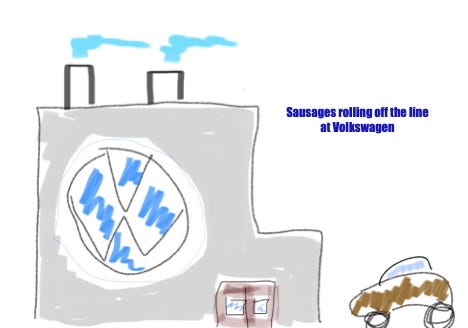
Personally, I am beginning to dabble in sketches to add some very amateur visual context to my stories. I don’t believe that I am very good at it, but the illustrations are fun and make me smile. Hopefully they bring a grin to at least one other person too, but if not, that is okay.
I doubt the first sausage that rolled off the Volkswagen production line was their best offering to date.
But they have had a lot of practice, and it is definitely paying off!
If you liked this article, you may also like:
Timothy Key spent over 26 years in the fire service as a firefighter/paramedic and various fire chief management roles. He firmly believes that bad managers destroy more than companies, and good managers create a passion that is contagious. Compassion, grace and gratitude drive the world; or at least they should. Follow me on Instagram, Facebook, and Twitter, and join the mail list.


