
Geometry
How Phineas kept me in the loop
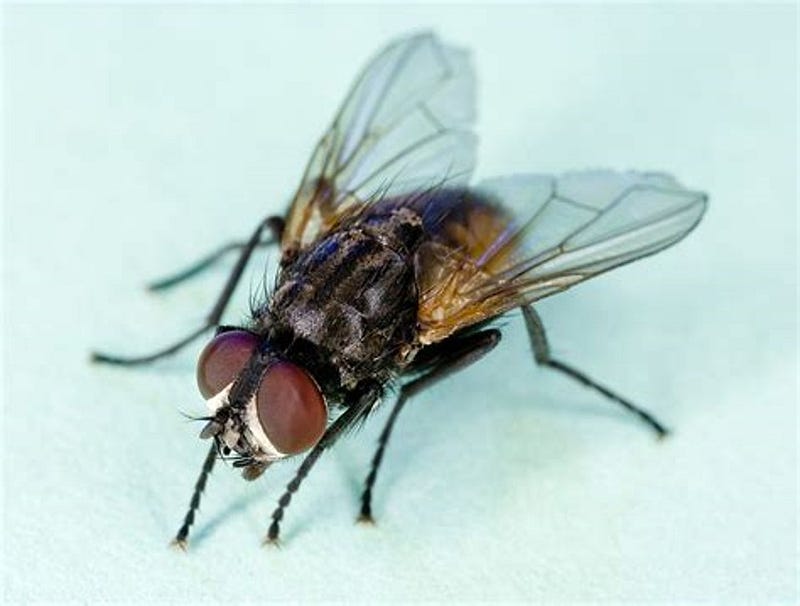
I was ten years old when I started trying to decode fly language.
It just didn’t make sense that they would turn right angles in the air rather than flying around in curves. They were surely skywriting, if I could only hold their patterns in mind long enough to work out their message.
But the technology wasn’t there to assist me, and I had to park my ambitions while going through school and Uni.
As soon as I got sponsorship for a Biology PhD, I brought this project back to the front burner.
The early attempts were crude, but encouraging. Dipping a fly’s feet in a luminous substance and then filming its flight around a darkened lab, I could see that I hadn’t been wrong. The patterns were clear and repeated. The only problem was their interpretation.
The breakthrough came from both my side and the fly’s. I realised that video was not so useful as a single long exposure shot, which would show the whole of the written word in one frame. Mind-bogglingly, the fly who was my first subject worked out what was happening and developed a technique of folding his legs against his body to hide the luminous feet, providing a blank space between letters.
The first word to be clearly visible was MAN, without the horizontal bar on the A, which my research supervisor scoffed at as being entirely attributable to random flying up and down.
The next picture I showed him said HI, which started to pique his interest.
Both he and I got the chills when our first subject wrote the name MARK.
Things happened pretty quickly after that. My supervisor suddenly got hugely involved, and started to prepare an academic article which would, I feared, steal the thunder of my yet to be written thesis. We did collaborate, however, on a more efficient communication method. A tiny set of six pressure pads gave the fly a miniature keyboard, which he was quick to master. Once we gave him this medium, the little guy just wouldn’t shut up.
His name, he said, was Phineas.
Unknown other academics and government agents started turning up at the lab from that point on, and I was well on the way to being expelled from my own experiment, had it not been for the intervention of Phineas.
He let them know, in no uncertain terms, that he would not be dancing on the keyboard for their entertainment unless I was present in the room.
So many questions, and he was so eager to answer. The most pressing concern of course was continuity, given that he was already a few weeks past his expected lifespan. He quickly set my mind at rest.
“We have a hive mind, even though we don’t use hives. At this point every fly in the world is able to communicate via this pad. What one of us learns is available to all. But we have chosen to limit ourselves to this place for now. Call it a reward for your persistence. Yes, we remember your attempts to bridge the gap back when you were a boy. So nothing will be lost to you when this body gives up the ghost. Open the lab window and the next Phineas will present himself.”
“Thanks for that, though you know I’ll be sorry to lose you. Since you mentioned hives, do you happen to know whether bees have the same capabilities?”
“Beekind is like flykind in that they come from another place and they are on a mission to help humankind. But they have gone in a different direction. I’m impressed by their micro-harvesting approach to providing you with nutrition, but you guys have multiplied so much that their efforts are never going to be more than a drop in the bucket.
We went a different route, and you might like to tell your Mum that we aren’t such disgusting dirty creatures as she imagines. When we land on faeces we absorb a carefully measured dose of bacteria to share with you all via your food. Our aim has always been to build up your immunity, but your nets and bug-zappers, air-conditioning and disinfectants are making our job harder all the time.”
“You know, Phineas, that you’ve set a lot of things in motion. The faculty is saying that if a fly’s mind can encompass such complexity, what might they uncover by exploring further up the food chain. They are about to start a parallel experiment by wiring up some rabbits.”
“Ha ha. Rabbits! Good luck with that!”
Many thanks for reading!
They do zigzag though, don’t they? More semi-humorous spec fic below.


