avatarTim Ward, Mature Flâneur

Free AI web copilot to create summaries, insights and extended knowledge, download it at here

1562

Abstract

boulder spherical?</p><figure id="1f37"><img src="https://cdn-images-1.readmedium.com/v2/resize:fit:800/1*[email protected]"><figcaption></figcaption></figure><p id="b0a0">Pick one of these explanations, or think up something of your own:</p><ol><li>Lumps of molten lava were thrown up by volcanoes. They spun in the air into perfect spheres, then hardened before they hit the ground.</li><li>Large rocks were picked up by glaciers and deposited on the beach, where waves and sand rolled them for millions of years, like a rock tumbler, until they were round.</li><li>Bits of sediment accumulated around something sticky, and over time added layers and layers, like a pearl in an oyster growing from a grain of sand.</li><li>The boulders are fossilised giant jellyfish.</li></ol><figure id="25f5"><img src="https://cdn-images-1.readmedium.com/v2/resize:fit:800/1*[email protected]"><figcaption></figcaption></figure><p id="5c9f">The answer is #3 (Thank you, Internet!) The Moeraki Boulders are what’s known as <i>concretizations</i>, and they are formed in a similar manner to a pearl. Just as an oyster coats an irritating grain of sand with layers of nacre, to form a pearl, so concretization forms when a speck of something “sticky” — a small pebble or shell — finds its way into sediment that has not yet hardened. Minerals in the sediment, such as calcite (a key mineral in making concrete) attach all round the suspended speck, forming layer after layer of encapsulating material that hardens even as the surrounding sediment stay

Options

s soft as gelatinous mud, like giant gumballs suspended in jelly.</p><figure id="2f9e"><img src="https://cdn-images-1.readmedium.com/v2/resize:fit:800/1*[email protected]"><figcaption></figcaption></figure><p id="cd22">This process took place in a shallow coastal sea some 60 million years ago. When the land rose, the sediment dried and hardened into sandstone. The waves wore down the sandstone and scoured out the hard concretizations onto the shore. Teresa and I found a couple of boulders still partly buried where the cliff meets the beach. Who knows how many more boulders are still buried, ready to roll out and onto the beach as the ocean rise in the decades to come?</p><figure id="5c0f"><img src="https://cdn-images-1.readmedium.com/v2/resize:fit:800/1*[email protected]"><figcaption></figcaption></figure><figure id="8c20"><img src="https://cdn-images-1.readmedium.com/v2/resize:fit:800/1*[email protected]"><figcaption>Tim, pretending to be Sisyphus. Photo credit: Teresa</figcaption></figure><p id="6b86">What I enjoyed most about Moeraki Boulders was simply encountering something inexplicable, and then learning that science can in fact explain how it came to be. Of course, there’s much more we still don’t know about the forces that forged the world we live in — a world of wonders we too often walk through with our eyes half closed.</p><figure id="ebb9"><img src="https://cdn-images-1.readmedium.com/v2/resize:fit:800/1*[email protected]"><figcaption></figcaption></figure></article></body>

Mature Flâneur Down Under

Geological Oddballs: New Zealand’s Moeraki Boulders
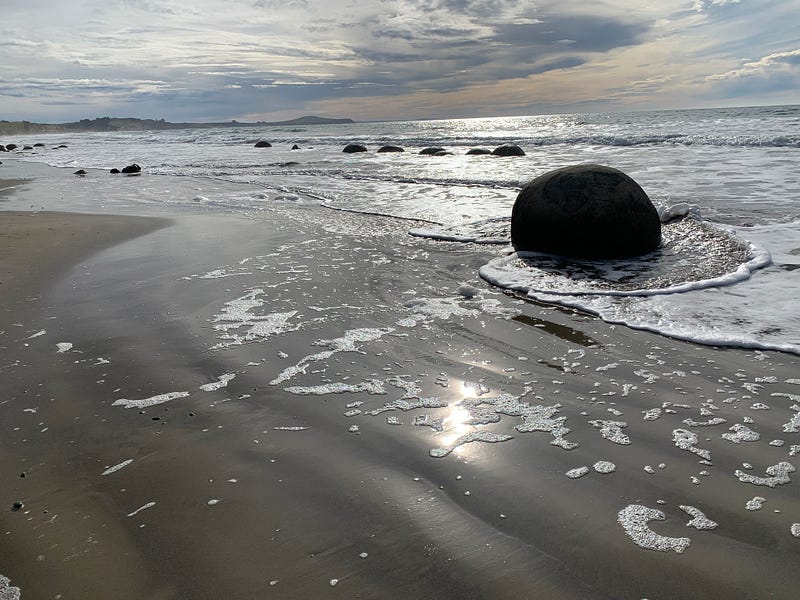
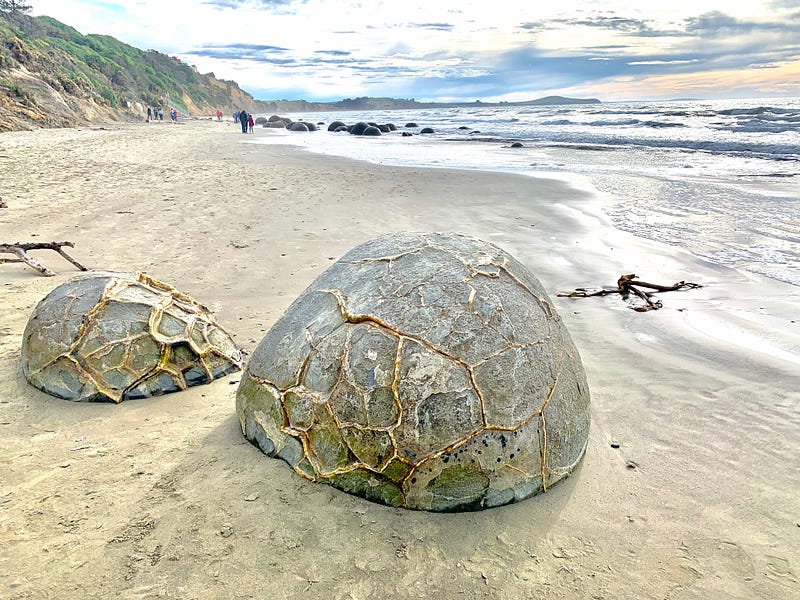
Moeraki Boulders. All photos by Tim Ward

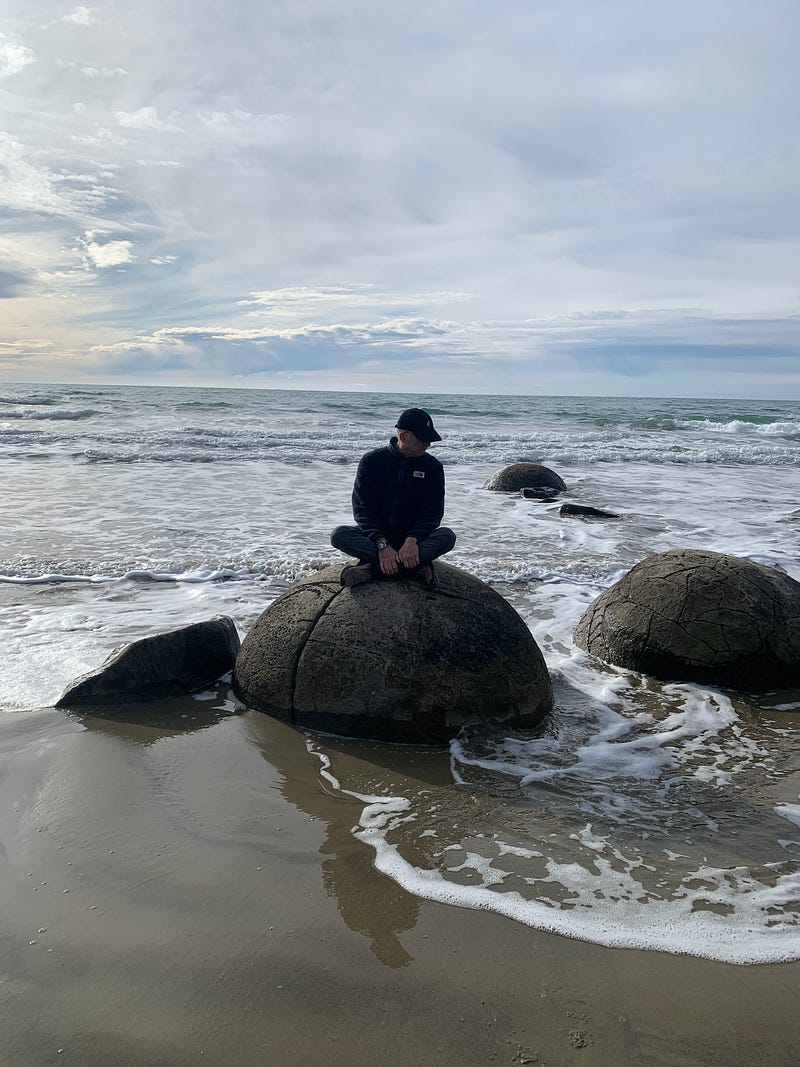
Giant’s Gobstoppers. Alien Eggs. New Zealand’s Stonehenge. These are just some of the names that have been applied to one of the most improbable-looking geological oddites in all New Zealand, the Moeraki Boulders. To the Māori, they were ancient eel baskets, thrown overboard when a great canoe of the ancestors capsized. The canoe became a large offshore reef; the boulders, half buried in the sand, looked like inverted giant baskets, turned to stone. I smiled at the myth when I first heard it….but when I saw the Moeraki Boulders with my own eyes , some of them two meters wide and near perfectly spherical damn, I could not come up with a better explanation.
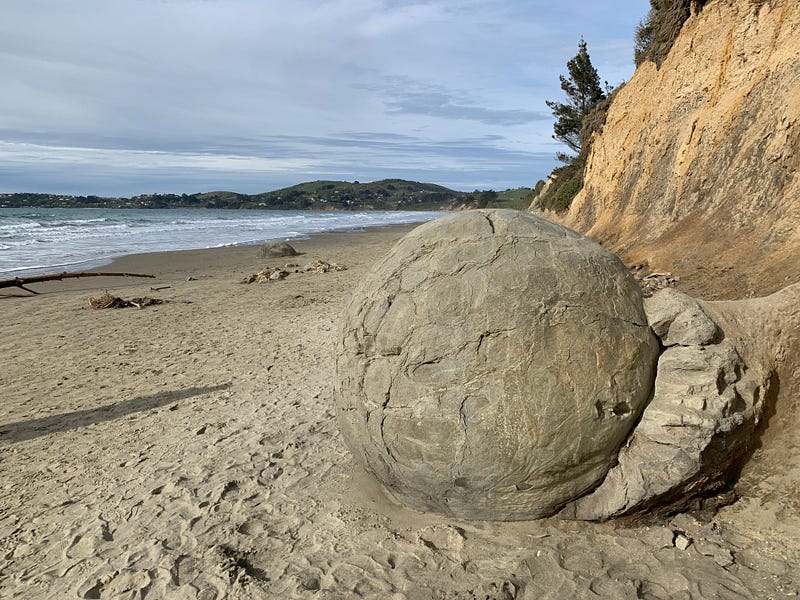
Teresa (my adorable spouse) and I stopped for a gander at the boulders as we were driving from Oamaru to Central Otago, and we saw the signpost to the beach. We thought, sure, this will be a little amusing. After trudging along the sand for awhile, when we finally came upon them, they stopped us dead in our tracks. It was hard to make sense of what we were seeing. What forces of nature can make a boulder spherical?
Pick one of these explanations, or think up something of your own:

  1. Lumps of molten lava were thrown up by volcanoes. They spun in the air into perfect spheres, then hardened before they hit the ground.
  2. Large rocks were picked up by glaciers and deposited on the beach, where waves and sand rolled them for millions of years, like a rock tumbler, until they were round.
  3. Bits of sediment accumulated around something sticky, and over time added layers and layers, like a pearl in an oyster growing from a grain of sand.
  4. The boulders are fossilised giant jellyfish.
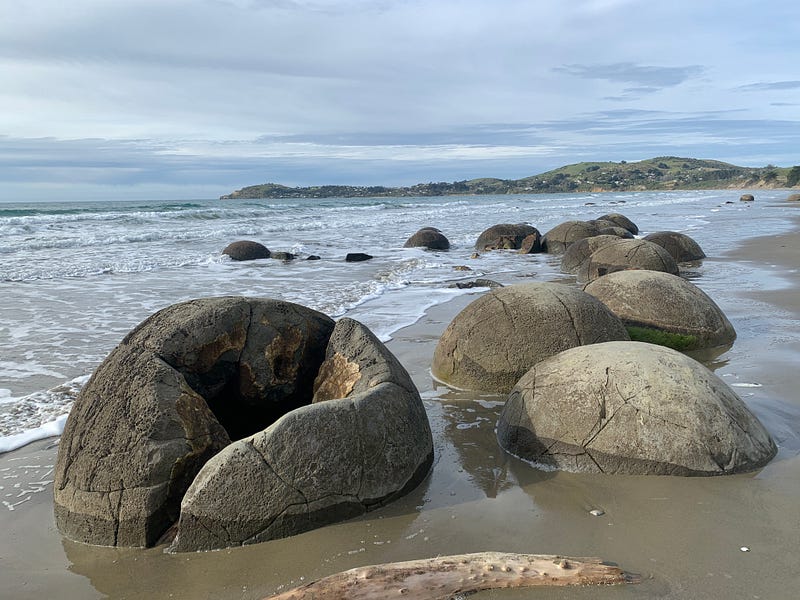
The answer is #3 (Thank you, Internet!) The Moeraki Boulders are what’s known as concretizations, and they are formed in a similar manner to a pearl. Just as an oyster coats an irritating grain of sand with layers of nacre, to form a pearl, so concretization forms when a speck of something “sticky” — a small pebble or shell — finds its way into sediment that has not yet hardened. Minerals in the sediment, such as calcite (a key mineral in making concrete) attach all round the suspended speck, forming layer after layer of encapsulating material that hardens even as the surrounding sediment stays soft as gelatinous mud, like giant gumballs suspended in jelly.
This process took place in a shallow coastal sea some 60 million years ago. When the land rose, the sediment dried and hardened into sandstone. The waves wore down the sandstone and scoured out the hard concretizations onto the shore. Teresa and I found a couple of boulders still partly buried where the cliff meets the beach. Who knows how many more boulders are still buried, ready to roll out and onto the beach as the ocean rise in the decades to come?
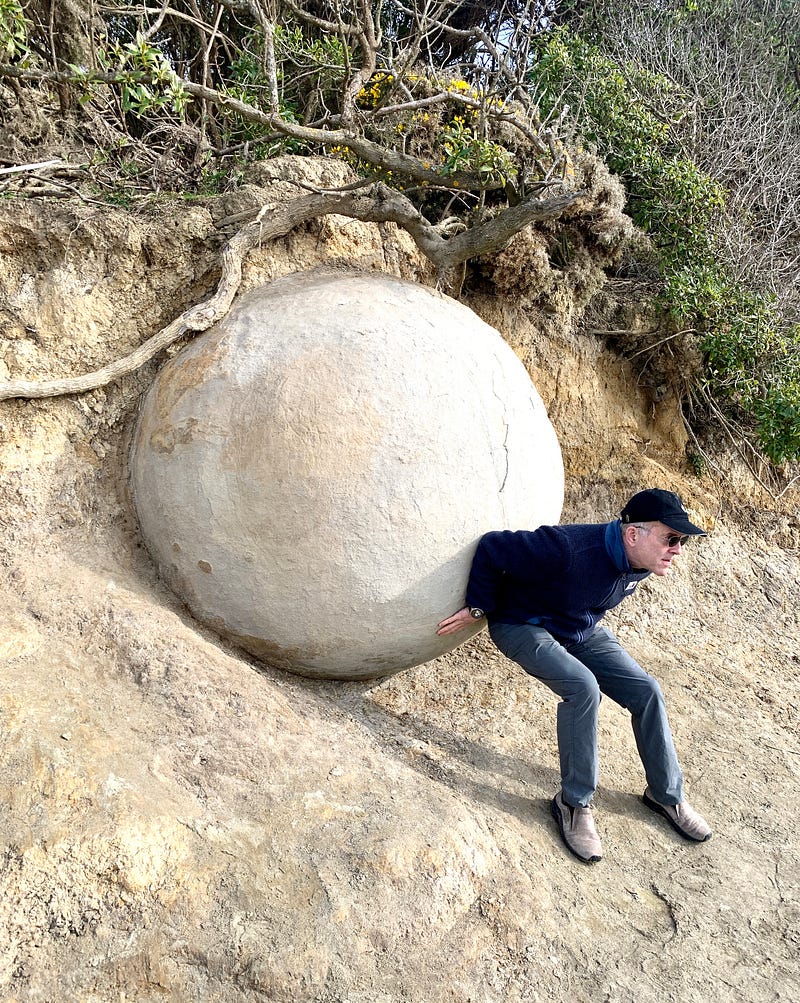
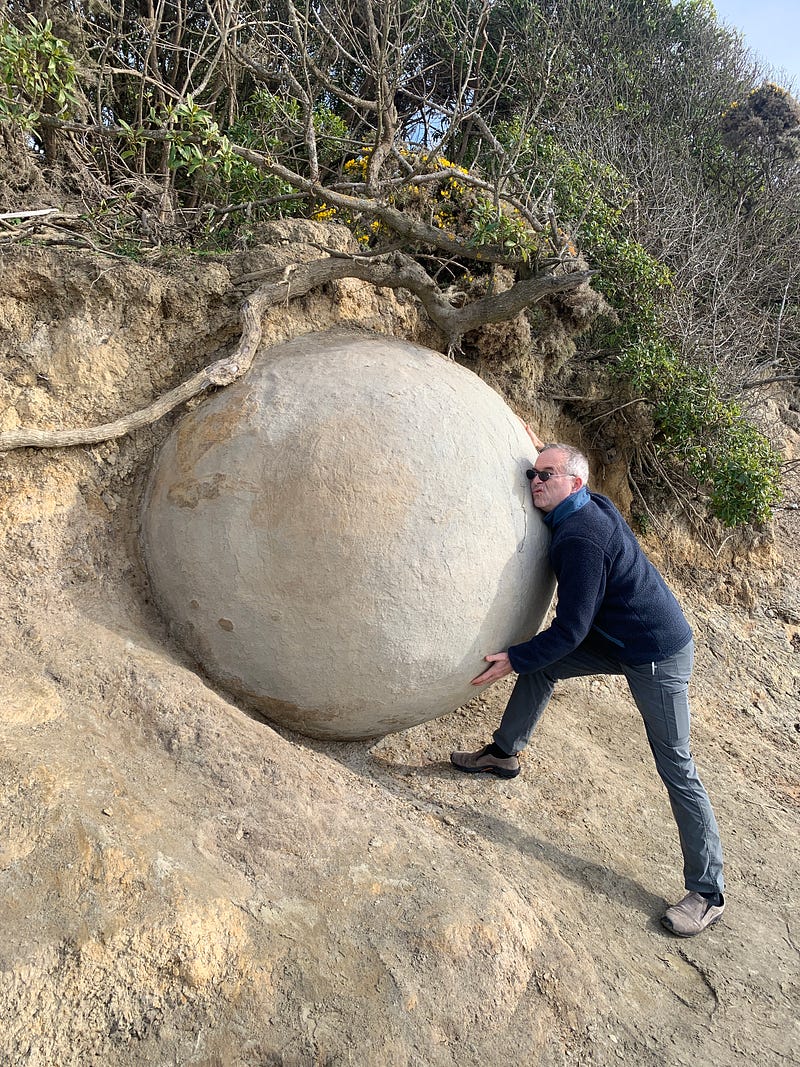
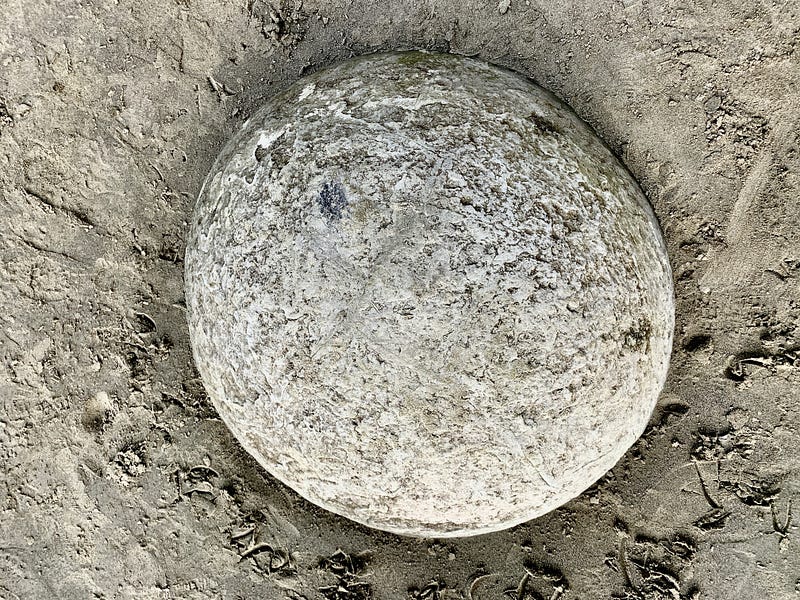
Tim, pretending to be Sisyphus. Photo credit: Teresa

What I enjoyed most about Moeraki Boulders was simply encountering something inexplicable, and then learning that science can in fact explain how it came to be. Of course, there’s much more we still don’t know about the forces that forged the world we live in — a world of wonders we too often walk through with our eyes half closed.
New Zeland
Globetrotter
Flaneur
Travel
Geology
Recommended from ReadMedium