
Genghis Khan — The Greatest Warrior in History
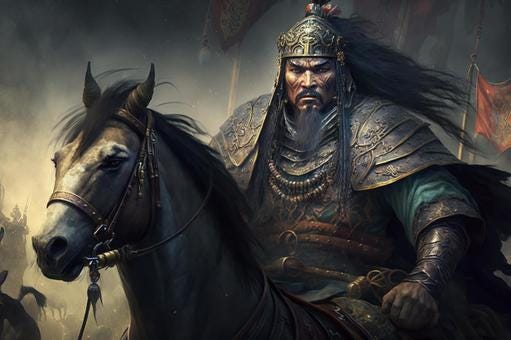
Throughout the passing of time, tales of bravery, genius, and indomitable strength have unfolded the legacies of numerous warriors throughout history. Yet, across the legends of valor, one name rises above all — a figure whose feats on the battlefield rises above mere mortal accomplishments. The quest to determine the greatest warrior in history is an odyssey through eras, cultures, and continents, yet one name consistently emerges — Genghis Khan.
Genghis Khan, born Temujin, is synonymous with an era of conquest and military aggression. Rising from the harsh Mongolian steppes, his meteoric ascent from an outcasted boy to the ruler of the largest contiguous empire in history is nothing short of legendary. His victories on the battlefield were unmatched, but it was not just his martial abilities that made him a standout conqueror.
One of Genghis Khan’s notable attributes was his strategic vision. He didn’t just conquer territories; he transformed the very nature of warfare. His military strategies were original, adapting to the terrain, weather, and calculating the strengths and weaknesses of his enemies. His use of psychological warfare, swift cavalry attacks, and incorporation of diversity into his army set new standards in military tactics.
Aside from his military might, Genghis Khan’s leadership and administrative skills were extraordinary. He implemented policies that encouraged unity among diverse peoples, expanded trade, promoted religious tolerance — an accomplishment that was ahead of his time.
However, the mantle of the greatest warrior is not a title easily bequeathed. In the collection of ancient warriors, names like Alexander the Great, Julius Caesar, and Hannibal Barca loom large. Each of these legendary figures carved their own place in history. Alexander’s conquests stretched from Greece to the borders of India, spreading Hellenistic culture across continents. Caesar’s military genius and political acumen revamped the Roman Republic, and Hannibal’s strategic brilliance, especially his daring crossing of the Alps with elephants, cemented his place in military lore.
Moving through history, the samurai Miyamoto Musashi stands as a paragon of martial greatness. His undefeated record in duels and mastery of clever calculation culminated in his treatise, “The Book of Five Rings,” immortalizing his philosophy on combat and life.
The concept of a single “greatest warrior” remains subjective, shaped by historical perspectives and cultural bias. Yet, Genghis Khan’s multidimensional legacy, blending military might, visionary leadership, and enduring impact, cements his place as a colossus among warriors.