
How Much Muscle Can We Build Naturally? Your Genetic Potential
You might want to look like Arnie or Thor, but your genetics dictate that you won’t. Not without steroids…
Many of us desire the muscular physique of our favourite athlete or action movie stars.
Building muscle requires two key things. First, resistance training and progressive overload through exercises such as lifting weights in the gym. Second, people must consume enough protein to repair the muscle they just damaged.
That’s how to build muscle 101.
If you’ve ticked those boxes, how much muscle can you grow?
We’ve all seen huge guys in the gym who are obviously using steroids. You cannot compare yourself to that. But if you want to build as much muscle as possible without using performance-enhancing drugs, what can we expect to achieve?
This article explores our ‘genetic potential’ or ‘genetic limit’ for building muscle naturally.
What is your genetic potential?
Genetics determines the upper limit of an individual’s muscle-building potential.
Think of it as a scale. On one end, we have the genetically gifted, who probably had muscle mass as a teenager, before they even started training. At the other end of the scale is that skinny guy who has been going to the gym five days a week for 10 years and has seemed to have gained much, if any, noticeable muscle.
We can only build a certain amount of muscle naturally, no matter how optimum our training and diet are. To surpass this level of muscularity, an individual has to use steroids or other PEDs.
It is impossible to ascertain exactly what an individual’s potential is. But, we can estimate their approximate limit, which this article explores.

What we can control: lifestyle and effort
An individual’s genetics are obviously outside of their control. We’re born with them. However, many variables that influence how much muscle an individual can build are under their control.
Before getting into genetics, we’ll quickly explore the variables a person controls, which impact how much muscle they build and their ability to realise their true genetic potential.
Many people who frequent the gym are in no way near their true genetic limit for building muscle. Lifestyle and effort limit their results. They don’t progressively overload — you can read the article below to learn more about that.
Some individuals use genetics as an excuse for lack of results. Yes, it might be a little harder for some, but their dedication and effort are likely lacking.
Five factors that we control that impact our ability to build muscle are:
- Training/exercise programming
- Diet
- Sleep
- Consistency
- Effort
What we can’t control: Genetics
In a perfect world, we would all have optimum genetics for gaining the physique of a Greek god. Unfortunately, it’s not a perfect world.
“Some genetic traits are predetermined and are not subject to change, for example, your height or the colour of your eyes.” — Hansen, 2005
If we have bad genetics for building muscle, we’re not going to be able to build the same physique as someone with better genetics.
Several studies show individuals experience huge variations in how much muscle they gain on training programs — e.g. this study and this study.
Genetics account for a lot of this variance. Factors that determine the limits of a person’s ability to increase their muscularity include:
- Height and bone structure
- Muscle shape
- Muscle cells and fibres
- Hormones like Testosterone
- Body type
These will each be discussed in more depth over the following paragraphs.
Height and bone structure
Research indicates that an individual’s potential for muscle growth is positively correlated with height and bone structure.
Taller men with larger bone structures usually have a higher potential to build muscle than shorter men with slender bone structures.
We can find an estimation for someone’s muscle-building potential by measuring the circumference of their wrist/ankle (We’ll discuss this shortly).
“…A great physique begins with the bones on which it is constructed. Bone structure can either make or break a good physique.” — Casey Butt, 2018
Francis Holway created a ratio for how much muscle can be grown according to how much bone you have. He measured thousands of athletes, from football (soccer) to weight lifters, to rugby players.
He found most men can gain around 5 kilograms of muscle for every kilogram of bone in their bodies. Women slightly less, at 4.1.
“Holway has found that each kilogram (2.2 pounds) of bone supports a maximum of five kilograms (11 pounds) of muscle.” — David Epstein, 2014
Dr Casey Butt found a link between peoples’ wrist and ankle sizes and their ability to build muscle. Wider ankles and wrist tends to be linked to being more muscular and having a better ability to build muscle.
Muscle shape
Where a muscle is attached determines a muscle’s shape. A muscle has two main parts:
The belly is the main mass of tissue that contracts and expands when a person flexes or works out that muscle. The tendon connects muscle bellies to the skeleton.
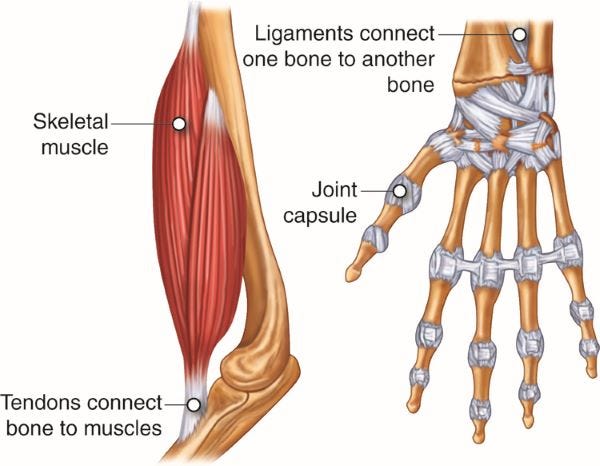
The tendon and belly both vary in length between individuals.
Muscles can only grow wider and can’t grow longer. Therefore, the longer the muscle bellies and the shorter the tendons, the more potential a muscle can grow physically larger.
See below for a comparison between a short belly and long tendons, and a long belly and short tendons.
Muscle cells and fibres
There is growing evidence that satellite cell activity influences variations in response to the training stimulus.
‘High responders’ to resistance training tend to have higher levels of satellite cells than ‘low responders’.
The size of muscle cells found in each muscle can also determine its growth potential. Bodybuilders were found to have bodybuilders have larger fibres rather than more fibres compared to the general population.
A process called hyperplasia increases the number of cells in the muscle as a direct response to exercise, enhancing a person’s ability to grow more muscle fibre.
Genetics determines the type of muscle fibre that is predominant in the muscle cell. There are two types of muscle fibres: white and red. White cells are also known as fast-twitch fibres and red slow twitch. Red cells are more suited to endurance and white to anaerobic activities such as sprinting, javelin throwing or weight lifting.
Another genetic factor influencing satellite cell activity and muscle growth is myostatin, which our body produces.
Lower levels of myostatin are shown to correspond with high levels of muscle hypertrophy — the ability to build muscle.
Testosterone
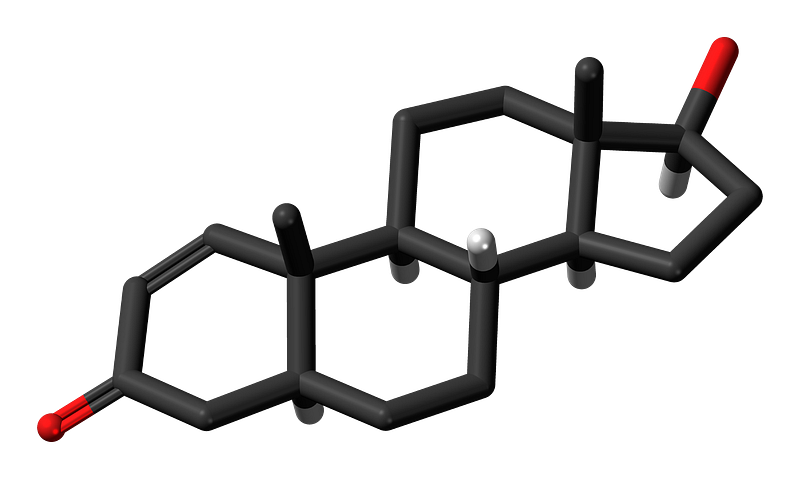
Testosterone is the main anabolic hormone produced by our body, influencing our ability to grow and maintain muscle. Steroids enhance an individual's ability to build muscle by boosting testosterone levels well above what occurs naturally.
Each individual’s ability to produce testosterone naturally will vary, and it declines over a person’s lifetime after peaking in their mid to late 20s.
Studies also indicate that people with high testosterone levels have higher levels of satellite cell activity, enhancing their muscle-building potential.
“There’s many, many other genes at play when it comes to human performance, but it definitely seems that testosterone and myostatin play a large role in muscle hypertrophy and might even mediate the activity of other genes involved with muscle growth” — Ottinger, 2018
Body type
In the 1940s, Dr William Sheldon developed the theory of somatotypes, classifying physiques into three broad categories: Endomorph, Mesomorph, and Ectomorph.
- An Endomorph is naturally heavy or overweight. They have round features, thick bone structure, and struggle to keep fat off.
- A Mesomorph is athletic, with wide shoulders and a large chest. They’re lean, strong and muscular.
- An Ectomorph is skinny, with long limbs, a flat chest and narrow shoulders. They hold little body fat and struggle to gain fat and muscle.
“All champion bodybuilders have mesomorph characteristics… Someone who is largely ectomorphic or endomorphic does not have the genetic makeup to become a champion bodybuilder” — Hansen, 2005
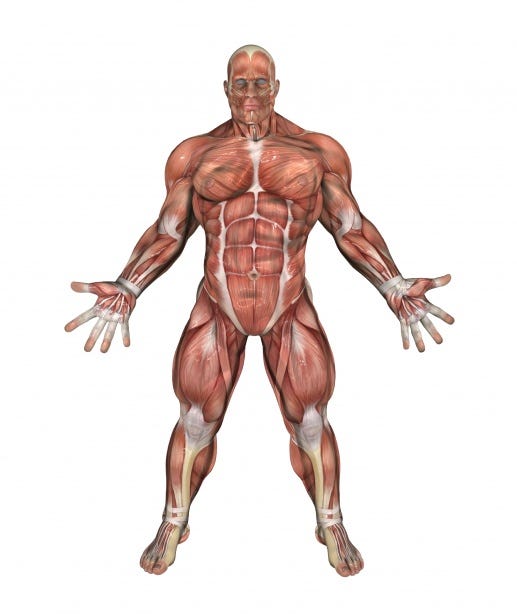
Having a Mesomorph body type is obviously a huge advantage for anyone who wants to gain muscle.
Calculating your genetic muscle-building potential
I have just outlined some of the variables which account for how much muscle a person can build.
But how do we know how close we are to our own potential?
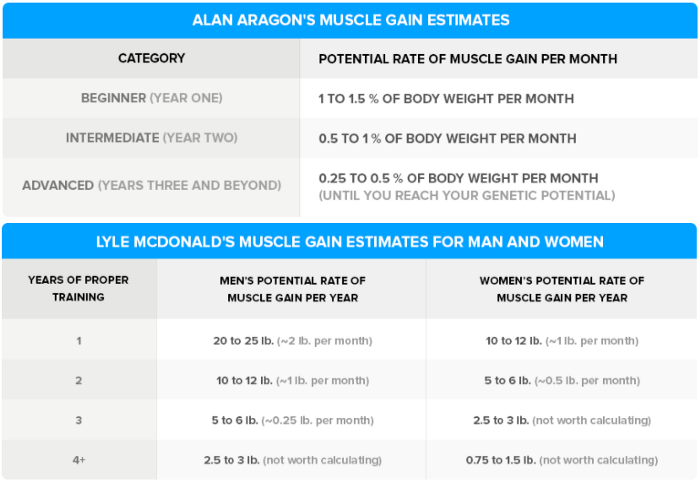
There have been several scientists researching how much muscle a person can build naturally. The first popular methods come from Alan Aragon and Eric Helms, who estimate that an advanced lifter — anybody who has been training for longer than four years, can add 0.25–0.5% of body weight in muscle a year.
The second method is from Lyle McDonald, who believes men can gain up to 40 to 50 pounds of muscle in their first 4 to 5 years of proper diet and training, and most women can naturally gain 20 to 25 pounds.
After this point, muscle gain is relatively negligible — A kg or a couple of pounds a year, and our ability to grow more muscle slowly diminishes as we age.
These models assume proper training, defined as exerting enough effort and following a program to progressively overload, using heavy compound lifts, eating enough protein to repair and grow muscle and getting enough sleep for the body to recover.
Anybody half-assing it won’t see these results.
A third model, from Casey Butt, introduced the theory of fat-free mass index (FFMI); a measurement of how much muscle we can build per unit of height. Butt believes most men can expect to gain around 30–35lbs of muscle.
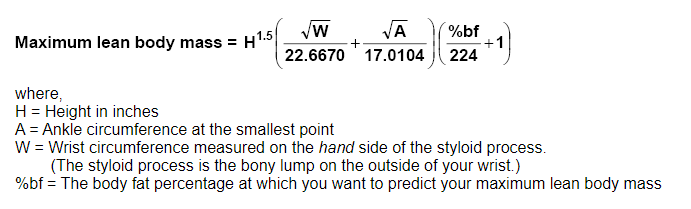
He created a formula to estimate an individual’s potential for building muscle, based on their bone structure and height.
The formula is: H1.5 (√W ÷ 22.667 + √A ÷ 17.0104)(%bf ÷ 224 + 1). It probably means very little; see below for an explanation.
Butt based his formula on the analysis of over 300 class and overall title-winning drug-free bodybuilders and strength athletes from 1947 to 2010. Due to being elite, they’re believed to have reached their natural muscle building potential.
He found the best indicator of bone mass and thus muscle-building potential was the thickness of the wrists and ankles.
There are several calculators online based on Butt’s formula or something similar to predict a person’s FFMI.
Final Thoughts
This article has explored the many factors that impact how much muscle a person can gain naturally without the assistance of performance-enhancing drugs.
We’ve covered the variances in individuals and formulas to give a generalised prediction of how much muscle a person can build.
If you’re interested in knowing how much muscle you can put on, hopefully, this article has given you some insight into what is possible for you.
Remember, it is impossible to know precisely what your genetic potential is for building muscle. But most people are nowhere near theirs, so remember that next time you’re in the gym, train a little bit harder than last time.
Thank you for reading.
If you liked the content, you might be interested in this article about the body transformations of Hollywood actors who were probably using steroids.
Read More Medium Articles
Non-Medium members can only read 3 articles a month.
Become a Medium Member for unlimited access to my content and articles from thousands of other writers, for just $5 a month.
Subscribe to be notified when I publish new content.


