
Generators in Python

Introduction
The generator is a convenient and powerful tool in Python to produce Iterators. This post will explain and dive into generators in Python by some examples.
If you haven’t totally understood Itreators yet, no worries, please read this post:
Why Python Has Generator?
We can get an Iterator by implementing the __iter__() and __next__() special methods in a Python class. However, this way is a little complex though it’s helpful to understand how the Iterators really work. Creating Iterators by generators is a much better and convenient way. In fact, the Generator is a subclass of the Iterator. The relationships of Iterable, Iterator and Generator are as following:
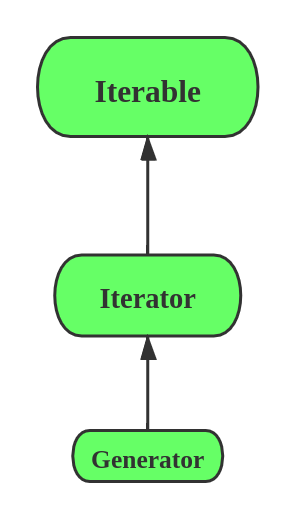
As above figure shown, Iterator is a subclass of Iterable and Generator is a subclass of Iterator.
An Generator, having the same ambition with an Iterator, is used to save a method which knows how to produce required elements. Operating a large list in Python is very time consuming. If we just need to get one element every time, generator is a very good choice to reduce both time and space costs.
How to Get a Generator?
1. Generator Expression
The generator expression is the simplest way to get a generator. It’s very similar with list comprehensions. We just need to change the brackets to parentheses.
Since a generator saves item producing method rather than items, we use next() function to get items one by one, which is the same as an Iterator. When all items were produced, the next() function will raise a StopIteration error information. Of course, we can also use a for loop to get items in a generator.
2. Use yield to Define a Generator
If a function includes the yield statement, it can produce generators.
The yield means “produce”. When the programme meets a yield statement, it “produces” an item and the next() function pauses there.
The key difference between normal functions and functions including yield is the execution flow:
- A normal function executes sequentially, and return results when encountering the
returnstatement or arriving the final line. - A function including
yieldis executed whennext()is called and returns when theyieldstatement is encountered. Whennext()is called again, it continues from theyieldstatement paused last time.
There is a example:
Note: A function including yield statement is not itself a generator. It is still a function but it can return a generator every time it is called. A generator is a class rather than a function. (As we said before, the generator is a subclass of the Iterator.)
The next() can only be used for a generator. It cannot be used to a function.
More Generator Application Examples
So far, we knew generators can help us save an algorithm to produce items and generate items when needed. Comparing with a huge list containing all items, a generator reduce the time and memory costs.
In fact, a generator can even represent an infinite stream of data. For example:
The fib is an infinite generator, we can use it based on our requirements.
Another interesting application of generators is that we can combine a series of generators to get a new generator, which is technically called “pipeline”.
As above example shown, we can use the two existing generators to define a new generator. Isn’t this wonderful?

Conclusion
Generator is a very useful mechanism in Python to reduce time and memory costs. It saves an item producing algorithm rather than items. We can also use generators to produce infinite data stream and pipelines.
Thanks for reading. If you like it, please follow my publication TechToFreedom, where you can enjoy other Python tutorials and topics about programming, technology and investment.


