Generative AI Learning Roadmap: From Absolute Beginner to Practioner [Part 3]
Mastering Generative AI: A Comprehensive Journey for Novices to Practitioners
Generative AI is one of the most active areas of AI nowadays not only in research but also in the industry due to its vast area of domains that it can be applied to. Embarking on a journey from absolute beginner to practitioner in Generative AI requires a structured and comprehensive learning roadmap.
In part 1, I covered phase 1 and phase 2 of the study plan in which we build important foundations for this learning plan. In part 2, I covered phases 3 and 4 which act as the core foundations of Generative AI. In this third and final part, I will cover the last two phases which are Real-world Applications and Stay Updated.
The overarching goal is to emphasize the significance of Generative AI and to guide learners through a systematic approach, ultimately enabling them to build practical Generative AI applications or start working in generative AI research.
This roadmap serves as a valuable resource for those aspiring to advance their skills from novice to proficient practitioner in the dynamic field of Generative AI.
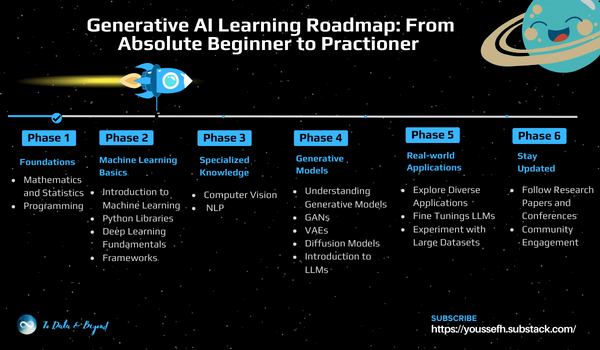
Table of Contents:
Phase 5: Real-world Applications
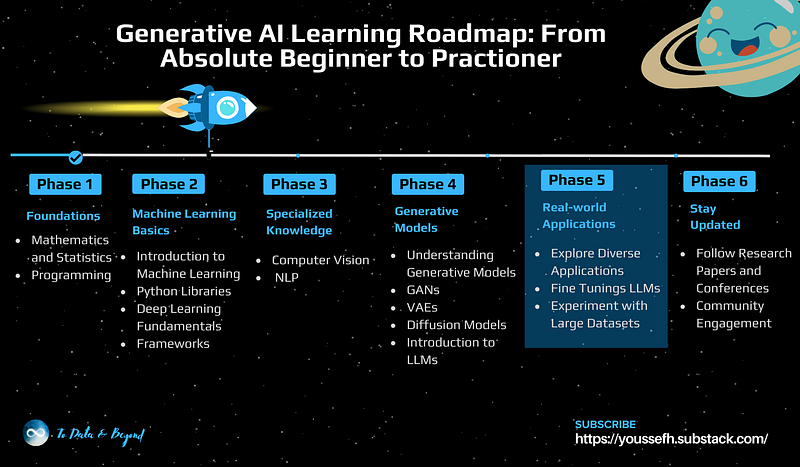
- Explore Diverse Applications
- Fine Tunings LLMs
- Experiment with Large Datasets
Phase 6: Stay Updated
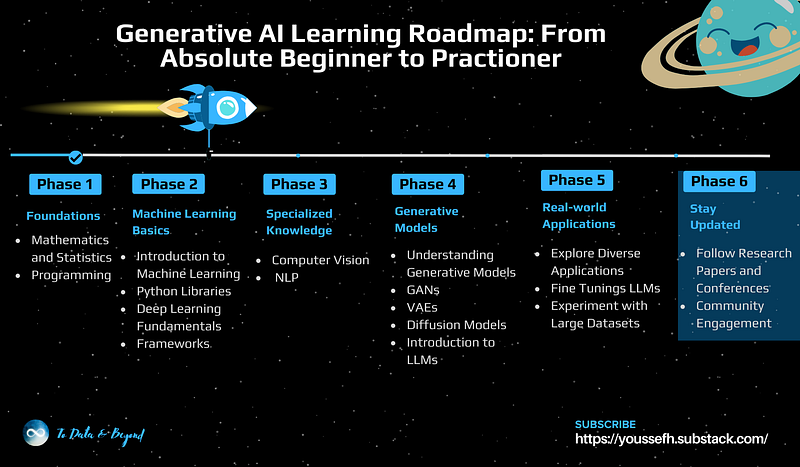
- Follow Research Papers and Conferences
- Community Engagement
Most insights I share in Medium have previously been shared in my weekly newsletter, To Data & Beyond.
If you want to be up-to-date with the frenetic world of AI while also feeling inspired to take action or, at the very least, to be well-prepared for the future ahead of us, this is for you.
🏝Subscribe below🏝 to become an AI leader among your peers and receive content not present in any other platform, including Medium:
Phase 5: Real-world Applications
12. Explore Diverse Applications
After finishing the previous learning steps you are now ready to explore diverse generative AI applications and get your hands dirty. By exploring diverse applications, you not only gain hands-on experience but also foster creativity and innovation in applying generative models across different domains. This step is instrumental in realizing generative AI's broad impact and potential in creative and practical contexts.
Let's have a look at some of the applications that you can start working on. There are a lot of applications of generative AI and there is no need to cover all of them. You can do small projects on most of them and focus on one or two areas that are most important to you and build end-to-end projects on them.
Let's first explore generative language applications:
- Text Generation: LLMs are used for creative writing, generating stories, poetry, and various forms of written content.
- Chatbots and Conversational Agents: LLMs power conversational AI, enabling chatbots and conversational agents for natural and contextually relevant interactions.
- Language Translation: LLMs contribute to multilingual translation and document summarization tasks, providing accurate and context-aware results.
- Sentiment Analysis: LLMs analyze sentiments in social media, customer feedback, and reviews, offering insights for brand management and market research.
- Text-Based Games and Storytelling: LLMs enhance text-based games and interactive narratives, dynamically generating storylines and responses.
- Code Generation and Summarization: LLMs assist in auto-generating code snippets based on natural language descriptions and summarizing code for improved documentation.
Next, you can explore generative image applications:
- Art Generation: Generative models are applied to create unique and aesthetically pleasing artwork, exploring different algorithms for visual content generation.
- Image-to-Image Translation: Conditional generative models are used for translating images between different domains, such as turning sketches into realistic images or transforming day scenes into night scenes.
- Style Transfer: Generative models are employed for artistic image modification, allowing for the application of different artistic styles to images.
- Text-to-Image Synthesis: Generative models can be used to translate textual descriptions into realistic images, contributing to storytelling, creative writing, and content creation.
- Interactive Creative Tools: The development of interactive generative tools is explored, enabling users to actively participate in the creative process by manipulating parameters or providing inputs.
Recommended Resources:
- 10 Guided Large Language Models Projects to Build Your Portfolio
- 10 Large Language Models Projects To Build Your Portfolio
13. Fine Tunings LLMs
By fine-tuning LLMs for real-world applications, you ensure that the models are adapted to the specific linguistic nuances and requirements of the target domains, enhancing their effectiveness in practical scenarios. Here’s a summary of the steps to fine-tune Large Language Models (LLMs) for real-world applications:
- Identify Target Domains: Define specific use cases and industries for LLM deployment. Understand domain-specific language nuances.
- Data Preparation: Curate domain-specific datasets covering diverse scenarios. Clean and preprocess data for effective training.
- Fine-Tuning Process: Leverage transfer learning techniques for adaptation. Adjust model parameters during fine-tuning and monitor performance.
- Evaluation Metrics: Define application-specific evaluation metrics. Continuously monitor and adjust the model based on feedback.
- Deployment and Integration: Integrate the fine-tuned LLM into the target application. Consider scalability and ensure seamless integration.
You can also use fine-tuning methods that do not require high computational power such as auto-train and Parameter-Efficient Fine-Tuning.
14. Experiment with Large Datasets
Experimenting with large datasets is crucial for understanding the scalability of Large Language Models (LLMs). This enables you to optimize LLM training processes and performance for real-world applications by addressing scalability challenges and leveraging diverse datasets. Here’s a more detailed exploration:
1. Understanding Scalability:
- Experiment with larger models and datasets to observe computational requirements and performance improvements.
- Investigate resource allocation and parallel processing to scale up a model size.
2. Diverse Data Sources:
- Incorporate multimodal data, including text, images, and audio, to explore challenges and benefits.
- Work with cross-domain datasets to simulate real-world adaptability.
3. Handling Imbalanced Datasets:
- Experiment with imbalanced datasets, addressing bias and fairness concerns.
- Implement data augmentation techniques to increase dataset diversity.
4. Scalability Challenges:
- Investigate the impact of larger datasets on training time and memory usage.
- Optimize batch sizes for efficiency and explore parallelization techniques.
Phase 6: Stay Updated
15. Follow Research Papers and Conferences
Staying updated with the latest research in generative AI involves actively following conferences like NeurIPS and ICML, reading relevant research papers, and engaging with the research community. Here is what you can do:
- Conferences: Attend premier conferences such as NeurIPS and ICML to explore a diverse range of topics, with a focus on deep learning and generative models.
- Research Papers: Regularly read research papers on platforms like ArXiv and journals to stay informed about the latest developments in generative AI.
- Engage with the Community: Participate in online communities, discussions, and social media platforms to connect with researchers, ask questions, and contribute to discussions.
- Subscribe to Newsletters: Subscribe to newsletters from AI organizations and publications to receive regular updates on new papers, conference highlights, and noteworthy research.
Recommended Resources
- Daily Paper by HuggingFace
- Top Important Weekly Computer Vision Papers GitHub Repository
- Top Important Weekly Large Language Models (LLM) Papers GitHub Repository
- Top 40 Twitter Accounts For The Latest In Machine Learning Research
16. Community Engagement
Engaging with the generative AI community provides opportunities for continuous learning, staying updated on industry trends, and building valuable connections with fellow practitioners. Here’s a more detailed exploration
- Online Communities: Join platforms like Reddit and Stack Exchange, as well as specialized forums, to participate in discussions and contribute to the community.
- Forums and Discussion Groups: Actively engage in forums and discussion groups to discuss research, projects, and industry challenges with practitioners.
- Social Media Engagement: Follow influential figures on Twitter and LinkedIn, contribute to discussions using relevant hashtags, and participate in online conversations.
- Online Meetups and Events: Attend virtual meetups, webinars, and events to connect with professionals, share insights, and expand your network.
This concludes the Generative AI learning plan which I think is the most comprehensive online learning plan. This plan consists of six phases and was covered in three articles. I covered two phases per each article. In the first part, I covered the first two phases which are Foundations and Machine Learning Basics.
In the second part, I covered the third and fourth phases which are Specialized Knowledge and Generative Models. In this last part, I covered the last two phases which are Real-world Applications and Stay Updated.
If you like the article and would like to support me, make sure to:
- 👏 Clap for the story (50 claps) to help this article be featured
- Subscribe to To Data & Beyond Newsletter
- Follow me on Medium
- 📰 View more content on my medium profile
- 🔔 Follow Me: LinkedIn |Youtube | GitHub | Twitter
Subscribe to my newsletter To Data & Beyond to get full and early access to my articles:
Are you looking to start a career in data science and AI and do not know how? I offer data science mentoring sessions and long-term career mentoring:
- Mentoring sessions: https://lnkd.in/dXeg3KPW
- Long-term mentoring: https://lnkd.in/dtdUYBrM