
Habits for Smart Writers
Generate ten ideas, outline two of them every day—and become proud of your new catalog of writing.
This is how I got on a writing streak of 2,000+ words daily for seven straight months (but the word count is not the point).

Since March, I’ve been on a writing streak. I spent the first two months of self-isolation working on my novel and finished the first draft (87,000+ words). I was also writing a few articles here and there, but then, once my novel was complete, I started writing one article daily.
Aside from the blog posts, I was also writing regular newsletters and working on my upcoming collection of short stories.
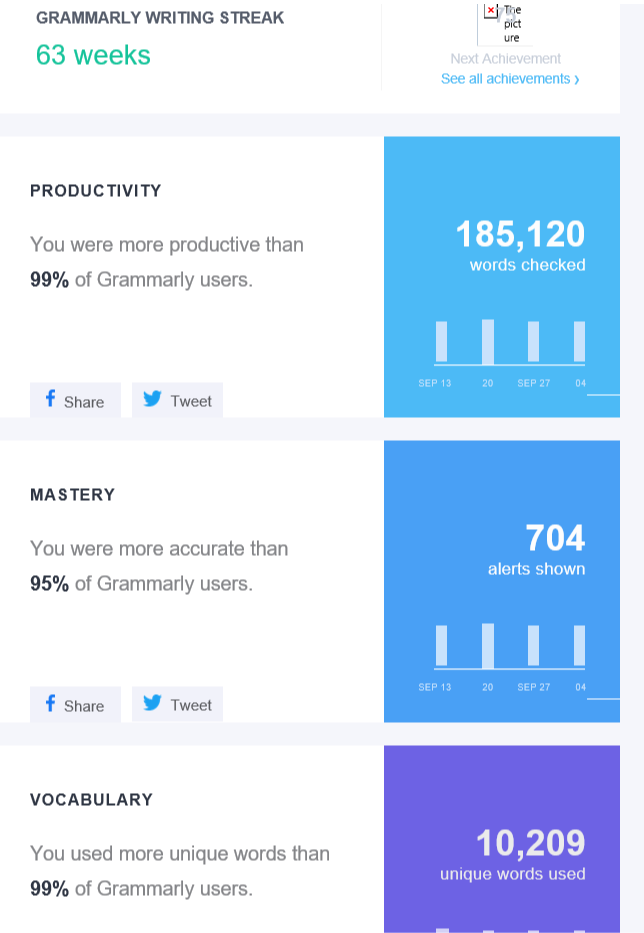
There were some fundamental mindset shifts and daily habits that helped me achieve this goal. This is how I made them, what I learned about how you can also improve your writing habits, and what my current writing routine is like now.
You don’t have to be self-employed to write 2,000 words daily. I have a full-time job and a part-time Ph.D. program, and all the writing I do is in the three hours of the day I’m able to take out for myself. Yes, working from home has helped—but this routine isn’t time-exhaustive, and I’m positive I’ll be able to carry it forward once the pandemic is over.
I’m not a full-time writer (yet), but this is what worked for me and helped me write 2,000+ words daily.
1. Generate Ten Ideas Every Day
I started taking writing seriously in 2014 when I discovered this fantastic platform called Quora that allowed me to put my writing in front of thousands of readers from all over the world. The instant feedback I received sparked the flame of creativity in my heart, and I started writing stories every day. Because the platform was built in such a way to reward consistency, I had no trouble churning out content on a regular basis. This streak was broken when I started working, but I learned from it.
In my pre-Quora days, I struggled with getting story ideas. I read a lot of articles, racked my brain, and it took me weeks to finally settle upon an idea good enough to be worked upon. Quora was a boon because the platform is in a question-and-answer format. The questions are prompts that fuel the creative process. But how does one go about generating amazing ideas without prompts?
The concept of transforming yourself into an idea machine and coming up with brilliant ideas at a moment’s notice is discussed by James Altucher in his book “Choose Yourself!” You can imagine an idea muscle in our brain that’s responsible for coming up with ideas. That muscle needs exercise to become stronger. The more you exercise your idea muscle, the stronger it becomes and the better your ideas will get. The brain workout Altucher suggests is to write down ten ideas daily.
This might sound simple, but when I started the habit of idea journaling, I found it extremely hard to come up with ten ideas every day. At the start of each journaling session, I used to sit and stare at the blank page, feeling as if I’d exhausted every ounce of creativity left in me. Like I could do nothing more than simply lament the lack of ideas. But I pushed on. I told myself this wasn’t something I’d show anyone else; this was for my eyes alone. And so I started with terrible ideas — ones I was sure I’d never write on.
With time, I found my ideas became better. Earlier, I had to discard all ten ideas I had come up with, but as of late, I’ve observed that almost all of the ideas I write down could be worked upon and turned into meaningful articles. This practice made me marvel at all the stories I’d held in my heart without being aware.
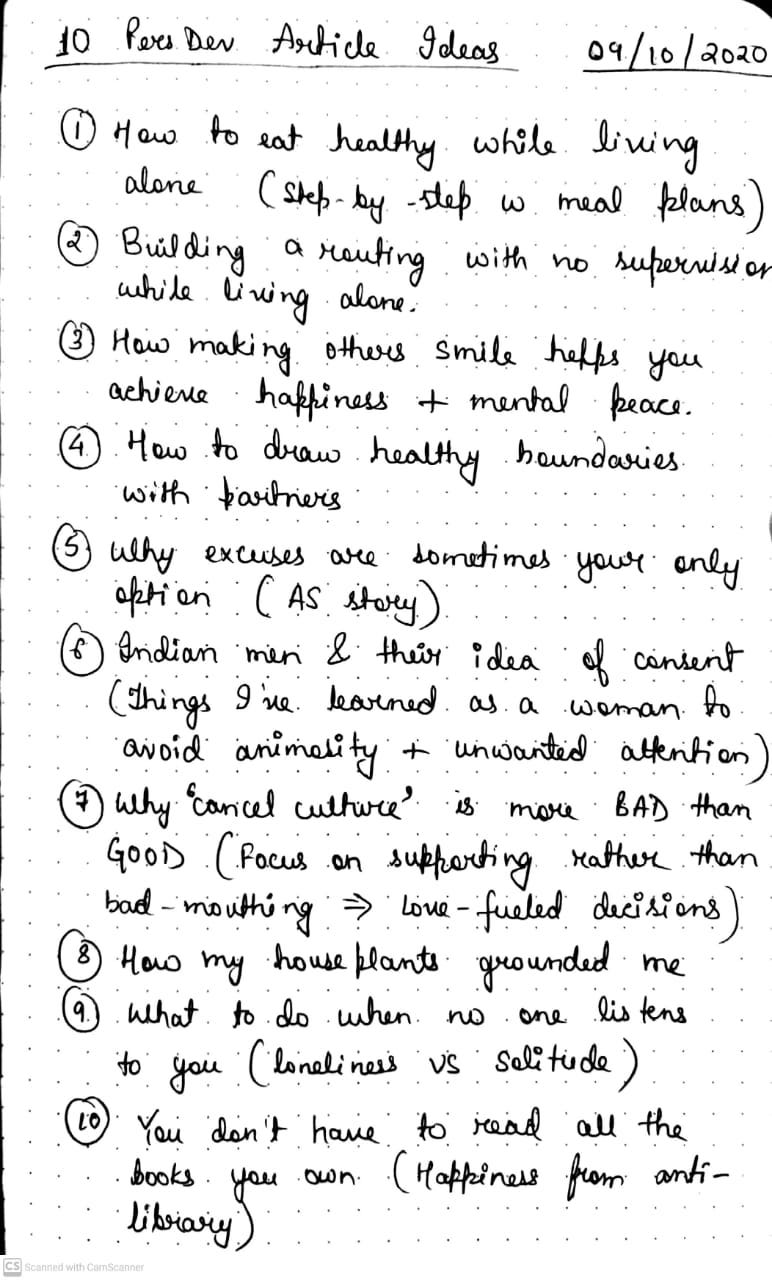
The routine is simple:
- Block out a time of the day for yourself to do this. Set a reminder if necessary.
- Take a pen and paper and write ten ideas of any quality.
If you write nonfiction, these can be ten titles or the concepts of articles you might write about. In the case of fiction, you can write about ten possible subplots, story ideas, or the setting of the story you’d like to write.
The point isn’t to write brilliant ideas you’re committing to develop. The point is to think up ten ideas every single day so your idea muscle knows what is expected of it and becomes stronger accordingly.
Idea journaling has to be done every single day. There are no cheat days, and even if you don’t have access to a pen and paper, you can quickly open the Notes app on your phone and write down at least ten ideas.
If you have a hard time brainstorming at a fixed time, keep a notebook handy with you at all times so you can jot down the ideas whenever they come. You may also use the Notes app on your phone. This extra noting of ideas can be done in addition to the daily idea journaling or as an alternative.
2. Pick the Two Best Ideas
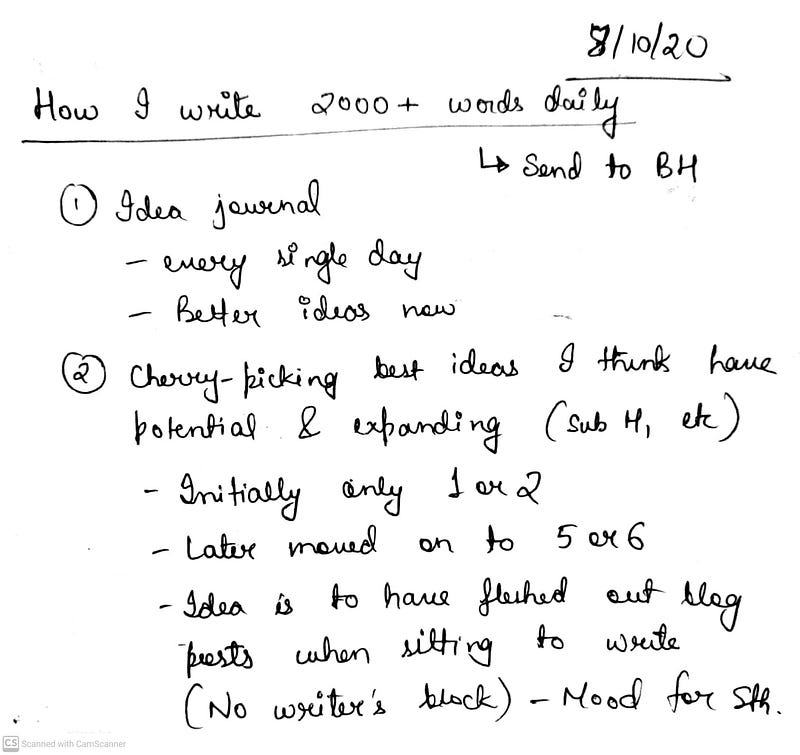
After a few weeks, I started picking two of the best ideas among the ten I had written. I decided what was best based on an intersection of the following:
- A topic I have expertise in and/or have read a lot about.
- Something that will be valuable to the reader. It should either educate, entertain, or inspire them. In the case of fiction, it should be relatable or provide them with an escape from reality.
- I’m passionate enough about the topic to not lose interest halfway through.
After deciding on the best ideas, I fleshed them out. I expanded on them, added subpoints, and turned them into full-fledged outlines for potential articles and stories.
The most tangible benefit of this practice was that, over time, I found I had a massive repository of fully fleshed-out article outlines. Whenever I sat down to write, I didn’t have to stare at a blank screen for hours deciding how to write the first sentence. Since I had the outline ready, I could pick any point and start expanding on it, thus saving precious time and energy.
Another advantage was the collection of ideas I had was so eclectic that I had a wide variety of outlines ready. On days when I didn’t feel like writing about personal development, I could write about feminism, books, or relationships. This helped me beat the crippling writer’s block that had plagued me for so many years. My collection of ideas left me no room for excuse.
Here’s how you can get into this routine
- Pick out one or two ideas from your daily list of ten that you believe have the most potential.
- Add subheadings, further points, or subplots and character traits (in case of fiction).
- Don’t worry about the structure or flow. Add the points as they come to you. Editing and formatting can be done later.
The best part is that since you’ll outline the article in a spurt of creativity, the flow will be excellent, making the piece easy for the audience to read.
Just like idea journaling, outlining has to be done every single day. Over time, you’ll build a repository of amazing ideas for yourself that’ll act as your crutch on days you feel the most demotivated.
3. Make Writing A Part of Your Routine
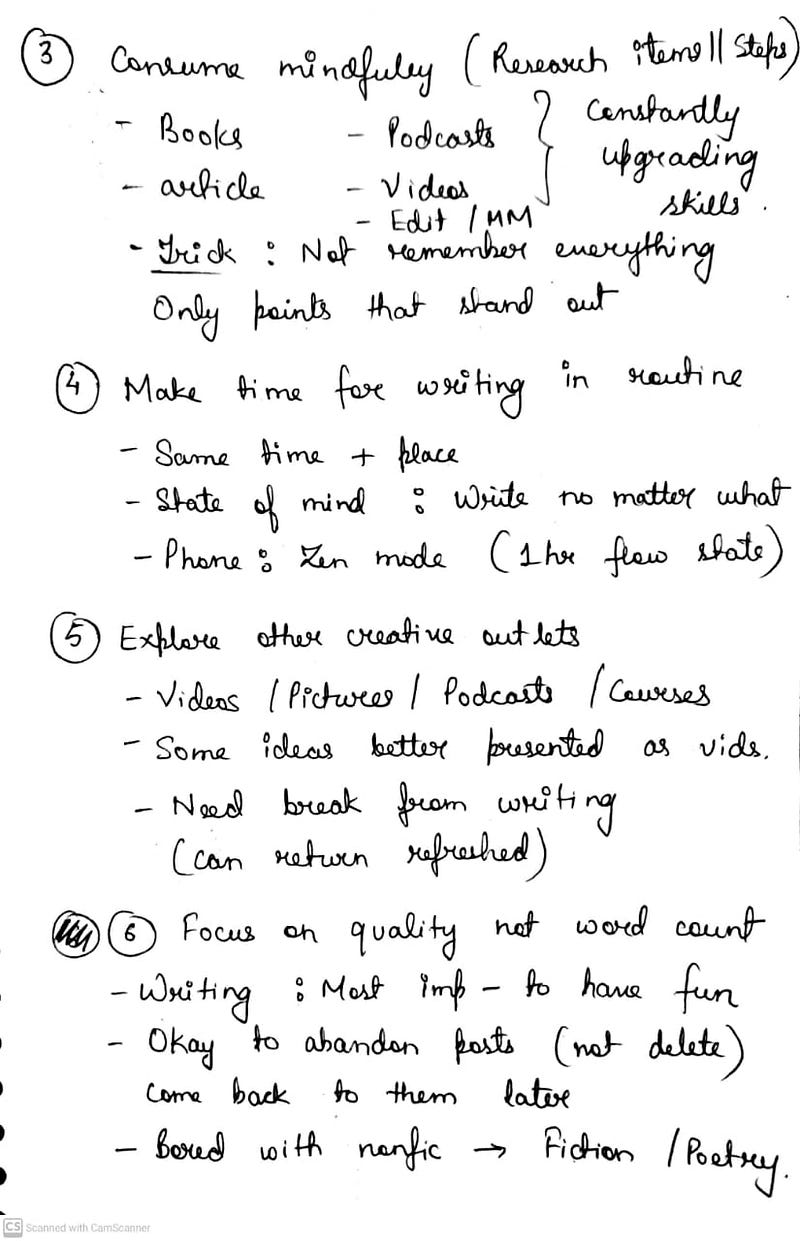
A significant factor that helped me in sticking to my daily word-count goal was that I made writing a part of my routine. Since my day job and my studies are pretty time-exhaustive, I set aside the time after dinner for my creative pursuits.
I also had a workspace that consisted of my table, some cheerful curtains and posters on the walls, and a bottle of water. I kept my phone on Zen mode for an hour, which prevented any notifications except calls (since I’m pretty much a loner, no one calls me this late at night unless it’s an emergency).
These factors helped me get into the state of flow that the Hungarian-American psychologist, Csikszentmihalyi, describes as:
“The state in which people are so involved in an activity that nothing else seems to matter; the experience in itself is so enjoyable that people will do it even at great cost, for the sheer sake of doing it.”
Here are the steps you can apply to build a writing habit. This is modeled after James Clear’s four-step process of building a habit and perfected with my own improvisations:
- Cue: The cue is the trigger that instructs your brain to initiate a behaviour. It’s the promise of a reward that gets you started. Before setting down to write, have the goal clear in your head. Look through your cherry-picked ideas, and pick the one that appeals to you the most. Say to yourself, “Today, I’m going to write one blog post” or “Today, I’m going to finish the fight scene for the climax of my book.” When your goal is clear, it gets easier to let go of your inhibitions and start.
- Craving: Cravings are the motivational force behind the writing habit. They’re the desire or motivation for some tangible change — in your case, the completed article or scene you’re working on. What you crave isn’t the habit itself but the change in state it delivers. Very few people love writing, but they love the idea of a finished piece. This is the promise that’ll make sure you don’t leave the task halfway through.
- Response: The response is the actual writing you perform. It depends on your level of skill and how promising the reward sounds to you. The fixed time of day and the place will help you stick to it, and the craving for the finished piece will keep you from getting distracted.
- Reward: The final result: Your completed piece and the sense of gratification you derive from it that’ll make all the effort worth it.
As James Clear puts it:
“The cue triggers a craving, which motivates a response, which provides a reward, which satisfies the craving and, ultimately, becomes associated with the cue. Together, these four steps form a neurological feedback loop — cue, craving, response, reward; cue, craving, response, reward — that ultimately allows you to create automatic habits.”
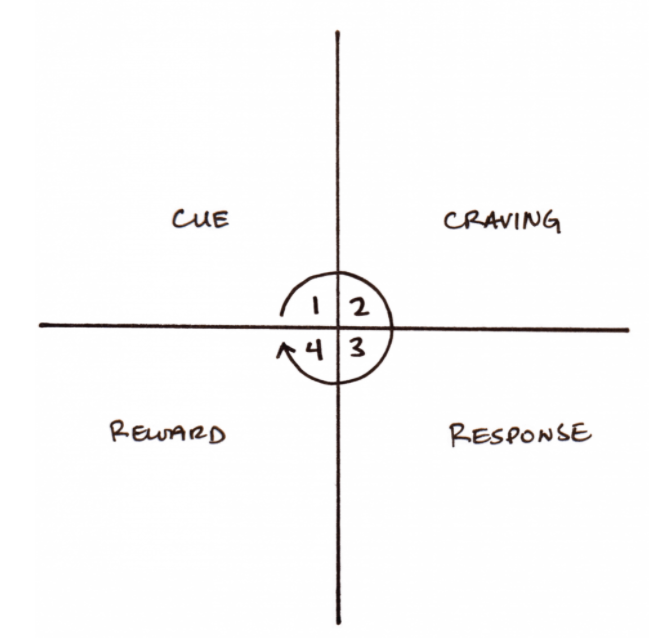
An important point to remember here is that if the effort you put into any of the four stages is insufficient, writing won’t become a habit. If you’re unsure of the cue, the habit will never start.
If you don’t crave for the finished piece enough, you won’t have enough motivation to act. If the process is too complicated, you won’t be able to see it to completion. And if the reward fails to ensnare your desire, you’ll have no reason to do repeat the process. So you need to be mindful; reflect on your desire for a finished article, and spend some time appreciating it when it’s finished.
This focus on your desired outcome and the reward of completing it is the fuel for making this a habit.
Mindset Shifts That Help in Sticking to the Writing Routine
Aside from writing ten ideas daily, picking two ideas to outline, and writing for a couple of hours a day after dinner, there were also some mindset shifts that helped me stick to my daily word-count goal.
Consume mindfully
Whatever content I consumed, be it books, research papers, podcasts, videos, or articles, I was always mindful about them. I didn’t just skim through for the sake of completing them but paid attention to the content and tried to imbibe the values. The critical point here isn’t to try and remember every single thing you read. The point is to take note of the ones that stand out and make conscious efforts to include them in your life.
According to The Mindful Word and Michael Bunn, here are some strategies on how you can consume content mindfully and create while you consume:
- Get curious. Identify what you wish to gain from the content you consume. Then, approach what you see in the media with critical curiosity.
- Ask questions. Before you get started, ask yourself what might be the creator’s purpose behind this piece of content and who the target audience is. This will help you appreciate the content better.
- Stick to your niche. Absorb yourself in TV shows, movies, books, and websites that align with your goals.
- Get into the mind of the creator. Try and decipher why the content creator presented the text in a certain manner. What do the choices of the characters portend? This method of active content consumption will help you identify foreshadowing and apply these techniques in your writing better.
If you’re mindful enough, there can be writing lessons everywhere you look. As a writer, I firmly believe it’s vital for us to constantly upgrade our skills. Mindful consumption of content is one way to achieve that goal.
Explore other creative outlets
When I feel too exhausted to sit down and write, I try and think of other forms of expression. Over time, I’ve found some ideas can be better expressed in the form of video or images, and, thus, I started exploring Instagram and YouTube as possible outlets of my creativity. These alternative forms of content creation gave me a much-needed break, and I felt I could return to writing with renewed vigour and inspiration.
Most creative people need multiple outlets. Creativity in any form is healthy, and finding a secondary creative outlet allows your creativity to define you, not your craft. Looking for alternative outlets also sparks your creativity and exposes you to new things. New things are inspiring. Trying something new will give you a break from the anxiety you might be feeling of needing to write daily and also give you better ideas.
Wrapping Up
Summing up, here’s how my creative routine looks like and how you can apply it too:
- Write ten ideas daily.
- Pick out two ideas that have the most potential and flesh them out. Add subpoints, and make an outline for a full article. Do this daily.
- Make writing a part of your routine. Keep aside a time and space for writing, and stick to it. To build a writing habit, it’s important to know the why of it. Once you have that promise of a reward figured out, you can write every day without being assailed by a creative block.
Remember, you can abandon posts halfway through if you don’t feel like completing them. Leave them in your drafts, but don’t delete them. You’ll be astonished at how appealing an old discarded idea might sound at a later stage.
If you feel too drained, keep trying new styles. When I get bored with writing too much nonfiction, I take a break and explore poetry or short stories. When I am frustrated with writing about books, I choose to write about paranormal movies instead. The best part of being a creative is that no matter how much you exhaust yourself, your creativity will never run out. Ideas will keep coming as long as you let them. Don’t forget to take care of yourself and your mental health along the way.
The most crucial part is to have fun.
If you feel pressured by the daunting word-count target, feel free to take a break. You don’t have to write 2,000 words every day, as long as you finish your targets on time. There will be days when you write 5,000+ words and others where you barely manage 50. It’s essential to celebrate the former and forgive yourself for the latter, believing that all of it will even out over time.
Author’s note: I’ve prepared a FREE 5-day course, including a detailed step-by-step guide on making money as an online writer. Grab the offer here.


