
Generalism and the Beauty of Being Purposeless

For almost my entire life, I’ve felt the itch to solidify the reason for my existence; I’ve sought purpose and meaning. And I’ve always been obsessed with whittling my purpose down into a condensed, concrete, and neat little package that I could easily explain to myself and others, and use as a carrot on a stick to help me navigate various life and career decisions.
As a kid, I would regularly, proudly declare my new career choice, only to have completely changed my mind in a few weeks or months (though some of them lasted more than a year, lo and behold!).
Over the years, after consistent self-exploration, I have in fact gained more clarity about what I’d like to do with my future:
I want to be a purposeless generalist.
And this article is dedicated to explaining this approach to life, which is by far the most empowering I’ve ever adopted. Let’s dive in.
Contents
- Purpose and Restlessness
- Embrace Purposelessness – But first… what is purpose? – The Purpose Obsession – Purposelessness: A Micro-Summary
- Embrace Generalism – Generalism: A Brief History – Mastery – Multi-Mastery – The ‘T’ Model – Reactivating Curiosity
- The Purposelessness Generalist
- Summary
Purpose and Restlessness
The notion of purpose can foster anxiety and restlessness within us. I’ve noticed this in myself and other purpose-seeking folks. Not everyone is a ‘purpose/passion junkie’ like us (I’m assuming you’re one if you’re reading this 😉), but those who are can be prone to feeling incomplete.
I’ve always felt as though something was missing from my life — like I was designed to do something that I wasn’t honouring.
But this feeling of incompleteness originated from a desire for purpose, and now that I’ve replaced this desire with a transformative knowingness, the restlessness and continuous existentialism that used to plague me has dissipated into my past; it no longer bothers me. And here, I’d like to share this new mindset!
There are two intertwined threads for today’s discussion: purpose and generalism. First, we’ll explore what ‘purpose’ actually is, then decide whether or not we need one, and finally, tie generalism into the picture to build a mindset that can satisfy any troubled purpose-seeker.
Embrace Purposelessness
But first… what is purpose?
We could view ‘purpose’ as a general explanation for the existence of life, to give a collective, overarching reason for living. But most purpose-based content is referring to individual purpose — i.e., what you personally should do with your life — so that’s the type I’m going to focus on here.
The Purpose Obsession
For a while now in the self-improvement community, there’s been a huge influx of purpose and passion content, imploring you to ‘find your purpose’ and ‘discover your natural gifts and share them with the world’, etc.
Following this, there was a kind of micro-trend of the contradicting idea that you don’t need a purpose, with self-help gurus advising: ‘stop trying to find your purpose’.
They suggest that instead of purpose being this magical thing floating around somewhere, waiting for us to discover it, it’s in fact something that we must create and carve through our actions.
Other narratives promote the idea that we can shed light on what our purpose is when we just take action and get stuck into life.
Personally, I found this mishmash of messages confusing and disconcerting, and it all left me thinking, well, do I need a purpose? Do I have a purpose?
So ultimately, which view is ‘correct’ (i.e. most conducive to our happiness and fulfilment)?
Let’s break it down and find an answer…
So, there are two common ideas about purpose circulating the purpose/passion topic sphere:
- A personalised purpose exists for each of us, and we must discover it (by doing self-exploration work, waiting, taking action, experimenting, etc.).
- There’s no such thing as a predefined personal purpose — purpose is something that we must build, and passion follows action.
Of these two ideas, I’d agree more with the second. But even this idea is limiting in a sense; it still places emphasis on the need for a specific purpose (or set of purposes).
And the very notion of purpose is exclusive:
By identifying something as your personal purpose, you’re excluding every other possibility.
What if you care about/are interested in/are good at (or could be good at) a multitude of things? Further, what if there are some things that you would deeply enjoy and thrive with, but haven’t discovered yet?
By declaring a purpose, or seeking one, you’re denying yourself the opportunities for exploration provided by the world.
Purposelessness: A Micro-Summary
If you’re struggling to figure out what to do with your life, it’s very limiting (and places a lot of pressure on you) to believe that your purpose is out there somewhere and you have to find it; I recommend that you abandon this idea altogether.
A better approach is to see purpose as something of your making — something that’s built over time by what you choose to pursue.
However, an even better approach is to forget the notion of purpose entirely and instead embrace life as a journey — a collection of experiences — during which you apply the knowledge and skills you’ve accumulated to whatever interests you.
And in order to do this, you’ll need to become a generalist …
Embrace Generalism
So, we’ve established that if you haven’t yet identified a purpose for your life, you’ll be better off abandoning the idea of purpose and embracing purposelessness.
But in order to live a successful (whatever that means to you) purposeless life, you’ll also need to embrace generalism.
Why?
Generalism will grant you agility and adaptability when forging a diverse career (and life). Being a generalist enables you to pivot, explore and build an extensive blend of knowledge and experiences which you can apply to all future ventures and pursuits.
Side Note
For those who already feel connected to a particular purpose or have known from a young age exactly what they’d like to do in life, specialism is likely the way to go (unless you’ve always known that you want to be a generalist).
For the rest of us, selecting a particular niche to burrow into is probably too risky; we’ll be increasing our probability of success and fulfilment if we decide to diversify and embrace generalism.
Generalism: A Brief History
There are many alternative words for ‘generalist’, including polymath, Renaissance person, multi-passionate person and multipotentialite.
They all point to the same thing: exploring and becoming an expert in multiple disciplines.
Generalism used to be normal — even revered — but has gradually drifted out of the limelight of convention and into the realm of rarity.
Let’s investigate two potential reasons for this.
1 — The Industrial Revolution and Education System
Industrialization introduced the factory and reduced people to providers of the labour commodity*. The education system was founded from this, hence its purpose was to effectively prime students to enter the workforce — the market for labour.
Specialisation was considered to be most useful for factory (company) owners, since a specialised employee could provide the most efficiency (they’d become adept at their particular job). Meanwhile, out-of-the-box, big-picture thinking became obsolete, because all that stuff was left to company owners**.
So, students (who would later become employees) were encouraged to develop and refine one particular craft. In this way, they’d be able to provide the most utility for employers; the education system was designed for this***.
This also benefits employers because it pits potential employees against each other, and the competition of becoming the very best at a chosen craft produces a vast array of highly skilled employees to select from. Additionally, the competition for budding students seeking employment drives down the wages employers have to supply their employees with.
Overall, this system of encouraged (or forced) specialisation has been very beneficial for company owners, but limiting and diminishing for prospective employees and their future careers.
*You can search for the ‘commodification of labour’ to explore this idea in more depth.
** Nowadays, CEOs are recognising the benefits of fostering and encouraging creativity and innovation in their employees. But the education system still, for the most part, doesn’t reflect this.
*** Well, the education system was initially intended to provide empowerment for all via education, but eventually transformed into a means for pumping out employees for employers.
2 — Increased Collective Knowledge
The second potential reason for society’s obsession with specialism relates to the ever-expanding pool of human knowledge about the world.
Following the dawn of human consciousness, the fundamental, core concepts and laws within different fields were established. Consequently, any further progress within those fields must entail a deep understanding of current knowledge, and with our rapidly increasing breadth and depth of understanding, specialism became necessary; there’s simply too much information to learn everything and make the same scale of advancement that happened earlier in humanity’s history.
But what if by exploring different, seemingly unrelated fields, we increase our chances of making breakthroughs? What if the connections between disciplines made by generalists can close the gaps between them and unify knowledge, to concoct a comprehensive solution to any problem?*
*Don’t mind this little discourse — I’m not really sure what’s possible! The combination of specialism and generalism is probably the way forward — the way to expand our existing knowledge and solve humanity’s problems.
But we weren’t always so preoccupied with specialism.
In the past (particularly the Renaissance period), generalism was viewed as the ‘best’ approach to work and the contributions of polymaths are still greatly valued today.
The likes of Leonardo da Vinci, Michelangelo, Pythagoras, Isaac Newton, Marie Curie, Maya Angelou, Benjamin Franklin and Nikola Tesla* are just a handful of the great generalists of the past (and there are plenty of polymaths of the present — though they aren’t idolised as much as those of the past).
*Notice the lack of female examples…
Why so few (famous) female polymaths? My guess is that during the times when society embraced generalism, men’s gifts were nurtured while women were assigned some domestic purpose.
These people’s existence and lives act as direct proof that a generalist approach to life is possible, and the results of pursuing one can be phenomenal.
Over time, generalism has been downtrodden and abandoned by convention. Meeting a self-declared generalist is rare — whenever I hear of one, I get excited 😆.
But now is the time for us to redress our repression of generalism and embrace it once more. And this must first happen on an individual basis.
Mastery
Here’s a key principle of mastery:
You can master anything, but not everything.
A specialist will choose to master one thing, and will gain incredible depth of knowledge in their chosen niche.
A generalist will choose to master multiple things, but sacrifices the depth of knowledge within those areas that a specialist can achieve.
Specialism = more depth, less breadth.
Generalism = more breadth, less depth.
So a specialist can still have a decent breadth of knowledge and a generalist can have a good depth of knowledge, but neither can achieve the level of breadth/depth of the other.
Multi-Mastery
On average, humans have around 100,000 spare hours, excluding eating, sleeping, chores, work, etc. Combining this with the 10,000 hour rule (that mastery of anything takes around 10,000 hours), you can, in theory, master about ten different things in your lifetime.
And this number could increase if you include working hours — if your work is related to one (or more) of these things you’re striving to master.
So, generalism doesn’t involve fickle flakiness; we’ll still commit ourselves to a finite set of subjects or passions to master. But that doesn’t prevent us from exploring everything else too 🤠.
A good way to think of a generalist is as a jack of all trades, master of some, which this great TED talk is about:
Although a generalist will never achieve the detailed depth of a specialist, they have a broader scope of knowledge, which can be cross-applied to their fields of involvement and actually strengthen and enhance their understanding of a specific domain.
As mentioned previously, many cultures across the globe promote and champion specialism; the (mostly higher) education system and work system are designed for specialists.
We’re told that to maximise our chances of success*, we must find what we’re good at, and then hone in on it and become the very best (or only person) in our niche.
*Success is subjective, and this particular approach to finding it (forced specialism) results from a very narrow definition of it.
But there are many overlooked benefits to being a generalist that we forgo if we select the specialist route. Here’s a non-exhaustive list:
Faster Learning
Possessing such a vast bank of knowledge and skills gives us more concepts to draw parallels with when learning new things; building up a network of relationships between ideas is the basis of human learning.
Multi-Discipline Collaboration
By becoming well versed in a wide variety of disciplines, generalists learn the communication methods within those disciplines. Then, they’re able to speak in the specialists’ language, which allows them to link together experts in apparently disconnected fields to work towards a common goal.
Big-Picture Thinking
Related to the point above, due to generalists’ spanning experience and knowledge, they’re better able to zoom out and connect the dots, synthesise multi-discipline ideas and generate holistic plans, theories and solutions.
Constant Novelty = Fun
Best of all, being a generalist is fun. Generalism is all about unbounded exploration; nothing is off-limits. Boredom is a foreign concept to the devout generalist.
The ‘T’ Model
The ‘T’ model represents a person who has specialised knowledge in (at least) one area, along with a wide base of general knowledge. With this model, you can get the best of both worlds: breadth and depth.
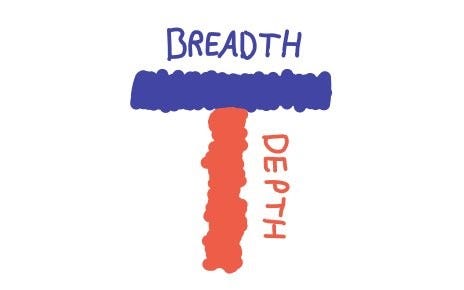
Here’s an article by College Info Geek that explains the ‘T-shaped person’ and how you can become one.
Reactivating Curiosity
Every human being has access to an innate curiosity that can be syphoned as fuel for learning. I can guarantee that this hunger to learn exists within you, even if it’s been lying low for a while; curiosity enabled our ancestors to learn the skills that have kept our species alive throughout our years of evolution.
So, if you want to become a better, more well-rounded generalist, the first step is to reactivate your curiosity. Here’s a short article by Scott H. Young that describes the joy of learning (yes, it’s cheesy but true) and explains the lens through which generalists view the world.
The Purposeless Generalist
Purposelessness and generalism go hand in hand, and there are two angles you could look at it from:
- You’re not sure what you’re good at or what you enjoy or are interested in. In this case, you’re probably best off embracing the way of the generalist and cultivating a medley of passions and pursuits, driven by your innate curiosity.
- You have a good idea of what you’re good at and what you enjoy, but can’t prune your interests to form a singular, unifying purpose. Embracing generalism applies here too — you can decide to weave your many passions together into a magnificent tapestry of knowledge and experience, which can be consulted whenever you’re trying to learn something new or solve a problem.
And in both of the above scenarios, embracing purposelessness will satisfy your need for meaning. When you resolve to ditch the notion of purpose and instead focus on continuous growth and knowledge expansion, you’ll no longer feel compelled to ‘find your purpose’.
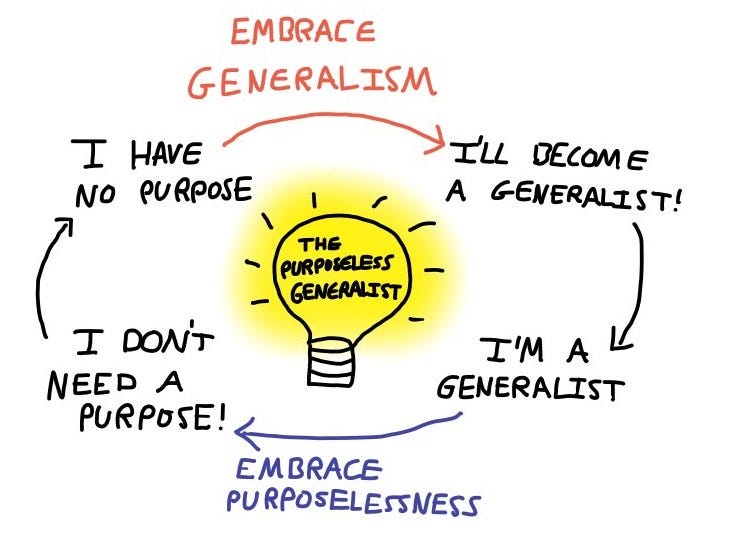
My recommendation: choose to master one thing at a time, and then dabble in anything else that takes your fancy. Your chosen specialism is your main gig, and everything else is an optional extra that enhances your overall expertise.
Summary
Searching for one thing to dedicate our career to can be anxiety-inducing, and can cause us to stagnate in life. Plus, if we ever do settle on a particular purpose, we exclude and blind ourselves to all other possibilities and unrelated opportunities.
So, it’s best to consciously choose to not have and not need a purpose.
And if we’ve decided to live without a single purpose, we’ll need to be able to explore a wide variety of fields and expand our knowledge base. And to achieve this, we’ll need to embrace generalism — we can use generalism as a means of living a fulfilling yet purposeless life.
And to become a ‘successful’ generalist, we need to consider the ‘T’ model and reactivate our curiosity.
Neither specialism nor generalism is better than the other; both are important to the progression of humanity.
Perhaps our preference for either is wired into our genetics. And if you resonate with the generalist approach to work and life, I encourage you to embrace it. It may not align with current conventions, so you’ll face more resistance in your pursuit of a generalist career.
But if you choose to nurture your dormant generalist, you’ll unlock a life of continuous novelty, excitement, exploration, curiosity and innovation; the beauty of the world and the interconnectedness of everything will reveal itself to you. Your life will unfold in an extraordinary way.
Check out the original version of this article at theathinks.com for an extensive collection of resources on generalism:
Thanks for reading! :)
Originally published at http://theathinks.com on March 28, 2022.


