
Gender ‘Stockholm Syndrome’
Society continues hindering my rehabilitation progress, but now with so many other gender escapees out there, my chances of success seem to improve every day.
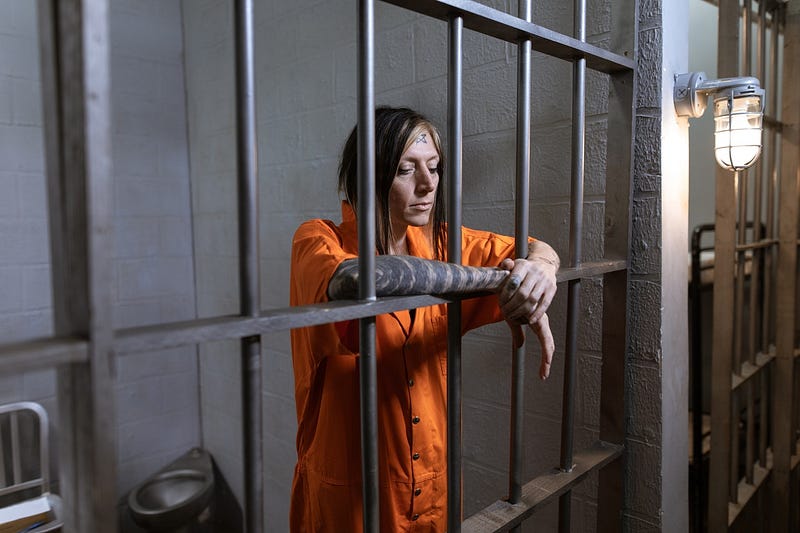
Stockholm Syndrome is a psychological response that occurs when hostages or victims of abuse bond with their captors or abusers. This psychological connection develops over the course of the days, weeks, months, or even years of captivity or abuse.
My gender suffered a similar experience.
All my life, society forced me to suppress my gender; it held my gender hostage.
For the most part, it was done with innocent ignorance by most, but I would argue that the concept of gender as a rigid binary is still strictly enforced and adhered to by an aggressively non-accepting cisgender population. That group includes members of all different sexual orientations, as well as members of most organized religions, with the media and politicians serving as their spokespersons.
Society held me captive in a binary cell for so long that I began to identify and live by their definition of gender. It took years of therapy, after 61 years of gender confinement, to finally realize that I’d been a prisoner.
I was happy (or at least I convinced myself that I was happy) in my confinement — happy as I could be — but I always felt something was missing. Something didn’t feel right. It was a strange sensation, one that I knew was there, but the source of it always seemed elusive. It was like a low-level emotional itch that I could never reach, so I ignored it as best I could…
Until I couldn’t.
Suddenly, the alarm sirens started screaming inside my prison cell.


In response, my subconscious began to dig an escape tunnel, handful by handful, just like Andy Dufresne did in The Shawshank Redemption. Each year my subconscious got a little further along; it hid the escape tunnel behind the poster of male privilege that hung on my cell wall.
Finally, my gender escaped from prison into a world that I discovered was still hostile to non-binary individuals. I was no longer being held a prisoner in cell, but my sense of gender was still being held captive to my societal “Stockholm” sense of gender.
I had become institutionalized.
According to sociology, institutionalization refers to the process of embedding some conception within a person, an organization, social system, or society as a whole. Society had embedded a male gender identity over my female gender identity, and sealed it with a lifetime of binary conditioning.
I accepted I was gendered female, but I could not accept I was a woman. I still saw a man in the mirror, but not in my soul.
I was trapped between two worlds and two identities, but gender dysphoria never, ever rests. Instead of my subconscious digging more of that tunnel, now, it is forcing me to de-institutionalize myself. It’s like I’ve been put in a gender half-way house while I try and figure out who I am, and who I need to be.
I am being rehabilitated.
It’s hard work. I have new skills to learn. Society continues hindering my rehabilitation progress, but now with so many other gender escapees out there, my chances of success seem to improve every day.
I hope that I can help future escapees as I have been helped, to make the world more accepting, and to make their lives so much better.
I hope the spirit that led the Stonewall Riots will continue driving the flame of outrage at gender mistreatment into the heart of our society. I hope that the gender prison cell blocks are closed forever, and become a chapter in a history and time that has long since passed away.
I will always continue to hope, but I am never going back into the cell.

Writers note: If you have read any of my writings on Medium you will have noticed some definite themes: the incredible pain of gender dysphoria, and all the difficult aspects of just being transgender.
My writing has three specific goals:
1. Writing is my therapy. I have a very limited outlet for my thoughts, so I write to find a way to process the most profound experience in my life. I need to understand and accept myself to move forward.
2. Being transgender, for me, is a very lonely existence and if I can share some of the things that I feel and think as I go through the process of transitioning with others who are transgender, and, in some way lessen their pain and sense of loneliness, then all of this public exposure of my personal thoughts is not a waste.
3. I write to help cisgender people understand that all trans people want is to simply be understood, accepted, and treated as normal people. We are.
Thank you for reading my work.