Gears are fundamental components that have been crucial to technological advancements throughout history, from ancient machinery to modern applications, and their design and function continue to be a subject of fascination and study.
Abstract
The article emphasizes the critical role of gears in the advancement of human civilization, showcasing their use in various historical and modern contexts. It touches on the complexity of gear design, the mathematical principles governing gear kinematics, and the practical aspects of gear manufacturing. The text highlights the efficiency of gear mechanisms due to their rolling motion, which minimizes friction and wear, in contrast to sliding friction exemplified by a pencil on paper. Historical examples such as the Antikythera mechanism and the gears of the Han dynasty illustrate the long-standing use of gears. The article also marvels at the natural occurrence of gear-like structures in the biological world, such as those found on the legs of plant-hopper nymphs, which serve to synchronize movement.
Opinions
The author expresses a personal connection to gears, having written a poem and taken courses in gear design, suggesting a deep appreciation and intellectual curiosity for the subject.
There is admiration for the craftsmanship involved in machining gears, as evidenced by the pleasure derived from watching an expert at work.
The author finds the meshing of gears to be a particularly fascinating aspect of their operation, indicating a profound interest in the mechanical interactions that enable gears to function effectively.
The text conveys a sense of wonder at the discovery of gears in nature, highlighting the intriguing parallels between biological mechanisms and human-engineered systems.
Gears are Vital to Our Civilisation.
Society absolutely depends on its ability to make and use gears.
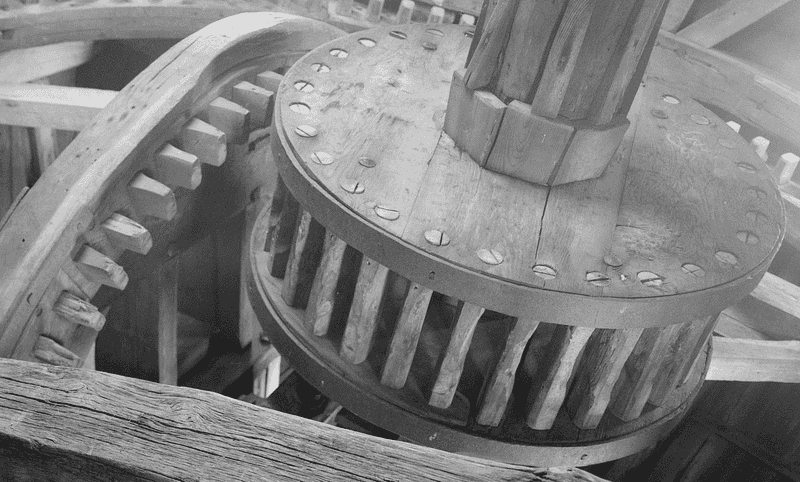
Cage gear in Pantigo Windmill, Long Island (with the driving gearwheel disengaged). By Interior_view_Pantigo_Windmill_East_Hampton_Suffolk_County_New_York.jpg: Historic American Buildings Survey, National Park Servicederivative work: Twirlip (talk) — Interior_view_Pantigo_Windmill_East_Hampton_Suffolk_County_New_York.jpg, Public Domain, https://commons.wikimedia.org/w/index.php?curid=12104712. This image or media file contains material based on a work of a National Park Service employee, created as part of that person’s official duties. As a work of the U.S. federal government, such work is in the public domain in the United States.
Helpful son
challenged me,
“Write poem
about gears”,
So here it is!
Think about car,
Gearbox for getting
low speed power and
high gear for speed,
Sowing machines have
complex gears,
Even my coffee grinder.
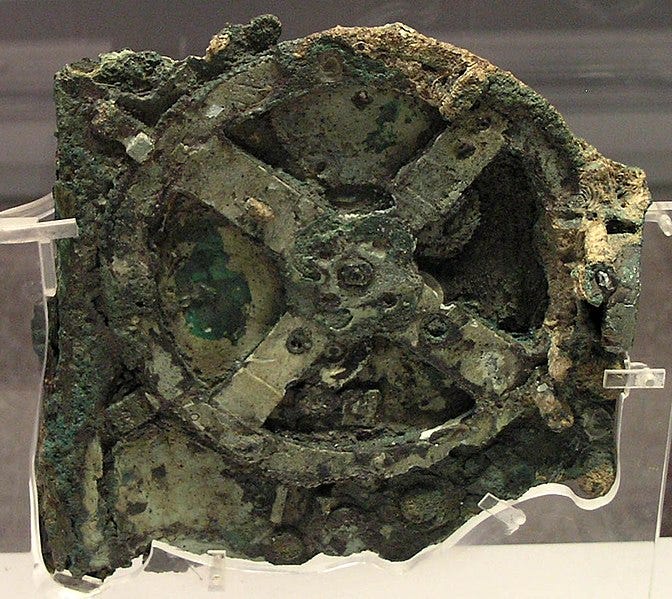
w:en:Antikythera mechanism fragment (fragment A). The mechanism consists of a complex system of 30 wheels and plates with inscriptions relating to signs of the zodiac, months, eclipses and pan-Hellenic games.
The mechanism was probably built by a mechanical engineer of the school of Posidonius in Rhodes. Cicero, who visited the island in 79/78 B.C. reported that such devices were indeed designed by the Stoic philosopher Posidonius of Apamea. The design of the Antikythera mechanism appears to follow the tradition of Archimedes’ planetarium, and may be related to sundials. His modus operandi is based on the use of gears. The machine is dated around 89 B.C. and comes from the wreck found off the island of Antikythera. National Archaeological Museum, Athens, №15987. By No machine-readable author provided. Marsyas assumed (based on copyright claims). Own work assumed (based on copyright claims)., CC BY 2.5, https://commons.wikimedia.org/w/index.php?curid=469865 Licensed under the Creative CommonsAttribution-Share Alike 3.0 Unported license.
Have done several
courses in gear design,
Mathematics
kinematics and
many other headaches,
Even had a go at
machining some
under instruction by
very nervous craftsman.
But there has always
been something that
fascinated me and
that’s how gears mesh.
Rolling Efficient and
low friction,
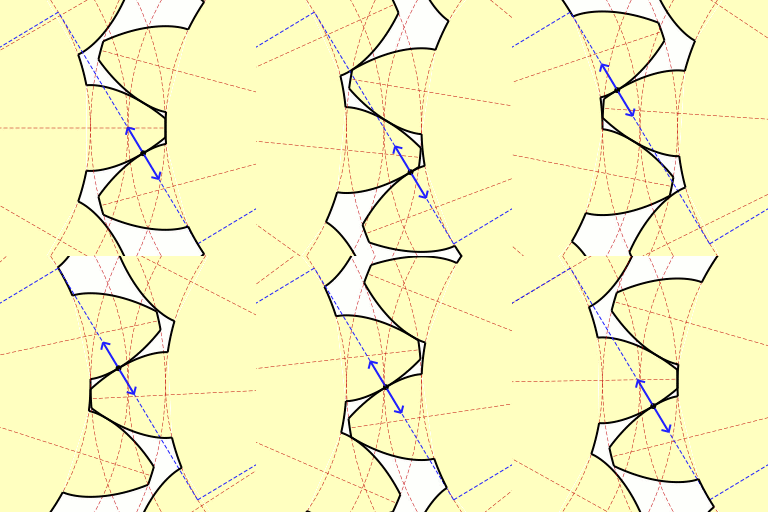
Two meshing gears
teeth’s contacting surfaces
roll off each other
neither sliding
nor scraping,
Difference seems semantic
just playing with words,
But rolling has huge
impact on life and
performance of gears by
minimising friction.
Pencil sliding on paper
tiny pigment amount
worn off and transferred to
sheet of paper,
Excellent for pencil
horrible for gears,
Gears must run for
millions of revolutions,
Can’t be resharpened
like pencils.