
GASLIGHTING | SOCIAL MEDIA | RESPONSIBILITY
Gaslighting, The Word Of The Year: Terrible Consequences For Decades And More
In the light of the word of the year, the future looks dim.
“In this age of misinformation — of “fake news,” conspiracy theories, Twitter trolls, and deepfakes — gaslighting has emerged as a word for our time.” — Merriam-Webster dictionary.
Mistrust is the flip side of that word. You and I have been bombarded by misleading, twisted and ill-willed messages since the beginning of social media platforms. It seems we cannot trust anything or anyone anymore.
What began in Zuckerberg’s dorm room as a fun way to rank girls has evolved into a plethora of channels to take our focus off the essential things in life. Read the scarily topical Stolen Focus by Johann Hari.
Social media hardly can be called social — unless there are pockets of belonging and positive purpose amongst the people who use it. Without that, the platforms become sewers of shit.
Merriam-Webster gives explanations for the adjective ‘social’. It is an eyeopener to read that it means, for example (bolded by the author):
– marked by or passed in pleasant companionship with friends or associates
– of or relating to human society, the interaction of the individual and the group, or the welfare of human beings as members of society
– tending to form cooperative and interdependent relationships with others
– living and breeding in more or less organised communities, especially for the purposes of cooperation and mutual benefit: not solitary
How much do we see this kind of social behaviour in media in the strict sense of the word?
What is gaslighting?
Why 2022 saw a 1740% increase in lookups for it?
In 1938 a play by Patrick Hamilton and later two movies (the first one directed by Thorold Dickinson in 1940 — and then famously remade by George Cukor in 1944 with Ingrid Bergman and other stars of the time) made the word gaslighting known as the synonym of deception.
The story’s main character tries to make his wife believe that she has gone mad — literally dimming the lights. The poor wife starts to doubt her perception and sanity.
This evil manipulation got a modern story to carry the meaning of the behaviour that so much describes current times.
Is your attic dim?
When reading what happens with Twitter, Facebook and other platforms, it feels that somebody is now trying to dim the lights.
It is easy to blame the algorithm as if the owners of those platforms have nothing to do with it. It is easy to move our focus from the responsibility and accountability of those giants to our own behaviour.
According to the algorithms, i.e. owners of the platforms, it is human nature to search for schadenfreude and negativity.
I don’t believe it.
I believe that human nature is inherently good, compassionate and on the side of good. The problem is that the manipulators move the goalpost so fast that we don’t know where to kick the ball and whether it goes to our team’s own goal.
We become confused, disillusioned and lose our faith in everything. A cynical cyclone of shit blurs our views of the world. It is easier to be sceptic, become cynical and finally believe that we must also react with the same kind of meanness.
Our attic becomes dark and lonely while the storm tears the roof away. And if you open your eyes, you feel the winds of the times dragging you out and far away — and you see a Ukrainian mother crying while burying her dead child into a crater that Putin digs for her with his bombs.
But don’t worry; her cry is soon forgotten and buried under a pile of tweets, Tik-Toks and Shit-Shots of so-called social media.
But I don’t want to believe that this is the whole truth.
We have a choice — or do we?
Humans have been clever in building catastrophes for the future and paying high prices when they happen while waiting in perfect bliss and living lenient lives of privileges.
Only a tiny minority (1.1% of the global population) owns nearly half of the world’s wealth — and 11.1% owns 84.9% of the global wealth, according to Visual Capitalist.
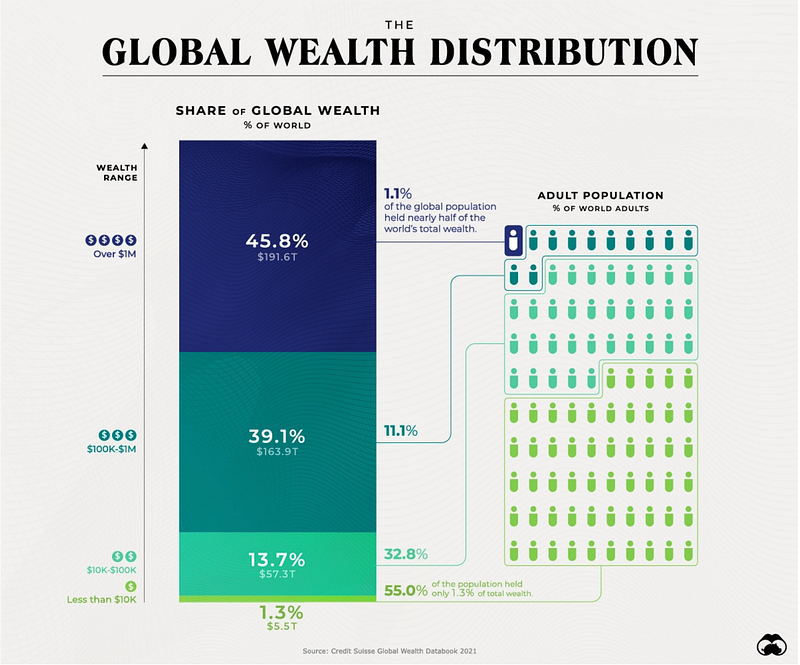
That minority has been steering our attention away from the causes of catastrophes because they wanted to have more and give less.
It is capitalism, and it has also worked for the masses simply because the 11.1% needs them to produce more, and when there is too much of the good stuff, they are used for cannon fodder when the war is necessary. Ray Dalio has done fantastic work in analysing these cycles.
It is a cyclic reshuffle of wealth: from deep pockets to an even deeper one — and fewer. And during the process, the pocket gets tighter and zippers better so that nothing slips out easily.
A human tragedy very seldom will reach 11.1%. They live a good life.
But we have a choice.
I don’t want to advocate anything other than capitalism, but it has to reinvent itself. Revolutions will eat their children, as the saying goes.
The only revolution that has sustainable outcomes is the inner transformation of our attitudes, approaches and ways we treat each other.
We cannot be happy if our society is broken. We cannot isolate ourselves from the world — unless we belong to the 11.1%. The rest of us must fight for justice, deal with climate change and prepare the world for the next generations.
Real social media is the answer
It is up to you and me to decide if we let a tiny minority suck the living daylight out of us and our planet.
The counter-offensive starts by reaching out, building bridges (metaphorically and in the real world) and embracing each other.
Gaslighting is from the era of fossil fuels. Deceit and betrayal belong to the past and to 11.1%, but most of us are decent, compassionate, well-intentioned ordinary people.
We need to switch our inner lights on instead of depending on any gaslights the platforms offer.
Becoming enlightened is not easy, but it is possible: it starts by consciously using compassion, wisdom and courage as our yardsticks when we measure the merits of any message, post or social media splash.
In conclusion, an example of the better future
Yesterday I sat in my favourite cafe, Glasshouse Cafe, writing my article. Then I took my Airpods off and heard a small voice reading something.
I turned to see better. Behind me was a very old lady sitting in a wheelchair.
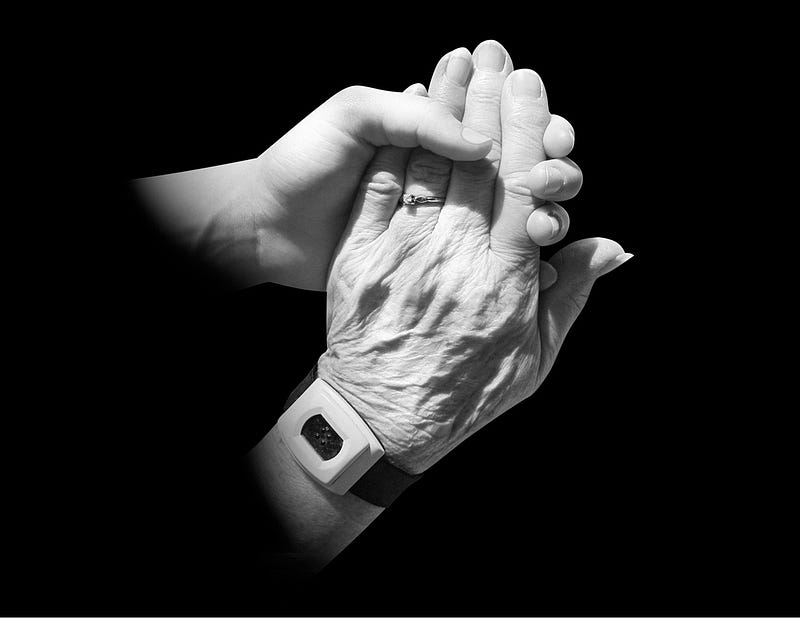
Next to her was a young boy, maybe 12 or so, reading a novel from an iPad to the lady. Her hand held the boy’s hand, shaking a bit — her eyes were shut, but a faint smile was on her wrinkled face.
The interplay of technology, the simple human touch, and the wisdom of written words was on display. The gentle voice of the boy touched my heart — and he too was learning something while reading aloud. There was no generation gap but a bridge that only words could help to build.
The beautiful boy saw me looking and smiled but continued reading, squeezing the old hand tenderly. I turned back to my MacBook and finished my article.
When I was done, I turned around, wanting to say something, but the boy and his granny were gone. Only an empty teacup and a hot chocolate cup reminded me of them.
I knew then that we are good people, and the selfish 11.1% will not be able endlessly to gaslight us to believe anything else.
This year’s word may be gaslighting. But the climate is changing, and the following year’s word must be compassion –, or the future is so dark that there is no point in writing any words for a year or ever.
I am a curiosity expert; if you want to know how I can help you to become a more curious leader, creative and confident thinker, book a free discovery meeting with me here.
If you enjoy reading stories like these and want to support me as a writer, consider signing up to become a Medium member. It’s $5 a month, giving unlimited access to Medium stories. If you sign up using my link, I’ll earn a small commission: click below to join.
You can also reach out by sending me a video message on Volley.