
Gartner Hype Cycle 2022 for Emerging Technologies
How 3 broad themes are constituting to the Emerging Technologies Landscape..

At the outset, we are noticing the evolution of multiple emerging technologies and their interplay. These are going to have significant impact on the businesses being done.
The Gartner Hype Cycle 2022 for Emerging Technologies can be looked at as clustered into 3 broad themes:
a) Artificial Intelligence and it’s accelerated impact
b) Optimization of the technology and the delivery being done around that
c) Evolution of immersive experiences
Now let’s take a look at some examples around each of these three dimensions.
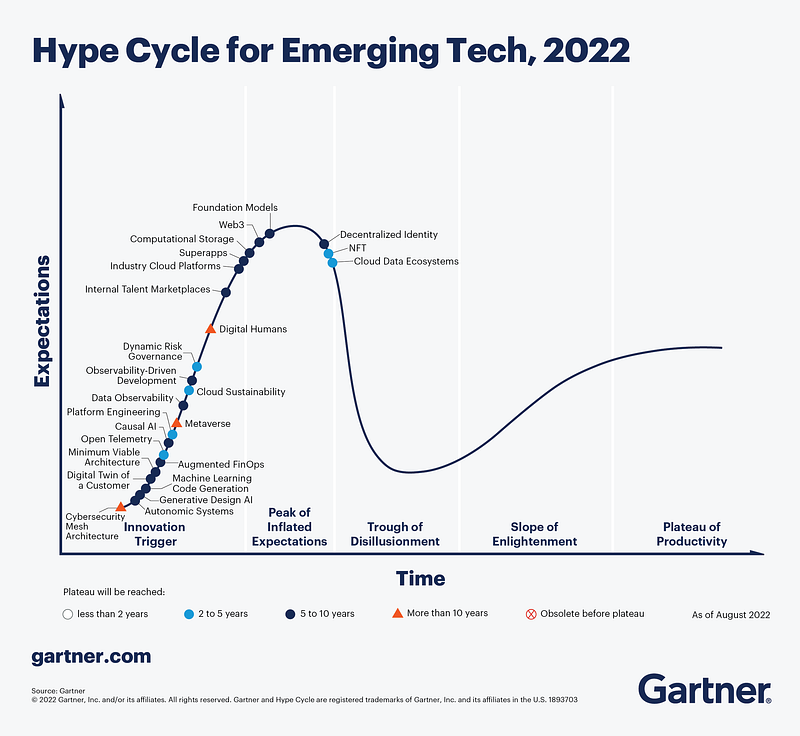
Dimension 1: Artificial Intelligence and it’s accelerated impact
While Data Science and AI is maturing, it’s adoption and expansion is critical from products, services and solutions standpoint. Creation of industry specific AI models, automation of multiple portion of Data Science phases are also happening. Outcomes are around better predictions from accuracy perspective where expectation is that the gap between predicted and actual result reduces, faster decisions based on insights are generated and quicker capture of benefits are realized.
- MLOps, Pipeline deployment & Observability — This has been gaining momentum and will continue to progress. Focus on model monitoring, model management, managing features in feature store will continue. The observability will be needed in business and will continue to contribute to outcomes in production.
- Causal AI — identifies and focuses more on cause and effect relationships instead of just correlation-based predictive models. This is more towards Data Science and AI applications that can prescribe actions more precisely and autonomously.
- Foundation Models — could be core ML models or classical ML models that can be used to solve problems, could be industry specific models such as BFS specific, or Retail specific or Manufacturing specific or Oil & Gas specific or Healthcare specific etc. Additionally, this could also be transformer architecture based models, such as language models which leverage deep neural network architecture to compute numerical representation of text corpus, emphasizing sequences of words in that text corpus. I personally feel the intent is to build on a baseline which is a foundational model and then try to perform custom efforts on top of it and work towards reducing of the custom effort to some extent.
- Generative AI — towards an augmentation of AI, ML, NLP technologies to automatically generate and build user flows, design steps, UI screen designs, content and presentation layer code base for digital products.
- ML Code Generation — tools include cloud-hosted ML models that plug into various IDEs (Integrated Development Environments) that provide some form of code base suggestions.
Dimension 2: Optimization of the technology and the delivery being done around that
The focus here is to build digital business and digital transformations from products, services, solutions and platforms standpoint. Cloud data ecosystems exemplify optimization of technology delivery and innovations associated with it.
- Augmented FinOps — it automates traditional DevOps concepts of agility, CI/CD strategies, end-user feedback to financial budgeting, cost optimization efforts, governance etc. These are leveraged predominantly by AI/ML methods.
- Data Observability — it is the ability to understand the health of firm’s data ecosystem, data pipelines, architecture and data infrastructure by monitoring continuously, tracking, alerting and troubleshooting as needed. This is something correlated to MLOps as far as AI/ML Observability is concerned.
- Industry Cloud Platforms — are collections of cloud services, tools, and applications optimized for the most important use cases in a specific industry. This can leverage PaaS, IaaS and SaaS to offer these industry-specific packaged and technical capabilities solutions on Cloud.
- Digital Risk Governance — is a new approach to the critical task of defining the roles and responsibilities for risk management. DRG customizes risk governance appropriately to each risk, enabling organizations to better manage risks and lower the cost of assurance.
Dimension 3: Evolution of immersive experiences
These are driven by innovation and provide humans control over their data and how to handle it. It can expand multitude of experiences into virtual venues and ecosystems that can be integrated with digital currencies. It may strengthen revenue streams for customers as well.
Augmented Reality (AR) and Virtual Reality (VR) bridge the digital and physical worlds. They allow us to take in information and content visually, in the same way we take in the world. Digital twin of the customer is a dynamic virtual representation of a customer that simulates and learns to emulate and anticipate certain behaviour. It can probably modify customer experience, enhance customer experience and support new digitization efforts as well.
- Decentralized Identity (DCI) — it allows an entity or humans to control their own digital identity by leveraging technologies such as blockchain or other distributed ledger technologies (DLTs), along with digital wallets.
- Metaverse — is a collective virtual 3 dimensional shared space, that is created by convergence of virtually enhanced physical and digital identity. A metaverse is persistent and may provide enhanced immersive experiences.
- Web3 — is a new stack of technologies for the development of decentralized web applications that enable users to control their own identity and data. Dune Analytics can be an example for Web3 data exploration using SQL.
- Non-fungible Tokens (NFTs) — is an unique programmable blockchain-based digital item that publicly proves ownership of digital assets, such as digital art or music, or physical assets that are tokenized, such as houses, cars or documents.
- Superapp — is a composite mobile app built as a platform to deliver modular microapps that users can activate for personalized app experiences. Examples could be: WeChat, AliPay, Grab, Gojek, Tata Neu etc.
- Internal Talent Marketplaces — match internal employees and, in some cases, a pool of contingent workers, to time-boxed projects and various work opportunities, with no recruiter involvement. Example could be: Gloat.
To Summarize, these emerging technologies will enable CXOs and business/IT leaders in their respective firms to deliver value on digital business transformation. Emerging technologies are driven by innovations, they are disruptive by nature, some may be without a proven competitive advantage. To realize value and capture opportunities, it is important to understand use cases and their path to mainstream adoption and at what rate will they adopt?
That’s all for now. Please feel free to provide your valuable feedback or comments and please do not forget to clap if you like.
Disclaimer: The postings here are personal point of views from my experiences, analysis, thoughts, readings from various sources.


