
Gandhi’s Three Monkeys-An Answer to Fight Corruption
“See no evil, hear no evil, speak no evil” — Gandhi
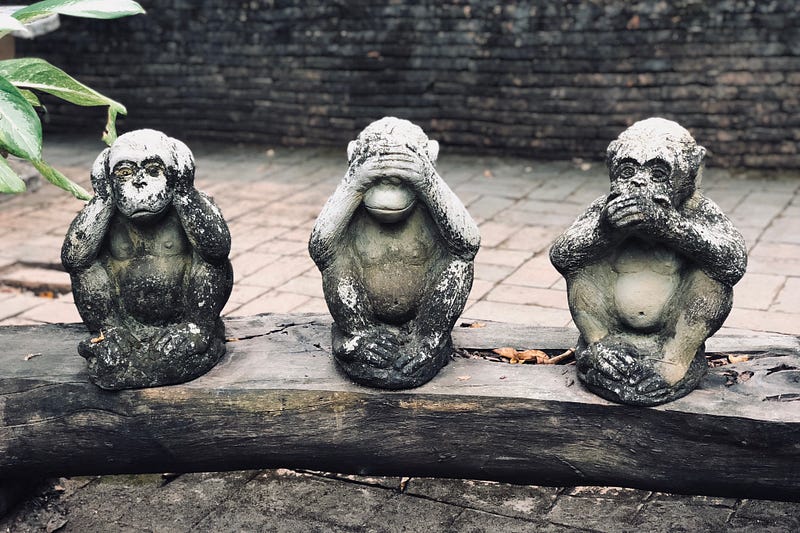
I had never heard of the word ‘Corruption’ until class sixth when our teacher gave us a project where we had to submit a report on the same topic.
But today, things have changed. I was sitting on the bench in the park one day, and my niece and nephew were playing with their friends, a group of kids, aged seven to nine.
They were playing the police and thief game. My nephew was role-playing a cop, and the other kid who had a mischievous smile was role-playing a thief.
I was watching them and enjoying their cute little act.
The thief (the other kid) acted to steal something and started running away from the cops. The cops, after running for a few minutes, caught the thief.
When the cop kid acted to handcuff him, the thief kid said, “Officer, why are you arresting me? You and I are the same. We both are corrupt, and everyone knows that. Just tell me your price, and we both will be happy”. All the other kids started laughing.
I could not believe what I had just heard and seen. Those were the young kids in front of me who were joking about the corruption in their innocent way. As the matter was serious, so I decided to intervene and talk to them about it.
I called the kids and asked them, “You all are good performers, but I am curious to know from where you learned such things about cops and corruption?”
“I have seen it on TV once,” one of the kids said excitedly.
The thief kid told me that he had heard his parents talking about corruption many times.
When I asked them about the meaning of corruption, they were silent, but one of the little boys said, “All Policemen are corrupt.”
It was shocking and disturbing to hear those words coming from an eight-year-old boy.
One thing was sure that they all had heard about corruption but they did not know its meaning. I told the kids that their parents must have been talking about some Crime television show. I told them that the Police protect good people and put bad people behind bars.
They looked convinced and went back to playing. “It is so easy to play with young minds”, I thought. And this is the reason why we should be more careful when children are around.
But it got me thinking about the society we live in today. If I had told the kids the whole truth, it could have done no good.
I was mad at their parents. They should not have talked about such things in front of young children. But I asked myself, were they the only guilty ones? What about me? I had also lied to kids. I had not told them the complete truth.
We, being responsible people, must understand that our negligence or ignorance towards such things is not going to solve anything. The word ‘corruption’ is damaging our life and it is making the atmosphere around us poisonous.
What is Corruption?
According to Google, the definition of corruption is, “Dishonest or fraudulent conduct by those in power, typically involving bribery.”
But in my opinion, “The people in the society who intend to ruin or damage anyone’s life using their influence of any kind, are corrupt.”
For example, when parents use their affection or love to poison their son’s mind against their daughter-in-law who is innocent, they are the corrupt parents because they are misusing their influence.
“The surest way to corrupt a youth is to instruct him to hold in higher esteem those who think alike than those who think differently.” — Nietzsche
It is so true. Every such person who misuses his power to get an advantage over others in any way is corrupt. The only person who is not corrupt is the one who is pure in his thoughts and deeds.
How to fight corruption
I have great reverence for Gandhi and I try to follow his teachings in my life.
Gandhi’s ‘Vow of Non-Thieving’ encompassed in it all aspects of corruption. Non-possession of things that we have more than we need, is the best solution to eradicate the corruption from the world.
©️ K A Simran 2019. All Rights Reserved.


