
Gandhi — The Disputed Sage
~Phases of /my/ Gandhi~ (#DiversityForReal)
Gandhi of childhood ~ was the man who wore rather few clothes and got India its independence. This skinny dude surrounded by people wearing white translucent garb either on a wheel or a march was the image of fight. As a kid, I have to say this was a good image of resistance. If I were angry I would just sit on my wheel (toys) or simply go about doing things I was told not to do and think this is how Gandhi got independence, this is the process of being heard. Weirdly, it did (temporarily) work. The protest in lack of classical protest had the world of parents and teachers confused, their usual methods of establishing control failed. It also made me different and unpopular. It did get me into unorthodox kinds of troubles.
Khadi stream of conscience bald head, salt shape Gandhi of my childhood was see through —
Gandhi of the young adult ~ Father of the nation. Hmmm. Weren’t there many fathers/mothers of the nation. Gandhi alone wasn’t the sole freedom fighter. An army of ideologies and strengths got us there. Growing up I read more about Rani Laxmi Bai, Tagore, Vallabhai Patel, Bhagat Singh and so on. I realised while ahimsa (non-violence) had a huge role to play. Other means of the fight were both required and commendable. I learned about the different aspects of approaching the right. Gandhi became an important element of diversity that we need for any kind of battle. But Gandhi also became a reflection of how others were equally important and needed. What their roles were. Through the lens of Gandhi I gained more respect for the wholistic movement of the freedom struggle. How these voices added up — to make a (somewhat) complete picture.
Ahimsa — white Blood — red Gandhi, the father with mud colored children The march of silence The march of anger The march of resistance One — destination
Gandhi during my Bachelors~ I did my bachelors in a small town in the state of Punjab. I lived in the hostel of my engineering college where most if not all students spoke Punjabi. In my first weeks I understood nothing of what was around me. On one of these days I was summoned in a room of angry young women telling me how Gandhi destroyed everything. I understood very little — except that I was being blamed for the possible wrongdoing of a long dead man. A man for the most of him — I liked. I protested and cried. They continued to be angry. I was utterly confused, what was even happening. How had a symbol of non-violence made a bunch of girls so angry. How had I become an extension of Gandhi — I didn’t even talk about him. I was just an outsider in that ecosystem and it was presumed that I loved the father of our nation. They weren’t completely wrong about any of that. They had finally found a person they could blame for all the wrong-doings they had suffered from. I was perplexed and sad. In Punjab, Gandhi was apparently more of what Churchill thought of him — a media manipulator, an image of fake purity. In short, Punjab seemed to hold Gandhi responsible for a lot of deaths that happened during the independence of India. To my angry college-mates, he was not only a credit stealer but also a person who had no problems turning a blind eye towards the plight of people during the division of India and Pakistan while being shown as the face of the pure freedom struggle. That night I learnt that Gandhi was not a saint. I was not surprised, the expectation of a leader to be a saint was thankfully already ridiculous to me.
Both Munnabhai M.B.B.S. and Lage Raho Munnabhai (superhit well-made Hindi movies celebrating the role of Gandhian ideologies in modern times) were released during my time in Punjab. While my family and rest of India were being entertained and reminiscing the values learned — I watched these two movies squashed between a bunch of angry girls hurling abuse at every instant of Gandhi praise. I don’t regret that at all. Their anger is/was valid to them. But in their anger they were also missing a lot of values in the art of ahimsa which by themselves had/have nothing to do with the individual Gandhi. In my time in Punjab all these women grew up to become my close friends. Somehow Gandhi taught me that my hero needn’t be my friends’ hero. And a hero can have (perceived to have) many very real and harmful flaws. Gandhi taught me that he wasn’t transparent and the world isn’t transparent. He taught me that I can make friends in a place where few are like me. That I can learn a new language and that I can learn to deal with the dislike of things I like. In my own way — again — I chose non-violence and for that I thank the Gandhi of my childhood. I always had my wheel (painting and writing) and I always had my march (I enjoyed the two Munnabhai movies despite the outrage)
Shades of the universe fall on the river of our hearts Draw lines or watch them play Fight — but don’t lose love
Gandhi of the in-between~I will merge some of the many Gandhi phases here. Over the years his ideologies got reinforced by the reverence of Gandhi while darker shades of his personality kept unfolding. Gandhi the racist. Gandhi the misogynist. Gandhi the molester. Gandhi the complete and utter hypocrite. Gandhi, still the father of our nation. I have chewed these allegations and researched their truth. Thankfully Punjab had prepared me enough to be not surprised by the reported “sins” of Gandhi. I can’t say it bothers me too much. To me, there isn’t enough to say that Gandhi really forced women to sleep with him (the role of consent seems not completely scrutinized in this scandal). However, other than that I do see how he could be and maybe was all of these horrible things. But again, when I zoomed out, I thought we spend too much time idealising people and then performing their character dissection. To me Gandhi was fiction — and like any well written character he had many shades — some downright hideous shades while others so saintly that he got coined — The Mahatma (great-soul). The image and anti-image of Gandhi both seemed blown out of proportion. In this phase, Gandhi became but a symbol. I had a choice — to defend, attack, love, hate Gandhi. Or revisit the symbolism and ask myself what can I do, what can I take from these stories. It was simple (at least for a while) — the idea of non-violence had nothing to do with Gandhi’s personal character.
“Ahimsa is the highest duty. Even if we cannot practice it in full, we must try to understand its spirit and refrain as far as is humanly possible from violence.”
This quote by Gandhi is bigger than Gandhi was my takeaway. This was not to dismiss the idea of Gandhi that must be disturbing to others, but to find my lesson from Gandhi.
In this sense Gandhi became the coin on one of which side was patriotism, purity, meditation, the white and on the other blood, pollution, the unjust, the disgusting, not white.
This contrast of Gandhi is the contrast of the world. Unfortunately/fortunately it does go to say how all shades reside in ONE. Reminds us of how we see what is relevant to us and ignore other shades of the story. And unfortunately/fortunately again every thing we see (Gandhi or not) has infinite such aspects to offer.
The decay of justice The impurity of blood made explicit The patriotism of blood in question The Gandhi on a stage The Gandhi nibbling on stolen air
The Gandhi — dissected
Gandhi of now~ After long (civil)debates and discussions with the lovers and haters of Gandhi including my own childhood idea of the man. Now, today on 02 October 2019 — Gandhi is a reminder of our human nature. How we worship people and strip them off their stardom. How we push and pull and look for answers and ideologies outside of ourselves. Symbolism of man and the symbolism of a country/tribe/ourselves are conflated. Gandhi today is a question mark really — as to what we take from the story of Gandhi (or any story for that matter). Stories of non- violence? Human natural spectrum? Role of media?
Or,
Bear with me — if it weren’t for Gandhi’s dubious duality we would never have seen one of the most beautiful disagreements and discussions we the people of this world can have. If it weren’t for Gandhi we wouldn’t have known of friendships and forward movements that can exist despite sharp disagreement.
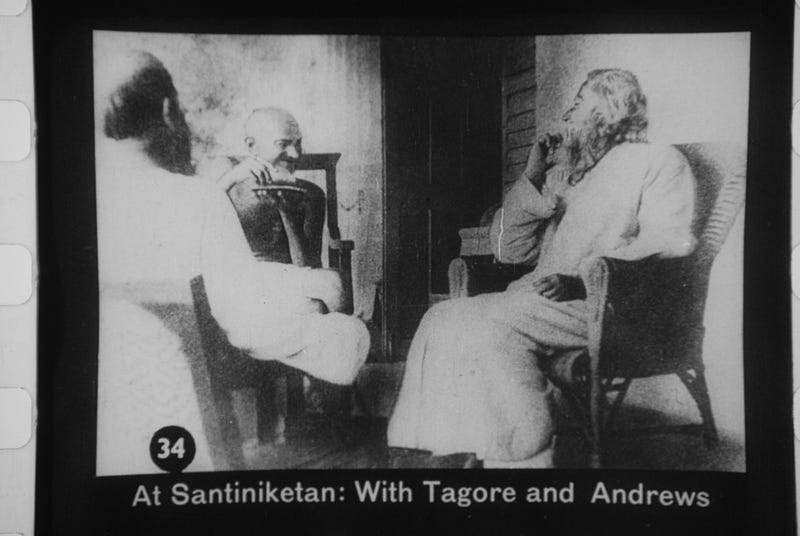
Tagore — in the most empathetic way asks Gandhi, pokes him, displays his agitations and teaches us the art of discourse. Their mutual respect, calculated conflict is an art-form that must be studied today. They exchanged poignant letters discussing their convictions with grace and honesty. In this they created a freedom struggle that rose above private ego and elevated to public ego.
Being critical of Gandhian ways, Tagore writes —
Dear Mahatmaji,
Power in all its forms is irrational; it is like the horse that drags the carriage blindfolded. The moral element in it is only represented in the man who drives the horse. Passive resistance is a force which is not necessarily moral in itself; it can be used against truth as well as for it. The danger inherent in all force grows stronger when it is likely to gain success, for then it becomes temptation…
Maybe Gandhi is everything but a sage, but it up-to us to allow this public figure to become a symbol of ordinary human actions and emotions and perhaps learn that disagreements can exist within one person, within friends, within fictional characters, within the world. It is up to us as how to handle these disagreements and find answers — for our forward movement.
Gandhi becomes shades rather than one person, he becomes a complex book/movie/character to be studied because of his easy public access — as a mirror to oneself. I do not wish to dismiss any of my phases of Gandhi or any of the aspects of Gandhi accessible to us — I only wish to utilise his life example for deep inspection. I guess that is what heroes (villains) are for.
The Gandhi, that who is a leader The Gandhi, that who is the question
Today is Gandhi’s birthday
Continuing Vaishali Paliwal’s thread Diversity For Real. #DiversityForReal


