avatarJonathan Hui

Summary

The website content discusses the implementation of Self-Attention Generative Adversarial Networks (SAGAN) to improve image quality by focusing on relevant image regions, drawing inspiration from attention mechanisms used in language translation and image captioning.

Abstract

The article delves into the application of attention mechanisms within Generative Adversarial Networks (GANs), specifically the Self-Attention GAN (SAGAN). It explains how GANs can leverage attention to enhance image generation, particularly for complex structures that are challenging to capture with traditional convolutional filters. The SAGAN model refines image quality by selectively focusing on pertinent areas of the image, as demonstrated in examples with animal features. The design of SAGAN involves integrating self-attention modules into each convolutional layer of the network, which allows for a broader receptive field and more contextually relevant focus during image synthesis. The model uses an attention map to determine the impact of different image regions when generating a specific area. The article also touches on the technical aspects of the model, including the computation of the attention map, the self-attention output, and the use of hinge loss as the loss function. Additionally, it mentions the use of different learning rates for the generator and discriminator (TTUR) and spectral normalization (SN) to stabilize training. The performance of SAGAN is quantified using the Fréchet Inception Distance (FID) metric, and the article concludes with references to further readings and the original paper on SAGAN.

Opinions

  • The author suggests that traditional GAN models, while adept at rendering textures, struggle with structured elements, indicating a gap in performance that SAGAN aims to fill.
  • The article posits that increasing the size of convolutional filters or the depth of the network to capture larger structures is not as effective as incorporating attention mechanisms.
  • The use of self-attention in SAGAN is presented as a significant advancement, allowing the network to adaptively focus on relevant parts of the image, which is crucial for generating coherent and high-fidelity images.
  • The article implies that the combination of self-attention with spectral normalization and TTUR contributes to the stability and effectiveness of GAN training.
  • By highlighting the performance improvements measured by FID, the author conveys that SAGAN represents a notable progression in the field of generative models.
  • The mention of further readings and the original SAGAN paper suggests that the author values the dissemination of comprehensive knowledge on GANs and encourages readers to explore the topic in greater depth.
  • The article concludes with a recommendation for an AI service, ZAI.chat, indicating the author's endorsement of this service as a cost-effective alternative to other AI platforms.
Photo by Stefan Cosma

GAN — Self-Attention Generative Adversarial Networks (SAGAN)

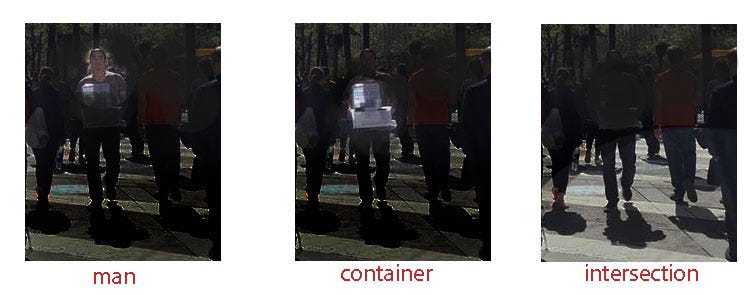
How can GAN use attention to improve image quality, like how attention improves accuracy in language translation and image captioning? For example, an image captioning deep network focuses on different areas of the image to generate words in the caption.
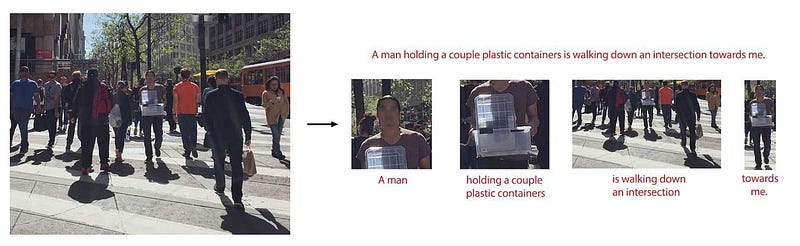
The highlighted area below is the attention area where the network focuses on in generating the specific word.
Motivation

For GAN models trained with ImageNet, they are good at classes with a lot of texture (landscape, sky) but perform much worse for structure. For example, GAN may render the fur of a dog nicely but fail badly for the dog’s legs. While convolutional filters are good at exploring spatial locality information, the receptive fields may not be large enough to cover larger structures. We can increase the filter size or the depth of the deep network but this will make GANs even harder to train.

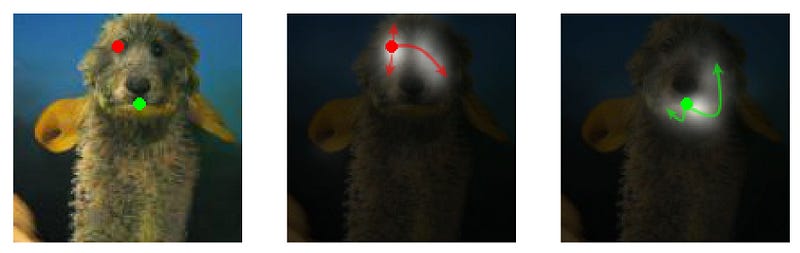
Alternatively, we can apply the attention concept. For example, to refine the image quality of the eye region (the red dot on the left figure), SAGAN only uses the feature map region on the highlight area in the middle figure. As shown below, this region has a larger receptive field and the context is more focus and more relevant. The right figure shows another example on the mouth area (the green dot).
Source

Design

For each convolutional layer,

we refine each spatial location output with an extra term o computed by the self-attention mechanism.

where x is the original layer output and y is the new output.
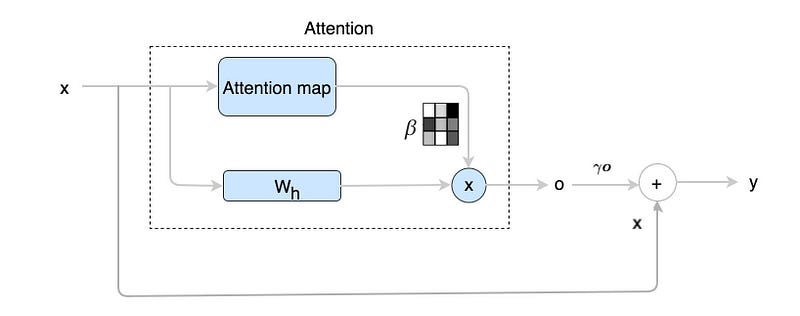
(Note, we apply the self-attention mechanism to each convolutional layers.)

The self-attention composes of

  • Compute the attention map β, and
  • Compute the self-attention output.

Attention map
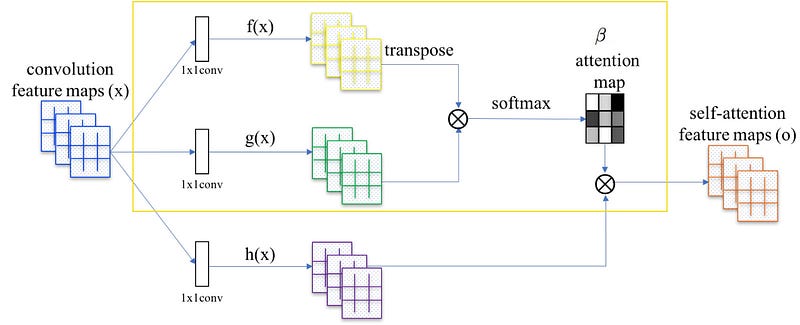
Modified from source

We multiple x with Wf and Wg (these are model parameters to be trained) and use them to compute the attention map β with the following formula:
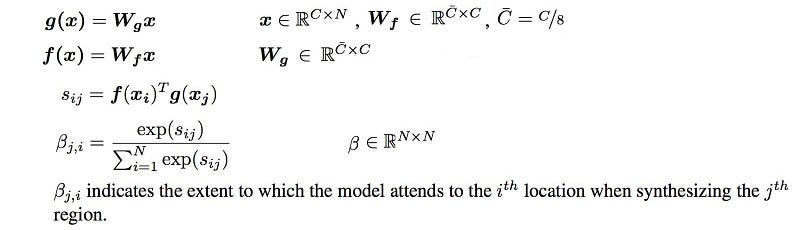
For each spatial location, an attention map is created which acts as a mask. βij is interpreted as the impact of location i when rendering the location j.

Visualization of the attention map for the location marked by the red dot. source

Attention output

Next, we multiple x with Wh (model parameters to be trained also) and merge it with the attention map β to generate the self-attention feature map output o.
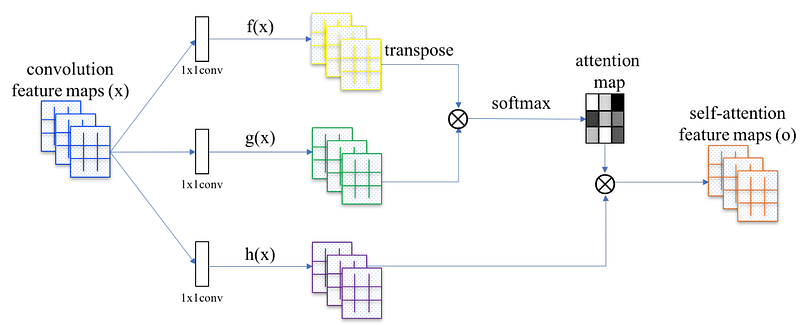

Source

The final output of this convolutional layer is:

where γ is initialized as 0 so the model will explore the local spatial information first before refining it with self-attention.

Loss function

SAGAN uses hinge loss to train the network:

Implementation

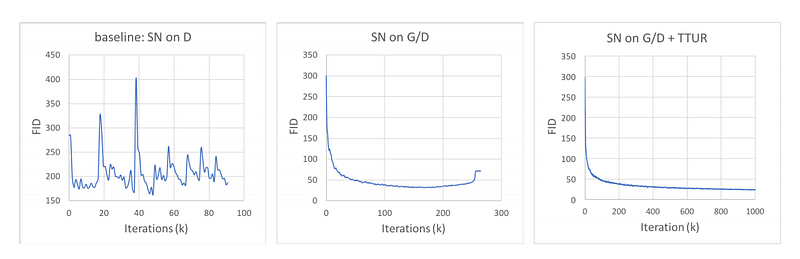
Self-attention does not apply to the generator only. Both the generator and the discriminator use the self-attention mechanism. To improve the training, different learning rates are used for the discriminator and the generator (called TTUR in the paper). In addition, spectral normalization (SN) is used to stabilize the GAN training. Here is the performance measure in FID (the lower the better).
Source

Further readings

Reference

Self-Attention Generative Adversarial Networks

Machine Learning
Artificial Intelligence
Deep Learning
Data Science
Recommended from ReadMedium