
Gaming: The Modern Demonization and Why I Still Play
It feels almost like starting a meeting in an Alcoholics Anonymous group.
Hello everyone, my name is Dima, I’m 30 years old, married, and I’m a gamer.
And I’m proud of it.
I’m proud that once again, I find the strength within me to stand against the popular public opinion that tries, over and over again, to pull you into a whirlpool of monotony and despondency.
But why does society continue to demonize the gaming industry?
Why am I writing this serious blog and still gaming?
Part 1. Social Space
Most of us have surely seen those news stories where a young man commits a shooting at a school.
Further investigation usually always shows that such people are lonely, introverted, and love to play video games.
And always, a particular emphasis is made on the latter.
Especially when it turns out that these individuals enjoyed playing various kinds of shooters.
And suddenly, no one is interested in delving into the psychological problems of the specific individual
Why they became introverted…
Why they had easy access to weapons…
All of that becomes irrelevant because society is convinced that if it weren’t for the games, he definitely wouldn’t have done it, as there is surely nothing good in them.
When society starts clamoring, solitary reasonable voices are no longer heard.
When yet another fitness blogger with 5,000 followers starts preaching about how much his life has changed for the better since he quit gaming and started engaging in “serious” activities, it only adds fuel to the fire and captures even more of the audience.
In this society, it seems easier to admit that you’re a heroin addict than a gamer.
I know many gamers.
Truly good people, who are simply cool and modest guys.
However, they would never discuss their passion publicly
No one would understand
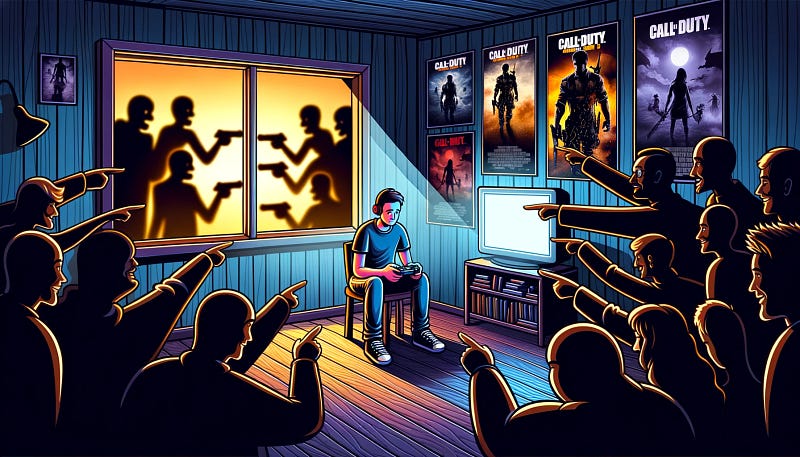
Most likely, they would even face judgment, complete with a twirl of the finger at the temple.
This is how depression, self-doubt, and impostor syndrome develop.
I also know not-so-great people in this sphere.
And it’s not the computer games that make them bad.
However, the virtual environment has one interesting characteristic:
Like money, it amplifies everything that is already present in a person.
The realization of impunity is a catalyst for human vices
Whether it’s the feeling that you can buy everyone
Or the understanding that there are 3,000 km between you and the person you’re communicating with.
Society also forgets the fact that games have been one of the fundamental tools for the development of humanity since ancient times.
🔹 It’s a simulation, a training ground for real skills.
Virtuality certainly takes us further away from our natural beginnings
Yet it creates a new space for self-expression and socialization.
It is a tool that, like any other, requires careful handling.
Part 2. Intriguing Facts
- Computer games are created by people, and just like people, they can be incredibly diverse.
- Like books, movies, TV shows, paintings, and any hobby, the majority of games are created with two goals in mind: to entertain the consumer and to take their money.
- All of the aforementioned are generally considered forms of art. And computer games are no exception.
- They are developed by incredible teams. Some work in small studios of 3–10 people, others in larger teams of 100–500, and some of the giants employ thousands of staff.
- Programmers, designers, scriptwriters, managers, voice actors, motion capture actors, composers — millions of jobs.
- The budgets for many of them are comparable to Hollywood blockbusters, and sometimes even surpass them.
- The average development time ranges from 3 to 5 years, sometimes longer, sometimes shorter.
- In any case, the gaming audience nearly reaches 3 billion people (a third of the entire world’s population‼️) — Source
- ️Interestingly, contrary to the expectations of many, the number of men and women is approximately equal. To be more precise, men still outnumber women, but only slightly — 55%. — Source
- In total, the global gaming industry generates 334 billion dollars in sales per year, and this amount grows annually. Source
Still think it’s all a joke?
Part 3. Game Categories and My Experience Through Them
Over time, I’ve managed to play almost all the main types of games.
So, what are they? Let’s start with the most disheartening.
3.1. Games with Elements of Random
Some games rely too heavily on this.
⚠️ This is the only category from which I would advise keeping a distance.
The first game I ever abandoned was exactly from this category: Hearthstone.
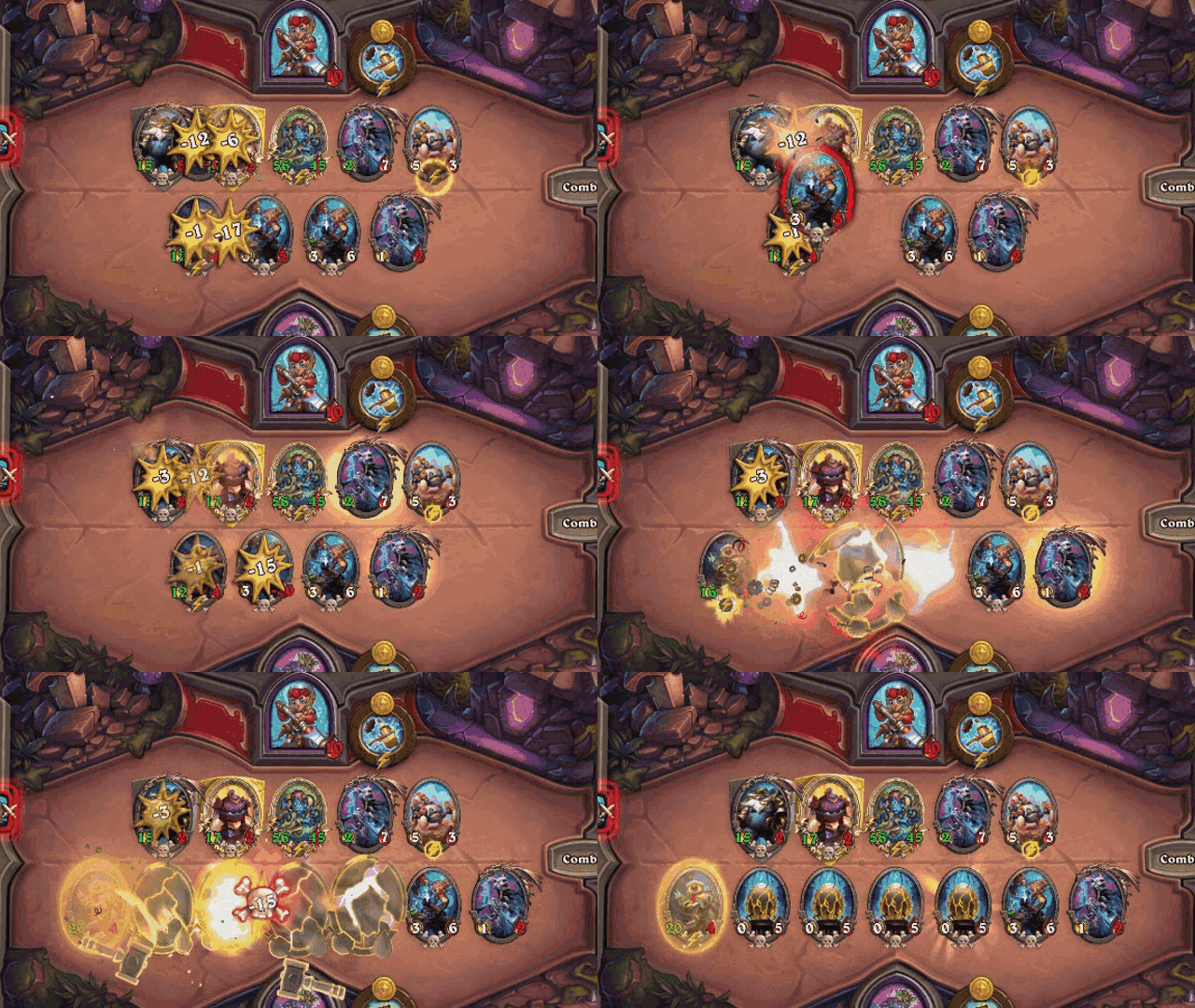
A game where you could spend an entire month climbing to the top.
And then lose everything in just a few hours.
Smells like a casino, doesn’t it?
Perhaps some find enjoyment in the process itself, and indeed, sometimes it does occur.
However, even 10 years ago, it didn’t take me long to realize that it wasn’t worth it.
3.2. Mobile Games
Nearly half of the gaming market is comprised of games that are always at your fingertips — mobile games on your phone.
These games are designed to take up as much of your time as possible, while subtly encouraging you to input your credit card details.
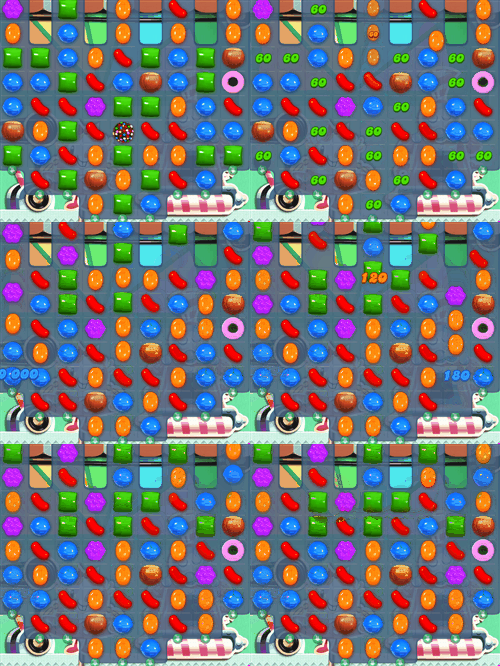
The characteristics are usually as follows:
- They are free.
- They lack a deep story.
- ️They are designed for short gaming sessions of 5–30 minutes, so you can find time to play anywhere, anytime.
- They focus on repetitive elements.
- You’ll never really finish these games; they contain thousands of levels.
- They rely, to some extent, on elements of random ⚠️
- To unlock new features, you’ll most likely need to pay real money.
- ️They offer minimal meaningful content.
I have never really found my place in this field over time.
But, I think it’s for the best 😅
There is a separate category of developers who release quite high-quality, charming, and kind games in which it’s pleasant to spend 10–20 hours, paying as much as you would for a movie ticket, sometimes even less.
But there are very, very few of them.
🔹 However, there are positive trends: mobile devices are becoming more powerful, and major companies that produce quality products for gaming consoles and computers are increasingly interested in this potential market.
Not so long ago, Apple made another breakthrough in this direction.
A game (Resident Evil 4 Remake) that has just been released for the most powerful gaming consoles will soon be available on all the company’s phones.
No one has done this before.
I’m eagerly waiting to see what happens next.
3.3. Online Multiplayer Games
Typically, this type of game is predominantly team-based.
There are two global subtypes here:
Session-Based
- Your session is, in one way or another, time-limited, usually to about an hour.
- ️With each new game, you have to start from scratch, only the experience from past victories and defeats remains with you.
One of the latest prize pools for one of these games, Dota 2, was a colossal 40 million dollars per team 😨
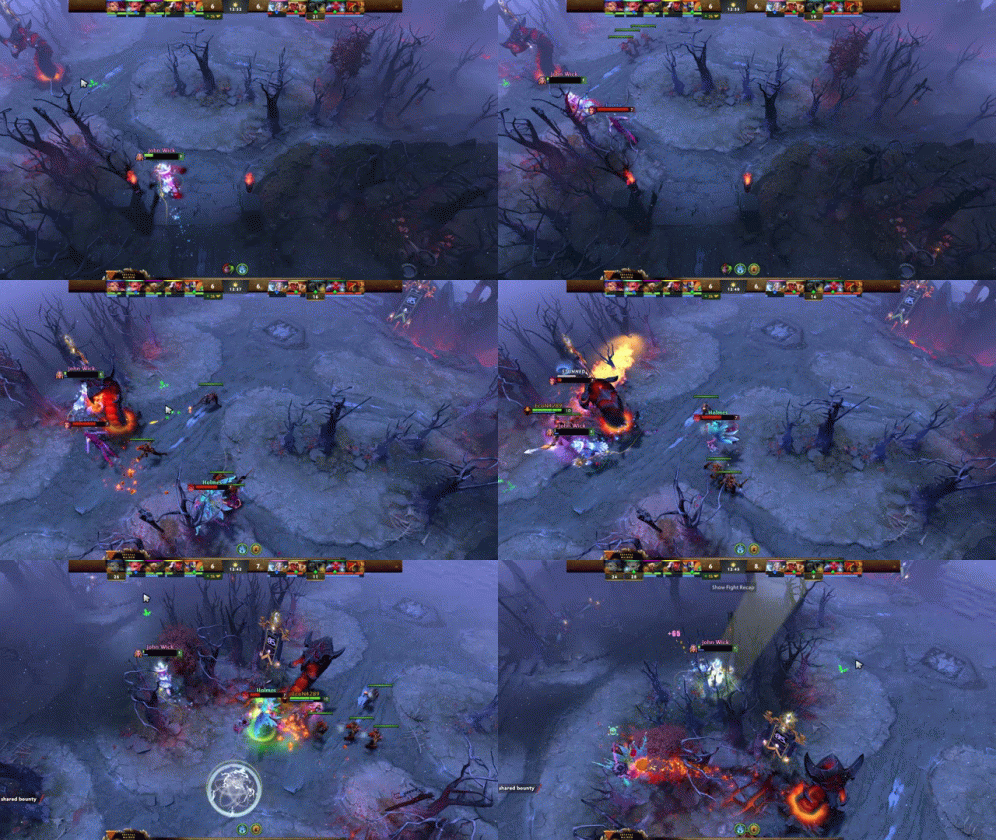
Such teams, just like Olympic athletes, go through “fire, water, and copper pipes” in pursuit of victory.
Years of training, not just in front of a computer, but also in the gym, trying to cope with back pain, neck pain, and carpal tunnel syndrome.
There’s no getting around the many hours of brainstorming sessions about winning strategies.
These are unique individuals.
Just as movies and series are made about the victories of real athletes, films and series are starting to be made about these gamers.
However, so far, this is mainly happening in China.
Links: one, two, and three (the last one is British)
In most typical realities, as usual,
Things are far from being so straightforward
You are alone, you don’t have a team.
More precisely, you do, but they’re picked by an automatic system,
People you see for the first time, with different beliefs, skill levels, and different motivations.
You want to play, you want to win
But your random partner is not as skilled as you are, and often dies at the hands of the opponent, leading to the enemy character becoming overly strong, and consequently, to your loss and the loss of your whole team.
Frustrating? Definitely.
Moving on to the saddest part, in such games there are usually text and voice chats.
And at the slightest mistake, your pseudo-partners won’t hesitate to indulge in foul language in the most sophisticated ways 🫢
In essence, it’s still the same element of random.
But it’s a bit more controllable, because equally poor teammates can also end up on your enemy’s team 😅
Some manage to enjoy the process.
But… that wasn’t my case. I got bored relatively quickly.
Because, just like in life, I came to win.
But you can’t win if you don’t have control over the situation.
Non-session games
Here, you create a character that you will play for a day, a week, a month, a year, two years or more.
The developers provide several development paths;
You can choose one or several, thereby giving the player the illusion of choice.
Why an illusion?
Because only one, or at most two, lead to significant growth in your character’s strength.
One of them copies elements from a session game, with all the ensuing consequences (with a team of 5 people).
The second one is unique. This is what people usually play these games for.
It’s a special group content — raids designed for 20 people, where you need to unite efforts to defeat the boss and get the best equipment for your character.
There is a certain period during which the dungeon is considered relevant — 4–6 months.
During this time, you need to manage to kill all the bosses, usually 8–12 of them, arranged in increasing order of difficulty.
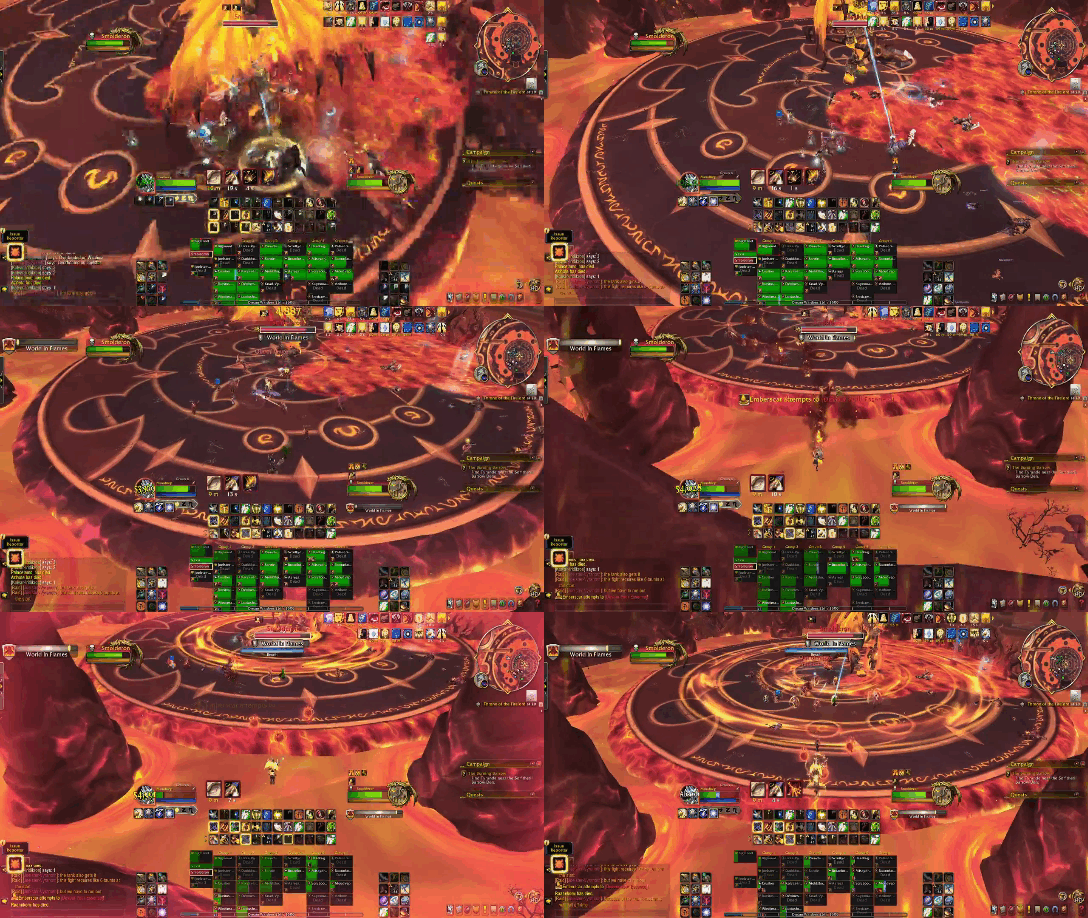
To defeat the final one, you need to bring a phenomenal amount of effort, comparable to the preparation of a professional league of cyber athletes.
Typically, these groups of people meet several times a week for 2–3 hours to try their hand.
During this time, people tend to become significantly attached to each other.
🔹 This is no longer just a simulation of relationships; it’s 95% full-fledged socialization.
By joining such a club, you have certain rights, obligations, responsibilities.
This pack has a leader and his deputies.
They perform the most important roles in maintaining the guild: developing strategies, are responsible for making lightning-fast and correct decisions during battle.
It doesn’t always work out, but that’s their duty.
In the professional league, everything is on a whole different level:
- Upon the release of a new update, they devote all their time to it.
- They play 10–14 hours a day for a week or two. What many people take months to achieve, they accomplish in a week.
- Tens of thousands of players watch their broadcasts, and huge amounts of money are also involved in this process.
- ️After completing the “learning” stage of the boss, when all the bosses have been killed for the first time, they start the “farming” stage and sell places in their raids to anyone interested. There are many of them.
- ️One such place can cost up to ~$1,500 😮
- ️They can take 2 to 5 such players in one raid, and organize about 10 such raids a day.
At one time, we also managed to make a bit of money in the gaming world, earning an additional ~$500 per month 😅
Once, I also had my own guild.
We achieved good results.
Despite the fact that I was an extremely questionable leader:
Young, authoritarian, impulsive, and loud 🤮
But… I used what life had taught me up to that point 😔
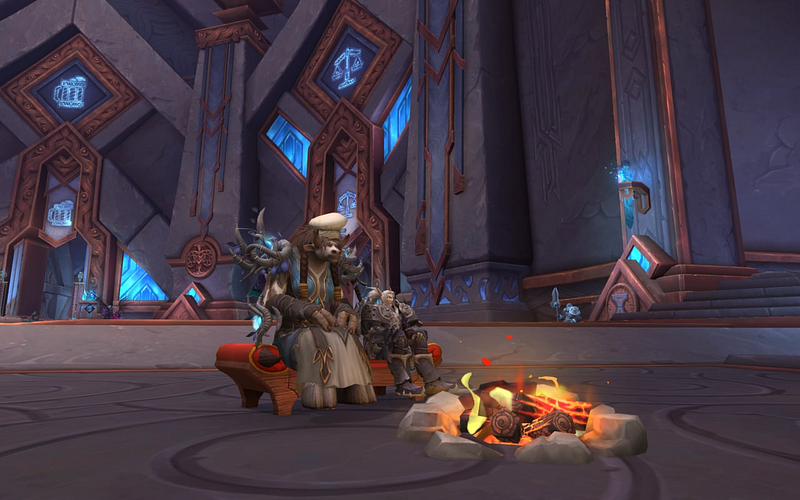
Our journey took 2 years.
The quality of the internet in my city deteriorated sharply, and it became unbearable to continue playing.
The decision was made to leave it all behind.
The “family” that was built with hard work, patience, and impatience, after approximately 6,500 hours (!!) spent together…
It was all crossed out in one day.
What lessons can be learned from all this?
- Teamwork is stressful.
- My first and last nervous breakdown, during one of the sessions, made me think about my well-being for the first time.
- I learned the basics of economics regarding “supply and demand”, price dumping, inflation, the influence of human moods on pricing.
- I began to think about how motivation affects people, what can keep people, how to encourage them to join your goals.
- I created my first website posted on the Internet — for recruiting purposes.
- I learned to analyze qualitative and quantitative data to make long-term decisions.
- ️Planning and risk assessment.
- ️The basics of time management.
- Emotion control, and, first and foremost, anger control.
- How the level of expectations affects our perception of the situation.
- Significant boost in English skill.
I still use all of these skills, without exception, in life and work, in software development.
I’ve been using many of them for quite some time.
A greater level of calmness came a little later.
🔹 And only quite recently I began to realize what it means to be a true leader.
And there is still much to learn here.
Would I recommend this experience?
Definitely — yes. But don’t push yourself as hard as I did 😅.
Would I repeat it?
Only if I have enough free time and health.
We have already realized the value of time, but I no longer have the health to sit for 3 hours in one position 😵.
So… probably unlikely. 😅
3.4. Single-player Games
And so, we’ve come to the gem of my collection.
🤤 My passion, my hobby, one of my sources of new experiences.
A source of motivation and inspiration.
This category gathers the very best that the gaming industry has to offer.
It’s like high-end restaurants.
In this section, developers leverage cutting-edge technologies and aren’t afraid to try out new ideas.
Some of these games, even the very best ones, offer cooperative gameplay for two to four players.
My wife and I have enjoyed many of them together, creating some of our best moments.
The joy, emotions, and genuine happiness we experience during these games are simple yet rare treasures in today’s world.
These games can be developed by small studios with just a few dozen employees, or by large companies with hundreds on their payroll.
Their prices can range from a few dollars to ~70 dollars 🤑
I don’t regret a single penny spent.
Some games are based on books and comics.
However, there is a vast array of original franchises across various genres that you won’t find in movies, books, TV shows, or anywhere else!
This is a unique experience.
Recently, there has been a trend of creating movies and TV shows based on these original game franchises.
The most successful to date is the TV series “The Last of Us”
It has been warmly received by both critics and fans of the original game.
This is a rare occurrence, as most film adaptations change too much for the modern audience, simplify too much, and lose the original essence, leading to great disappointment for fans and the failure of the entire adaptation idea.
And do you know the secret?
The creators of the adaptation simply followed the original plot, invented nothing new, rewrote nothing, and, together with the game’s authors, revealed more about the main characters and aspects that were missed during the game’s development.
On the other hand, the recent adaptation of the great saga “The Witcher” by Netflix was a disappointment.
Especially since my conscious gaming journey began with the game about Geralt of Rivia. (By the way, the book by Andrzej Sapkowski is the original source.)
The first game that made me cry for 30 minutes after finishing it was “The Witcher 3: Wild Hunt” 😭
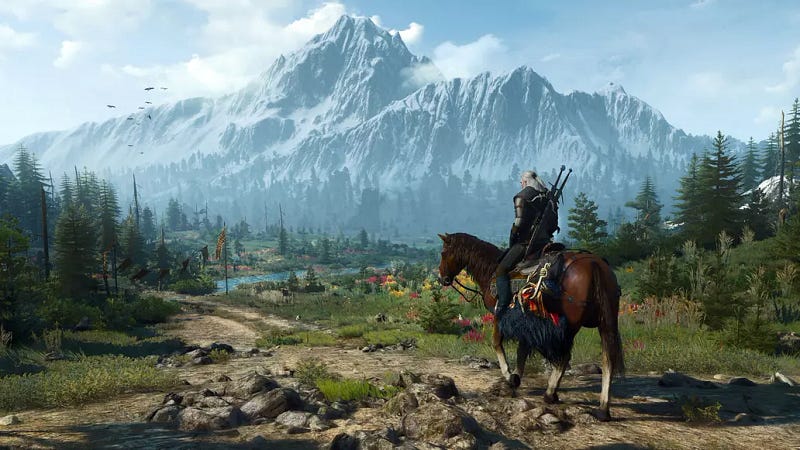
I remember it as if it were yesterday:
2015, summer, dawn visible from the balcony 🌅
I couldn’t react any other way.
That’s when I set a goal to buy my first gaming PC, to try everything I had missed and everything that was yet to come.
Two years later, I achieved this goal.
I’ve transformed into so many amazing characters and places 🤪
I’ve worn Batman’s cloak, explored the mysteries of Ancient Egypt, and even been the tomb raider herself, Lara Croft 😅
That was just the beginning, and since then, I’ve been the main character in dozens of amazing and unforgettable stories, which I still recall fondly, warming my soul 🥰
This was not just entertainment, although it could be considered as such.
🔥 These were deep stories about difficult moral choices, good and evil, betrayal, love, self-sacrifice, heroism, and friendship.
Writing these lines, I had to take a break, recalling the emotions I experienced, and I couldn’t help but shed a tear or two. This is my first article of this kind 🥹
All these themes and scripts are written by people who wanted to share their view of the world through the lens of virtual world characters.
Characters experience the same stories and emotions as real people.
Some things you have already experienced yourself
While others are yet to come, making you reflect…
A few years ago, I started keeping a list of games I’ve played.
So I wouldn’t forget,
So I could periodically review, recall, and compare.
Some years see the release of several masterpieces, while others have none.
I strive to see as many positive things in this life as possible.
And it’s a bit sad to realize that you won’t see that many masterpieces in this field in your lifetime.
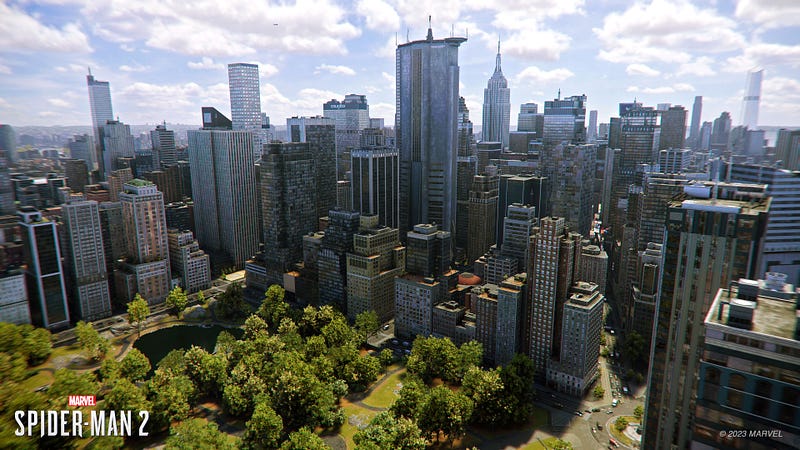
Adventures in the virtual world go hand in hand with studying English material.
Once, I had significant difficulties with listening comprehension.
After two years of English-only games, I’ve listened to hundreds of hours of content, which has greatly strengthened my skills, aided me in my job, and continues to help when working in public spaces.
Part 4. Conclusion
As always, first and foremost, I just wanted to express what was on my mind.
With a faint hope that it might contribute to the general perception of gaming.
And, perhaps, over time, there will be fewer traumatized and insecure children.
Parents will become more tolerant of such hobbies.
Will I play until the end of my days?
I don’t know.
It goes against our physical nature.
And someday I might take a longer break.
But I sincerely believe that I will return.
I am greatly motivated by famous and successful people, such as Henry Cavill and Hideo Kojima, who, despite their age and success, still find the strength and time to play.
This is a part of me.
People often compliment me on my life experience, my way of thinking…
They often forget…
Forget what exactly made me who I am now.
I can’t imagine what kind of person I would have become if my parents didn’t have a computer on which, in my early childhood, which I barely remember, I played Warcraft 2 for the first time.
The desire to win, the spirit of competition, simulating failures.
All this forged and strengthened the “mental skeleton” that I ride on to this day.
If you liked the article, you can follow me on X (former Twitter) as well.


