"><figcaption></figcaption></figure><p id="5b43">After a little walk, Manu and I found ourselves in the midst of more temples in ruins, which seemed to be from the same era as the Krimchi temples. Once upon a time, the temple bells would have rung, conches would have sounded and the voice of a Pujari doing puja would have wafted from the temple under the same blue skies but now, there was just silence and stillness. And yet, it was beautiful.</p><figure id="b08a"><img src="https://cdn-images-1.readmedium.com/v2/resize:fit:800/1*[email protected]"><figcaption></figcaption></figure><figure id="8a11"><img src="https://cdn-images-1.readmedium.com/v2/resize:fit:800/1*[email protected]"><figcaption></figcaption></figure><p id="73f2">I was intrigued by the name Babour. When I looked it up later, I came to know that it was a distortion of Babbapura, the old name of the place, which was mentioned in the famous <i>Rajatarangini</i>, the historical chronicle of the kings of Jammu and Kashmir. I dug out a 1907 <a href="https://www.jstor.org/stable/25210417">paper</a> by Dutch archaeologist Jean-Philippe Vogel in which he established that Babour was the same as Babbapura and also that it was destroyed by invaders. He said:</p><blockquote id="b223"><p>On Survey sheet No. 29 the spot is marked as “ Pandoo ruin,” on account of the local tradition which ascribes the origin of the place to the sons of Pandu. The site contains no less than seven temples built of heavy stones. Two of them are a mere mass of debris. Five are still standing, two being used for worship up to the present day, but all exhibit a more or less advanced stage of decay. There is every evidence that the town which once stood on this spot shared the fate of so many Indian cities at the hands of foreign invaders.</p></blockquote><p id="6ed9">The Dera Babour temple was far more intact than the ones at Krimchi. The columns of the mandapa still held up parts of the ceiling. Several sculptures could be seen somewhat clearly. I looked at the empty <i>garbagrihas</i> and wondered which <i>rupa</i> of Shiva and Parvati had once adorned the spaces. The sunlight streaming inside the temple created a unique ambience.</p><figure id="6aff"><img src="https://cdn-images-1.readmedium.com/v2/resize:fit:800/1*[email protected]"><figcaption></figcaption></figure><figure id="b8a2"><img src="https://cdn-images-1.readmedium.com/v2/resize:fit:800/1*[email protected]"><figcaption></figcaption></figure><figure id="8714"><img src="https://cdn-images-1.readmedium.com/v2/resize:fit:800/1*[email protected]"><figcaption></figcaption></figure><figure id="8426"><img src="https://cdn-images-1.readmedium.com/v2/resize:fit:800/1*[email protected]"><figcaption></figcaption></figure><figure id="ba1f"><img src="https://cdn-images-1.readmedium.com/v2/resize:fit:800/1*[email protected]"><figcaption></figcaption></figure><figure id="b884"><img src="https://cdn-images-1.readmedium.com/v2/resize:fit:800/1*[email protected]"><figcaption></figcaption></figure><figure id="d04a"><img src="https://cdn-images-1.readmedium.com/v2/resize:fit:800/1*[email protected]"><figcaption></figcaption></figure><figure id="7fd2"><img src="https://cdn-images-1.readmedium.com/v2/resize:fit:800/1*[email protected]"><figcaption></figcaption></figure><p id="7183">I learned that Babbapura might have been named after Babruvahana. But Babruvahana was the son of Chitrangada (and Arjuna) who ruled over Manipura in the northeast of India. Could he have had ties with this part of the country? Certainly not impossible in a civilization where a Greek built a temple for Krishna in a place thousands of miles away from Greece.</p><p id="a18c">Our car driver took note of Manu and me talking animatedly about temples and asked if we would like to visit the Narsingh Temple near his village. He said it would not be too much out from the way to Mansar Lake. “It’s a temple where hundreds of people go to get wishes fulfilled,” he added. Of course, we both had wishes to seek so off we went to the temple.</p><p id="a6fd">I was mesmerized by the serene beauty all around me. Manu kept telling me stories from the folklore of Jammu. I was glad she remembered to bring along her recently authored book <i>Mountain Goddesses — Finding Feminine Power from an Unexpected Place </i>which I later read on the flight back from Jammu to Delhi. She has described the significance of Devis in the Jammu region such as Baawe Wali Mata, Vaishno Devi, Sukrala Mata, Mahamaya, Pingla Mata, Chauntra Mata, Machhail Mindhal Mata, Sarthal Mata, Mata Mangla Devi, Sheetla Mata, Chanchloyee Mata and Nagani Mata (Mansa Devi). She has also described the Kuldevis and women warriors of the region. Such is the love for the Divine Mother in Jammu that the locals greet each other not with Namaste or Ram Ram but Jai Mata Di.</p><figure id="9208"><img src="https://cdn-images-1.readmedium.com/v2/resize:fit:800/1*[email protected]"><figcaption></figcaption></figure><p id="b8db">Soon, we were at Jansaal, at the entrance of Shri Narsingh temple and climbing the steps. Hindu temples are often atop sacred hills and devotees reach the temple only after expending some energy. There’s a nice feeling one gets after climbing to the top of a hill to get the darshan of a devata.</p><figure id="c27e"><img src="https://cdn-images-1.readmedium.com/v2/resize:fit:800/1*[email protected]"><figcaption></figcaption></figure><p id="87c5">There were beautiful views all around as we climbed up, and when I reached the top, a cool breeze began to blow and it felt so caressing. Just like the Baawe Waali Mata temple, this one too was neat and quiet. It evoked memories of times when temples were uncrowded and uplifting. The time for darshan was over at 12 noon itself and the pujari had changed from traditional clothing to trousers and shirt, which was a bit of a dampener for me.</p>
<figure id="ed8a">
<div>
<div>
<img class="ratio" src="http://placehold.it/16x9">
<iframe class="" src="https://cdn.embedly.com/widgets/media.html?src=https%3A%2F%2Fwww.youtube.com%2Fembed%2FYPyK_uz3Oqk&display_name=YouTube&url=https%3A%2F%2Fwww.youtube.com%2Fwatch%3Fv%3DYPyK_uz3Oqk&image=http%3A%2F%2Fi.ytimg.com%2Fvi%2FYPyK_uz3Oqk%2Fhqdefault.jpg&key=a19fcc184b9711e1b4764040d3dc5c07&type=text%2Fhtml&schema=youtube" allowfullscreen="" frameborder="0" height="480" width="854">
</div>
</div>
</figure></iframe></div></div></figure><p id="9202">Narasimha Avatara is one of my dearest Avataras of Vishnu and I can never tire of the story of how he came to the rescue of his young Bhakta Prahlada to destroy the Rakshasa Hiranyakashipu (but also to release the Rakshasa from his evil life which he had got as the result of a curse). I learned from the Pujari that Vishnu was only worshipped in the form of the sacred Saligrama stones in Jammu and not in the form of any moorti. The Saligrama stones were all covered by a cloth since the last puja was over at noon. However, pictures of the fierce Narasimha were all around. When I asked the pujari why the temple’s pujas concluded so early and why there was no evening aarti, he told an interesting story.</p>
<figure id="8788">
<div>
<div>
<img class="ratio" src="http://placehold.it/16x9">
<iframe class="" src="https://cdn.embedly.com/widgets/media.html?src=https%3A%2F%2Fwww.youtube.com%2Fembed%2FTV4irc75LP4%3Ffeature%3Doembed&display_name=YouTube&url=https%3A%2F%2Fwww.youtube.com%2Fwatch%3Fv%3DTV4irc75LP4&image=https%3A%2F%2Fi.ytimg.com%2Fvi%2FTV4irc75LP4%2Fhqdefault.jpg&key=a19fcc184b9711e1b4764040d3dc5c07&type=text%2Fhtml&schema=youtube" allowfullscreen="" frameborder="0" height="480" width="854">
</div>
</div>
</figure></iframe></div></div></figure><p id="1c7e">There was also another story about a weighing balance that once stood in the temple and which could be used to adjudicate in disputes. The disputing parties would put their case before Narasimha Bhagwan and as soon as the aarti got over and the conch sounded, the weighing balance would tilt in favour of the person who was right and in this manner, justice would be delivered. When the king came to know about this, he was not too pleased because as per the law of the times, he was the final authority for disputes. The events that happened next and how the balance was finally destroyed were narrated to us by the Pujari as we heard in rapt attention.</p>
<figure id="0bf9">
<div>
<div>
<img class="ratio" src="http://placehold.it/16x9">
<iframe class="" src="https://cdn.embedly.com/widgets/media.html?src=https%3A%2F%2Fwww.youtube.com%2Fembed%2FZnPr5PBnllA%3Ffeature%3Doembed&display_name=YouTube&url=https%3A%2F%2Fwww.youtube.com%2Fwatch%3Fv%3DZnPr5PBnllA&image=https%3A%2F%2Fi.ytimg.com%2Fvi%2FZnPr5PBnllA%2Fhqdefault.jpg&key=a19fcc184b9711e1b4764040d3dc5c07&type=text%2Fhtml&schema=youtube" allowfullscreen="" frameborder="0" height="480" width="854">
</div>
</div>
</figure></iframe></div></div></figure><p id="1b17">Finally, the pujari asked us to wish for any
Options
thing from Narasimha. He told us that thousands of people came there to ask for wishes and when they got fulfilled, they returned to donate clay pots to the temple. I did as he asked. May I soon return to the temple to offer my thanks with clay pots like these.</p><figure id="7a40"><img src="https://cdn-images-1.readmedium.com/v2/resize:fit:800/1*[email protected]"><figcaption></figcaption></figure><p id="a85e">All over Jammu, (and perhaps Himachal Pradesh too) there is a peculiar manner in which Hindus express their gratitude for wishes fulfilled. They get moortis carved of Bheem Devata and donate them. On the previous day, Kirpal Singh ji had taken me to a place where there were dozens of carvings of Bheem Devata that people had got made as a thanksgiving. It was fascinating for me as I come from the Madhva Sampradaya which venerates Bheema as an Avatara of Vayu. However, Manu informed me that the Bheema Devata carvings in Jammu might not really depict the Bheema we admire in Mahabharata but could be a local hero or deity. Oh well, yet another mystery.</p>
<figure id="8aa6">
<div>
<div>
<img class="ratio" src="http://placehold.it/16x9">
<iframe class="" src="https://cdn.embedly.com/widgets/media.html?src=https%3A%2F%2Fwww.youtube.com%2Fembed%2FU6ZidQLfbgI%3Ffeature%3Doembed&display_name=YouTube&url=https%3A%2F%2Fwww.youtube.com%2Fwatch%3Fv%3DU6ZidQLfbgI&image=https%3A%2F%2Fi.ytimg.com%2Fvi%2FU6ZidQLfbgI%2Fhqdefault.jpg&key=a19fcc184b9711e1b4764040d3dc5c07&type=text%2Fhtml&schema=youtube" allowfullscreen="" frameborder="0" height="480" width="854">
</div>
</div>
</figure></iframe></div></div></figure><p id="0ff7">Just in passing, I asked the driver if he lived nearby since he had mentioned that the temple was in his village. He immediately started calling his wife on the phone to tell her we were coming! Manu and I remonstrated with him and said we did not have much time left and there was still the Mansar Lake to visit. He said it would not take much time. And thus we stopped in front of a house which belonged to the driver’s chacha and chachi. He told us that his house was just behind and we could walk to it. When we again repeated that it would soon get dark, the driver asked his wife and sons to quickly get ready and come to meet us. Meanwhile, I began to film the beautiful hilly terrain all around. How idyllic it was! I wondered if it got cold in the winter but they said no, it was pleasant. Suddenly, the chachi emerged from the street carrying two pails of fresh water from a <i>baoli</i>. At first, she looked a little grumpy because I was filming her.</p>
<figure id="e3d7">
<div>
<div>
<img class="ratio" src="http://placehold.it/16x9">
<iframe class="" src="https://cdn.embedly.com/widgets/media.html?src=https%3A%2F%2Fwww.youtube.com%2Fembed%2F92FDiVPbnkA%3Ffeature%3Doembed&display_name=YouTube&url=https%3A%2F%2Fwww.youtube.com%2Fwatch%3Fv%3D92FDiVPbnkA&image=https%3A%2F%2Fi.ytimg.com%2Fvi%2F92FDiVPbnkA%2Fhqdefault.jpg&key=a19fcc184b9711e1b4764040d3dc5c07&type=text%2Fhtml&schema=youtube" allowfullscreen="" frameborder="0" height="480" width="854">
</div>
</div>
</figure></iframe></div></div></figure><p id="44ab">But within minutes, she remembered the tradition of hospitality and insisted that we should go inside her house and taste the water she had just brought from the <i>baoli</i>. I was in a bind because I knew that my immunity levels might be way lower than the locals because of living in the US and I could fall sick from drinking water. Despite my protests, the lady sat us down and gave us two big glasses of water from the pails she had just carried. Manu drank it up saying she was used to drinking local water. I just took a sip with utmost fear and returned the glass. Later, the chachi said that the water from the <i>baoli </i>had even been tested by some government authority and it was perfectly safe, so I should have drunk it. Oh well…me and my stupid misgivings.</p>
<figure id="33e5">
<div>
<div>
<img class="ratio" src="http://placehold.it/16x9">
<iframe class="" src="https://cdn.embedly.com/widgets/media.html?src=https%3A%2F%2Fwww.youtube.com%2Fembed%2FlQ-NmzwT0m8%3Ffeature%3Doembed&display_name=YouTube&url=https%3A%2F%2Fwww.youtube.com%2Fwatch%3Fv%3DlQ-NmzwT0m8&image=https%3A%2F%2Fi.ytimg.com%2Fvi%2FlQ-NmzwT0m8%2Fhqdefault.jpg&key=a19fcc184b9711e1b4764040d3dc5c07&type=text%2Fhtml&schema=youtube" allowfullscreen="" frameborder="0" height="480" width="854">
</div>
</div>
</figure></iframe></div></div></figure><p id="314e">Next, we made our way to Mansar Lake. I witnessed first-hand a biological disaster with invasive fish taking over the lake. Read my account of the invaders <a href="https://medium.com/@sahana.singh/invasive-fish-have-caused-an-ecological-disaster-at-mansar-lake-aba0446bb603">here</a>.</p><p id="59ca">I had begun to feel a little tired and wondered whether Kehwa, the famous beverage of Kashmir was also available in Jammu. Manu said it was very much a Jammu beverage as well though not available at every place. She suggested that we could have it at the restaurant near Amar Mahal, the palace built by Maharaja Amar Singh. I jumped at the idea. Long ago, when I had been tired at the end of long day, my mother, sister and I had been offered Kehwa at a Kashmiri handicrafts shop which was so refreshing that I had never forgotten it.</p><p id="60c9">Not far from Amar Mahal, there is the Mubarak Mandi Palace which looks breathtaking. There was no time to visit it but I heard it was in ruins and not at all maintained by the government, which is very sad. Even just looking at it from a distance was so captivating that I could not look away from it.</p><figure id="c919"><img src="https://cdn-images-1.readmedium.com/v2/resize:fit:800/1*[email protected]"><figcaption></figcaption></figure><p id="362b">Amar Mahal has been converted into a museum. It was closed by the time we reached it. However, Manu gave me an excellent briefing on the history of the Dogra Maharajas.</p>
<figure id="fb86">
<div>
<div>
<img class="ratio" src="http://placehold.it/16x9">
<iframe class="" src="https://cdn.embedly.com/widgets/media.html?src=https%3A%2F%2Fwww.youtube.com%2Fembed%2FIdUUQ5vmGKE&display_name=YouTube&url=https%3A%2F%2Fwww.youtube.com%2Fwatch%3Fv%3DIdUUQ5vmGKE&image=http%3A%2F%2Fi.ytimg.com%2Fvi%2FIdUUQ5vmGKE%2Fhqdefault.jpg&key=a19fcc184b9711e1b4764040d3dc5c07&type=text%2Fhtml&schema=youtube" allowfullscreen="" frameborder="0" height="480" width="854">
</div>
</div>
</figure></iframe></div></div></figure><p id="9a6c">Finally, it was time to unwind with some delicious Kehwa and snacks like Crispy Nadru (lotus stem) at Hari Niwas while soaking in spectacular views of the Tawi River. It was hard to believe that I was not in a dream.</p><figure id="52ef"><img src="https://cdn-images-1.readmedium.com/v2/resize:fit:800/1*[email protected]"><figcaption></figcaption></figure><p id="d78a">I owe so much to Manu for having learned about beautiful Jammu. Until now, it was the Kashmir Valley that got all my attention when I thought about the erstwhile state of Jammu and Kashmir. I never thought of Jammu as a separate entity. Most of us say “Kashmir” when we mean ‘Jammu and Kashmir’. The issues of Kashmiri Pandits make many of us get all worked up but we don’t spare a thought for the neglected Dogras of Jammu. Now I can see the huge injustice which has been done to the people of Jammu since 1947 after the Abdullah family took over the political reins. While Kashmir got all the attention and resources (which were misappropriated by the corrupt politicians), Jammu was relegated to the background. All this happened despite the fact that Kashmir formed only a tiny part of the earlier state of J&K. Ladakh was neglected even worse than Jammu. Manu has been espousing the cause of the Dogras of Jammu for a long time. Many are the Dogras who have laid down their lives for Bharat. It is high time we recognised the value of Jammu, its history and contributions.</p><p id="a583">To give an example of how Jammu is bypassed even in the terminologies used by news media, think of the world’s highest railway bridge which is being currently constructed over the Chenab River and is hailed as an engineering marvel. The bridge is located entirely in the Reasi District of the Jammu region. It will help to connect the districts in Jammu with the districts in Kashmir and at the same time connect J&K with the rest of India. And yet, Jammu is often left out of the headlines.</p><figure id="7837"><img src="https://cdn-images-1.readmedium.com/v2/resize:fit:800/1*t12dxqiLTAVtG74YQ7QLXA.png"><figcaption></figcaption></figure><figure id="d437"><img src="https://cdn-images-1.readmedium.com/v2/resize:fit:800/1*n8f-be7gtKEBAlnCc8wUUg.png"><figcaption></figcaption></figure><p id="f543">It is high time we included Jammu’s rich narratives and traditions in the rich tapestry of Bharat’s culture.</p><p id="5dbf">Jai Mata Di!</p></article></body>
G20, Temples, History and Sacred Water Bodies — My Dream Trip to Jammu (Part 2)
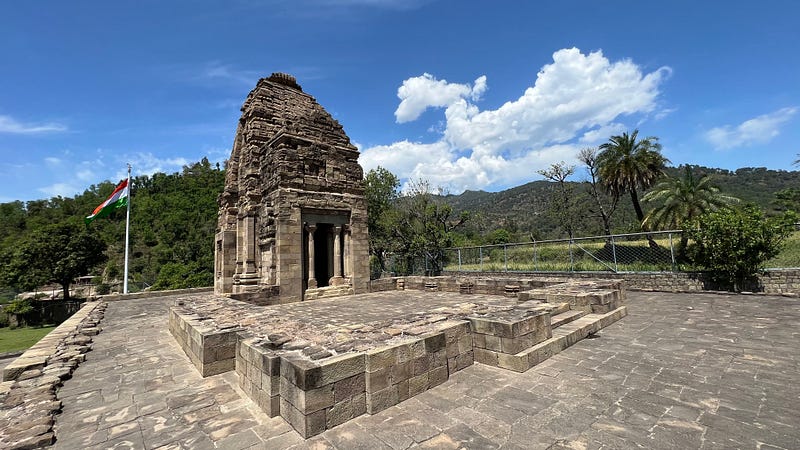
It was my last free day at Jammu after the Y20 consultation at the University of Jammu (a side event of G20) and I wondered how much I would be able to pack into it. Who knows when I would visit this region again; I wanted to soak in as much as possible. Manu Khajuria, my Jammu-born, UK-based friend said she would first take me to the Krimchi temples in Udhampur District, which were associated with the visit of the Pandavas during the Mahabharata period followed by Dera Babour temples and then we could visit Lake Mansar. So, off we went in her car, and as we crossed the Tawi River, I began to recognise some landmarks that I had seen on the previous day.
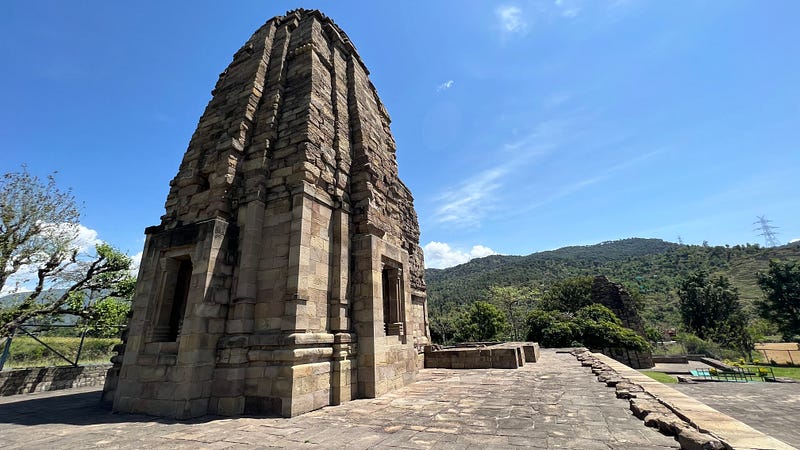
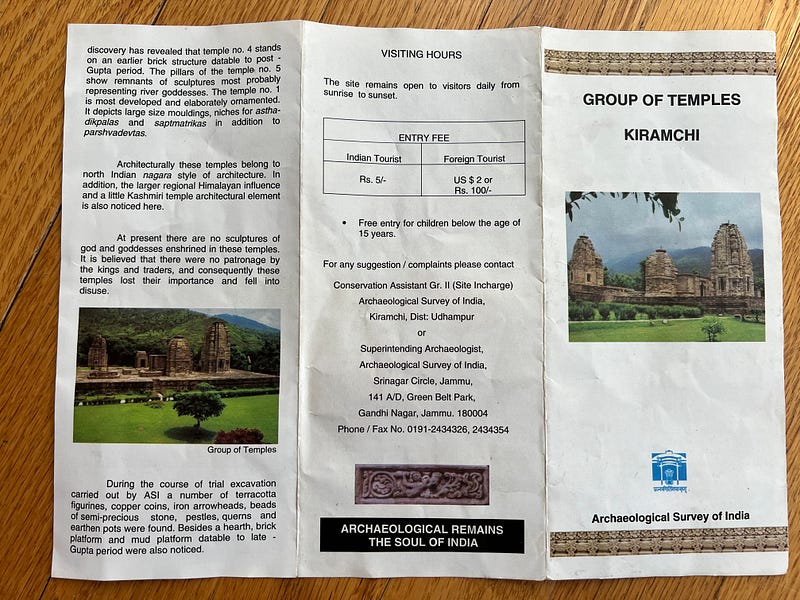
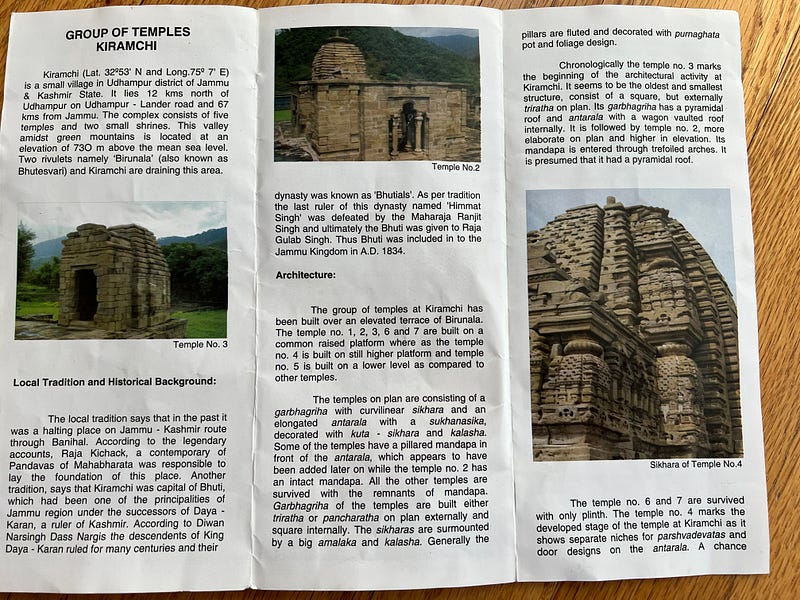
The sun was high up in the sky by the time we reached the Krimchi temples. The old temples in the midst of beautiful greenery were an arresting sight. It felt strange to see the place so deserted. If this was in any other state in India, there would be swarms of visitors and I would be pouting at the difficulty of getting a good picture. But here, we were the only visitors in the whole complex! For some reason, there were a variety of spellings for the place — Kirmachi on the signboard, Kiramchi in the ASI brochure handed to us while the Jammu Tourism website calls it Krimchi. I turned my phone camera in all directions to capture the rolling hills.
There were five temples on an elevated terrace that were built in the northern Indian Nagara style of architecture. According to local tradition, this was a place to halt while travelling from Jammu to Kashmir through Banihal. I learned that the temples were built in the 11th century but clearly, the site must be from prior to the common era (before 3000 BCE) if it is linked with Mahabharata times. Apparently, Kichaka, mentioned in Mahabharata laid the foundation of these temples. Kichaka was the lecherous commander-in-chief of Virata, the king who ruled over the Matsya kingdom where the Pandavas spent their Agyatavasa. But the Matsya kingdom is in modern-day Rajasthan, not Jammu, so I found it a little confusing. Be as it may, these temples must be linked in some way with the Pandavas’ stay in the wilderness during the year they went incognito.
The ASI brochure said that Krimchi is also referred to as “the capital of Bhuti, which was one of the principalities of Jammu region under the successors of Daya Karan, a ruler of Kashmir.” The descendants of King Daya Karan ruled for many centuries. Himmat Singh was the last ruler of the dynasty which was called Bhutial and he was defeated by Maharaja Ranjit Singh.
As I went around the temple ruins and noticed that every garbagriha was empty, I wondered who took away the moortis of the deities. Perhaps the usual suspects for whom idol-worship is the biggest crime on earth. The ASI brochure, of course, gave a bland explanation of “no patronage by the kings and traders” which led to the temples falling into disuse.
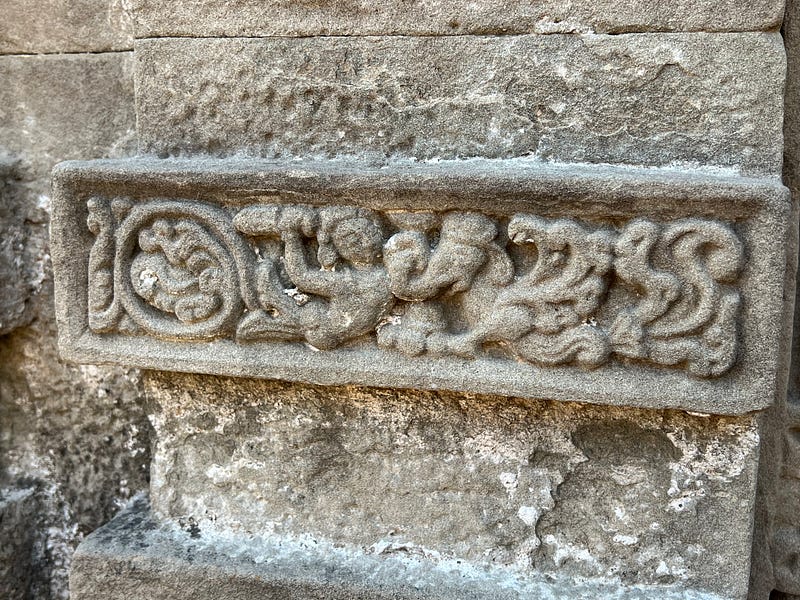
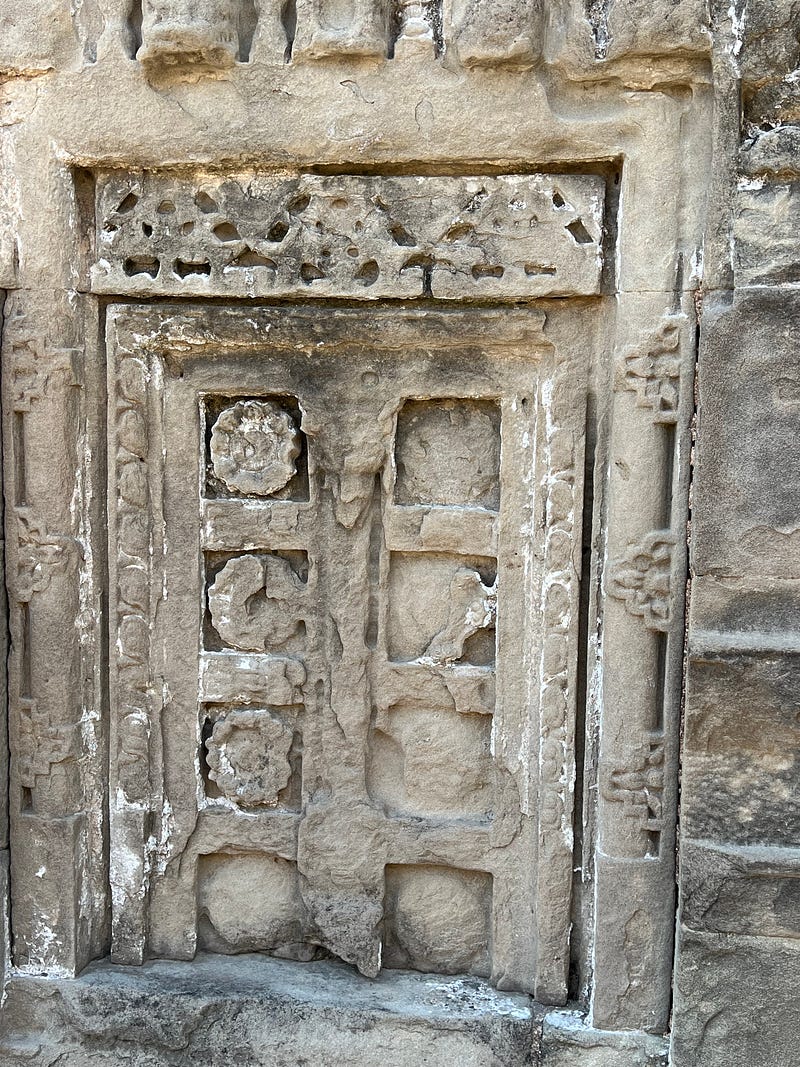
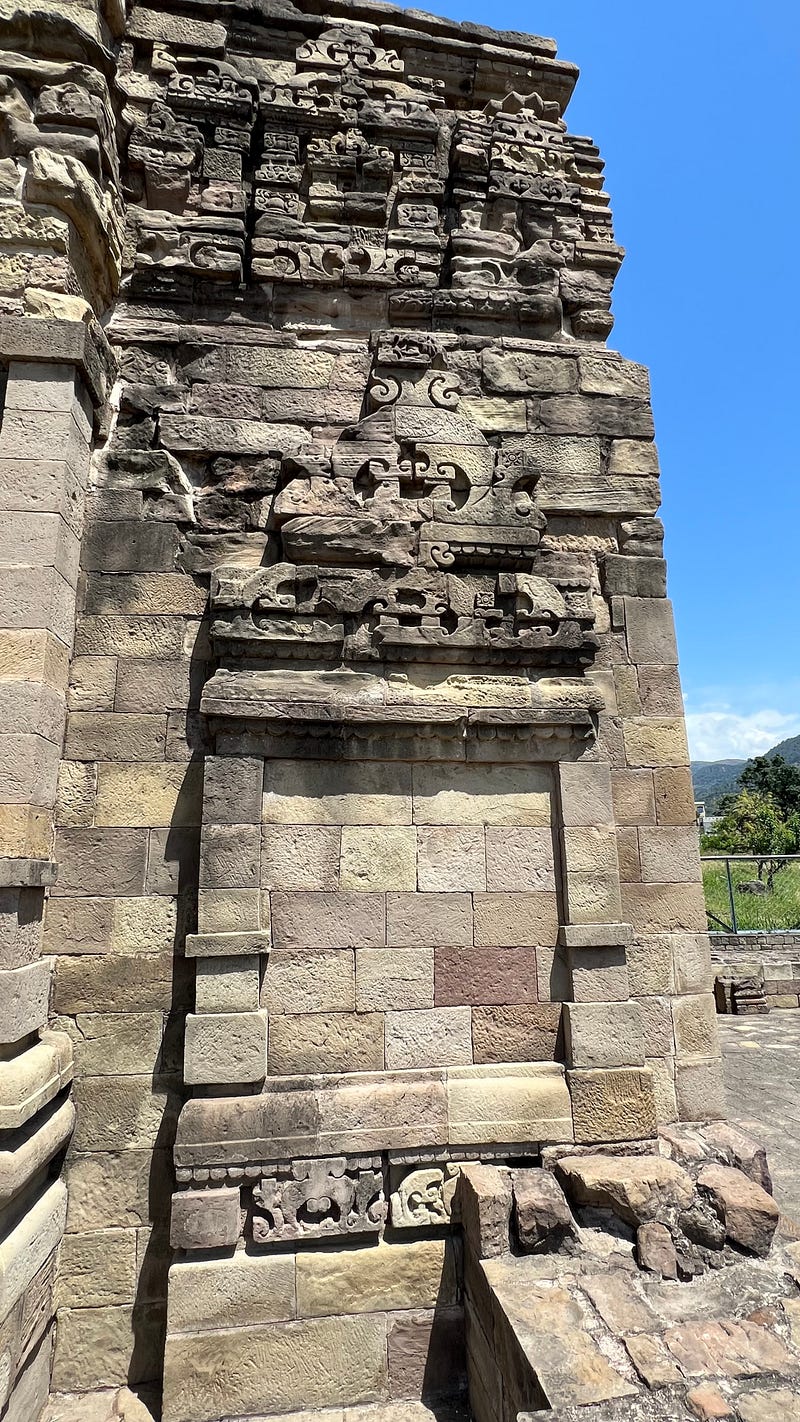
Many of the carvings seemed to have got flattened by the elements over time and I wished I could see the details more clearly. On googling, I found that many people considered these to be Indo-Greek carvings of the Gandhara style. I would love to get more information on this.
The ASI brochure also informed that during a trial excavation, a number of terracotta figurines, copper coins, iron arrowheads, beads of semi-precious stones, pestles, querns and earthen pots were found in the site.
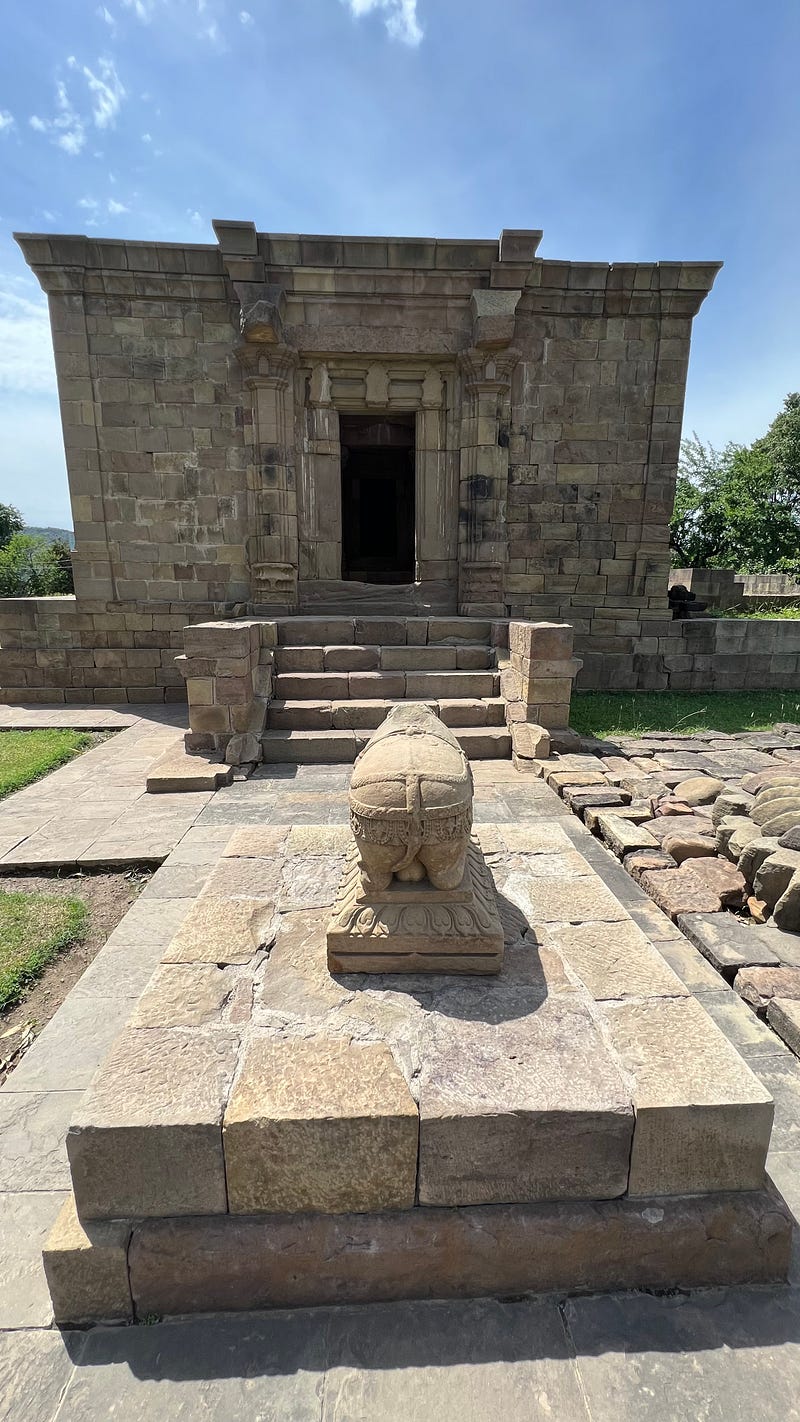
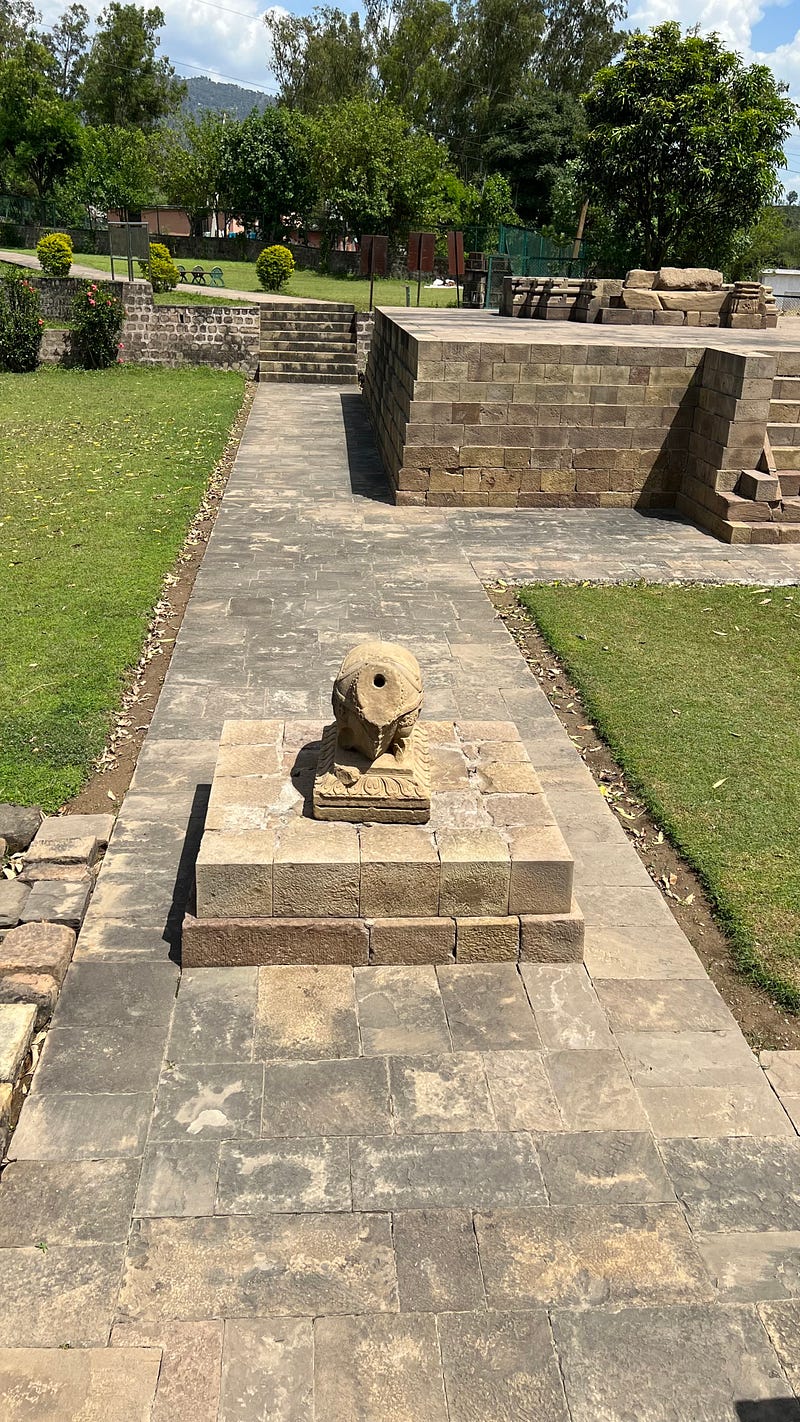
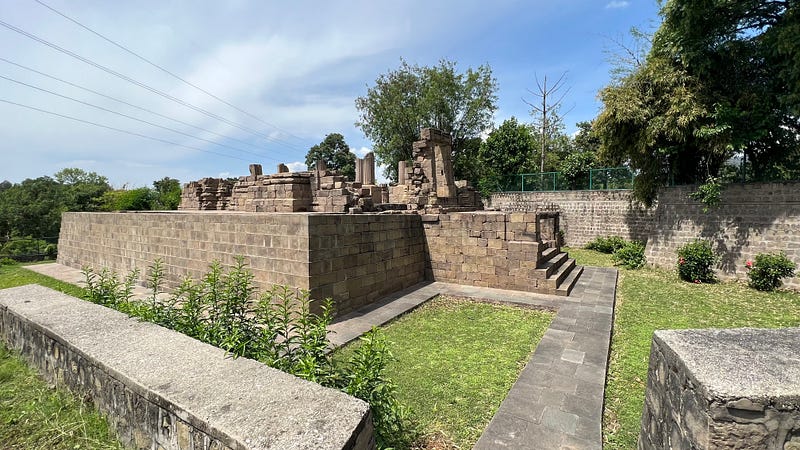
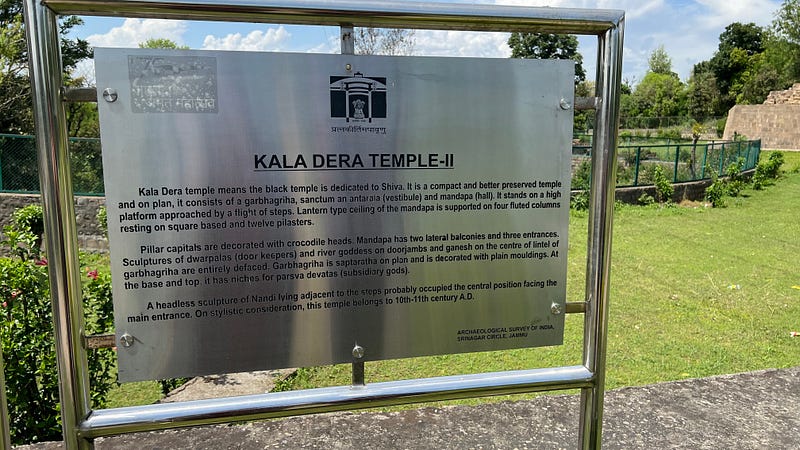
In front of one of the temples (Kala Dera Temple II), there was a Nandi but it was painful to see that its head had been broken off. There were remnants of a Shiva Linga inside the garbagriha.
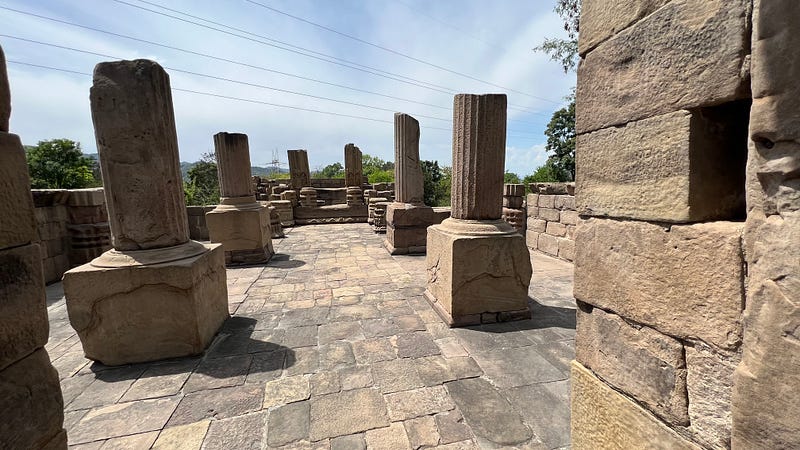
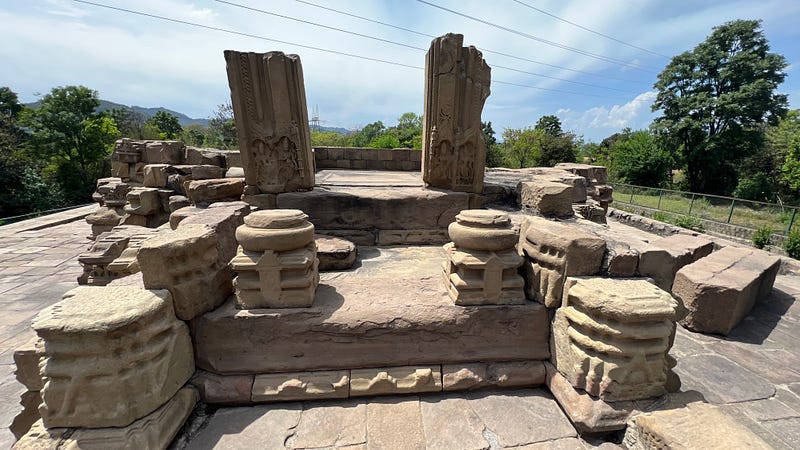
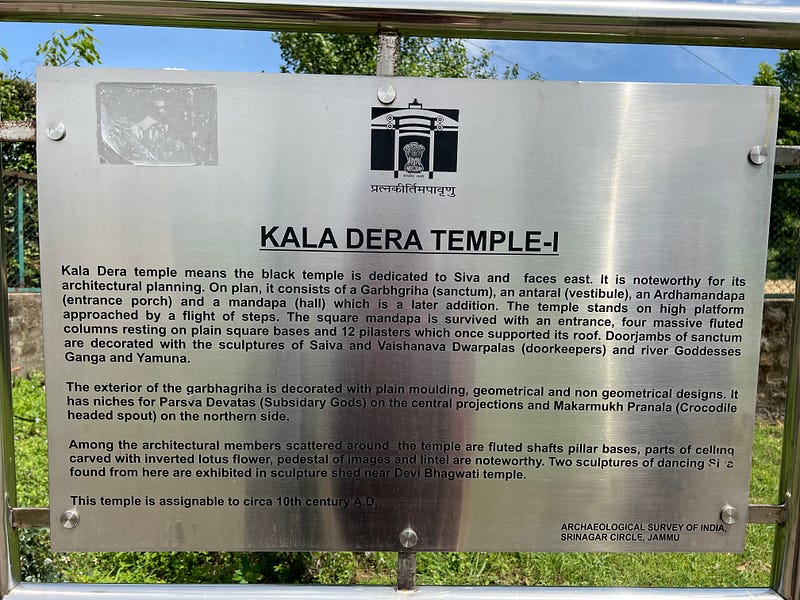
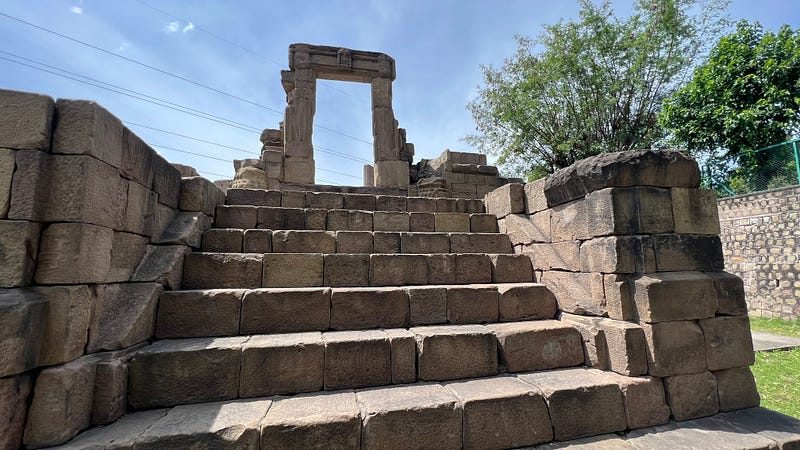
One temple in the complex (the Kala Dera Temple 1) had no ceiling left at all and only a door frame atop a flight of steps could be seen leading into a mandapa (hall) which had broken columns of different kinds.
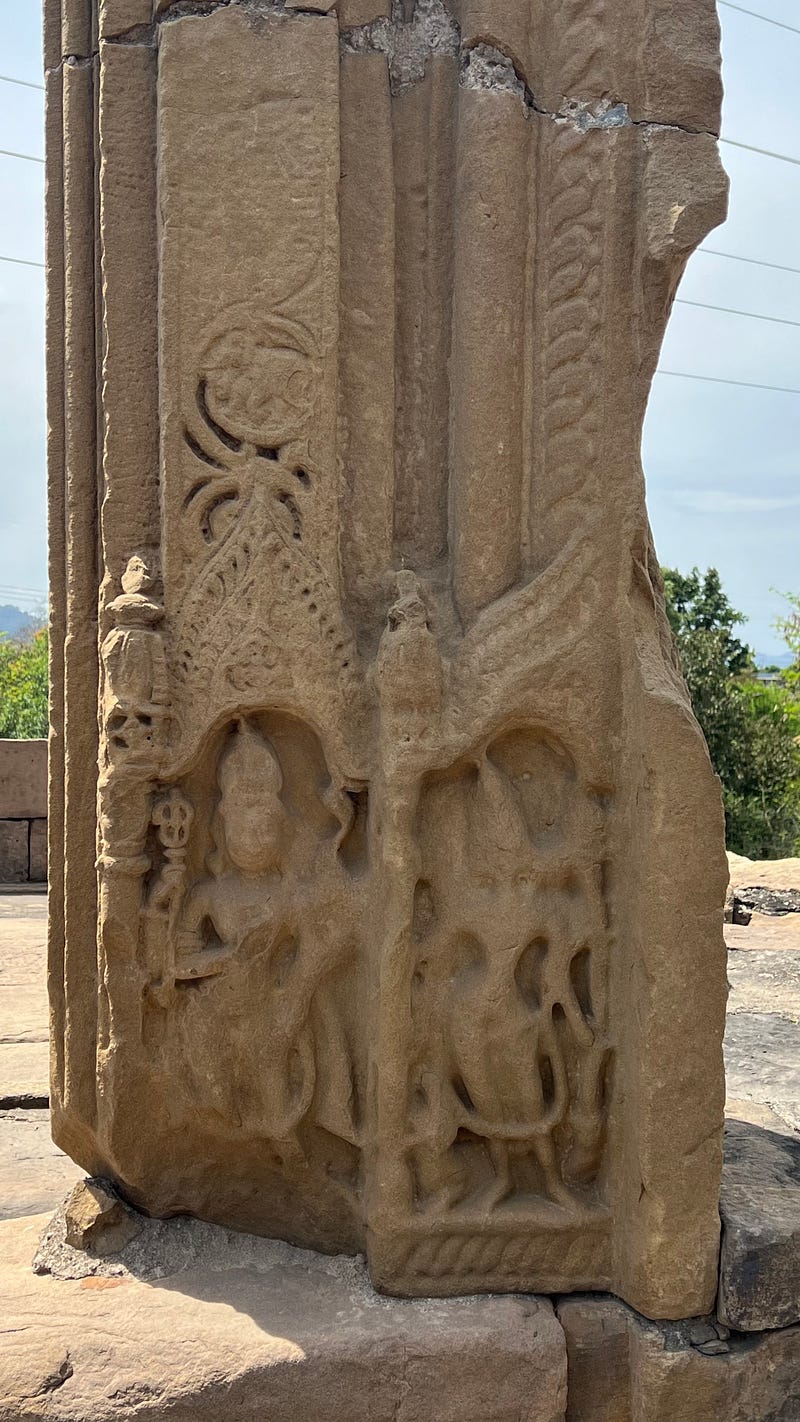
Carvings of Ganga and Yamuna adorned one of the columns. For Hindus, it is not hard to visualize rivers as Devis, just like the Earth herself is a Devi. Goddess feels like a very trivial word in comparison to Devi. After all, the English language comes from a very alien culture in which God is a He. How I longed to know what this temple looked like when its ceiling, columns and carvings were all intact!
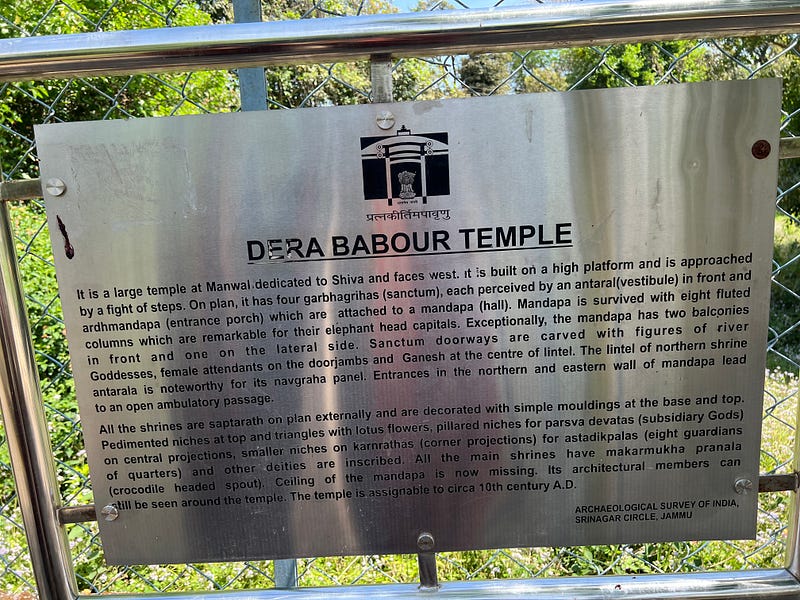
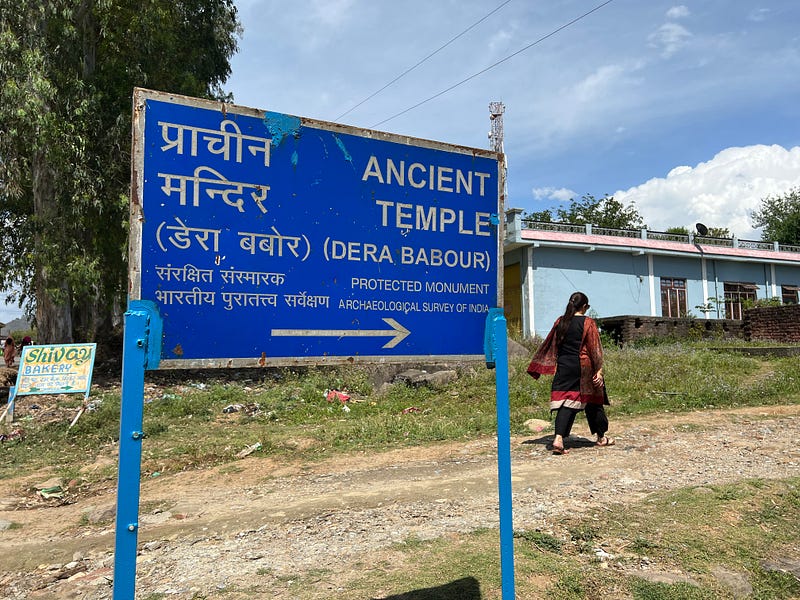
A little away from the Krimchi Temples was another set of temples. A signboard indicated the way to the Dera Babour temples which were also classified as “protected monument” by the ASI.
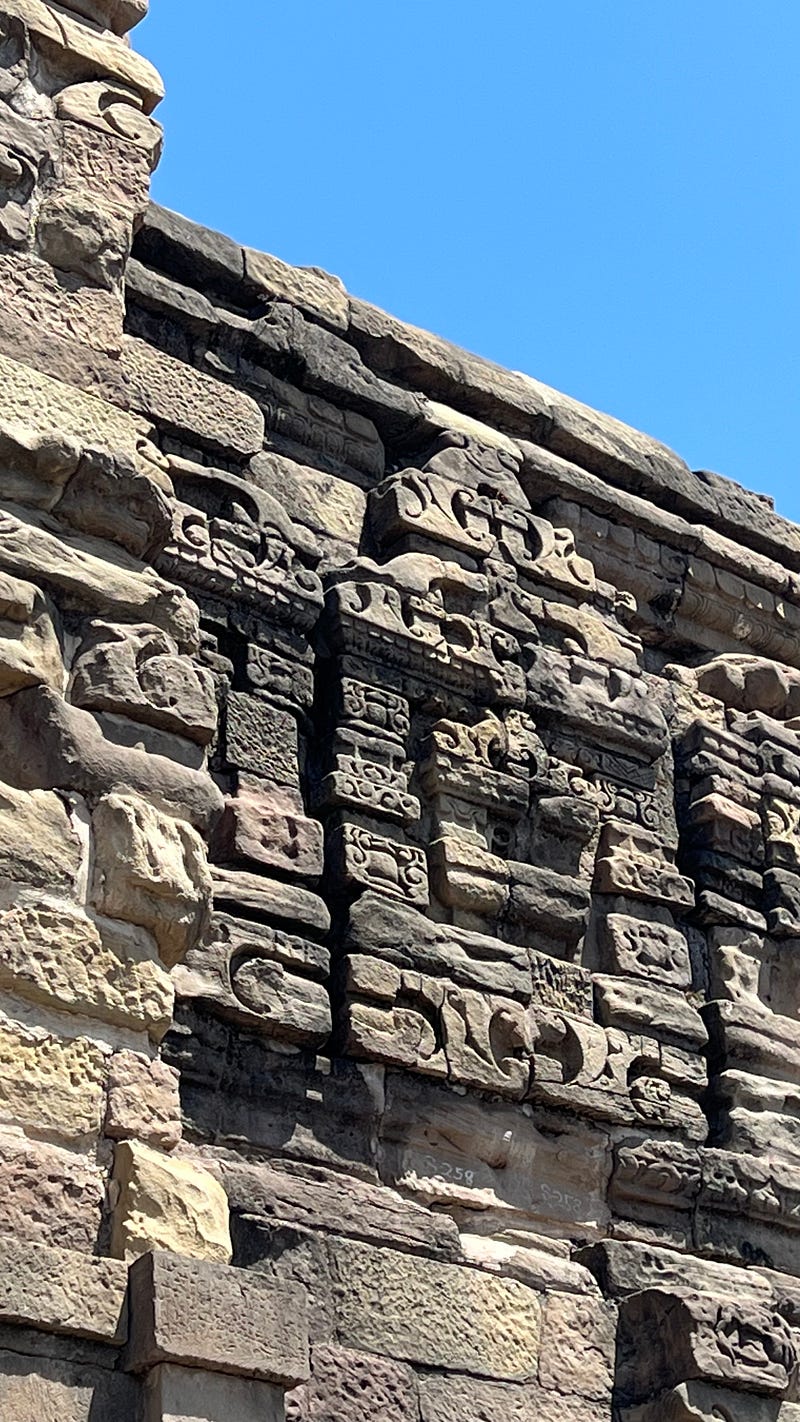
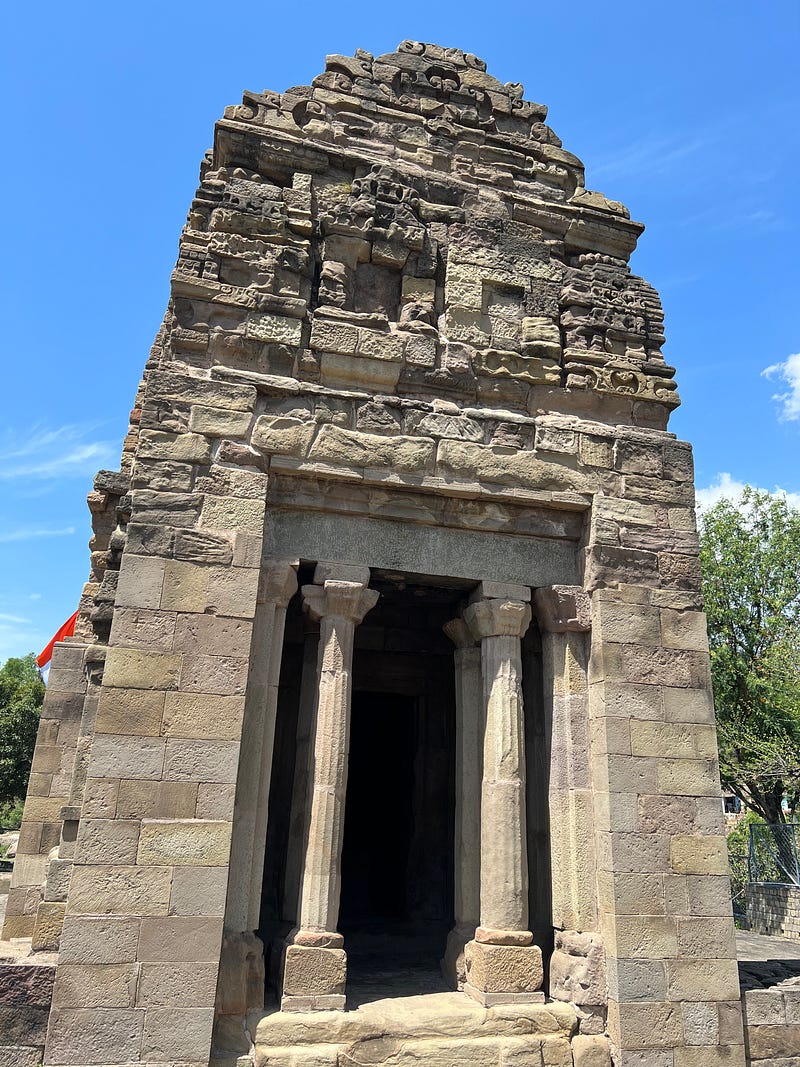
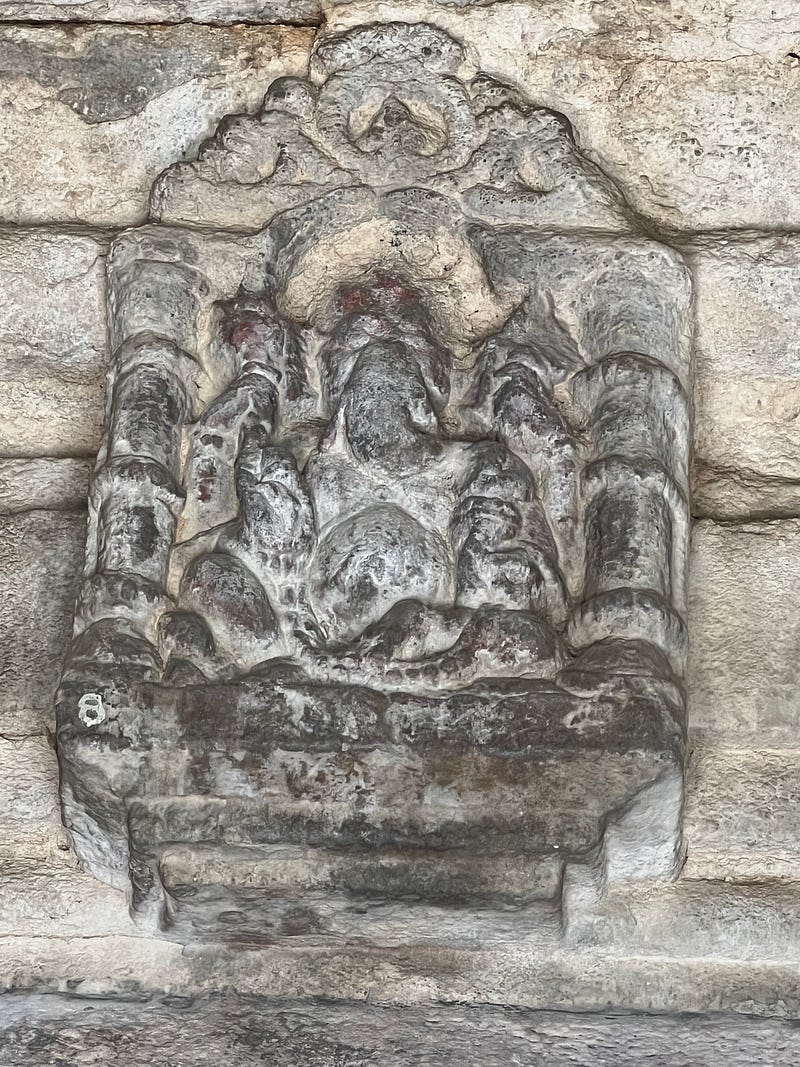
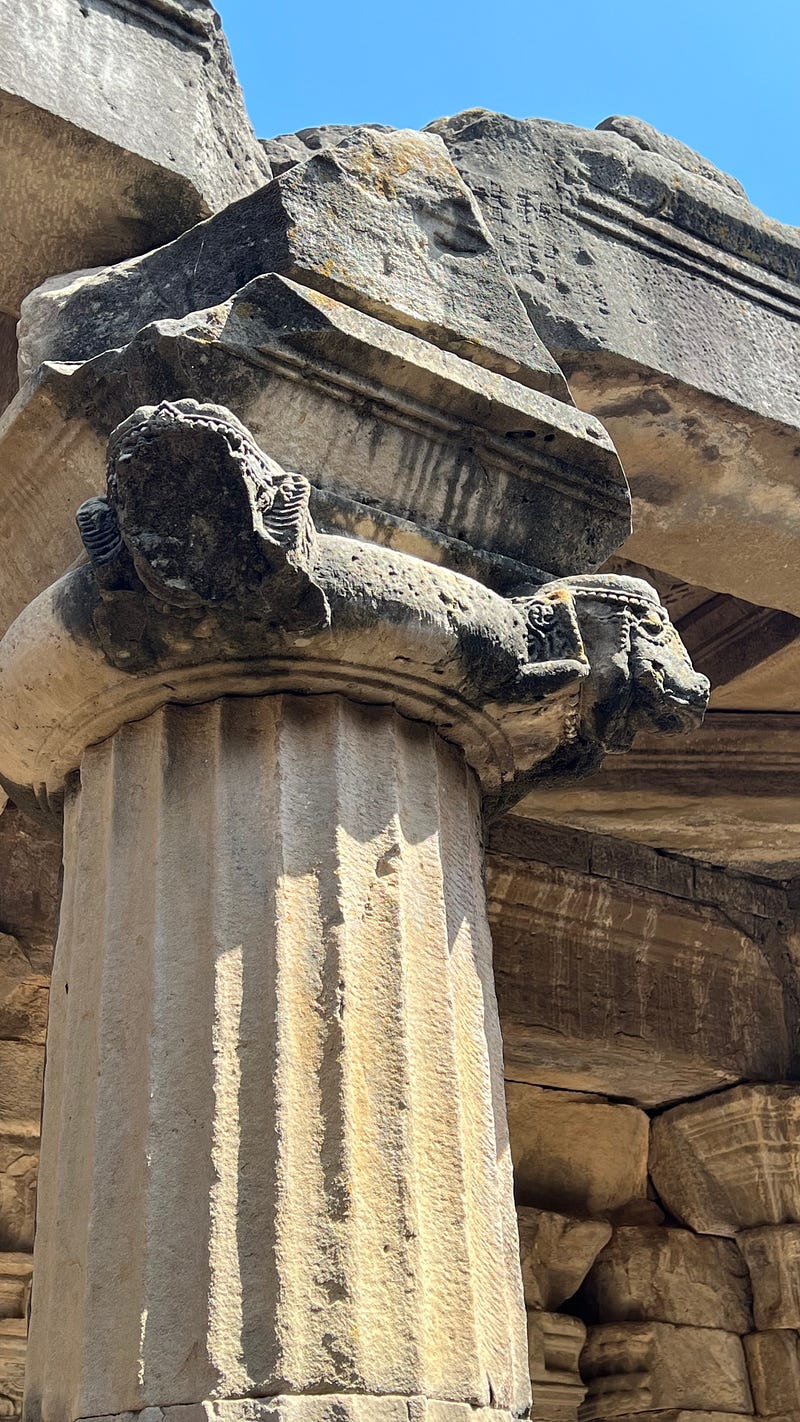
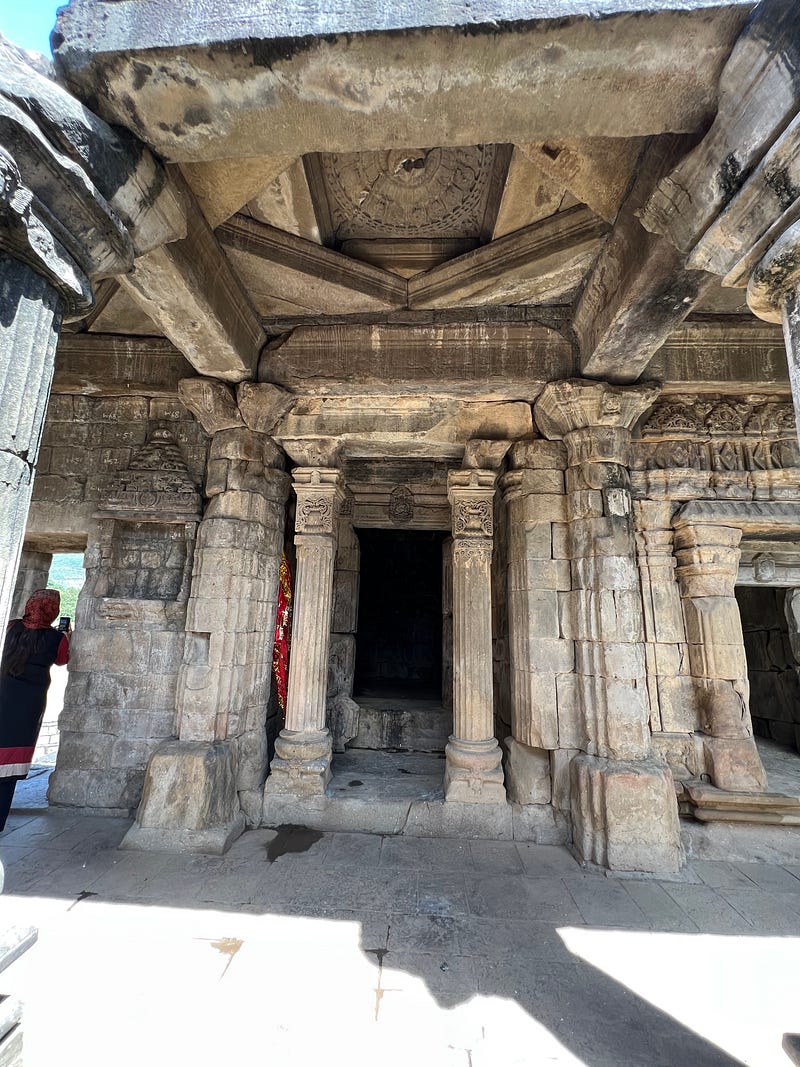
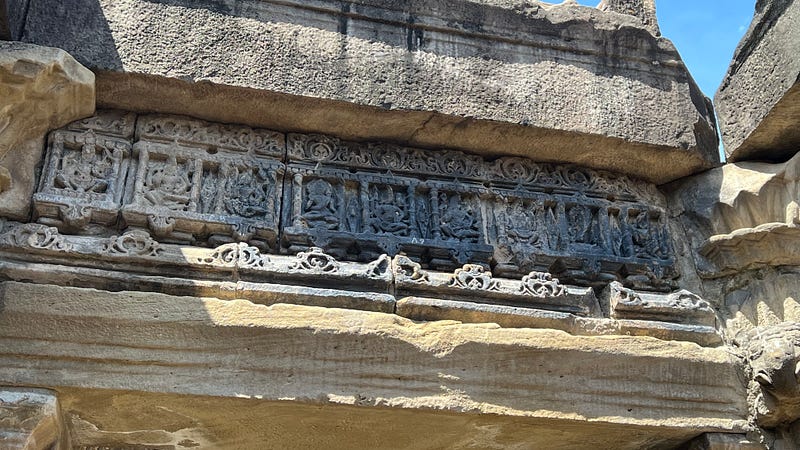
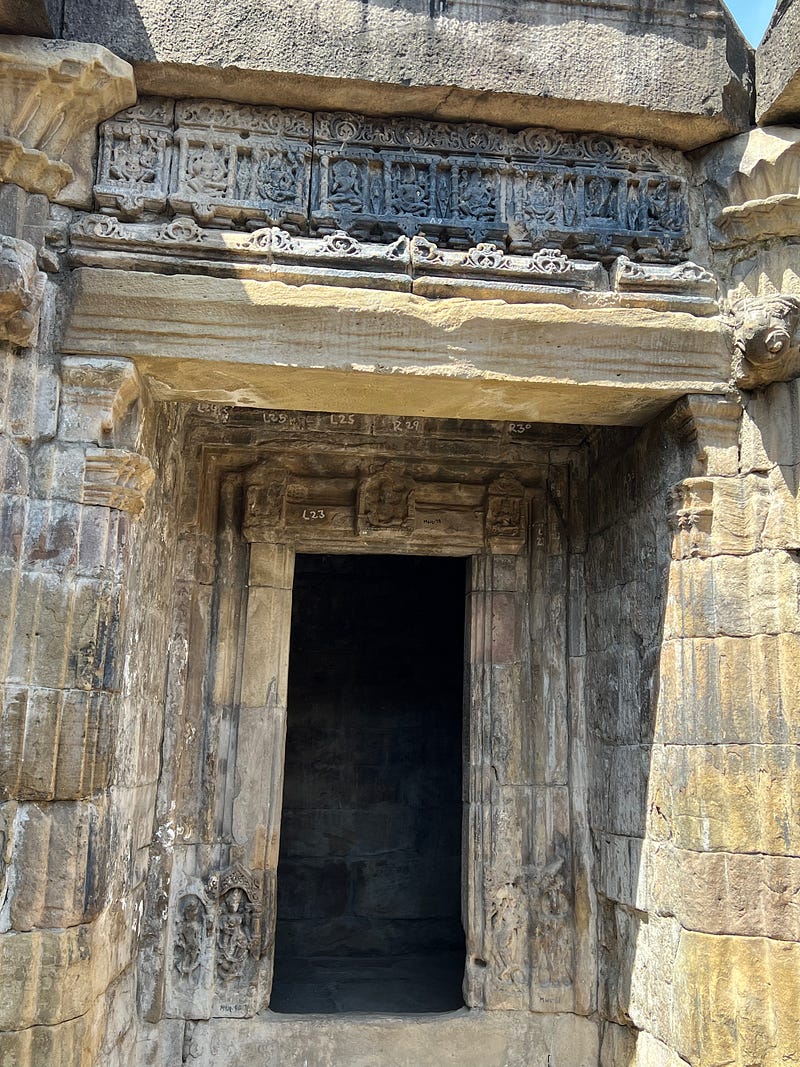
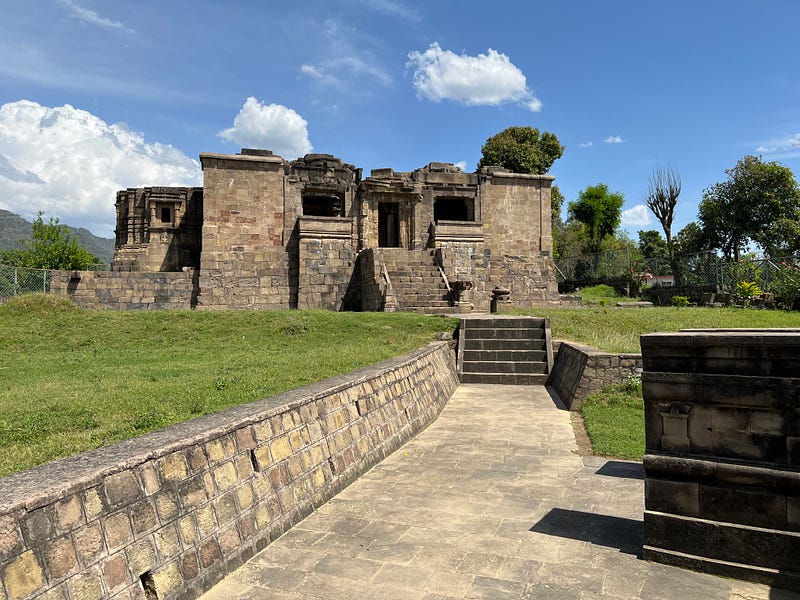
After a little walk, Manu and I found ourselves in the midst of more temples in ruins, which seemed to be from the same era as the Krimchi temples. Once upon a time, the temple bells would have rung, conches would have sounded and the voice of a Pujari doing puja would have wafted from the temple under the same blue skies but now, there was just silence and stillness. And yet, it was beautiful.
I was intrigued by the name Babour. When I looked it up later, I came to know that it was a distortion of Babbapura, the old name of the place, which was mentioned in the famous Rajatarangini, the historical chronicle of the kings of Jammu and Kashmir. I dug out a 1907 paper by Dutch archaeologist Jean-Philippe Vogel in which he established that Babour was the same as Babbapura and also that it was destroyed by invaders. He said:
On Survey sheet No. 29 the spot is marked as “ Pandoo ruin,” on account of the local tradition which ascribes the origin of the place to the sons of Pandu. The site contains no less than seven temples built of heavy stones. Two of them are a mere mass of debris. Five are still standing, two being used for worship up to the present day, but all exhibit a more or less advanced stage of decay. There is every evidence that the town which once stood on this spot shared the fate of so many Indian cities at the hands of foreign invaders.
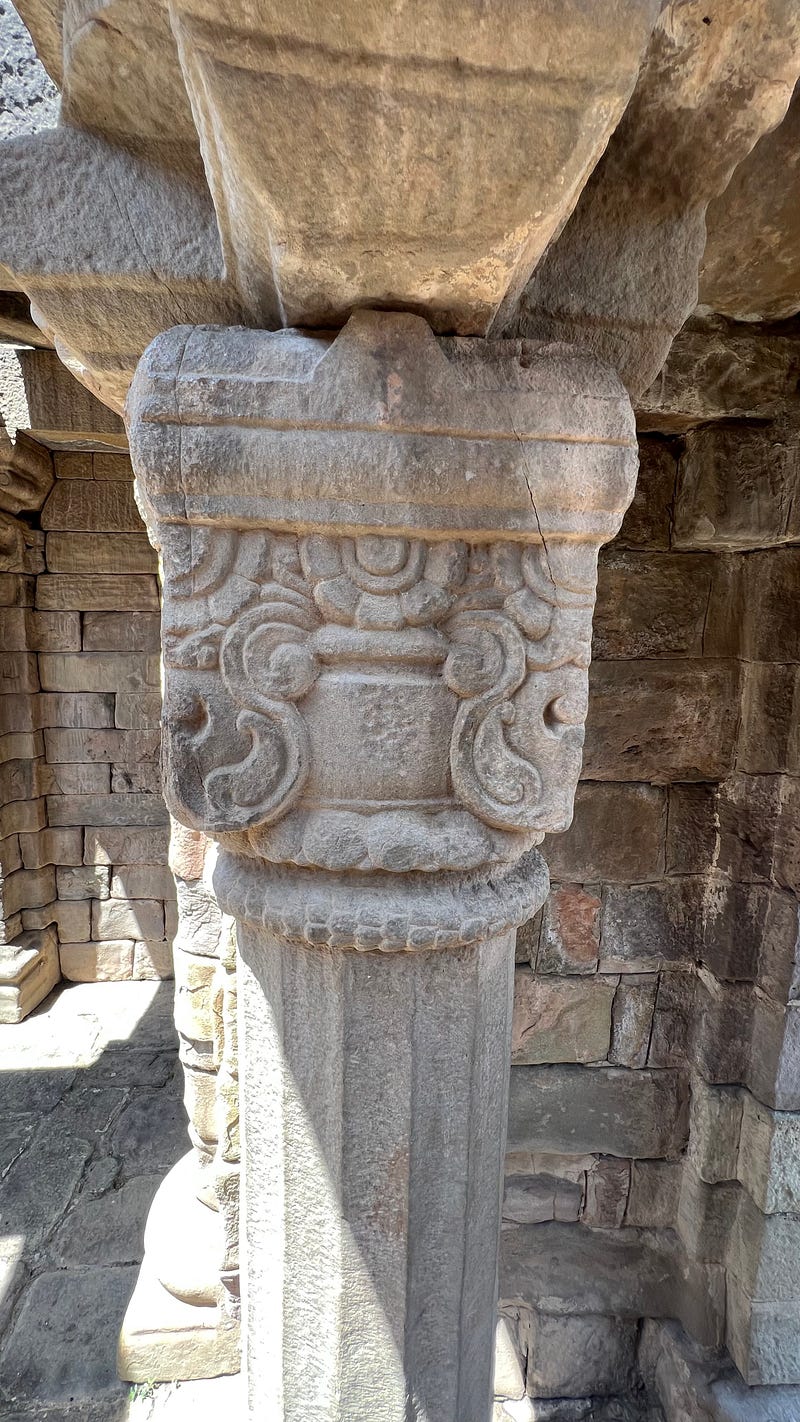
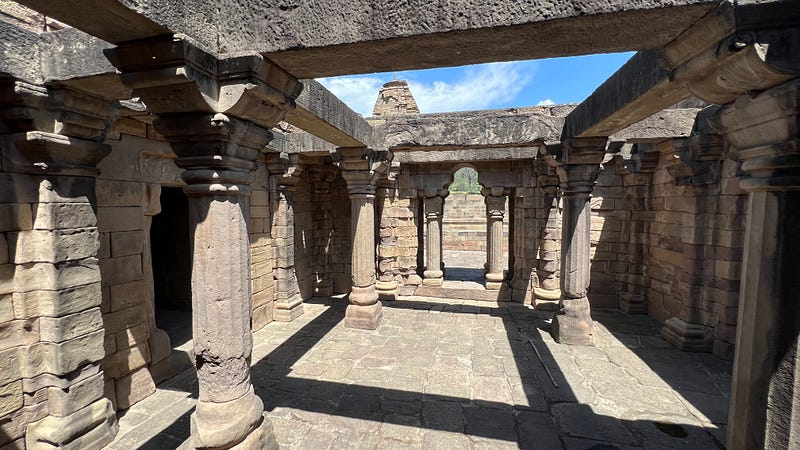
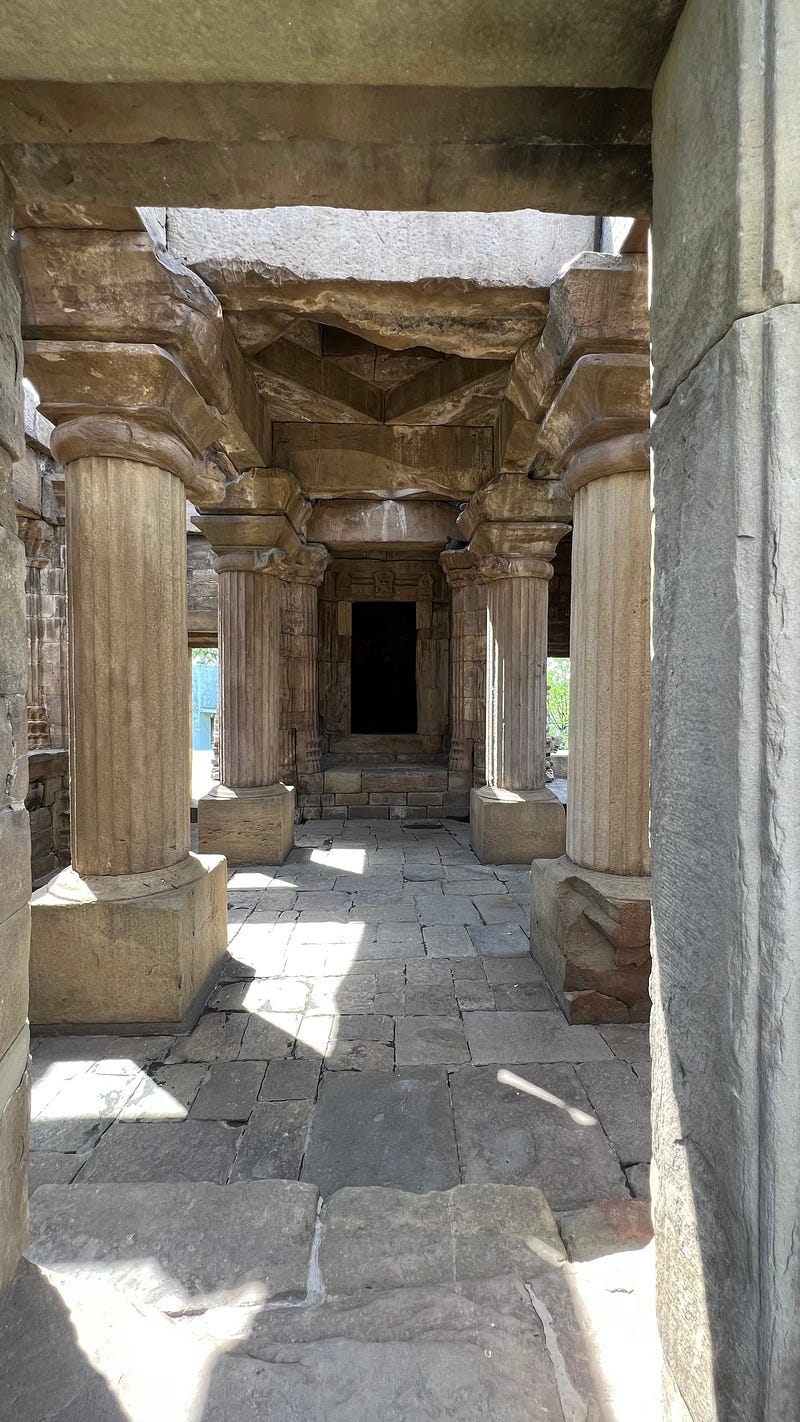
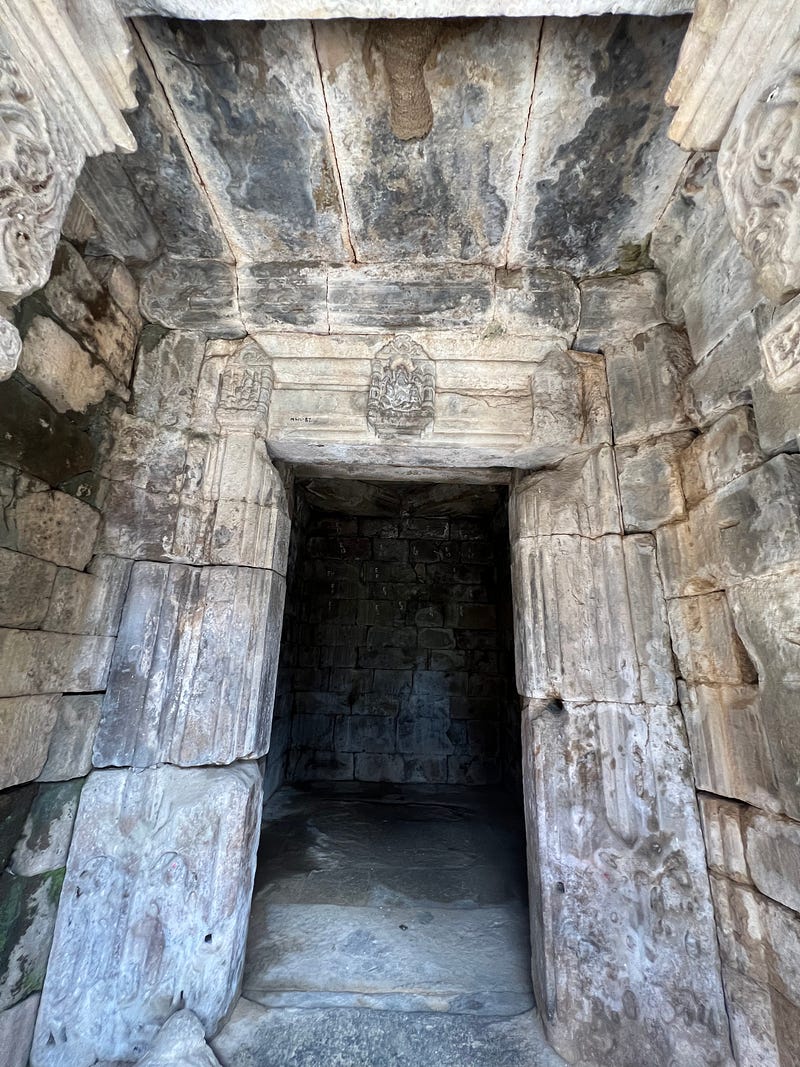
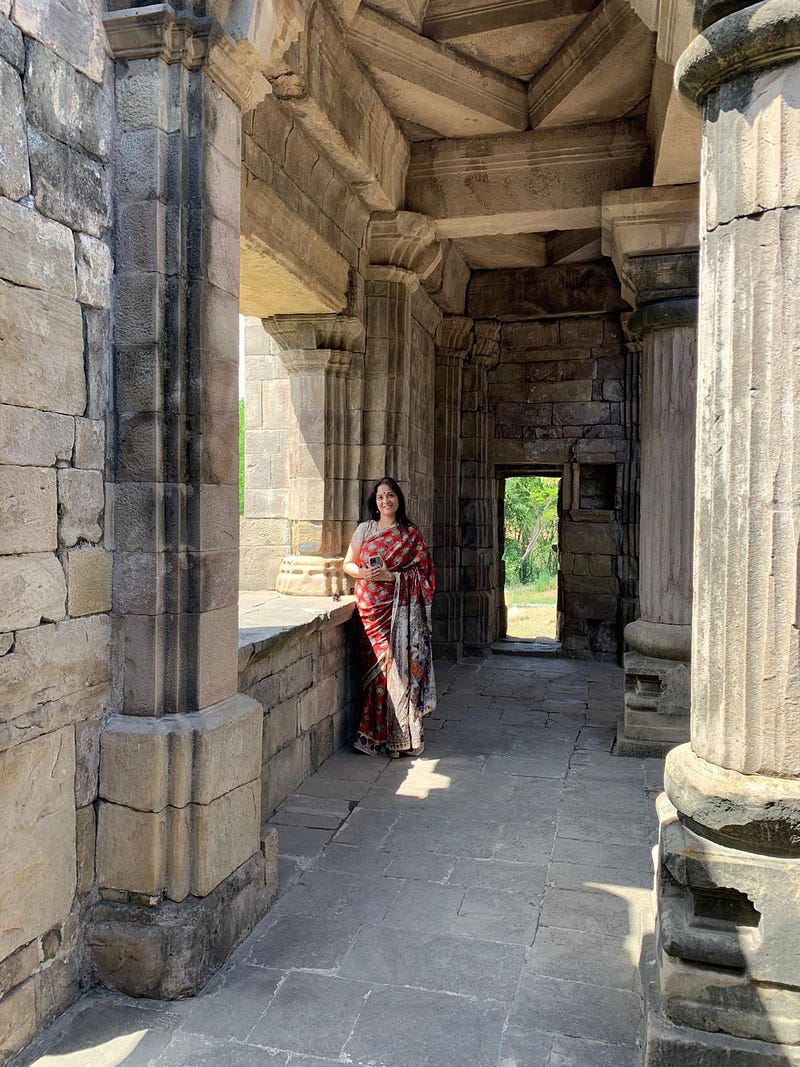
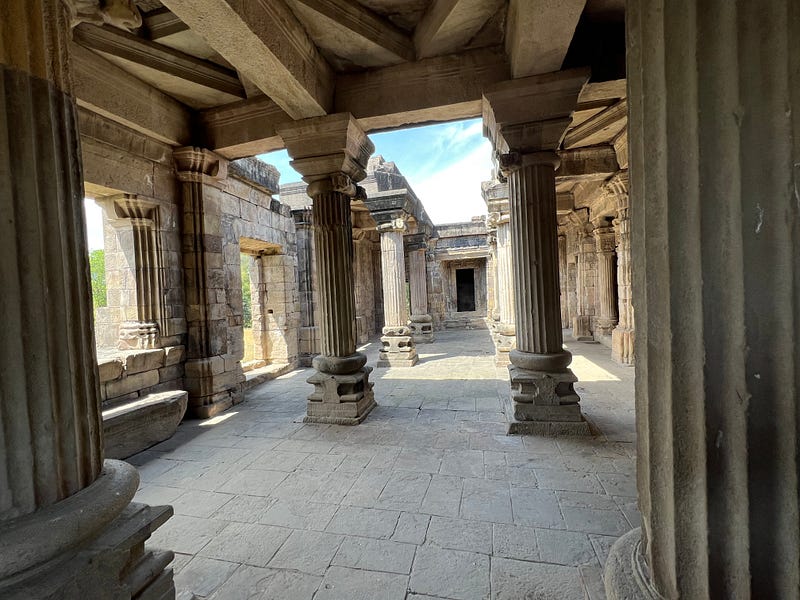
The Dera Babour temple was far more intact than the ones at Krimchi. The columns of the mandapa still held up parts of the ceiling. Several sculptures could be seen somewhat clearly. I looked at the empty garbagrihas and wondered which rupa of Shiva and Parvati had once adorned the spaces. The sunlight streaming inside the temple created a unique ambience.
I learned that Babbapura might have been named after Babruvahana. But Babruvahana was the son of Chitrangada (and Arjuna) who ruled over Manipura in the northeast of India. Could he have had ties with this part of the country? Certainly not impossible in a civilization where a Greek built a temple for Krishna in a place thousands of miles away from Greece.
Our car driver took note of Manu and me talking animatedly about temples and asked if we would like to visit the Narsingh Temple near his village. He said it would not be too much out from the way to Mansar Lake. “It’s a temple where hundreds of people go to get wishes fulfilled,” he added. Of course, we both had wishes to seek so off we went to the temple.
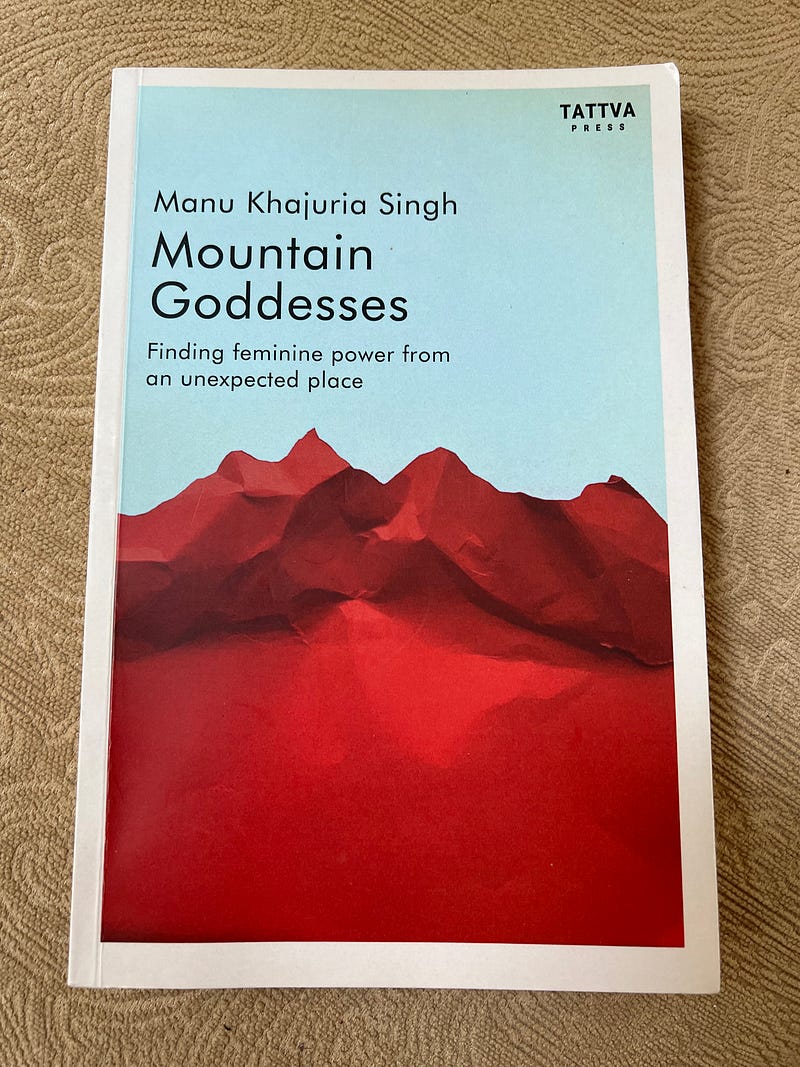
I was mesmerized by the serene beauty all around me. Manu kept telling me stories from the folklore of Jammu. I was glad she remembered to bring along her recently authored book Mountain Goddesses — Finding Feminine Power from an Unexpected Place which I later read on the flight back from Jammu to Delhi. She has described the significance of Devis in the Jammu region such as Baawe Wali Mata, Vaishno Devi, Sukrala Mata, Mahamaya, Pingla Mata, Chauntra Mata, Machhail Mindhal Mata, Sarthal Mata, Mata Mangla Devi, Sheetla Mata, Chanchloyee Mata and Nagani Mata (Mansa Devi). She has also described the Kuldevis and women warriors of the region. Such is the love for the Divine Mother in Jammu that the locals greet each other not with Namaste or Ram Ram but Jai Mata Di.
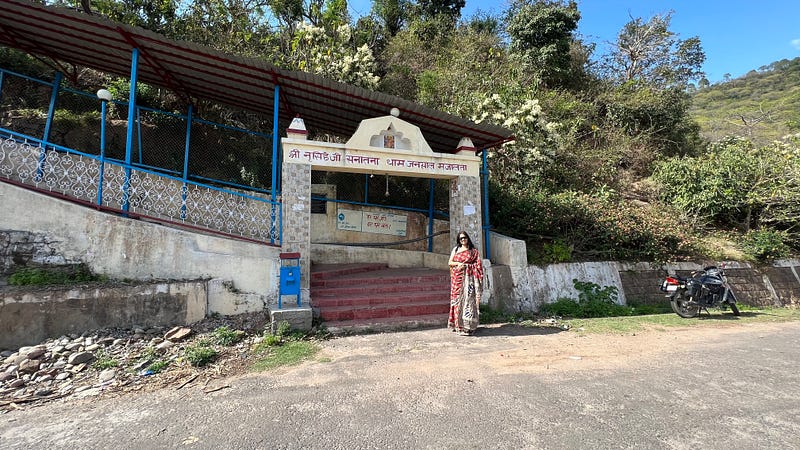
Soon, we were at Jansaal, at the entrance of Shri Narsingh temple and climbing the steps. Hindu temples are often atop sacred hills and devotees reach the temple only after expending some energy. There’s a nice feeling one gets after climbing to the top of a hill to get the darshan of a devata.
There were beautiful views all around as we climbed up, and when I reached the top, a cool breeze began to blow and it felt so caressing. Just like the Baawe Waali Mata temple, this one too was neat and quiet. It evoked memories of times when temples were uncrowded and uplifting. The time for darshan was over at 12 noon itself and the pujari had changed from traditional clothing to trousers and shirt, which was a bit of a dampener for me.
Narasimha Avatara is one of my dearest Avataras of Vishnu and I can never tire of the story of how he came to the rescue of his young Bhakta Prahlada to destroy the Rakshasa Hiranyakashipu (but also to release the Rakshasa from his evil life which he had got as the result of a curse). I learned from the Pujari that Vishnu was only worshipped in the form of the sacred Saligrama stones in Jammu and not in the form of any moorti. The Saligrama stones were all covered by a cloth since the last puja was over at noon. However, pictures of the fierce Narasimha were all around. When I asked the pujari why the temple’s pujas concluded so early and why there was no evening aarti, he told an interesting story.
There was also another story about a weighing balance that once stood in the temple and which could be used to adjudicate in disputes. The disputing parties would put their case before Narasimha Bhagwan and as soon as the aarti got over and the conch sounded, the weighing balance would tilt in favour of the person who was right and in this manner, justice would be delivered. When the king came to know about this, he was not too pleased because as per the law of the times, he was the final authority for disputes. The events that happened next and how the balance was finally destroyed were narrated to us by the Pujari as we heard in rapt attention.
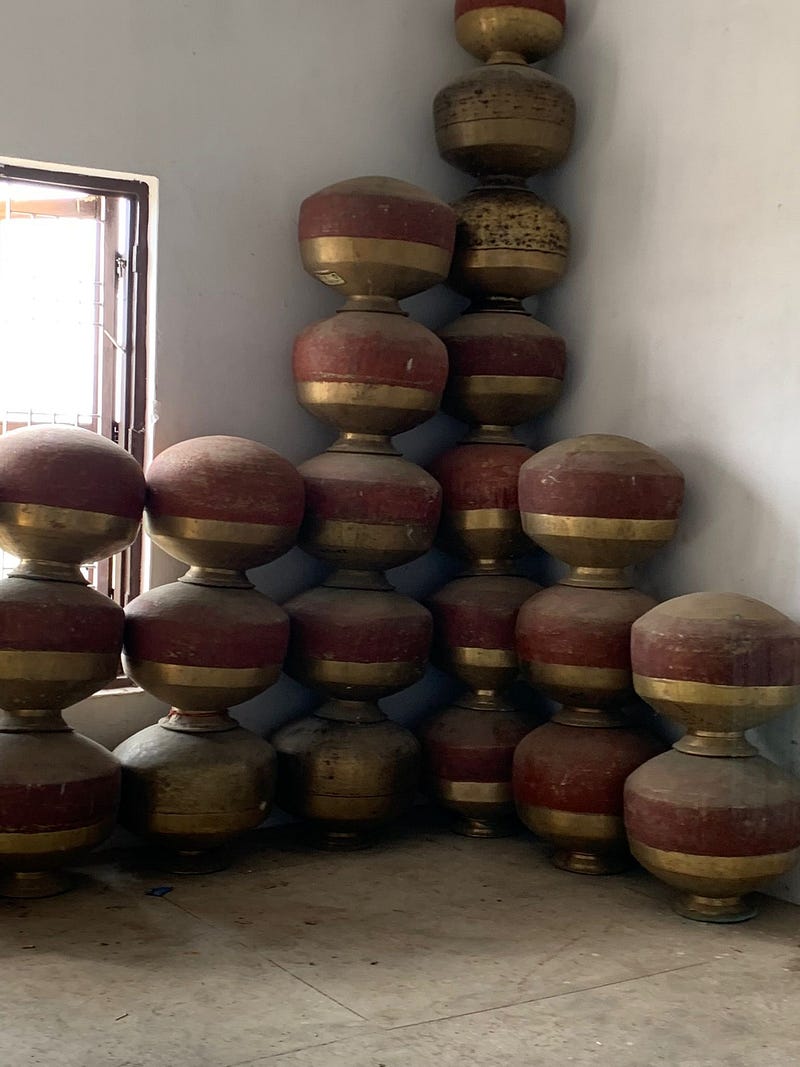
Finally, the pujari asked us to wish for anything from Narasimha. He told us that thousands of people came there to ask for wishes and when they got fulfilled, they returned to donate clay pots to the temple. I did as he asked. May I soon return to the temple to offer my thanks with clay pots like these.
All over Jammu, (and perhaps Himachal Pradesh too) there is a peculiar manner in which Hindus express their gratitude for wishes fulfilled. They get moortis carved of Bheem Devata and donate them. On the previous day, Kirpal Singh ji had taken me to a place where there were dozens of carvings of Bheem Devata that people had got made as a thanksgiving. It was fascinating for me as I come from the Madhva Sampradaya which venerates Bheema as an Avatara of Vayu. However, Manu informed me that the Bheema Devata carvings in Jammu might not really depict the Bheema we admire in Mahabharata but could be a local hero or deity. Oh well, yet another mystery.
Just in passing, I asked the driver if he lived nearby since he had mentioned that the temple was in his village. He immediately started calling his wife on the phone to tell her we were coming! Manu and I remonstrated with him and said we did not have much time left and there was still the Mansar Lake to visit. He said it would not take much time. And thus we stopped in front of a house which belonged to the driver’s chacha and chachi. He told us that his house was just behind and we could walk to it. When we again repeated that it would soon get dark, the driver asked his wife and sons to quickly get ready and come to meet us. Meanwhile, I began to film the beautiful hilly terrain all around. How idyllic it was! I wondered if it got cold in the winter but they said no, it was pleasant. Suddenly, the chachi emerged from the street carrying two pails of fresh water from a baoli. At first, she looked a little grumpy because I was filming her.
But within minutes, she remembered the tradition of hospitality and insisted that we should go inside her house and taste the water she had just brought from the baoli. I was in a bind because I knew that my immunity levels might be way lower than the locals because of living in the US and I could fall sick from drinking water. Despite my protests, the lady sat us down and gave us two big glasses of water from the pails she had just carried. Manu drank it up saying she was used to drinking local water. I just took a sip with utmost fear and returned the glass. Later, the chachi said that the water from the baoli had even been tested by some government authority and it was perfectly safe, so I should have drunk it. Oh well…me and my stupid misgivings.
Next, we made our way to Mansar Lake. I witnessed first-hand a biological disaster with invasive fish taking over the lake. Read my account of the invaders here.
I had begun to feel a little tired and wondered whether Kehwa, the famous beverage of Kashmir was also available in Jammu. Manu said it was very much a Jammu beverage as well though not available at every place. She suggested that we could have it at the restaurant near Amar Mahal, the palace built by Maharaja Amar Singh. I jumped at the idea. Long ago, when I had been tired at the end of long day, my mother, sister and I had been offered Kehwa at a Kashmiri handicrafts shop which was so refreshing that I had never forgotten it.
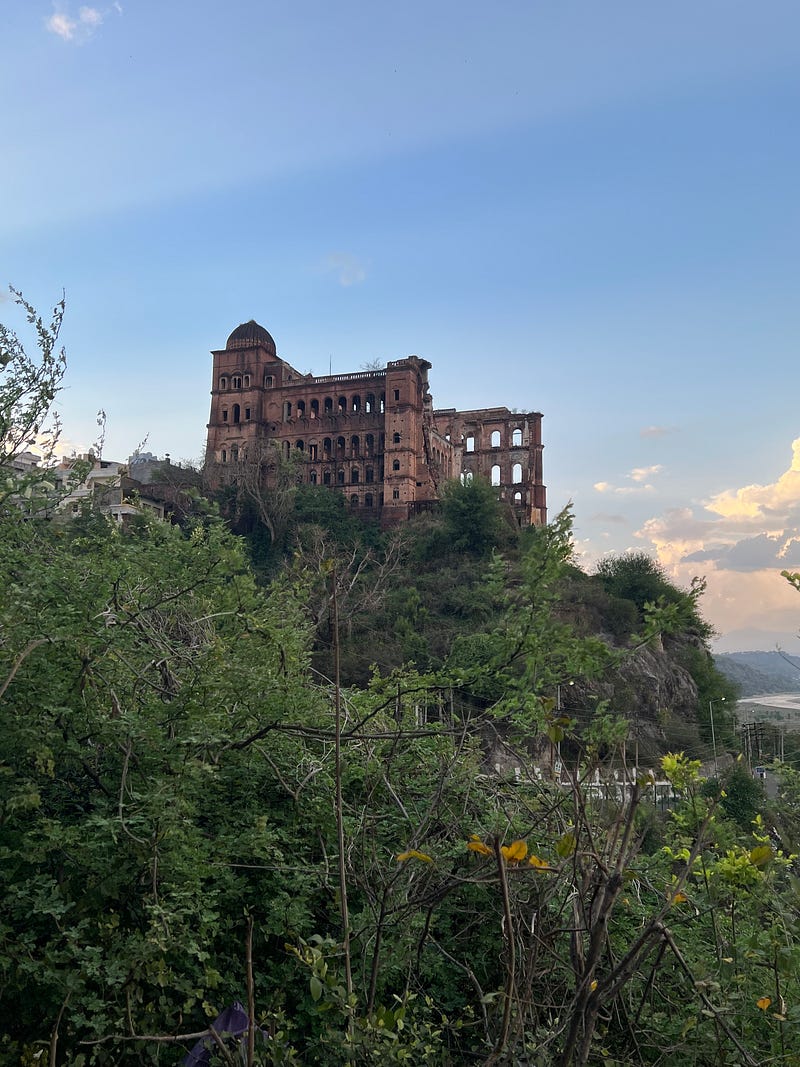
Not far from Amar Mahal, there is the Mubarak Mandi Palace which looks breathtaking. There was no time to visit it but I heard it was in ruins and not at all maintained by the government, which is very sad. Even just looking at it from a distance was so captivating that I could not look away from it.
Amar Mahal has been converted into a museum. It was closed by the time we reached it. However, Manu gave me an excellent briefing on the history of the Dogra Maharajas.
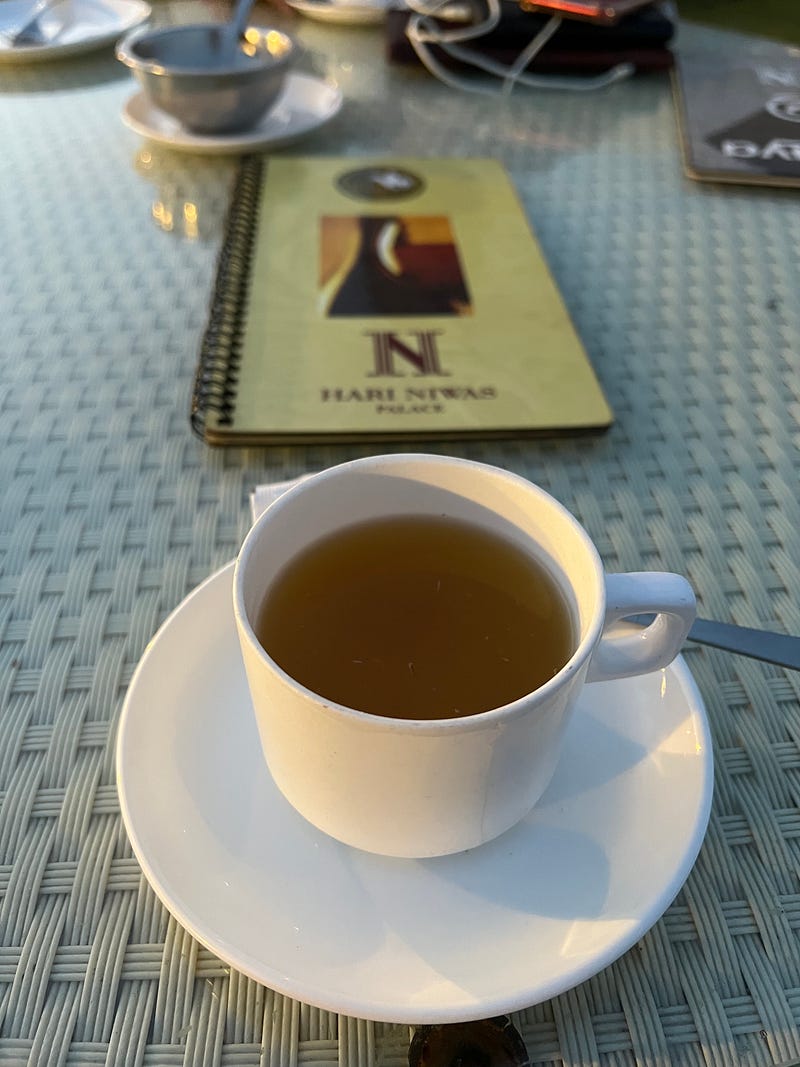
Finally, it was time to unwind with some delicious Kehwa and snacks like Crispy Nadru (lotus stem) at Hari Niwas while soaking in spectacular views of the Tawi River. It was hard to believe that I was not in a dream.
I owe so much to Manu for having learned about beautiful Jammu. Until now, it was the Kashmir Valley that got all my attention when I thought about the erstwhile state of Jammu and Kashmir. I never thought of Jammu as a separate entity. Most of us say “Kashmir” when we mean ‘Jammu and Kashmir’. The issues of Kashmiri Pandits make many of us get all worked up but we don’t spare a thought for the neglected Dogras of Jammu. Now I can see the huge injustice which has been done to the people of Jammu since 1947 after the Abdullah family took over the political reins. While Kashmir got all the attention and resources (which were misappropriated by the corrupt politicians), Jammu was relegated to the background. All this happened despite the fact that Kashmir formed only a tiny part of the earlier state of J&K. Ladakh was neglected even worse than Jammu. Manu has been espousing the cause of the Dogras of Jammu for a long time. Many are the Dogras who have laid down their lives for Bharat. It is high time we recognised the value of Jammu, its history and contributions.
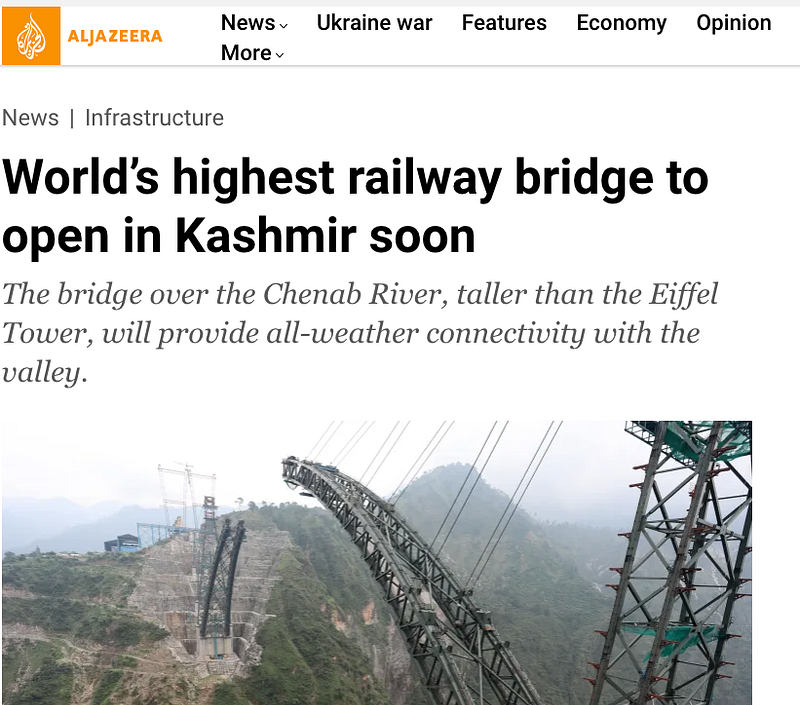
To give an example of how Jammu is bypassed even in the terminologies used by news media, think of the world’s highest railway bridge which is being currently constructed over the Chenab River and is hailed as an engineering marvel. The bridge is located entirely in the Reasi District of the Jammu region. It will help to connect the districts in Jammu with the districts in Kashmir and at the same time connect J&K with the rest of India. And yet, Jammu is often left out of the headlines.

It is high time we included Jammu’s rich narratives and traditions in the rich tapestry of Bharat’s culture.