
G-R-A-T-I-T-U-D-E
How to Enrich Your Life and the Lives of Others
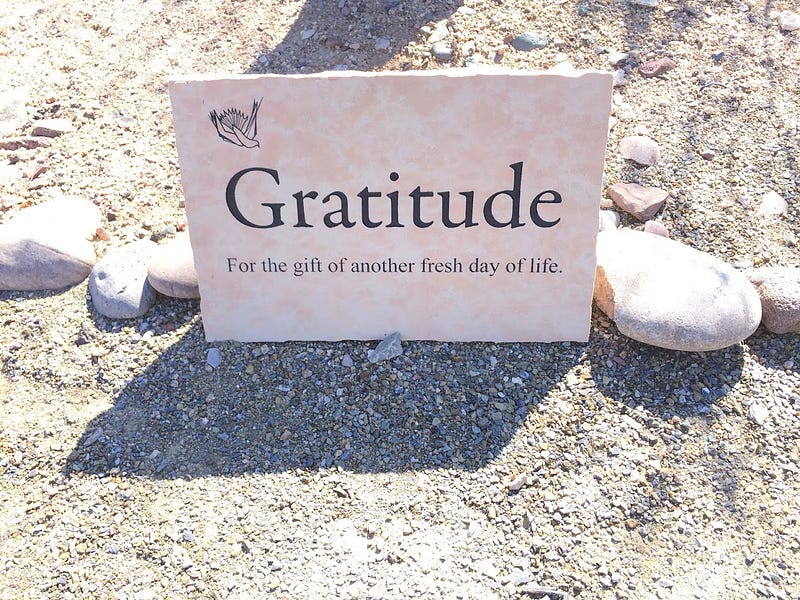
I woke up this morning thinking about gratitude. (Well, actually, it has been several mornings now as I’ve written, pondered, read and edited this story.)
Interestingly, I discovered that one of my first stories was on gratitude. I wish I could say I always practice gratitude, but I don’t. I’m far from a saint. Maybe that is why it keeps cropping up in my thoughts and spilling out onto my screen. I need to learn it.
One of the things I do periodically, especially if I’m having a rough day, one of those where things aren’t going well, is to make a gratitude list in my journal. I take a few minutes and just stop and list things I’m thankful for. It doesn’t take long and I’m feeling much better. I realize I’ve got it pretty darn good.
But what is “gratitude”? Having gratitude amounts to having a GREAT ATTITUDE. Drop a few letters and you’ve got GRATITUDE. Gratitude is an affirmation of goodness. Having gratitude means we are in a right relationship with all of creation including ourselves and other people. It means we find things within ourselves and outside ourselves to give thanks for.
And whom do we thank? We may thank ourselves or another person or a Supreme Being or the Universe. Wherever we direct our “thanks”, we acknowledge that we’ve received something special and perhaps something undeserved. We also affirm that the situation or outcome could have been much worse. We feel fortunate or blessed. Life provides more satisfaction.
Gratitude fills our souls with light and that light reflects out into the world and brightens the day for people we meet.
Dr. Wayne Cordeiro a pastor in Hawaii at the time, writes in his book Attitudes that Attract Success, that our attitude is like an odor that follows us around, it can be fragrant or foul. Gratitude insures we have a sweet-smelling attitude.
Recently, I thought in terms of a “Kindness List” in answer to the question what kindness has God/The Universe poured out upon me that I am grateful for?
- The kindness of this day — a new day
- The kindness of this quiet time in the morning — a time to ponder
- The kindness of birds chirping and ears to hear them with — I can hear
- The kindness of books to read and eyes to see — I can see
- The kindness of juice and coffee to drink and a tongue to taste with — I can taste
- The kindness of pen and paper and the ability to write — I can feel and write
- The kindness of clean fresh air after a rainstorm — I can smell
- The kindness of a brain to think with — I can think
- The kindness of good health — I feel like getting up and writing
- The kindness of family and friends — I’m not alone
- The kindness of a warm/cool/safe home — I’m not homeless
- The kindness of financial security — I’m not broke
In thinking about the word “gratitude” and its meaning, I constructed the following acronym for GRATITUDE:
Grateful — According to one source “Grateful people are more helpful, altruistic, and compassionate — in other words, more prosocial.” Robert Emmons, the world’s leading scientific expert on gratitude, who has studied it for over a decade, says people report the following benefits from practicing gratitude:
Physical • Stronger immune systems • Less bothered by aches and pains • Lower blood pressure • Exercise more and take better care of their health • Sleep longer and feel more refreshed upon waking
Psychological • Higher levels of positive emotions • More alert, alive, and awake • More joy and pleasure • More optimism and happiness
Social • More helpful, generous, and compassionate • More forgiving • More outgoing • Feel less lonely and isolated.
Please note that all the benefits are positive! Want to be more positive? Be more grateful. Want things to go better for you? Be more grateful.
In her book Attitudes of Gratitude: How To Give and Receive Joy Every Day of Your Life M. J. Ryan says, “As we count our blessings, we literally bathe ourselves inwardly in good hormones (endorphins).” You just can’t go wrong by maintaining a sense of gratitude.
Real — The effects of gratitude, as described above, are real. Anyone who practices gratitude will tell you that living with a sense of thankfulness makes them feel better about themselves and other people and life in general. They have joy. No matter what the situation, they find things to be grateful for. Someone fighting cancer appreciates the care they receive and the love and concern others show. Another finds the strength to go on living and bounce back from a financial failure. A homeless family finds housing and gets back on their feet due to help from a church resource center. A drug addict recovers and gets a job.
Granted, climbing out of a pit of despair may take time, but embracing gratitude adds rungs to the ladder making the climb easier and faster.
Attitude — It is all about attitude. Attitude is not something we have, but something we develop. Being grateful helps us develop a positive attitude. And, having a positive attitude we become naturally more grateful for all that comes our way.
Granted, things don’t always turn out the way we want. When something bad happens to us, we have two choices: we can get bitter or we can get better. Learning to deal with adversity and failure is key. Living with a sense of gratitude deep within helps us deal positively with setbacks.
Teachable — When we have a good attitude, we become teachable. We learn more easily because we can see what others have that we lack. Our good attitude attracts people and they want to help. People enjoy being around people who have a good attitude. When we have a good attitude, we expect good things to happen and they usually do.
And, even if things don’t turn out the way we’d hoped, we accept them and play the hand we are dealt.
A person with a good attitude can teach better, too. Why? Because they have a desire to help others, to lift them up and to encourage them. They want to make a difference in other people’s lives.
Interesting — People who have a good attitude are interesting. When you encounter someone with a good attitude, don’t you want to be around them and get to know them better? If nothing else, we want to know why they have such a positive outlook, especially if they are dealing with a crisis. And, if the crisis happens to be the same as what we are dealing with, we will pay close attention. We hope to learn how we can better deal with setbacks in our own lives.
Trusting — People who live in gratitude are more trusting. Because they expect good things from people and situations, they have less fear. They look forward with hope to a positive outcome. They give it their all and trust that all will go well. They know that they are responsible for the effort, but not the results.
Uplifting — Grateful people are uplifting. You can’t feel down when you expect good things to happen. The Bible says “Seek and you will find.” When we look for the good in other people, we usually find it. When we encourage positive behaviors in others, we lift them up. When we feel buoyed, we want others to feel uplifted as well.
Doing — Gratitude is not so much about thinking as doing. We need to take action to help someone or improve a situation. We can call a friend who’s ill. If we haven’t seen someone for a while, we can call them to see how they are doing. We can get together inside with a friend, we offer to meet in a park or go for a walk. Acts of compassion and generosity make us more grateful people.
Doing random acts of kindness, especially if we can do them without getting caught, will boost our self-esteem while it helps someone else. In this time of COVID-19, we could practice the Drive-thru blessing by paying for the customer behind us. We can send an anonymous contribution to a food bank or a homeless shelter or give more to our church, synagogue, mosque or favorite charity.
Enthusiasm — Enthusiasm makes the difference. No matter what we do, if we lack enthusiasm, the result will be disappointing. Enthusiasm means we find the undertaking thrilling. We look forward with joy. We tackle a project with gusto and determination.
Can we live in Gratitude all the time? Yes we can. Some days we may need to dig deeper to find the joy, but if we do, we will find it. Trusting God, trusting in the goodness of the universe is key. The more we look for that goodness, the more we will find it.
We may need to learn to appreciate the small things in life. This morning just as the sun came up a tiny hummingbird came and sat on a wire just outside our window. My wife and I stood silently watching it for several minutes. We seldom see one sitting still. It perched there for a while, stretched its wings, and flew off zipping out of sight around the corner. We both felt thrilled and blessed to see such a sight. It provided a perfect start to our day.
In past stories, I’ve told about the deer and the fox that visited us in our backyard. Rather than bemoan the limitations placed on us by COVID-19, we seek to enjoy the small pleasures that come our way, like seeing the hummingbird, the deer and the fox.
Rather than looking at what we lack, we can appreciate what we have.
Whatever the situation you find yourself in today, if you practice gratitude, you’ll find your day brightened and you’ll light up the day for others as well. No matter how dark the day is, gratitude will shine a bright line on it.
If you’d like to learn some other ways of fostering gratitude in your life, see Robert Emmons’ article “10 Ways to Become more Grateful.”
Some related articles…
Happy Reading, Writing, and Connecting!