
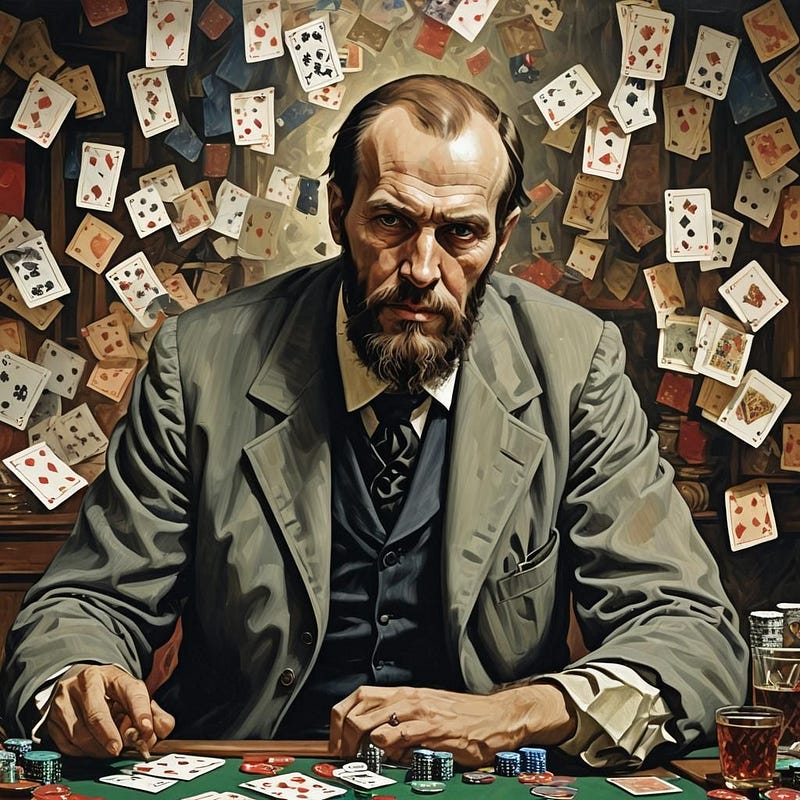
Fyodor Dostoevsky’s Gambles with Destiny
Examine his compulsive gambling, near-execution, and how these experiences informed his psychological novels.
Fyodor Dostoevsky, the legendary Russian author, stands as one of the greatest writers of all time.
His works, such as “Crime and Punishment,” “The Brothers Karamazov,” and “Notes from Underground,” have captivated readers for centuries, poking the deepest recesses of the human psyche.
What many do not know is that Dostoevsky’s life was just as tumultuous and fascinating as his literary creations.
Plagued by gambling addiction, near-execution, and a myriad of personal struggles, Dostoevsky managed to channel his torment into works of unparalleled psychological depth and insight.
The author’s tumultuous life experiences shaped his literary genius, focusing on his compulsive gambling, near-execution, and the impact these events had on his psychological novels.
The Demons of Dostoevsky: A Lifelong Struggle with Gambling
From a young age, Dostoevsky was drawn to the allure of gambling.
Often described as a compulsive gambler, he would spend countless hours and rubles in the pursuit of that elusive winning streak.
Despite the devastating consequences on his personal life and financial stability, Dostoevsky found himself unable to resist the siren call of the roulette wheel, which became a recurring motif in his life and works.
A Brush with Death: Dostoevsky’s Near-Execution
In 1849, the young Dostoevsky faced the ultimate consequence of his gambling addiction when he was arrested for his involvement in a secret political organization.
Sentenced to death by firing squad, Dostoevsky was just moments away from facing his maker when news arrived that his sentence had been commuted to four years of hard labor in Siberia.
This harrowing experience left an indelible mark on the author, who would later draw upon this near-death experience to create some of his most memorable characters.
The Crucible of Siberia: How Dostoevsky’s Imprisonment Shaped His Worldview
Dostoevsky’s four years of hard labor in Siberia were marked by extreme physical and psychological suffering.
It was during this time that he began to develop the unique worldview that would come to define his literary masterpieces.
Isolated from society and forced to confront the darkest aspects of human nature, Dostoevsky gained a profound understanding of the human condition, which he would later articulate in his novels.
The Birth of Dostoevsky’s Psychological Novels
Upon his return to St. Petersburg in 1854, Dostoevsky began to channel his experiences into his writing.
Drawing upon his own struggles with gambling, near-execution, and the harsh realities of life in Siberia, Dostoevsky crafted a series of psychological novels that would come to define the literary landscape of the 19th century.
Crime and Punishment: The Dark Journey of Raskolnikov
In “Crime and Punishment,” Dostoevsky explores the mind of a young man, Raskolnikov, who commits a brutal murder in the hopes of proving his own intellectual superiority.
Haunted by his crime and struggling to come to terms with the consequences of his actions, Raskolnikov enters a tortured experience of self-discovery that mirrors Dostoevsky’s own struggles with guilt and redemption.
The Brothers Karamazov: A Family’s Tragedy Unfolds
In “The Brothers Karamazov,” Dostoevsky delves into the complex relationships between the members of a dysfunctional family, each of whom is driven by their own personal demons.
As the characters grapple with questions of morality, faith, and the nature of human existence, Dostoevsky weaves a tapestry of psychological insight that has captivated readers for generations.
Notes from Underground: The Inner Turmoil of a Narrator
In “Notes from Underground,” Dostoevsky presents the inner monologue of a bitter and resentful man, who struggles to come to terms with his own failings and shortcomings.
Through the eyes of this unreliable narrator, Dostoevsky offers a scathing critique of the human condition, revealing the dark underbelly of the human psyche and the often futile search for meaning and purpose in life.
Fyodor Dostoevsky’s tumultuous life, marked by gambling addiction, near-execution, and harsh imprisonment, served as the crucible from which his literary genius was forged. By drawing upon his own personal struggles and experiences, Dostoevsky crafted a series of psychological novels that have endured for centuries, offering timeless insights into the human condition and the complexities of the human psyche.


