
Future Communities for a Changing World
In the last few years and especially with the advent of Covid-19 and the suffering caused on a global scale by it, we are belatedly becoming aware that the ideals our trusted educators taught us to accept are not altogether indisputable. Generations have lived out their lifespans believing in fallacies, fervent followers of systems that measure everything and everyone as economic units with the almighty profit as our God. In their ignorance, our parents passed on these reverent beliefs, and our education system rigidly reinforced them with the questionable end goal of producing a placid, obedient and grateful workforce. By entering wholeheartedly into the shiny pond of consumption, we would all make the world a better place and improve our lot in it, or so they tell us. Now we are all beginning to see the cracks running through the walls of this tower of fantasy. Infinite consumerism powered by the idyll of endless growth is not sustainable and takes us, the human species, down the road of eternal suffering. Rampant pollution, acidic oceans, species extinctions, changing weather patterns, growing soil infertility, forests destruction, melting glaciers and permafrost, methane release and carbon over-production, freshwater shortages and clean air degradation, advancing inequality and socio-political destabilisation — you name it, and it is happening. It sounds almost biblical. We are not the only inheritors of this garden which birthed us, but we are fast fashioning ourselves as the only ones left standing on its increasingly barren soil. As individuals, we can attain anything. Alone we can achieve everything. All it takes is hard work and self-belief. We stand and fall solely on our efforts. On a personal level, loneliness, depression, suicide, social maladjustment and isolation, and meaningless work are becoming more commonplace. On a social level, unrest, polarisation, perceived cultural threats, and stressful environmental change take their toll. Time seems to be running out for what we once held dear. What shall we do? What can we do? The answer, I believe, lies in the rediscovery of community.
Governments and corporations are the beneficiaries of our present and outdated economic system of eventual destruction. They refuse to shift from the narrow path they are on and put their investment into technologies for carbon extraction that exist, at present, solely in the minds and on the drawing boards of scientists. A rescue is waiting for us in the future, so why break a good thing? This is a smug, reassuring position. We cannot depend on it or them. The change will have to start at the grass-roots. We, who think ourselves powerless, must start the revolution. But how?
Some years ago, I came across an article talking about a social experiment to reorganise Barcelona’s city fabric. The proposal posited the formation of city super-blocks. https://www.vox.com/energy-and-environment/2019/4/9/18300797/barcelona-spain-superblocks-urban-planocks.
This idea can go much further than merely pushing out the cars that dominated the streets of modern urban environments. Let us take Rome as our template. Rome lies mostly covered in old, venerable buildings in which the population lives in harmonious disharmony with shops and businesses. The layout is organised in irregular, sprawling blocks in which people behave in many ways as Italian villagers in the countryside have done for aeons. Many residents go to the local bar for coffee and cornetto before heading off to work. The older, retired men tend to congregate there discussing whatever old men discuss. Their wives wander around the local area shopping. School children hustle to the local schools either on their own or tagging after their mothers. It’s an age-old, unbroken rhythm that echoes the tolling bell of the nearby Catholic Church. Why not use this and add to it?
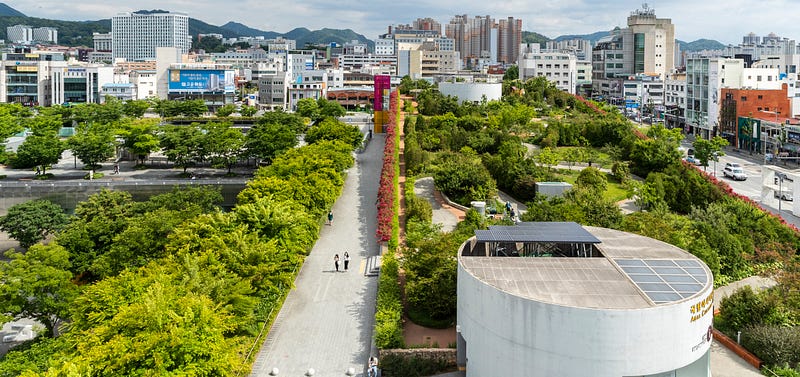
The first step is to examine individual apartment blocks. Many have spacious, open roof spaces littered with TV antennae and very little else. With a bit of direction and encouragement, the residents could convert these communal terraces into roof-top gardens tended by the occupiers and watered by rain-filled, water butts. They could even add balconies to this endeavour. Everyone becomes potentially entitled to a share of the produce. Alternatively, they could also use these roof-top spaces to set up solar-powered or even wind-driven, if feasible, energy technology for the building’s use. This first step could be a start for each block to regulate its temperature and become self-sufficient clean energy consumers. They could run this start-up as a mini-non-profit cooperative. Another benefit of this enterprise would be people reconnecting with their neighbours. Isolated behind their doors are many elderly citizens as Rome has many of these. The building community would become aware of them and their needs. They could join in activities which makes them feel capable and useful once again.
The second step will depend on support from local councils and regional government. As in the Barcelona model, they could reduce or even restrict traffic through designated super-blocks and remove parked cars from the roadside curbs. Perhaps by constructing more underground car parks with free parking for residents — not an easy solution considering Rome’s treasure trove of ancient ruins lying everywhere beneath the surface. Bus stops would no longer be laid out along the streets but have stops on circuitous routes around the super-blocks. Small, self-driving battery-operated cars could take those unable to walk to these points and other destinations within the blocks. Local government could also grant funds and incentives to local enterprises within the super-blocks, encouraging more self-employment and small business developments. This juncture is where the central government could introduce a basic income to all citizens, similar to the Korean model. https://www.youtube.com/watch?v=EbWv_1NbWyw. With the stipulation that this extra, untaxed income has to be spent locally and not on the products of large, multi-national corporations.
Small parks within these zones would be handed over into their care. Now that citizens receive a no strings attached income the compulsion to do meaningless work to survive reduces significantly. Community and the well-being of the community become the focus of meaningful work. The rewards become self-perpetuating, separating work from existing as an economic unit to enrich faceless others. In this environment, voluntary work that serves the community loses the stigma insinuated from a profit-driven, financial world.
Success in any area that produces excess beyond the needs of any block can be traded with another. In this way, there is not only cooperation within individual super-blocks, but communication throughout the city, divided into its particular super-blocks. Each zone cooperative has a large degree of autonomy to innovate across a cleaner, more environmentally friendly line, feeding their ideas to the local government for approval and support when needed and through them to Central government.
To me, there is so much more there to input and discuss. Enough, I hope, to get governments to stop inventing smart phrases to avoid implementing necessary action to impede the introduction of a new and vital story for all of us — a plan to help us survive into the future.


