
KINDERTOTENMUSIK
Funeral Music
Play the right notes
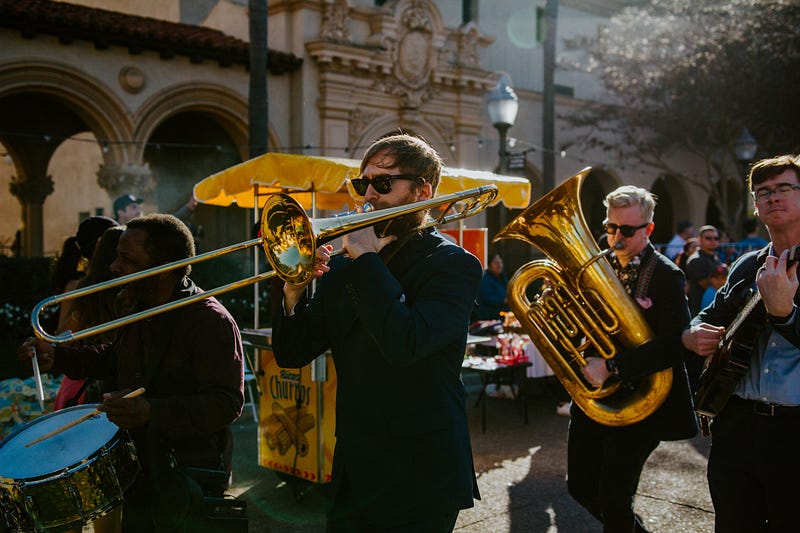
At rehearsal, the evening prior to the funeral, we realize our usual rendition of I’ll Fly Away, which Anne requested for the recessional, will never do. We need something solemn. We practice until we have a brass choir vibe down, then, in case we need more music, work up a similar version of Just a Closer Walk With Thee.
It is the day of the Funeral. The blinding rain and the wind nearly blow my seventy-one year old self down the stone steps in the park. I arrive soaked and dripping onto the carpeted church floor, the wind having destroyed my umbrella. It’s OK, sir, it’s only water. Please come in.
No way could I miss this. You and I are now kin, Anne. We share a bond only those who make music together know. Now we share another, deeper bond, one no one wants — that of having a child who died. In the receiving line, I say I’m so sorry to your husband and other son whom I barely know. When I reach you, you move to embrace me but I put out my hand to dissuade.
I’m a wet mess Anne
You look into my face and are effusive in your thanks for my letter. Words stumble out of me in reply but mostly I am relieved. Relieved that I didn’t mess up. These moments are delicate. I applied considerable thought, creating a word of hope, a connection not about me but even our best efforts may land with a thud. Had you said nothing I would have worried. Thanks to whatever god takes care of such things I hit the right notes, caught you at the right time, moved you in the right way.
Now we come to the service, where the living speak of the dead.
I listen to talk about how proud you all were and are and how he struggled and what a good heart he had. It is you because I did not know him. I came for you, out of regard for this terrible bond we now share.
Yet I feel him here with us, crowding out these sentiments, staring down this brave face everyone puts on. We dance around this dread cloud, this whirlwind, this bloated, accusing finger, this idea too terrible to face. All the brave words, the music, the sentiment, the contemporary platitudes — none of it can conceal him. If he could speak to us, would we wither beneath his rage? The rage that so vexed when alive, now silenced, shaming us. Hypocrites. Pretenders. Cowards.
When a teenager dies in this way, a life is wasted. Utterly. The predations of capitalism, of Big Pharma, of whatever we want to blame notwithstanding, the result is the same: utter waste. Yet decorum must be preserved, making the unspoken accusation apply to the whole lot of us. It is a dance, a cotillion, a game. We know the rules.
So we tell ourselves, as I told you, that if our dead children could speak to us they would counsel that we forgive ourselves. Yet we have no idea what howling monster lies beyond that veil, what it would tell us if it could. If it spoke, would we even know, much less understand? Of this presence we ask forgiveness? It is for us to bow in silence before the mystery of death.
Now it is the recessional. Due to the church’s COVID policy, we must play outside. As a mercy from God, the rain and wind left the sky beforehand.
The absent children never leave us. The earth cannot hold them. Crouched within, yet unhidden, they return like wind and rain. Expect this, my dear friend. There is no forgetting. More than forty years on and barely a day goes by that I don’t think of him, however brief his little life.
We remember. We tell ourselves that our remembering keeps them alive. The rational mind knows better, but as irrational beings, we find it easier to maintain this pretext. In this way they do continue on, to haunt our dreams, to weigh on us all over again when a new dear one comes to the door of this, the home no one wants to enter, the family no one wants to join.