
Fundamentals of the American Court Hierarchy
From the federal and state courts to the concept of dual sovereignty.
The United States uses a common law. With it, the way the U.S. laws work and how disputes are settled in court is “adversarial.” The decisions in court cases are based on precedents. Once a decision has been made, future cases must adhere to it whenever the situation comes up again. There’s a principle at the core of this system called “stare decisis,” a less-than-friendly-Latin way of saying “stick to what’s already been decided.”
Basically, when a court makes one decision about a case, it’s going to stick with that decision on future cases that are mostly the same. This creates a kind of legal chain reaction, where one decision leads to another, and another, and so on, to make sure that cases that are pretty much alike get pretty much the same treatment. If a court in one region (jurisdiction) makes a decision, the decision is kind of like a rulebook for all future cases in that region. Courts in other areas can peek at this rulebook for ideas, but they don’t have to follow it.
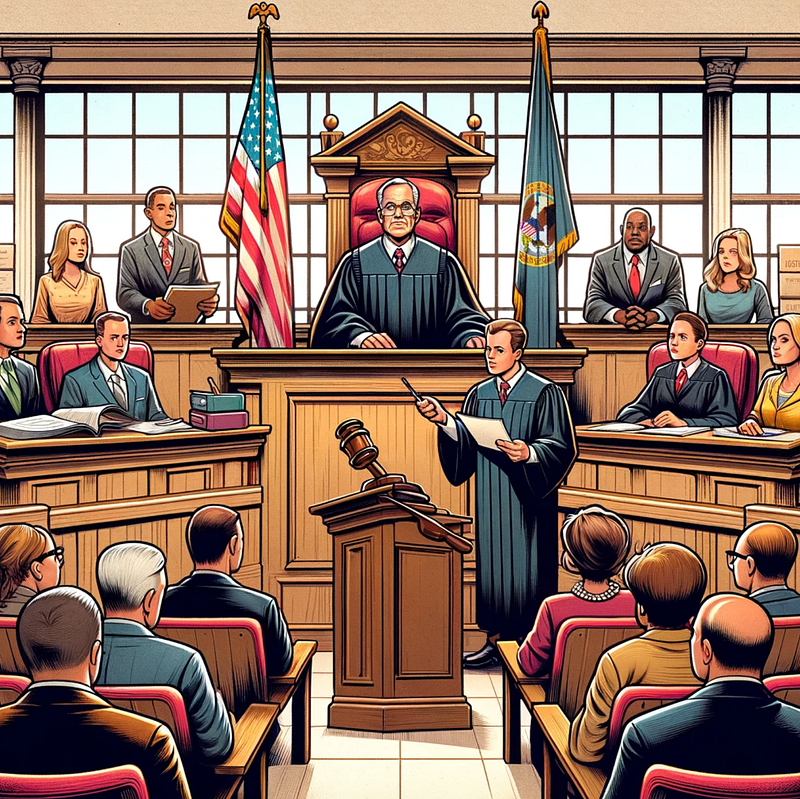
American Dual Court System
Understanding the American legal system begins with the United States’ dual nature of the court system. In general, the Constitution grants certain powers to the federal government and leaves the remaining powers to the states. This “dual sovereignty” creates the basic legal process, which is divided into federal and state courts. Federal courts handle matters specifically designated by the Constitution, and state courts handle everything else.
It is helpful to keep in mind that courts are also divided by geography within the federal system and by corresponding state court systems. Courts within both of these broad categories are organized into various hierarchies, and thus comes the concept of jurisdiction.
Jurisdiction describes the legal boundaries within which courts can operate. It is a fundamental concept that will become increasingly important as you progress in your study of civil procedure, if any.
To illustrate how court decisions affect different jurisdictions, let’s use an analogy: think of the court system as a river system. The Supreme Court, like the main river, is the most influential, and its decisions flow downstream, affecting all the tributaries and streams below it. In this river system, the decisions of the higher courts are like the current of the main river, powerful and guiding the direction of the water (or legal precedent) throughout the system. Lower courts, like smaller streams, have their own current, but must follow the overall direction set by the main river.
Just as rivers and streams can influence each other through their interconnectedness, decisions from one court can influence others within the same level (lateral influence), but in a more compelling way, like streams merging or diverging, rather than a direct flow.
The Role of Trial Courts
Trial courts are the foundation of the legal system — these courts serve as the first-level arenas where legal disputes are brought and resolved. The core function of the trial court is to decide disputes by applying legal principles to specific facts. They are bound by the legal precedents established by appellate courts and supreme courts within their jurisdiction.
A judge in a trial court listens to the evidence, assesses the credibility of witnesses, and makes decisions consistent with the requirements of the law and the evidence presented. This function is the foundation of the administration of justice and ensures that each case receives a fair and impartial hearing.
Example: A civil lawsuit for breach of contract would be filed in the New York Supreme Court (in fact trial level despite its naming) in the county where one of the parties resides.
Example: A criminal case involving burglary charges would be initiated in the California Superior Court (also trial level) in the jurisdiction where the crime occurred.
The decisions of trial courts are immediately binding only on the parties before the court, but their influence is felt far beyond the confines of a courtroom because
Although trial court decisions are not binding precedents for future cases, they play a critical role in the development of legal reasoning and doctrine. Higher courts often rely on the detailed factual analyses and legal interpretations of trial courts to establish larger principles of law.

Overview of Appellate Courts
When the final gavel falls in a trial court, anyone who leaves the courtroom unsatisfied knows that the appellate court is the next stop in the courtroom drama.
Appellate courts are critical to the review of trial court decisions. They are not places where witnesses are cross-examined again, nor are they places where new evidence is introduced. Instead, they closely analyze legal principles. They determine whether the trial court correctly applied the law and fairly followed the proper procedures for a fair trial.
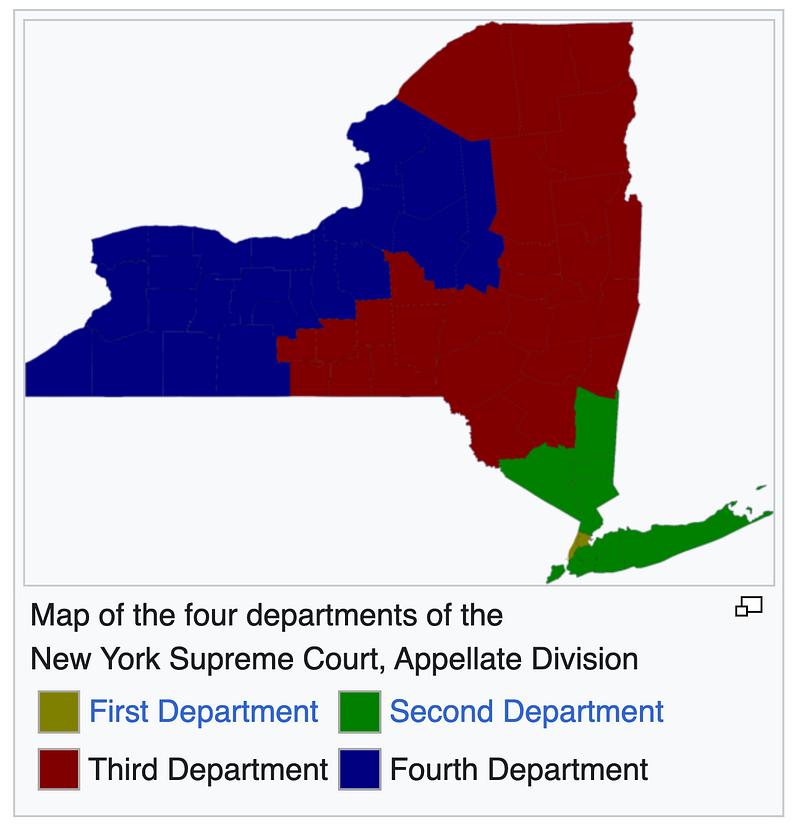
Appellate Courts in New York: Appellate Division of the Supreme Court
Example: An appeal from a decision made by the Supreme Court in a personal injury case would go to the Appellate Division of the Supreme Court, within the appropriate department based on the location of the original trial court.
Appellate Courts in California: California Court of Appeal
Example: An appeal from a ruling by a Superior Court in a divorce case would be heard by the California Courts of Appeal in the district that covers the county where the Superior Court is located.
Appellate courts are charged with the systemic duty of keeping the law in line. Through their review, these courts affirm or reverse. Their effects extend beyond the parties to the controversy and establish guiding decisions that influence future interpretations and applications of the law.
The Highest Courts
The court of last resort, or the court of final determination, is the highest recognized judicial authority within its jurisdiction, with the United States Supreme Court as the final authority.
The highest judicial authority, for instance, in California follows a conventionally named Supreme Court. Parties can appeal cases from the California Courts of Appeal to the California Supreme Court, if it decides to hear the case.
This path from trial courts to these courts of last resort is the path of the process by which legal disputes are resolved. These courts of last resort are discretionary, but their decisions are the most authoritative and serve as binding precedents for all lower courts within the state, guaranteeing that a jurisdiction’s legal disputes will be resolved uniformly and conclusively by courts at the top of a state’s judicial hierarchy.
As with New York, a significant legal challenge levied in a New York Supreme Court (trial court) may be appealed to the Appellate Division and then ultimately to the New York Court of Appeals — New York’s highest court.
The importance of these courts of last resort cannot be overstated; these highest courts are not only by resolving disputes, but by clarifying and establishing legal principles and helping to guide lower courts in their application of the law.
Disclaimer
The information provided in this article is for informational and educational purposes only and is not intended to serve as legal advice or as a substitute for legal counsel. While efforts have been made to ensure the accuracy and completeness of the content herein, it is important to note that legal principles and regulations can vary significantly based on jurisdiction and specific circumstances. Therefore, this article should not be used as a definitive legal resource or as a basis for making legal decisions. Readers are strongly advised to consult with a qualified attorney for advice on legal issues or matters, as each individual case may require detailed and personalized legal analysis.
Reliance solely on the information provided in this article without seeking professional advice from an attorney may lead to unintended legal consequences or misinterpretation. The author or publisher of this article do not accept responsibility for any potential errors or omissions, nor will they be responsible for any losses, injuries, or damages arising from its display or use. The information provided here does not create an attorney-client relationship between the reader and the author or publisher.