
Functions in JavaScript Have More Secrets Than You Think
Things that advanced JavaScript programmers must know.

Functions are a familiar syntax to every programmer. In JavaScript, functions have a very high status and are often referred to as first-class citizens. But are you really good at using functions?
Here I’ll introduce some advanced tips for using functions that I hope will help you. This article includes the following sections:
- Pure Function
- Higher-Order Function
- Function Caching
- Lazy Function
- Currying
- Function Compose
Pure Function
What is a pure function?
A function that meets both of the following conditions is called a pure function:
- It was always returned the same result if given the same arguments.
- No side effects occur during the execution of the function
Example 1:
function circleArea(radius){
  return radius * radius * 3.14
}
When the values of the radius are the same, the function always returns the same result. And the execution of the function has no effect on the outside of the function, so this is a pure function.
Example 2:
let counter = (function(){
  let initValue = 0
  return function(){
    initValue++;
    return initValue
  }
})()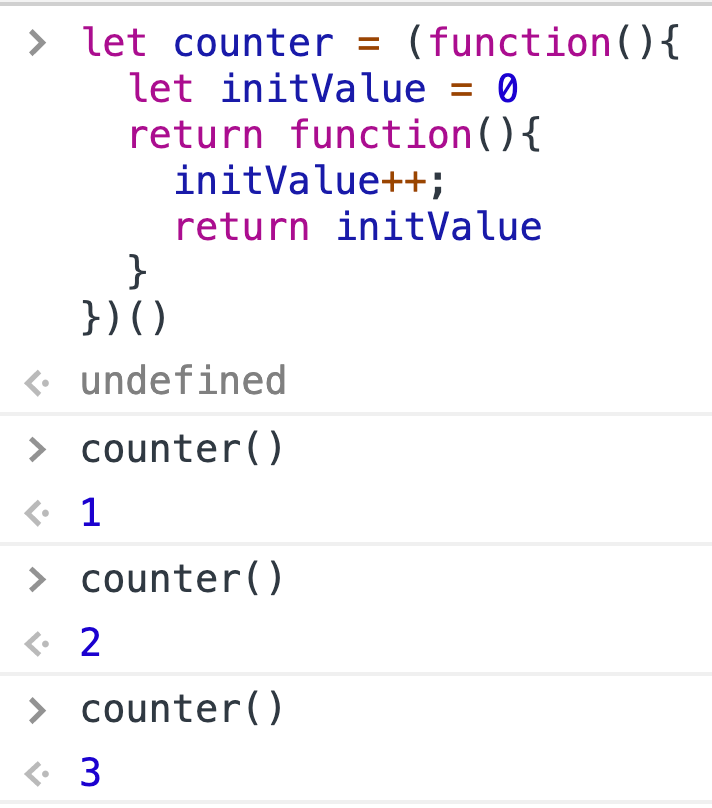
This counter function will run differently every time, so this is not a pure function.
Example 3:
let femaleCounter = 0;
let maleCounter = 0;
function isMale(user){
if(user.sex = 'man'){
maleCounter++;
return true
}
return false
}In the example above, the function isMale, given the same argument, always has the same result, but it has side effects. The side effect is to change the value of the global variable maleCounter, so it is not pure.
What’s the use of pure functions?
Why do we distinguish pure functions from other functions? Because pure functions have many advantages, we can use pure functions to improve the quality of our code during the programming process.
- Pure functions are much clearer and easier to read
Each pure function always accomplishes a specific task and has an exact result. This will greatly improve the readability of the code and make it easier to write documents.
2. The compiler can do more optimization on pure functions
Let’s say I have a code snippet like this:
for (int i = 0; i < 1000; i++){
    console.log(fun(10));
}
If fun were not a pure function, then fun(10) would need to be executed 1,000 times while this code is running.
If fun were a pure function, the editor would be able to optimize the code at compile time. The optimized code might look like this:
let result = fun(10)
for (int i = 0; i < 1000; i++){
    console.log(result);
}
3. Pure functions are easier to test
Tests of pure functions do not need to be context-dependent. When we write unit tests for pure functions, we simply give an input value and assert that the output of the function meets our requirements.
A simple example: A pure function takes an array of numbers as an argument and increments each element of the array by 1.
const incrementNumbers = function(numbers){
  // ...
}
We just need to write the unit test for it like this:
let list = [1, 2, 3, 4, 5];assert.equals(incrementNumbers(list), [2, 3, 4, 5, 6])If it’s not a pure function, we have a lot of external factors to consider, and it’s not a simple task.
Higher-Order Function
What is a higher-order function?
A higher-order function is a function that does at least one of the following:
- takes one or more functions as arguments
- returns a function as its result.
Using higher-order functions can increase the flexibility of our code, allowing us to write a more concise and efficient code.
Let’s say we now have an array of integers, and we want to create a new array. The elements of the new array have the same length as the original array, and the value of the corresponding element is twice the value of the original array.
Without using higher-order functions, we might write like this:
const arr1 = [1, 2, 3];
const arr2 = [];
for (let i = 0; i < arr1.length; i++) {
arr2.push(arr1[i] * 2);
}In JavaScript, the array object has a map() method.
The
map(callback)method creates a new array populated with the results of calling a provided function on every element in the calling array.
const arr1 = [1, 2, 3];
const arr2 = arr1.map(function(item) {
  return item * 2;
});
console.log(arr2);
The map function is a higher-order function.
Using higher-order functions correctly can improve the quality of our code. The next sections are all about higher-order functions, so let’s move on.
Function Caching
Let’s say we have a pure function that looks like this:
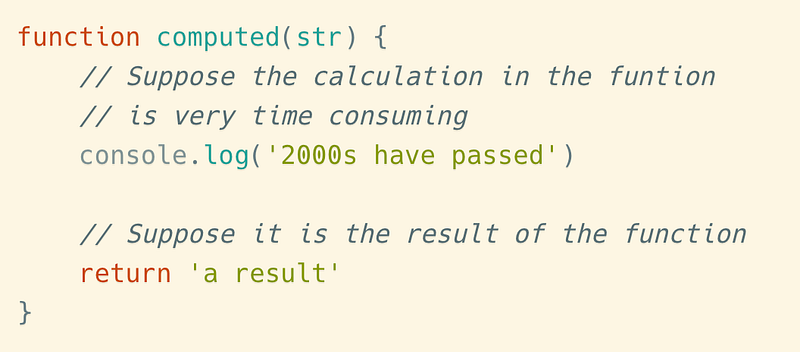
function computed(str) {
    // Suppose the calculation in the funtion is very time consuming
    console.log('2000s have passed')

    // Suppose it is the result of the function
    return 'a result'
}
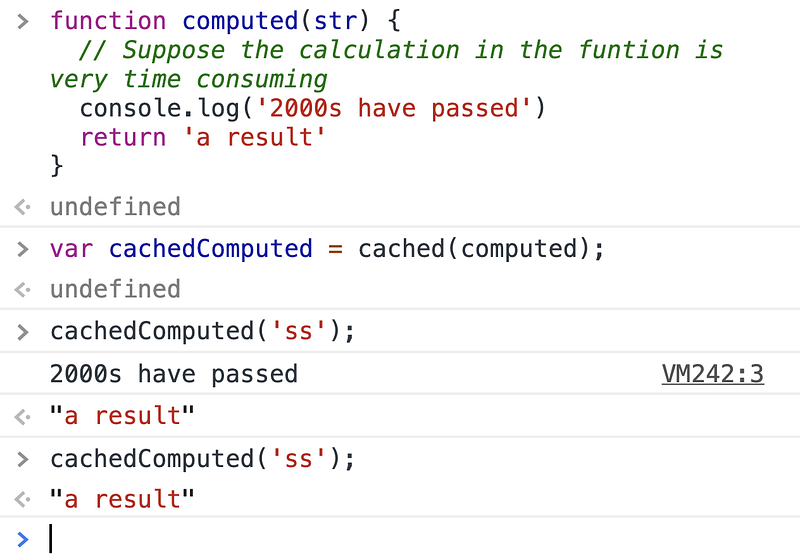
To increase the speed of the program, we want to cache the result of the function operation. When it is called later, if the parameters are the same, the function will no longer be executed, but the result in the cache will be returned directly. What can we do?
We can write a cached function to wrap around our target function. This cache function takes the target function as an argument and returns a new wrapped function. Inside the cached function, we can cache the result of the previous function call with an Object or Map.
Here is an example:
Lazy Function
The body of a function usually contains some conditional statements. Sometimes these statements only need to be executed once.
We can improve the performance of the function by ‘deleting’ these statements after the first execution, so that the function does not need to execute these statements in subsequent executions. That is lazy function.
For example, we now need to write a function called foo that always returns the Date object from the first call, note ‘the first call’.
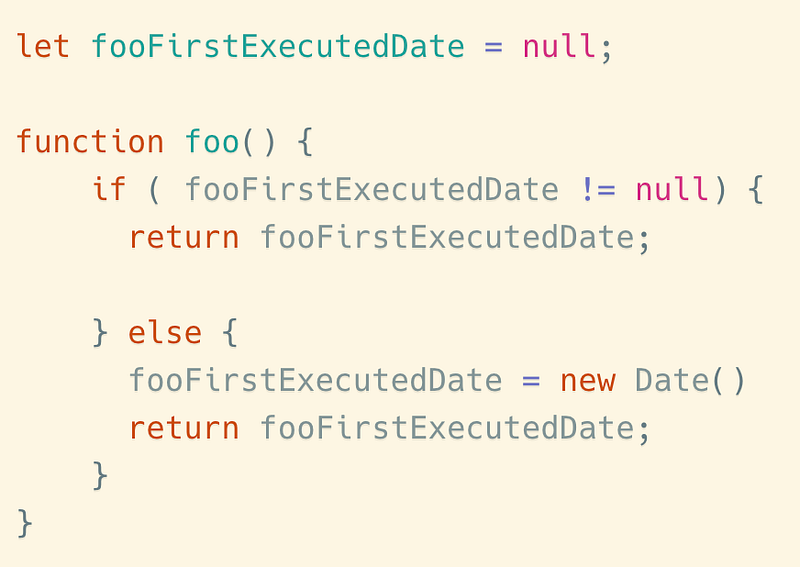
let fooFirstExecutedDate = null;
function foo() {
    if ( fooFirstExecutedDate != null) {
      return fooFirstExecutedDate;
    } else {
      fooFirstExecutedDate = new Date()
      return fooFirstExecutedDate;
    }
}
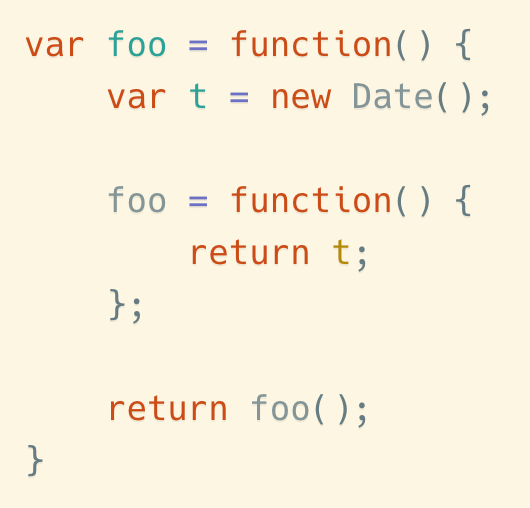
Each time the above function is run, the judgment statement needs to be executed. If this judgment condition is very complex, then it will result in the performance degradation of our program. At this point, we can use the technique of lazy functions to optimize this code.
We could write code like this:
var foo = function() {
    var t = new Date();
    foo = function() {
        return t;
    };
    return foo();
}
After the first execution, we overwrite the original function with the new function. When this function is executed in the future, the judgment statement will no longer be executed. This will improve the performance of our code.
Then let’s look at a more practical example.
When we add DOM events to the element, in order to be compatible with modern browsers and IE browsers, we need to make a judgment on the browser environment:
function addEvent (type, el, fn) {
    if (window.addEventListener) {
        el.addEventListener(type, fn, false);
    }
    else if(window.attachEvent){
        el.attachEvent('on' + type, fn);
    }
}
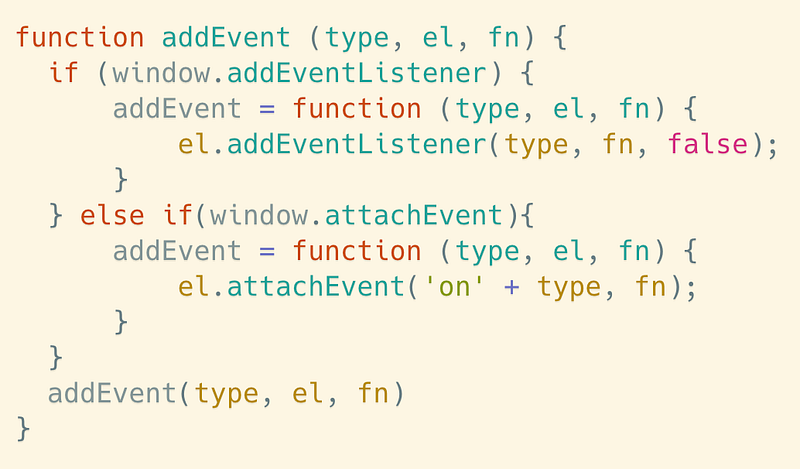
Every time we call the addEvent function, we have to make a judgment. Using lazy functions, we can do this:
function addEvent (type, el, fn) {
  if (window.addEventListener) {
      addEvent = function (type, el, fn) {
          el.addEventListener(type, fn, false);
      }
  } else if(window.attachEvent){
      addEvent = function (type, el, fn) {
          el.attachEvent('on' + type, fn);
      }
  }
  addEvent(type, el, fn)
}
To sum up, if there is a conditional judgment within a function that only needs to be executed once, then we can optimize it with lazy functions. In particular, after the first judgment is made, the original function is overwritten with the new function, and the new function removes the conditional judgment.
Function Currying
Currying is a technique of evaluating function with multiple arguments, into a sequence of functions with a single argument.
In other words, when a function, instead of taking all arguments at one time, takes the first one and return a new function that takes the second one and returns a new function which takes the third one, and so forth until all arguments have been fulfilled.
That is when we turn a function call add(1,2,3) into add(1)(2)(3) . By using this technique, the little piece can be configured and reused with ease.
Why it’s useful?
- Currying helps you to avoid passing the same variable again and again.
- It helps to create a higher-order function. It is extremely helpful in event handling.
- Little pieces can be configured and reused with ease.
Let’s look at a simple add function. It accepts three operands as arguments and returns the sum of all three as the result.
function add(a,b,c){
 return a + b + c;
}
You can call it with too few (with odd results), or too many (excess arguments get ignored).
add(1,2,3) --> 6
add(1,2) --> NaN
add(1,2,3,4) --> 6 //Extra parameters will be ignored.
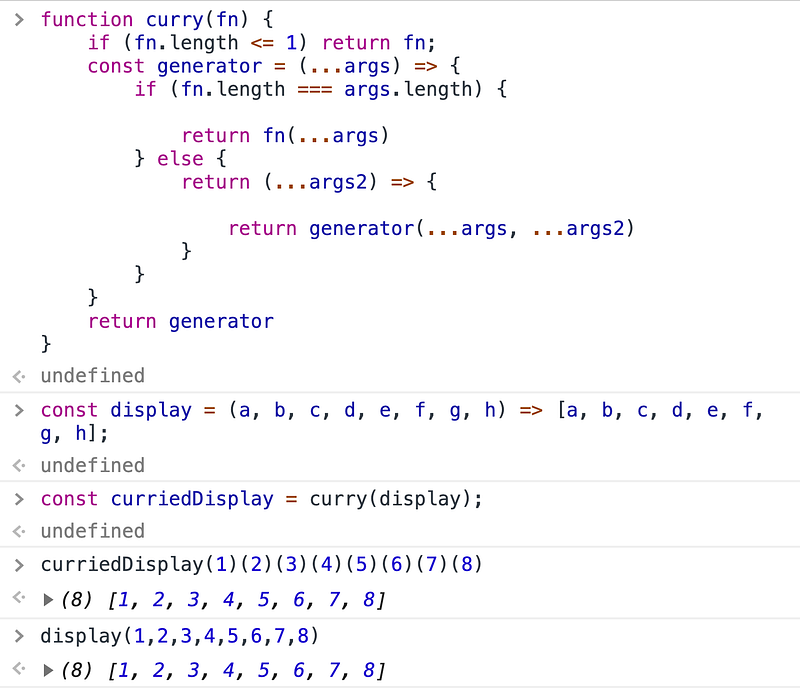
How to convert an existing function to a curried version?
Code:
Example:
Function Compose
Suppose we now need to write a function that does this:
Input ‘bitfish’, return ‘HELLO, BITFISH’.
As you can see, this function has two components:
- Concatenated strings
- Converts the string to uppercase
So we can write the code like this:
let toUpperCase = function(x) { return x.toUpperCase(); };
let hello = function(x) { return 'HELLO, ' + x; };
let greet = function(x){
return hello(toUpperCase(x));
};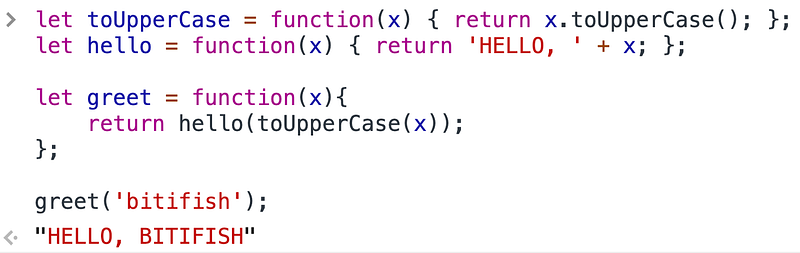
There are only two steps in this example, so the greet function does not look complex. If there were more operations, the greet function would need more nesting in it, writing code similar to fn3(fn2(fn1(fn0(x)))).
To do this, we can write a compose function exclusively for composing functions:
let compose = function(f,g) {
    return function(x) {
        return f(g(x));
    };
};
Thus, the greet function can be obtained through the compose function:
let greet = compose(hello, toUpperCase);
greet('kevin');
Using compose functions to combine two functions into a single function makes the code run from right to left, rather than from the inside out, making it much more readable.
But now the compose function can only support two parameters, and we really want the function to accept any number of parameters.
The composer function is implemented this way in the well-known open source project underscore.
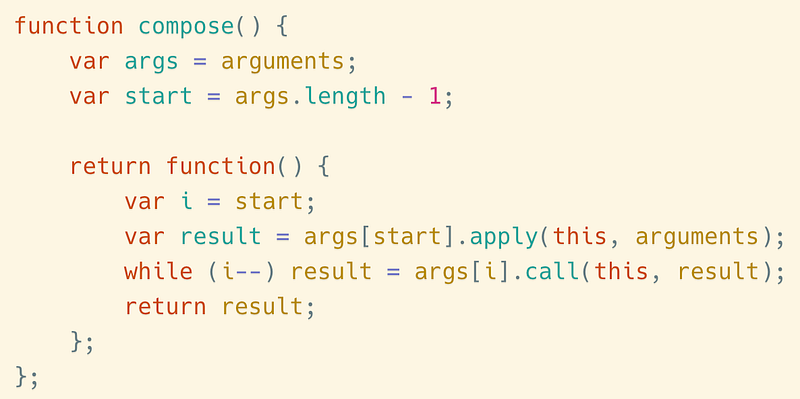
function compose() {
    var args = arguments;
    var start = args.length - 1;
    return function() {
        var i = start;
        var result = args[start].apply(this, arguments);
        while (i--) result = args[i].call(this, result);
        return result;
    };
};
Through function compose, we can optimize the logical relationships between functions, improve the readability of the code, and facilitate future extensions and refactoring.


