
Fun facts from the new Facebook filter bubble study
Facebook’s new study on the filter bubble has lots of interesting tidbits on how liberals and conservatives consume content on the platform. (My main take on what it all means is here.)
Here are a few of the most fascinating facts:
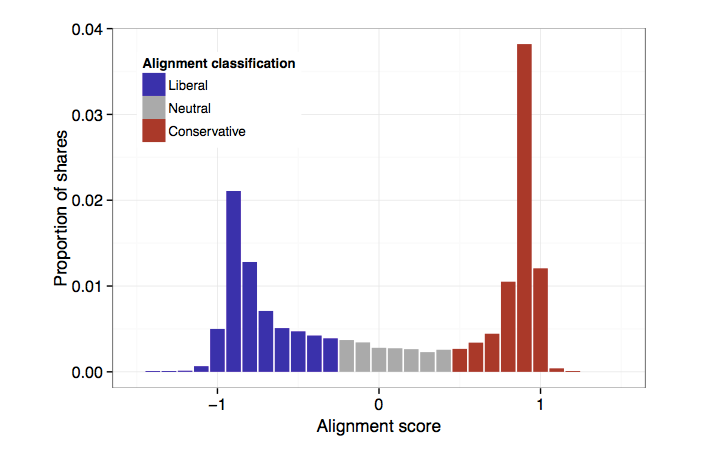
- The hard news people share tends to either be favored by folks at the edges — strong liberals or conservatives:
- The “filter bubble effect” — the degree to which Facebook’s algorithm narrows what content you consume — is almost as strong as your individual choices about what you click on.
- The relative effect of the algorithm in filtering news is stronger for liberals than conservatives. For liberals, the effect of what you click is about 6%, whereas the algorithmic effect is 8%. For conservatives, the filter bubble effect is about 5% and the click effect is about 17%. (Table S6)
- When presented with news that contains opposing views, conservatives click on it a lot less than liberals. (17% for conservatives vs. 6% for liberals)
- Roughly 13% of all links posted on Facebook were “hard news”-oriented content. On average, viewers clicked on 7% of the hard news content available in their feeds.
- The Washington Post does a remarkable job of being shared by folks across the political spectrum. While a majority of links from the Post are shared primarily by liberals, 43% of shares come from moderates and conservatives. No other site listed comes close to that kind of breadth.
- According to the study, conservatives actually see more liberal-favored news on Facebook than liberals see conservative news. In general, 35% of the news seen by conservatives is favored by liberals, whereas only 24% of the news liberals see is favored by conservatives. This is a bit misleading, though, due to the way the articles were tagged — because liberals tend to favor large outfits with less of an ideological bent. (E.g. CNN, New York Times)
- Self-labeled liberals have more friends on Facebook than self-labeled conservatives — 551 to 475 on average. (This is probably a function of demographics as much as anything.)
- There are more conservative-aligned hard news shares than liberal-aligned hard news shares.
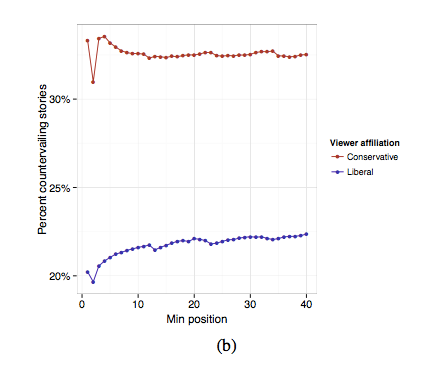
- But it looks like liberal-aligned content may be more engaging than content that’s popular among conservatives — that’s my guess about what’s going on in this graph, which looks at how high in the News Feed cross-cutting content shows up for liberals and conservatives. As you can see, liberal-aligned content seems to be upranked more for conservatives than the reverse:
Eli Pariser is the author of the New York Times bestseller The Filter Bubble: What the Internet is Hiding From You and the co-founder of Upworthy, a website dedicated to drawing attention to important social topics. He’s at @Elipariser on Twitter.


