avatarJeremy Roberts

Free AI web copilot to create summaries, insights and extended knowledge, download it at here

19586

Abstract

ook part in a number of sessions in late 1967, including a number of tracks in November of that year — which is where “My Baby Needs Me” comes from.</p><p id="19d3">There are also the so-called demos from the same period including “Easy Rider,” “Everywhere I Go,” “Long Time Movin’”, and “I’m Going to Love You,” and others that are still kept in the archives. Combining those two sets of recordings, that’s another album’s worth of material already, although none were released at the time.</p><p id="cc03">One thing to remember is that the Direction albums were the only ones where Bobby wrote all the songs, and we know they were done in the run up to recording. So even that took more time, along with setting up the label.

Interviews from the time also suggest that Bobby was, if you like, contemplating who he was and what he wanted to be before Bobby Kennedy’s death.

His output had slowed down a number of years earlier. He recorded six albums in 1960 and 1963, although not all were released at the time. But he only recorded one in 1964, two in 1965, three in 1966 [one unreleased], and two in 1967. We then got one in 1968, so it’s not that much of a difference in output.</p><p id="71bb">The biggest slowdown, of course, is that there were no albums between <i>Commitment</i> in 1969 and the Motown album in 1972 — although we now know that he was busy recording in 1971 but released virtually nothing.</p><p id="917e">There was also a trip to Australia to factor in during the autumn of 1968, which no doubt took its toll on Bobby’s health, and around 20 TV appearances that year, too. Bobby went to Australia to perform on stage in a nightclub setting, and to record a TV special entitled <i>Bobby Darin at the Silver Spade</i>.</p><p id="56b0">This was an hour-long special in which Bobby was filmed on stage in a Sydney hotel in front of a celebrity audience. He performed, amongst other things, “Talk to the Animals,” “If I Were a Rich Man,” and “Mack the Knife.” He also appeared on a couple of Australian chat shows.</p><figure id="ab6f"><img src="https://cdn-images-1.readmedium.com/v2/resize:fit:800/1*HJAvSDttqhFkGP30aOMJQg.jpeg"><figcaption></figcaption></figure><figure id="d61f"><img src="https://cdn-images-1.readmedium.com/v2/resize:fit:800/1*CRg30NlwXUVYb2OdPAV2dw.jpeg"><figcaption><b>“Well I’ve been too busy listenin’ to what everybody else had to say:” A mustachioed Bobby Darin grants an interview upon his arrival in Sydney, Australia, for a season performing at the Chevron Hotel on November 19, 1968. Note the trendy jeans jacket and black leather hat resting on the entertainer’s knee, possibly the same hat he wore on the “Commitment” cover issued a year later. Image Credit: Fairfax Media / Getty Images; At right, presenting the innovative cover of “Bobby Darin Born Walden Robert Cassotto,” the activist’s debut LP unleashed on his own Direction label in July 1968. Darin notably composed all nine cuts, yet the record never had a chance with deejays and the general public. Image Credit: The Bobby Darin Estate / Amazon</b></figcaption></figure><p id="d2d7"><b>When Bobby started Direction Records in 1968, how much precedence was there for such a risky endeavor besides Sinatra and Reprise Records?</b></p><p id="d907">I guess Sinatra and Reprise were different because he started the label at the peak of his career. That wasn’t quite the case for Bobby. I’m not sure how it worked out financially, or if he really cared by that point. He was happy, and doing what he wanted. Bobby’s contentment shines through in a letter written to his family from the period that is included in the book thanks to the generosity of a fan.</p><p id="1a7e"><b>Containing inspired rock arrangements and autobiographical lyrics, why were “Route 58” and “City Life” left in the can during Bobby’s lifetime?</b></p><p id="5ec7">I don’t think anyone really knows why some songs and albums were not released at the time, but it was quite common for Bobby to record things and then not issue the results. For example, three complete albums were recorded in 1963 alone and not released until more than 30 years later, and another in 1966, and two in 1971!</p><p id="0024">It’s safe to make the assumption that Bobby planned to issue “City Life” as a single. He performed it regularly on stage, and also performed it on <i>The Mike Douglas Show </i>on TV. There have also been stories that he was working on a third album for Direction, and these two songs may well have been part of that work.</p><p id="05ba">The Direction years were a sudden burst of artistic energy. However, Darin ran out of steam quite quickly, or perhaps became disillusioned that his music wasn’t getting the attention it deserved. He planned a march in Washington at one point in 1970, but then cancelled it and went to the UK to appear on a game show and give a concert at the Royal Albert Hall.</p><p id="e4b5">The switch from Bob back to Bobby seemed to be sudden, as did the move from the Direction label to Motown. I’m guessing all these things contributed to the songs not being released. I wouldn’t be surprised if there were more Direction studio recordings in the vaults.</p><figure id="accd"><img src="https://cdn-images-1.readmedium.com/v2/resize:fit:800/1*Zs4zDst8mYwYDiVP3N_Vrw.jpeg"><figcaption></figcaption></figure><figure id="4dfa"><img src="https://cdn-images-1.readmedium.com/v2/resize:fit:800/1*NDG8E5SQQDTcgJsKgqMwlA.jpeg"><figcaption><b>“I guess I’m just a rock and roll singer tryin’ to find my way:” Literally turning his back on snobby record execs who thought he was nuts to abandon his greatest hits and re-brand himself as a denim-clad, funky folk rocker, here is the front and rear cover of Bobby Darin’s “Commitment,” released in July 1969. This is the United Kingdom LP edition of “Commitment.” According to Shane Brown, “My understanding is that the USA edition was a gatefold effort, with the back being the rest of the front cover image [i.e. Bobby’s lower body and legs].” The second and final album on the multi-faceted singer’s own Direction label, all 10 cuts, including A-sides “Song for a Dollar” and “Distractions [Part One]”, were written and arranged under the moniker of “Bob Darin.” Photography by Martin Singer / The Klaus Hiltscher Collection / Flickr / The Bobby Darin Estate</b></figcaption></figure><p id="317a"><b>Was Bobby a musician on the Direction-era material?</b></p><p id="4422">As for what he played on the Direction material, we know that Bobby plays harmonica and keyboards at various points, and some of the guitar work is his, too — “In Memoriam” [<i>Born Walden Robert Cassotto</i>, 1968], for example.</p><p id="0867"><b>Did indie label status hinder Bobby’s Direction material from reaching stores? Neither <i>Bobby Darin Born Walden Robert Cassotto</i> nor <i>Commitment</i> charted, and “Long Line Rider” was the only A-side to peak inside the Hot 100 at No. 79.</b></p><p id="7df0">They were distributed by Bell and available in the usual way — across the world — as far as I’m aware. Some of the overseas picture sleeves for the Direction singles are shown in the book.</p><p id="07a2"><b>Was it a mistake for Bobby to sign with Motown and expect that a company predominantly known for nurturing African American talent could produce hits for him?</b></p><p id="695d">I think it was a mistake, but not for that reason. Their way of working was completely alien to Bobby. Bobby was used to having arrangements written for him, going into the studio and recording them live with the orchestra in most cases, and an album would be completed in three nights. That’s not how things worked at Motown.

The booklet for Real Gone Music’s <i>Go Ahead and Back Up: The Lost Motown Masters</i> [2018] gives quite a bit of detail on how each song was recorded.</p><p id="f834">Some songs allocated to Bobby found him adding vocals to an already-recorded backing track intended for another singer — sometimes a female singer like Martha Reeves as is the case on “Stray Dog” — and overdubs being done on different days etc. You can’t expect a man to sing in anything like the same key as a woman, and this is why we have Bobby straining away trying to reach notes on some occasions.

As an example, according to the information we have, “I’m Glad About It” had the backing track cut on May 7, 1971, and assigned to Sammy Davis, Jr. Backing vocals were added the next day. Strings and horns were added on June 1 alongside a demo lead vocal. Bobby recorded his vocal on June 15.</p><p id="3ba1">Compare that to the <i>You’re the Reason I’m Living</i> album [1963], which was recorded from start to finish in three consecutive nights. As a singer who relied on being in the moment and his own instinct, there was no way he could thrive at Motown.</p><p id="23d5">It’s worth adding that the songs that Bobby produced himself at Motown issued almost 50 years later on <i>Go Ahead and Back Up</i> were more successful — the arrangements were written with him in mind, in a key that suited him, and while the various elements were recorded on different days — as I think they had been at Direction, too — it was over a much shorter space of time.</p><figure id="6f89"><img src="https://cdn-images-1.readmedium.com/v2/resize:fit:800/1*IEIP4EdUfqmxFGYtc9fQOA.jpeg"><figcaption></figcaption></figure><figure id="f400"><img src="https://cdn-images-1.readmedium.com/v2/resize:fit:800/1*L318z3vIZvV9Zu1KULN7Kw.jpeg"><figcaption><b>Bobby Darin casually records a lead vocal at MoWest, Motown’s California recording studio on Romaine Street that only existed for a couple of years, for the cover of the self-titled “Bobby Darin” album, distributed by Motown to commercial indifference in August 1972. Up next is “Darin: 1936–1973,” the artist’s first posthumous studio album released in February 1974 by Motown. In spite of eight unreleased sides plus “Sail Away” [recycled from the self-titled 1972 LP] and an extended version of the “Happy” single being assembled by Four Seasons producer Bob Crewe, it rose no higher than No. 204 POP during its six-week chart run. “Darin: 1936–1973” remains the final Darin album to chart on Billboard. It had been seven years since he had seen any Billboard stats — the “If I Were a Carpenter” album debuted on February 11, 1967, reaching No. 142 POP. Photography by Jim Britt / Universal Music Group / The Klaus Hiltscher Collection / Flickr</b></figcaption></figure><p id="93cb"><b>Does Bobby’s Motown tenure hold merit?</b></p><p id="024a">Not for me, no, and mostly for the reasons given in the previous question. The results are mostly Motown recordings rather than Darin recordings. Illness no doubt played a part in that — perhaps where he wasn’t willing to fight for what he wanted as much as he had done.</p><p id="9e35">But for much of the time, he was being allocated songs rather than choosing them himself. In the 1972 <i>Bobby Darin </i>album he was attempting to belt out ballads à la Tom Jones or Elvis. He wasn’t that singer.</p><p id="8e42">The <i>Go Ahead and Back Up</i> disc includes a protest song written by the Corporation called “We’re Getting There.” When you compare it to the Direction material, the difference is startling. Compared to the witty or biting lyrics of <i>Commitment</i>, you get a song with all the subtlety of a brick.</p><p id="7db1">It wasn’t just Motown — his TV series wasn’t very good either. Aside from onstage performances, Bobby appears to have lost his touch to some degree. But the 1971 <i>Live at the Desert Inn</i> album [Motown did not officially distribute it until 1987] contains some of the best work he ever did.</p><p id="5afe"><b>When did Bobby start producing himself?</b></p><p id="9c57">Bobby produced a Nashville session in May 1957, which was a group of demos that then got taken to ATCO and were his first releases for the label. They were his first session after leaving Decca — or — after Decca left him! But remember Bobby was making demos for his own songs before this, and no doubt producing those.</p><p id="06de">Bobby was producing for other people by 1959, and for a lot of others, most notably Wayne Newton, by the time of T. M. Music, his independent record production and music publishing firm, around 1963.</p><p id="6467">He produced his Direction albums, and the unreleased <i>Go Ahead and Back Up </i>at Motown. Quite why he allowed himself to be produced by others at Motown, I don’t know. He did a much better job by himself.</p><figure id="fbb1"><img src="https://cdn-images-1.readmedium.com/v2/resize:fit:800/1*c_X8sXbyYoZNCqDX64Cqhg.jpeg"><figcaption><b>Bobby Darin is surrounded by Atlantic Records executives Jerry Wexler, Nesuhi Ertegun, and Ahmet Ertegun in this circa 1965 snapshot. Photography by William “PoPsie” Randolph/ Atlantic Records Archives</b></figcaption></figure><p id="7649"><b>Of all the studio producers Bobby worked with, who was a match made in Heaven?</b></p><p id="1ab2">Bobby! But his natural home really was ATCO / Atlantic where he was under the guidance of Ahmet Ertegun. He was given almost free reign to record what he wanted there. Why he wanted to leave that, I have no idea.</p><p id="6a23"><b>Was Ahmet Ertegun in the studio for the Darin sessions where he received official credit? Was Ertegun hands-on offering constant feedback, did he make suggestions that Bobby disagreed with, and were there any public comments from Bobby about Ertegun?</b></p><p id="8a28">Ertegun championed Bobby as soon as he moved to ATCO in 1957, and it was Ertegun who made sure Bobby had one last chance to get a hit when ATCO was about to drop him a year later. They went into the studio together and came out with Bobby’s first smash single “Splish Splash” [№3 POP, May 1958].</p><p id="81ff">If you look at the back covers of the ATCO albums you will find that most don’t have a producer credit at all, but they have a “supervision” credit, which was normally given to Ertegun. I don’t think that wording is coincidental, as it suggests a somewhat different role to producer.</p><p id="7e9c">Of course, Bobby worked well with other producers — Nik Venet is most notable at Capitol [1962–1965] along with Charles Koppelman and Don Rubin at Atlantic [1965–1967].</p><figure id="7b18"><img src="https://cdn-images-1.readmedium.com/v2/resize:fit:800/1*DAfZWMBE6xzBPnvrni8fmA.jpeg"><figcaption><b>“Somewhere beyond the sea, somewhere waiting for me, my lover stands on golden sands, and watches the ships that go sailin’:” Onstage most likely in 1971 or 1972 during his Motown Records tenure, Bobby Darin sheds his tuxedo jacket and tie for an intimate Las Vegas crowd. Photography by Bill Crespinel / Globe Photos / Image Collect</b></figcaption></figure><p id="d6a8"><b>What was one of the worst concert reviews that Bobby received?</b></p><p id="048c">I honestly have yet to find a “bad” Darin concert review, but he was criticized at certain points for certain elements in his show. When doing shows outside of nightclubs in 1966–1968 some critics complained about rather adult language and humor that they didn’t think was suitable for family audiences.</p><p id="b63f">Occasionally he was criticized for throwing away “Mack the Knife” — particularly in 1967–68 — and while his attempt at audience participation in a song we only know about through reviews — there is no recording — was praised to start with, eventually it was deemed to be too long.</p><p id="39cf">Earlier than that period he was criticized for talking too much and for entering into impressions and patter mid-song [we hear this type of thing on <i>Darin at the Copa</i>, 1960]. But as for a “bad” show along the lines of what we read about for Elvis, there simply aren’t any such reviews that I have found.</p><p id="c304"><b>Did Bobby tour in the early ‘70s? He has a fantastic-sounding quartet — pianist Bobby “Rosie” Rozario, lead guitarist Terry Kellman, drummer Tommy Amato and bassist Quitman Dennis — backing him when he guested on <i>The</i> <i>Midnight Special</i> [broadcast on March 16, 1973].</b></p><p id="ba68">Bobby didn’t do many shows outside of Las Vegas or Lake Tahoe in the 1970s. We don’t have his touring schedule, and so we don’t know his full itinerary. Bobby used to take his core musicians and then use the house orchestra. You can hear him name the musicians at the end of <i>Live at the Desert Inn</i> and the final TV show in his series.</p><p id="afbc"><b>Bobby and Tommy Amato wrote two songs together — “Something in Her Love” and “Another Song on My Mind” — during the Motown sojourn. They also may have collaborated on “Go Ahead and Back Up.” Have you had any correspondence with Amato?</b></p><p id="916b">I’ve purposely had no correspondence with Tommy Amato or anyone close to Bobby. That was never an intention as part of my book. Amato started playing for Bobby during the Direction years, and they were clearly close. Amato appears in <i>The Bobby Darin Show</i> in comedy sketches as well as playing drums in the band.</p><p id="b54e">My impression is that Bobby wrote “Go Ahead and Back Up” alone, but the Real Gone CD of the same name doesn’t list a writer’s credit for the song. So we can’t be sure.</p><figure id="2d68"><img src="https://cdn-images-1.readmedium.com/v2/resize:fit:800/1*f_LBWUSG0k4a9mkJSGQ4KQ.png"><figcaption><b>“I’ll be there when all your dreams are broken, to answer your unspoken prayer.” In his early twenties, multi-instrumentalist, singer, and songwriter Bobby Darin stands on a brick patio in the late 1950s when “Splish Splash,” “Queen of the Hop,“ “Dream Lover,” and “Mack the Knife” were storming the charts while admirer Elvis Presley was ensconced in the Army. Image Credit: Pinterest user Chiara Parsley</b></figcaption></figure><p id="0c1c"><b>Any particular reason why you’ve “purposely had no correspondence” with any Darin insiders?</b></p><p id="d9a7">I didn’t mean that I didn’t want to talk to them, as I would have been happy to — overjoyed to — but interviews simply weren’t within the remit of the book, and I don’t see how they would have worked into the fabric of a book that was already over 450 pages of a large format paperback.</p><p id="1809">If you look at Will Friedwald’s 1995 book <i>Sinatra! The Song Is You: A Singer’s Art</i> — which is essentially a critique — you’ll find that he talked to everyone he could who worked with Sinatra during the writing of it. That’s the way he works.</p><p id="0e9f">Just as Ernst Jorgensen did with <i>Elvis Presley: A Life in Music — The Complete Recording Sessions</i> [1998] — part sessions book, part critique. Countless others have done the same for biographies, etc., but they had contacts within the field to start with. Plus they are in the United States, which helps matters considerably even in these days of the Internet.</p><p id="471b">My Elvis and Bobby tomes started off as nothing more than something to write as a hobby. They ended up being something much more ambitious, I guess, but my strength as a researcher is in working with magazines, newspapers, trade journals, and other ephemera and pulling together information from them.</p><p id="6f7b">Both the Elvis and Bobby books are pretty unique within the written works on them in doing that. A reviewer of my book <i>Queer Sexualities in Early Film: Cinema and Male-Male Intimacy</i> [2016] referred to me as a “detective,” and that is quite a good description of what I do. I’ll hunt down evidence, sort it, and draw conclusions from it.</p><p id="75e7">For a book with literally no budget, and with me living i

Options

n a different country, interviews weren’t the sensible route for me to take. I did try my luck in the later stages of the Bobby book contacting a few people in the hope that they could clarify some information, but I didn’t hear back from them. I don’t have an agent or, indeed, a publisher, so it’s much more difficult to “get through” or get messages seen. That is important, too.</p><p id="1a70">Despite that, there are excerpts in the book from many interviews, albeit ones that were in newspapers and magazines 40 or more years ago. Most have never been reprinted since and so the quotes are fresh and “new” to the eyes of most readers.</p><figure id="7719"><img src="https://cdn-images-1.readmedium.com/v2/resize:fit:800/1*14MYejy5zenM2FwkoHYpcQ.jpeg"><figcaption><b>“Hurry! Ends Saturday. Bobby Darin with a 23-piece orchestra first in the parade of superstars in the elegant, new Mr. D’s, San Francisco’s finest show room!” A vintage advertisement from the California engagement Bobby Darin was doing when he learned that Democratic presidential hopeful and compadre Bobby Kennedy had been assassinated just six hours south of San Francisco at the Ambassador Hotel in Los Angeles on June 6, 1968. Image Credit: Courtesy of Shane Brown</b></figcaption></figure><p id="e4f9"><b>How much did Bobby revamp his setlist towards the end of his life?</b></p><p id="0df3">When Bob turned back to Bobby, he came back with quite a different setlist to what he had before, and soon it established itself into the type of material that we see on the <i>Live at the Desert Inn — </i>a few hits, but mostly covers of current material by others.</p><p id="cecf">Not only the songs on the <i>Desert Inn</i> album but also “Sweet Caroline,” “You’ve Lost That Lovin’ Feelin,” “Spinning Wheel,” “Help Me Make It Through the Night,” “The Midnight Special,” etc. Other than some minor tweaking, the general format of his live show changed very little in the final three years of his life.</p><p id="f29c"><b>What was the last song Bobby worked on in a recording studio?</b></p><p id="f8d7">For years it was thought that “Happy [Love Theme from <i>Lady Sings the Blues</i>]” was the last studio recording made by Bobby, but the <i>Go Ahead and Back Up</i> CD tells us that he returned to the studio in February 1973 to record “I Won’t Last a Day Without You” and “Another Song on My Mind.”</p><p id="45dd">The liner notes for that CD were as much of a revelation as the music itself, for the first time giving us session dates and recording information. Bobby got a release from his Motown contract a few months later, and wasn’t affiliated with any label after that, and so it’s not thought that he recorded again unless it was to create a demo for his own use.</p><figure id="421d"><img src="https://cdn-images-1.readmedium.com/v2/resize:fit:800/1*s7wDt3gLvv2VZLojCxUCtw.jpeg"><figcaption><b>In a dark blue pin-striped jacket, light blue shirt, and dark blue bowtie, Bobby Darin is seen in a studio portrait publicizing “The Bobby Darin Show,” which aired 13 episodes between January 19 and April 27, 1973. Decades later the shot appeared as the cover of “Another Song on My Mind: The Motown Years,” a 2-CD set issued on May 6, 2016, compiling the “Bobby Darin” and “Darin: 1936–1973” albums plus bonus material. Image Credit: Freetown Collection / Cache Agency / Real Gone Music</b></figcaption></figure><p id="d426"><b>Do “I Won’t Last a Day Without You” and “Another Song on My Mind” sound like the work of a dying man? The latter may well have been Bobby’s final songwriting effort [co-written with Amato].</b>

Like so much of the Motown material, they are unremarkable, but there is no indication that Bobby was ill here — there is more indication during a couple of TV appearances that followed.</p><p id="0358">Two episodes of <i>The Bobby Darin Show</i> find him clearly struggling — the one aired on <a href="http://www.bobbydarin.net/darin323.html">March 23, 1973,</a> featuring Dusty Springfield is particularly poor — and he is also clearly having problems during “If I Were a Carpenter”<i> </i>on his <i>Midnight Special</i> appearance.</p><p id="80ec">Bobby pretty much gave up songwriting during the Motown years — only three songs have materialized from 1971 onwards — “Something in Her Love,” “Another Song on My Mind,” and “Go Ahead and Back Up.” There is a caveat — my gut tells me that “Go Ahead” was written the year before — just going by the style and the similarities with the Direction songs.</p><p id="5574">His gift for songwriting didn’t leave him, even if I personally think the Carpenters-like territory he was covering in his final years did him no favors.</p><p id="5b4b"><b>Why did Bobby get out of his Motown contract? Did any Motown executive put up a fight and try to convince him to stay even though chart success had eluded him? Do we know if another label expressed interest in signing Bobby? Is an interview available where Bobby discussed his recording plans post-Motown?</b></p><p id="75f8">We have very little information about Bobby’s final year, and even less about if he had plans post-Motown. My guess is that there were likely to be two reasons for the end of his contract.</p><p id="4dad">The first would have been Bobby knowing full well that he shouldn’t have signed to Motown in the first place, and that he and the label were not a good fit for each other — one has to wonder why he thought they would ever be. The second reason is that Bobby’s health was worsening quickly, and he probably didn’t want to be under pressure to record and fulfill contracts.</p><p id="b545">I have found no articles giving info on what Bobby planned after Motown, if anything. I think he knew deep down he was living his last months. After his last Vegas performance in August 1973, he effectively withdrew from public life.</p><p id="d07d">A photo exists from a couple of months after that, and it is a very sad image, with Bobby almost unrecognizable. It has only ever been seen in a Bobby Darin group on Facebook, and should stay there.</p><p id="ec9e">The person who owns it would have let me use it in the book, but to do so would have just been giving in to any morbid curiosity a reader might have had. Bobby retreated from the spotlight for a reason, and part of that was so he wouldn’t be seen in the condition he was in.</p><figure id="eb69"><img src="https://cdn-images-1.readmedium.com/v2/resize:fit:800/1*wdrZ7EFBfS5l-Ztw3Bf_7g.jpeg"><figcaption></figcaption></figure><figure id="d6b3"><img src="https://cdn-images-1.readmedium.com/v2/resize:fit:800/1*RgoWvb_J6V4sBMQ62pgHaQ.jpeg"><figcaption><b>A colorized shot of a self-assured Bobby Darin at home in Beverly Hills in 1971 was used for the CD cover of “Go Ahead and Back Up: The Lost Motown Masters,” distributed by Real Gone Music on July 13, 2018. Photography by Bob Willoughby / Redferns / Real Gone Music / The Trémolo LeLaboratoire Collection; As far as the back cover photo, Shane Brown reveals, “There is some debate about when this candid was taken. It’s generally thought to be from a tour of Australia in late November 1968, but the query comes because the press photos and TV appearances from that visit have him with a mustache. But the hair and sideburns suggest it is from the late 1960s. It is actually rather heavily photoshopped — the original picture has a large, hairy, shirtless man sitting behind Bobby on the boat!” Image Credit: The Susan Johnson Côté Collection / Real Gone Music / Bear Family Records</b></figcaption></figure><p id="595f"><b>If Bobby had regained his health and signed with another label, does a song[s] come to mind where you ponder, “Wow, Bobby would have sung the fire out of that!” And was his time as a hit-maker behind him?</b></p><p id="80a8">He was only 37 when he died, so there was no real reason for his time to be over. He did have to find himself again, as he had lost sight of who and what he was at Motown. Even the standards he attempted, finally issued on <i>Go Ahead and Back Up</i>, were pretty awful with regards to arrangements.</p><p id="5201">His best work was when he was totally in control of what he was doing. Seeing him belt out the rock ’n’ roll songs on <i>The Midnight Special</i> TV program in 1973 makes you wonder if he might have made a rock n roll album — this was the time of the revival after all.</p><p id="72b0">The late ’60s and early ’70s were difficult times for singers like Bobby. Sinatra temporarily retired. Doris Day didn’t record after 1967. Julie London hung up the microphone in 1969. Basie and Ellington were recording pop songs. Ella Fitzgerald was without a permanent contract. Big band music was definitely “out,” although it came back in the late 1970s thanks to Sinatra’s <i>Trilogy: Past Present Future </i>[containing “Theme from <i>New York, New York</i>”].</p><p id="f5a9">Bobby could have made a rock ’n’ roll or country album. Personally, it would have been interesting to see him pair up with someone like Bill Evans as Tony Bennett did. Or Oscar Peterson or George Shearing — do a proper jazz album.</p><p id="4488"><b>For a kid unaware about Bobby’s multifaceted artistry, which YouTube performances would you encourage them to catch?</b></p><p id="c124">Bobby doesn’t have any official YouTube or Vevo presence — go figure — and many of the performances are in poor quality. There is a playlist of excerpts from his appearances on <i>The Andy Williams Show</i> put together by C Ying Ho, who was so helpful when I was writing the first edition of the book.</p><p id="bdd3">A user called “The Vault” has also uploaded the <i>Coke Time</i> 1960 ABC special, an episode of <i>The Bobby Darin Amusement Company</i>, and a couple of episodes of <i>The Mike Douglas Show</i> with Bobby co-hosting and singing.</p><figure id="e564"><img src="https://cdn-images-1.readmedium.com/v2/resize:fit:800/1*uF2bc7JWePilbdpT0poQnQ.jpeg"><figcaption><b>Flip, flop, Bobby’s doin’ the bop: Circa August 18, 1960, during the time frame when he waxed the Top 20 jazz hits “Artificial Flowers” and “Lazy River,” Bobby Darin is seen passionately playing piano. Image Credit: Globe Photos / ZUMA Press</b></figcaption></figure><p id="2849"><b>If you were the steward in charge of Bobby’s entire recorded output, what creative projects would you initiate to keep his music relevant?</b></p><p id="0904">In all honesty, the Bobby Darin legacy is in a mess with the exception of the Motown material. Most of it is out of print on CD, and much of it isn’t even available on Spotify. It’s a very sad state of affairs considering most albums were available a dozen years ago.</p><p id="a661">Sadly Bobby recorded for six different labels, which doesn’t exactly help. Some of his work is owned by the estate, and even that is out of print, which seems very strange.</p><p id="70ca">We seem to be in the age of the boxed set, and getting Bobby’s albums out there in that format is what I would do — if labels would agree. For example, the Atlantic albums [i.e. <i>Shadow, Broadway Bag, Carpenter, Inside Out, Doctor Dolittle</i>] could be compiled in a box — each one on a separate disc, and each with bonus tracks made up on singles from the period and the 1967 demos.</p><p id="a7b7">Do more of those demos exist? We don’t know. The demos that we have heard are very good. There are a couple of blues numbers, as well as some folk / country material, all of which were released for the first time in 1995.</p><p id="4516">Very little is known about why they were recorded, but other titles have been mentioned in connection with them. They effectively bridge the gap between the Atlantic years and the move to Direction.</p><p id="70d0">But we do know that two unreleased songs from the period exist and a project was announced in 2015 which was to include them, but it never appeared. So they could be included too. Also there’s the <i>Something Special</i> UK-only live album from 1967, which has never had an official CD release. So it would be a perfect place for that too.</p><p id="5046">Theoretically the Direction albums could be added too — again with bonus tracks — and I’m sure there must be more material from the live shows at the Troubadour and the Bonanza. Add in some detailed liner notes.</p><p id="0ed5">Labels have been putting boxes together like that for the last 10 years, covering all kinds of artists, and it seems to work for them. So I see no reason why Bobby couldn’t be treated in the same way.</p><figure id="f95a"><img src="https://cdn-images-1.readmedium.com/v2/resize:fit:800/1*lJaGVAgyXvqFZgc6yUMwgA.jpeg"><figcaption><b>“ I wanna dream lover, so I don’t have to dream alone:” Cradling an acoustic Martin guitar, Bobby Darin intensely stares into the camera lens at the apex of his fame in 1959. Image Credit: Michael Ochs Archives / Hubbard Radio Phoenix</b></figcaption></figure> <figure id="3972"> <div> <div> <img class="ratio" src="http://placehold.it/16x9"> <iframe class="" src="https://cdn.embedly.com/widgets/media.html?src=https%3A%2F%2Fwww.youtube.com%2Fembed%2F9_oog7ErqXk%3Ffeature%3Doembed&amp;url=http%3A%2F%2Fwww.youtube.com%2Fwatch%3Fv%3D9_oog7ErqXk&amp;image=https%3A%2F%2Fi.ytimg.com%2Fvi%2F9_oog7ErqXk%2Fhqdefault.jpg&amp;key=a19fcc184b9711e1b4764040d3dc5c07&amp;type=text%2Fhtml&amp;schema=youtube" allowfullscreen="" frameborder="0" height="480" width="640"> </div> </div> </figure></iframe></div></div></figure> <figure id="eebf"> <div> <div> <img class="ratio" src="http://placehold.it/16x9"> <iframe class="" src="https://cdn.embedly.com/widgets/media.html?src=https%3A%2F%2Fwww.youtube.com%2Fembed%2FNcutgEYW5mI%3Ffeature%3Doembed&amp;url=http%3A%2F%2Fwww.youtube.com%2Fwatch%3Fv%3DNcutgEYW5mI&amp;image=https%3A%2F%2Fi.ytimg.com%2Fvi%2FNcutgEYW5mI%2Fhqdefault.jpg&amp;key=a19fcc184b9711e1b4764040d3dc5c07&amp;type=text%2Fhtml&amp;schema=youtube" allowfullscreen="" frameborder="0" height="480" width="854"> </div> </div> </figure></iframe></div></div></figure> <figure id="b2ca"> <div> <div> <img class="ratio" src="http://placehold.it/16x9"> <iframe class="" src="https://cdn.embedly.com/widgets/media.html?src=https%3A%2F%2Fwww.youtube.com%2Fembed%2FrSA6tX7UGNs%3Ffeature%3Doembed&amp;url=http%3A%2F%2Fwww.youtube.com%2Fwatch%3Fv%3DrSA6tX7UGNs&amp;image=https%3A%2F%2Fi.ytimg.com%2Fvi%2FrSA6tX7UGNs%2Fhqdefault.jpg&amp;key=a19fcc184b9711e1b4764040d3dc5c07&amp;type=text%2Fhtml&amp;schema=youtube" allowfullscreen="" frameborder="0" height="480" width="854"> </div> </div> </figure></iframe></div></div></figure><div id="d54c" class="link-block"> <a href="https://readmedium.com/tony-bennetts-last-christmas-with-zany-late-night-host-conan-o-brien-a2ce8fc9ae3c"> <div> <div> <h2>Tony Bennett’s last Christmas with zany ‘Late Night’ host Conan O’Brien</h2> <div><h3>The “Cold, Cold Heart” crooner guested 16 times on the red-headed Irish comedian’s absurd NBC late night shows, always…</h3></div> <div><p>medium.com</p></div> </div> <div> <div style="background-image: url(https://miro.readmedium.com/v2/resize:fit:320/1*adrj0eDM8blBM0EUE70vgQ.jpeg)"></div> </div> </div> </a> </div><div id="49f8" class="link-block"> <a href="https://readmedium.com/what-johnny-carson-really-said-about-elvis-presley-on-the-tonight-show-e9b0b42c5206"> <div> <div> <h2>What Johnny Carson really said about Elvis Presley on ‘The Tonight Show’</h2> <div><h3>A less publicized facet of Elvis Presley’s fascinating character is that he admired comedy with an intense passion…</h3></div> <div><p>medium.com</p></div> </div> <div> <div style="background-image: url(https://miro.readmedium.com/v2/resize:fit:320/1*TIbS8VWW5X4THclziAedPw.jpeg)"></div> </div> </div> </a> </div><div id="c009" class="link-block"> <a href="https://readmedium.com/bobbie-gentrys-archivist-explores-colossal-girl-from-chickasaw-county-box-set-d54d316856fb"> <div> <div> <h2>Bobbie Gentry's archivist explores colossal 'Girl from Chickasaw County' box set</h2> <div><h3>Producer Andrew Batt examines "The Girl From Chickasaw County - The Complete Capitol Masters," the first comprehensive…</h3></div> <div><p>medium.com</p></div> </div> <div> <div style="background-image: url(https://miro.readmedium.com/v2/resize:fit:320/1*jfMfC6yOTOqPL8RxaWpWow.jpeg)"></div> </div> </div> </a> </div><div id="967f" class="link-block"> <a href="https://readmedium.com/as-long-as-we-had-him-rick-nelsons-inner-circle-expose-his-unreleased-last-record-acad31262342"> <div> <div> <h2>As long as we had him: Rick Nelson’s inner circle expose his unreleased last record</h2> <div><h3>Sam Nelson, Telecaster picker James Burton, producer Jimmie Haskell and manager Greg McDonald on the myths behind Rick…</h3></div> <div><p>medium.com</p></div> </div> <div> <div style="background-image: url(https://miro.readmedium.com/v2/resize:fit:320/1*dcSP5yybqUjQ2M5-0K19oA.jpeg)"></div> </div> </div> </a> </div><div id="d9d8" class="link-block"> <a href="https://readmedium.com/the-complete-songwriting-list-of-wichita-lineman-glen-campbell-240272b110b0"> <div> <div> <h2>The complete songwriting list of ‘Wichita Lineman’ Glen Campbell</h2> <div><h3>Glen Campbell’s virtuoso skills as a Wrecking Crew guitarist and vocal stylist are assured, but did you know he also…</h3></div> <div><p>medium.com</p></div> </div> <div> <div style="background-image: url(https://miro.readmedium.com/v2/resize:fit:320/1*I36pDua4vUL2i7DW70QzFA.jpeg)"></div> </div> </div> </a> </div><div id="57f0" class="link-block"> <a href="https://readmedium.com/surfs-up-on-al-jardine-s-bombshell-smile-revelation-27f9d3a24a64"> <div> <div> <h2>Surf’s up on Al Jardine’s bombshell ‘SMiLE’ revelation</h2> <div><h3>Arguably the greatest lost pop masterpiece of all time, check out a detailed guide to Brian Wilson and the Beach Boys’…</h3></div> <div><p>medium.com</p></div> </div> <div> <div style="background-image: url(https://miro.readmedium.com/v2/resize:fit:320/1*-exI_8Kdw6mqKLqTynUKXQ.png)"></div> </div> </div> </a> </div><p id="8ff3"><i>© Jeremy Roberts, 2019. All rights reserved. To touch base, email <a href="mailto:[email protected]"></a></i><a href="mailto:[email protected]">[email protected]<i></i></a><i> and mention which story led you my way. I appreciate it sincerely.</i></p></article></body>

Full sail with ‘Bobby Darin: Directions — A Listener’s Guide’ word slinger Shane Brown
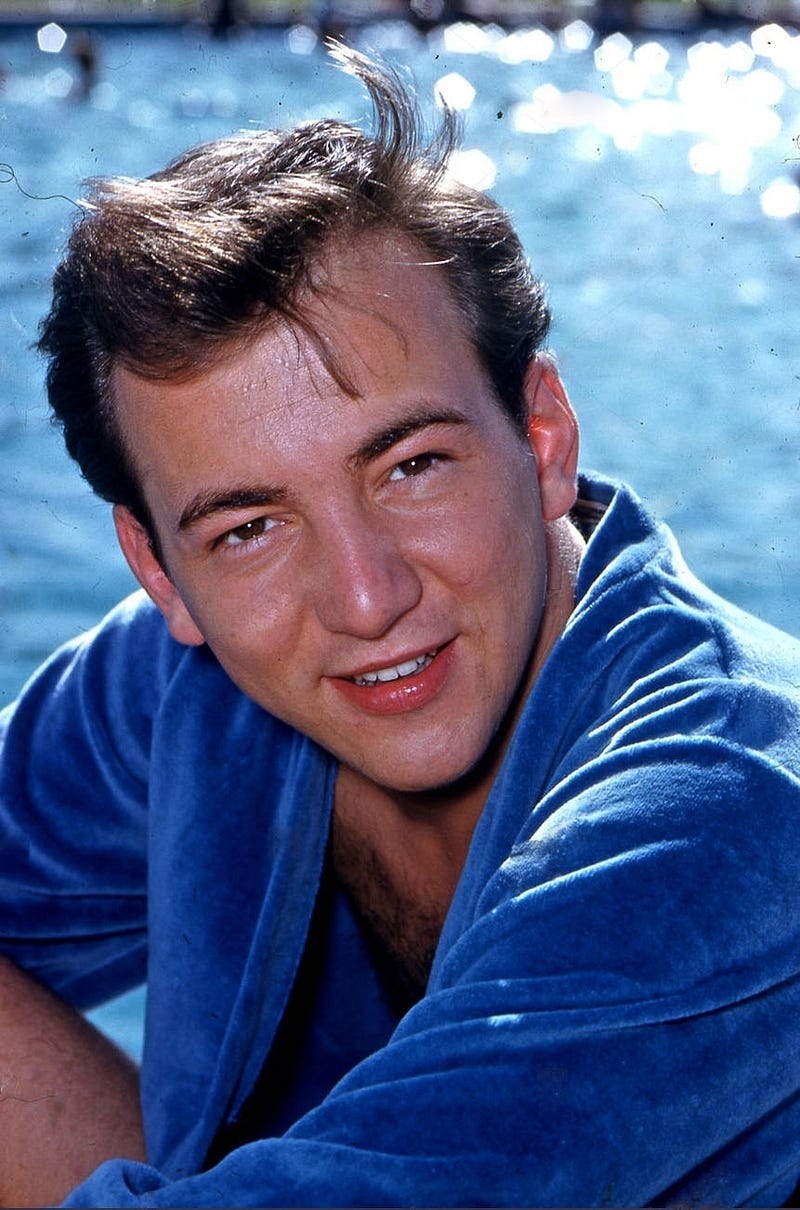
A watercolor-worthy 1959 portrait finds a royal blue-clad Bobby Darin on top of the world alongside a Las Vegas swimming pool. Photography by Lawrence Schiller / Polaris Communications

Bobby Darin’s rapport with Elvis Presley, supposed Frank Sinatra feud, sudden burst of protest songwriting inspired by the assassination of Robert Kennedy, Motown misfires, the mess that is the current state of the entertainer’s legacy, and tons more are dissected in a riveting conversation with British researcher Shane Brown, who holds a PhD in Film, Television, and Media.

“Splish Splash,” “Queen of the Hop,” “Dream Lover,” “Beyond the Sea,” “You Must Have Been a Beautiful Baby,” “Things,” “You’re the Reason I’m Living,” “18 Yellow Roses,” and “If I Were a Carpenter” were all Top Ten hits for the driven East Harlem native and ran the gamut from rock ’n’ roll, pop, country and western, folk, big band, and jazz.

Obviously multifaceted and adept at arranging, production, and guitar-piano-harmonica, Darin won the 1959 Record of the Year Grammy for “Mack the Knife” and would have continued conquering the stage, studio, and even screen [nominated for a Best Supporting Oscar as a World War II corporal unable to move past a harrowing plane crash aided by Gregory Peck’s Captain Newman, M.D.], if open heart surgery to replace two faulty heart valves had not ended the Rock and Roll Hall of Famer’s life way too soon at age 37.

The Shane Brown Interview

How were you introduced to Bobby Darin’s discography?

I was about 20 years old in 1995, and we had a rather kitsch Saturday night TV show called Stars in their Eyes in the UK. A guy named Lee Griffith won that series impersonating Bobby.

I didn’t know much about Bobby at that time but had just started getting into Frank Sinatra. So I went into town to pick up a Darin CD. There weren’t many to choose from in the mid-‘90s. I ended up buying the Spotlight on Bobby Darin compilation containing big band sides from the Capitol years.
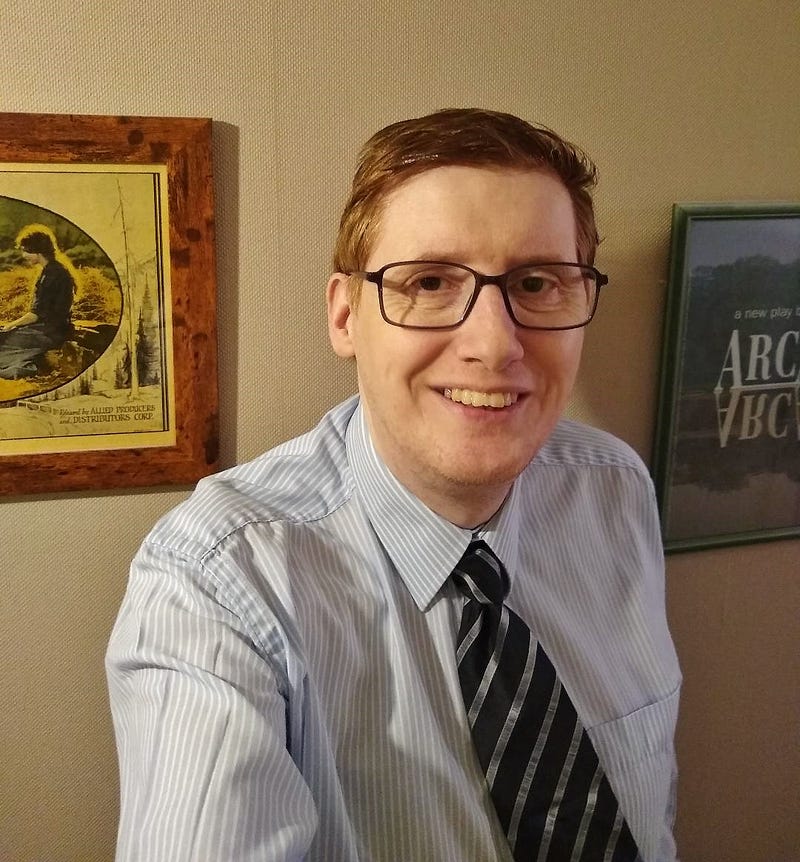
According to Shane Brown’s Amazon author’s page, his first book, the young adult novel "Breaking Point," was published in 2013. The sequel, entitled “Breaking Down,” is also available. Brown's other fiction books are the young adult fantasy-cum-ghost story "A Ghost of a Chance" and "The Successor," a retelling of “The Picture of Dorian Gray” set on a university campus in the year 2000. Shane's non-fiction writing includes substantial "Listener's Guides" to Elvis Presley and Bobby Darin and a book on queer images in films from 1894-1934. He is also the editor of "Silent Voices," which pulls together print interviews with silent film stars first published in the 1910's and 1920's. Brown lives in Norwich, England, and has a PhD in film and television from the University of East Anglia. Image Credit: Courtesy of Shane Brown

Was there a particular Bobby performance[s] that gave you contemplation and made you wanna dive in full throttle?

The thing that made me “dive into Darin” was the liner notes on the Spotlight on Bobby Darin CD. They outlined Bobby’s life story and, for some reason, I was rather intrigued, particularly by the idea of the Direction material. I got to hear some of it about six months later when I got my hands on As Long As I’m Singing: The Bobby Darin Collection, Rhino’s four-CD box set from 1995.

I still think As Long As I’m Singing was a wonderful achievement in displaying Bobby’s musical talents. Sure I’d swap a few of the songs for others, but not many. Over the next few years I slowly picked up what albums I could find — mostly on vinyl back then as most weren’t on CD.

What prompted you to tackle Bobby Darin: A Listener’s Guide [2015]?

Well, I had written Elvis Presley: A Listener’s Guide the year before. It had gone well, so Bobby was an obvious person to turn to for me. Jeff Bleiel had written a book about Bobby’s career 20 years earlier called That’s All: Bobby Darin on Record, Stage, and Screen. It is a very fine book, so I knew I had to give mine a different dimension, which is where the inclusion of the contemporary reviews came in.

That was the first edition which turned out better than the Elvis book. I did a second edition of the Elvis book — Reconsider Baby — and took the contemporary articles element even further, and created something really quite different that I don’t think had been done with Elvis before.
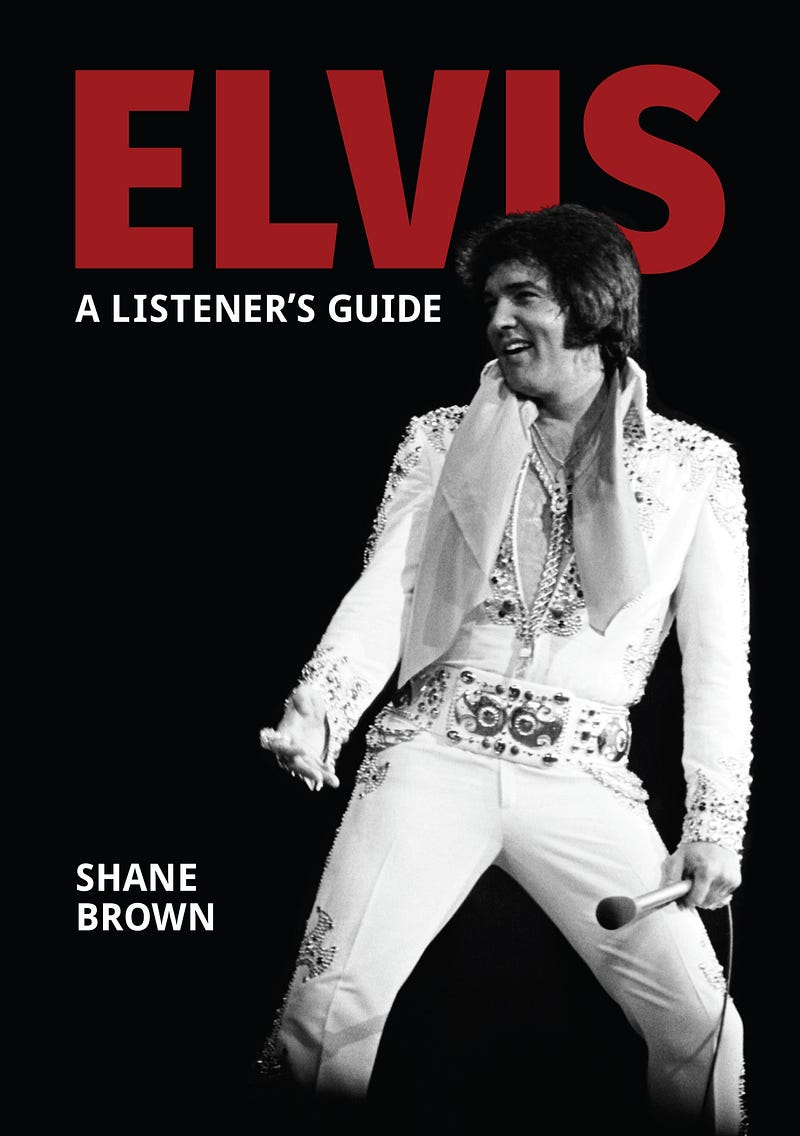
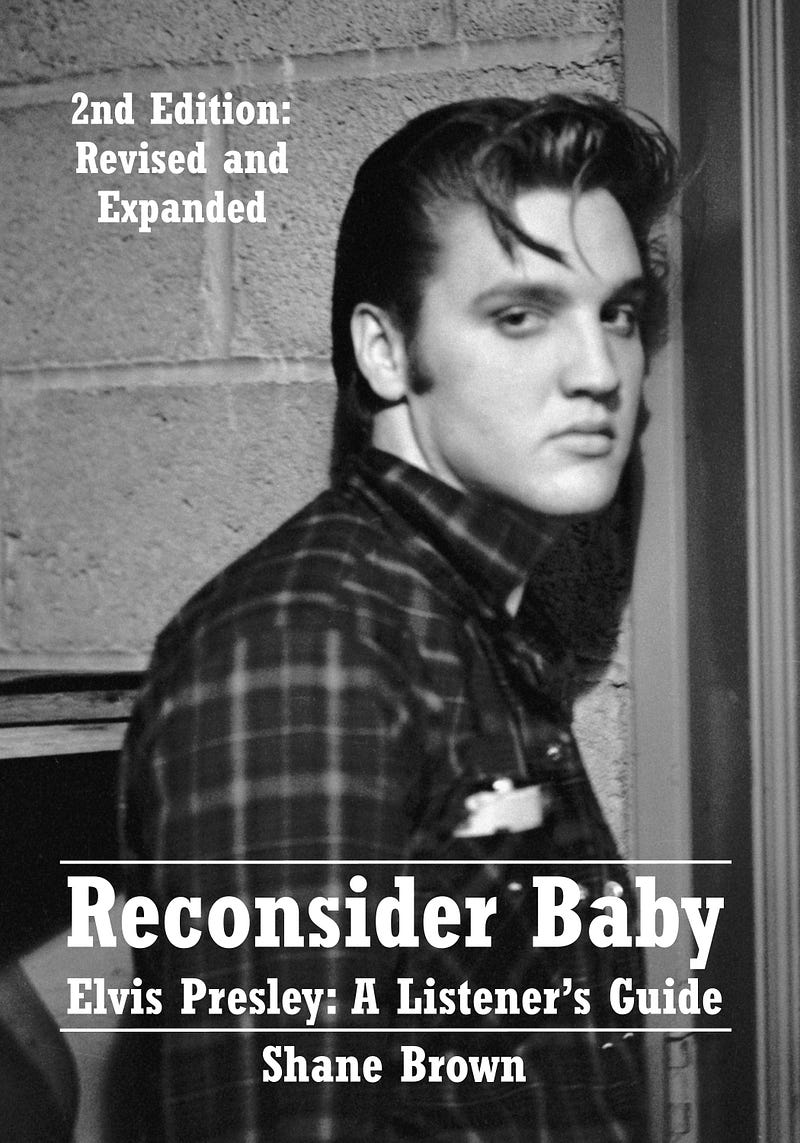
Elvis Presley’s infamous September 3, 1973, closing show where he chastised Conrad Hilton for attempting to fire a waiter friend named Mario, much to Colonel Tom Parker’s chagrin, during the middle of a sold-out show at the Las Vegas Hilton Hotel is immortalized on the book cover of “Elvis Presley: A Listener’s Guide,” written by Shane Brown and released independently via Amazon on July 10, 2014. Presley is wearing the 1973 Arabian jumpsuit, which was soon nicknamed the Memphis jumpsuit after he wore it during the show captured on the “Elvis Recorded Live on Stage in Memphis” album. Thanks to For Elvis CD Collectors message board user “Dr. John Carpenter” for confirming the exact date. Photography by Laurens van Houten / appears in the book “Elvis: Caught in a Trap” by Arjan Deelan and Laurens van Houten / Courtesy of Shane Brown; At right, Presley is innocently forlorn in this striking backstage black and white photo taken on May 27, 1956, at the University of Dayton Fieldhouse in Dayton, Ohio. Brown reveals, “It was chosen as the cover shot of ‘Reconsider Baby: Elvis Presley — A Listener’s Guide 2nd Edition’ purely because it looked good!” Photography by Marvin Israel / Courtesy of Shane Brown
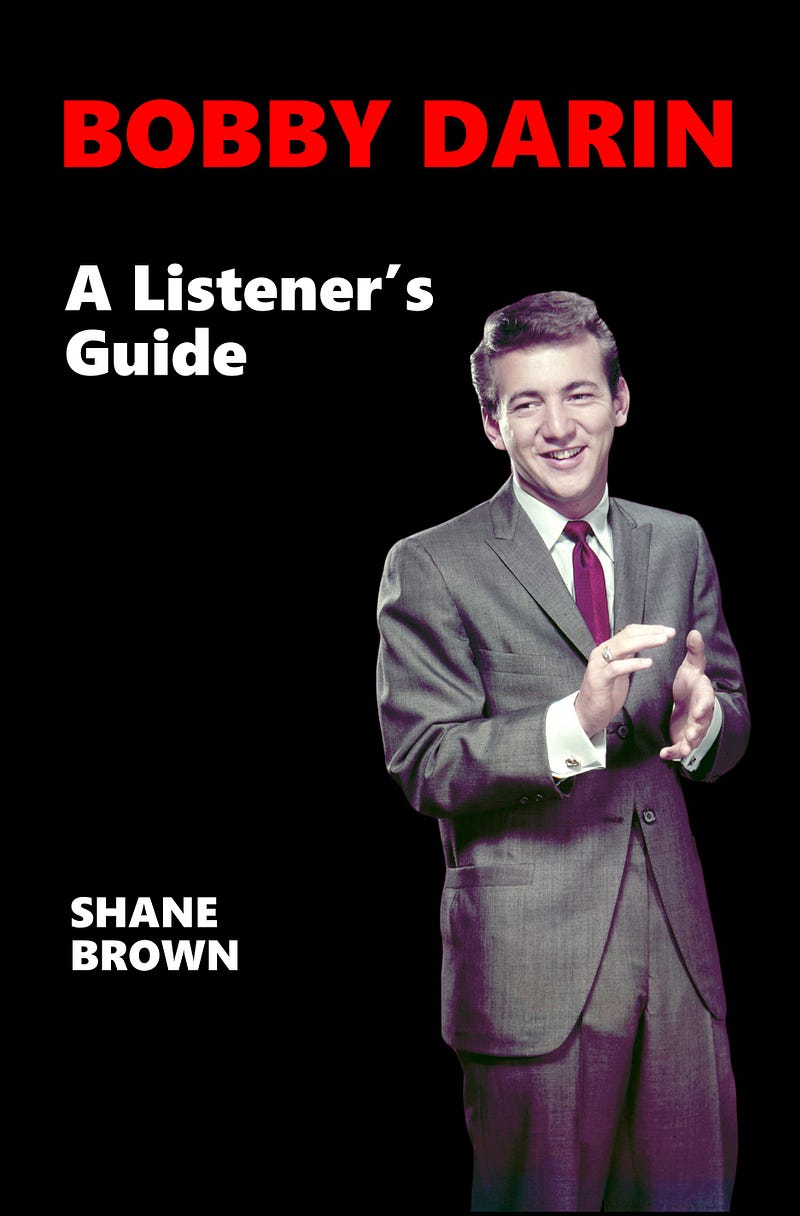
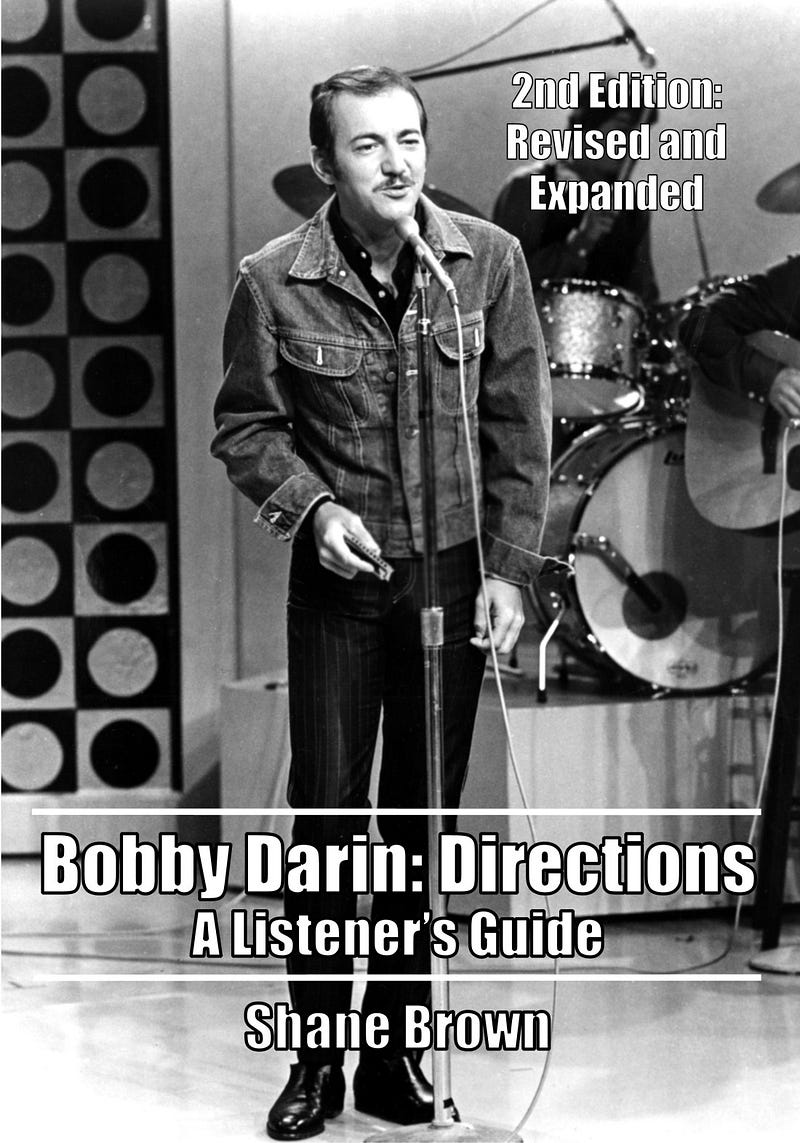
A 1957 or 1958 publicity still of Bobby Darin was used for the first edition cover of “Bobby Darin: A Listener’s Guide,” published independently via Amazon on October 15, 2015. Image Credit: Courtesy of Shane Brown; For the whopping 463-page second edition entitled “Bobby Darin: Directions — A Listener’s Guide,” dropped on December 19, 2018, the cover shot “is from one of Bobby’s three appearances on the syndicated ‘Della!’ TV show,” says researcher Shane Brown [either August 11, 1969, November 12, 1969, or January 28, 1970, according to BobbyDarin.net]. “People keep telling me it’s ‘The Mike Douglas Show’ but it’s not! That one was chosen specifically because I wanted a Darin picture from his late ’60s singer-songwriter era to help demonstrate that this wasn’t a straightforward biography, and that it would look at things in a slightly different way.” Image Credit: Everett Collection / Alamy / Courtesy of Shane Brown

A second edition of the Bobby book was inevitable. The new version, Bobby Darin: Directions — A Listener’s Guide is around forty percent longer than the first edition going by word count, and most of that is in telling the story of how Bobby and his music was regarded while his career was ongoing. There are a few myths put to bed as well, and a significant amount of new information that we didn’t know before the archival work I’ve done for this new version.

We now have evidence of many more TV appearances than we had even in the last edition of the book, which contained the most complete list at that point. There’s a lot more local TV appearances listed this time around — and my own favorite “new” TV appearance is the discovery that there was an hour-long TV special in 1963 called Darin at the Grove.

Screened on local TV in LA, it contained rehearsal footage of Bobby, interviews, and then concludes with a live broadcast of the beginning of his nightclub act at the Cocoanut Grove. This sounds a little like the documentary footage from 1966 but shouldn’t be confused with it. It’s an entirely different program. Sadly, it’s unknown whether any footage from it exists.

Alongside that, it has been reported in books for as long as I can remember that Bobby was booed on stage during the Direction years, and / or that people walked out.

I’m confident that I have been through more reviews from the period, and more newspapers and trade publications, than anyone and there is no indication that this ever happened. There is a report that someone called out for “Mack the Knife” and was told politely “that was yesterday,” but no indications of significant dissatisfaction in general.

Likewise, Steve Blauner is quoted in books as saying that Bobby gave up live performances in 1963 partly because he was playing to empty seats — and yet the reviews of the period state clearly there was nearly always full houses when he played nightclubs.

There is also what I hope is the end of the Sinatra / Darin feud myth. There’s an interview with Bobby in the early 1960s where he said he met Sinatra and talked to him, also reports that he had gone to see Sinatra perform twice, and a rather nice interview with Tina Sinatra from 1975 where she talks about a planned tribute concert to Bobby that Frank had agreed to perform in.

The show never happened, but it’s more evidence that the feud didn’t exist. Perhaps the most concrete proof came in 2018 with the release of Standing Room Only, a three-CD box set containing a 1966 Vegas concert at the Sands Hotel by Sinatra where he encourages his audience to check out Bobby while they’re in town.

I’m also pleased to include a few pages dedicated to arranger Richard Wess. We know virtually nothing about Wess, arranger of “Mack the Knife” and “Beyond the Sea.” He doesn’t even have a Wikipedia page.

I’ve pieced together what info I could find through newspaper stories, etc. Hopefully that will act as a tipping of the hat to his wonderful work both with Bobby and elsewhere. Sadly he passed away in the same year as Bobby.

Many of the over 100 images in Bobby Darin: Directions — A Listener’s Guide came to me thanks to generous fans, most notably Susan Johnson Côté. She kindly allowed me access to a number of photos including rare candids that haven’t appeared outside of a Facebook group before. L. Vergara Herrero provided almost all of the non-domestic rare single, EP, and LP covers.

How was the reception for Bobby Darin: A Listener’s Guide?

Nearly all of the user reviews for the first edition were positive, and they are the ones that count. It’s a self-published book and so it doesn’t get critics reviews normally. I’m hoping that will be the case this time around. It has the same format as Elvis Presley: A Listener’s Guide and the reviews of that were positive, so I’m hopeful!
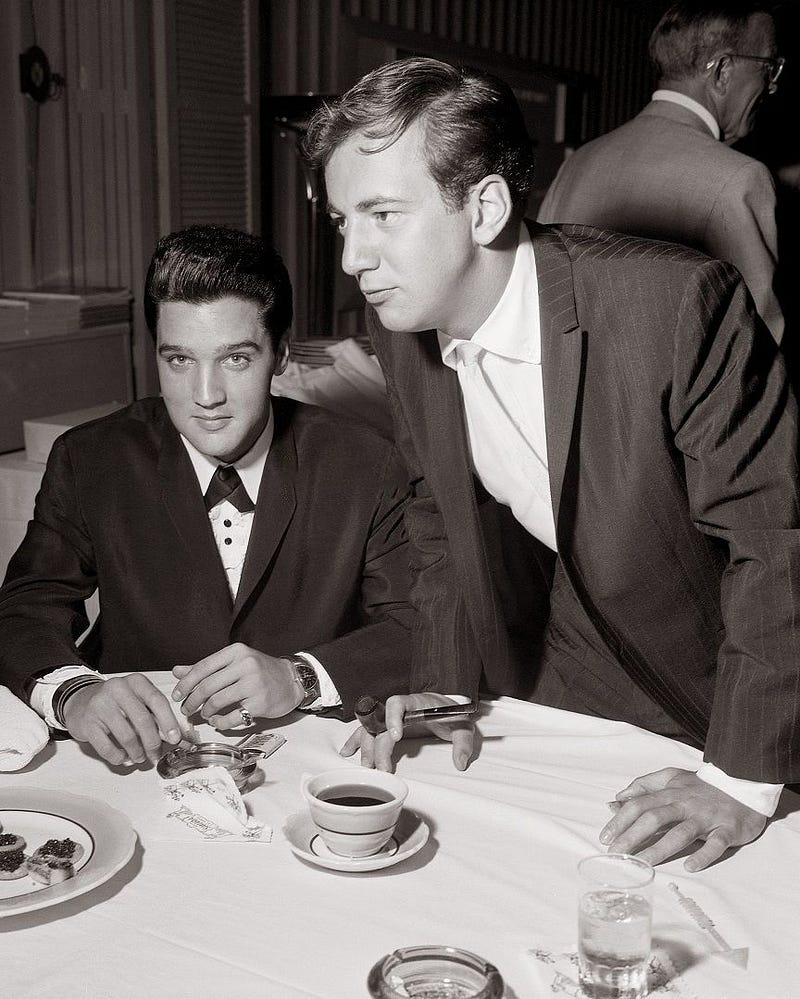
Just five months back from his Army hitch as a sergeant stationed with the 3rd Armored Division in Germany, 25-year-old Elvis Presley and pipe-carrying 24-year-old Bobby Darin were part of the special guest lineup at a surprise birthday party George Burns gave for his wife and comedy partner Gracie Allen at the Sahara Hotel in Las Vegas on July 26, 1960. Darin’s post-”Beyond the Sea” singles distributed throughout the remainder of that year — “Clementine,” “Won’t You Come Home, Bill Bailey,” and “Artificial Flowers” — faltered a bit, failing to move beyond the Top 20. On the other hand, just a few weeks earlier the King of Rock ’n’ Roll delivered “It’s Now or Never” b/w “A Mess of Blues,” his second A-side released post-Army and perhaps his greatest vocal waxed to vinyl. Nine years later Presley delivered an off the cuff, albeit infectious rendering of Darin’s “I’ll Be There,” coincidentally the B-side of “Bill Bailey,” with producer Chips Moman and the Memphis Boys at American Sound Studio. If anyone knows what type of tie Presley is sporting, comment below! Image Credit: For Elvis CD Collectors message board / Popperfoto / Getty Images

Did Bobby comment about Elvis or his spontaneous January 1969 American Sound rendition of “I’ll Be There,” best known as a No. 14 POP hit for British Invasion band Gerry & the Pacemakers? Are there any other Darin songs that you wish Elvis had covered?

No, I don’t think Bobby spoke of it, but then Elvis’s version did slip out unannounced on the RCA Camden budget album Let’s Be Friends. We don’t know how well they knew each other, but there are photos of them together.

It’s clear Elvis liked Darin and his work from the two covers we have of Darin compositions and also “I Want You with Me” [Something for Everybody, 1961] which Darin recorded first [For Teenagers Only, 1960], although Woody Harris wrote it.

I’m unaware of Elvis mentioning Bobby, either. All we know about is the March 22, 1975, midnight show at the Las Vegas Hilton where Elvis is asked by an audience member to sing “I’ll Be There.” He starts it, doesn’t know it, and then ad-libs his way through “You’re the Reason I’m Living” instead.

I am sure Elvis could have done great versions of “Not for Me” [the 1963 B-side of “18 Yellow Roses”], “Wait by the Water” [the 1964 B-side of “Things in This House”], “Funny What Love Can Do” [the 1965 B-side of “We Didn’t Ask to Be Brought Here”], and “Another Song on My Mind” [Darin 1936–1973].

Were Elvis and Bobby on the same musical wave length?

I’m not sure they had that much in common musically beyond the fact that they had a huge knowledge of popular music both past and present and they both drew on that. Bobby reached back and plucked various songs out of obscurity and so did Elvis. Bobby was getting his songs from forgotten films, novelty songs, or jazz, while Elvis was more looking back at country, gospel, and blues.

They worked in very different ways. Bobby was almost always planning albums, whereas Elvis worked one song at a time, and not even thinking about the album they might go on to — soundtracks aside. Elvis would probably be quite happy with iTunes and streaming where the notion of the album is starting to fade a little bit.
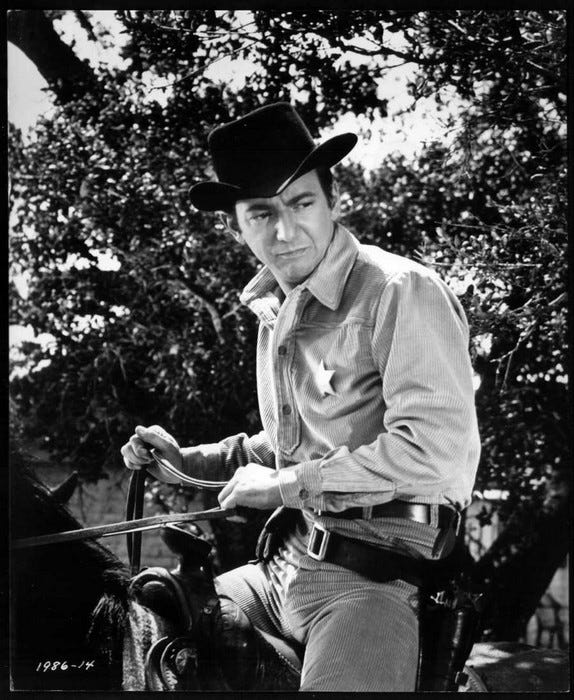
As conflicted Sheriff Cal Wayne, a firm, black-hatted Bobby Darin sits atop a horse in “Gunfight in Abilene,” the musician’s final theatrical starring role. Released in March 1967, Darin composed and sang the William Hale-directed western’s theme song “Amy” over the opening credits. Image Credit: Universal Pictures / Western Movies Forum [France] user Abilène

What are the good and bad elements of Gunfight in Abilene? I suspect the post-Civil War 1967 western had a low budget, but Bobby’s performance as well as that of his onscreen adversary Leslie Nielsen are solid. Did Bobby actively seek the part or was it specifically written for him?

Gunfight in Abilene was Bobby’s last starring role in a film, and it’s better than its reputation might suggest. It’s very much a routine western. I didn’t research how Bobby got the role. He is said to have been unhappy with the western, supposedly referring to it as Gunfight at S**t Creek. But reviews were largely positive considering that the film was intended as a routine, unambitious western. No one was raving about it, but it was deemed to be above-average for its type.

It’s interesting that there is the anti-violence theme running through it thanks to Bobby’s character [accidentally killing his best friend and fellow Confederate, a tormented Cal Wayne accepts a sheriff vacancy in the post-Civil War frontier city even though he abhors guns], and I’m wondering if that is a coincidence considering the move to his own record label, Direction, the following year. The same is true of the peace, love, and understanding elements of the Dr. Dolittle film that Bobby recorded an album of songs from in the same year. Was Bobby drawn to these projects because of these themes or is it just a coincidence?

By the late summer of 1967 when the Bobby Darin Sings Doctor Doolittle album was issued, how was Bobby’s relationship with Atlantic Records?

I don’t think there is any evidence that Bobby was anything but on good terms with Atlantic — after all, they had agreed to him recording and released Bobby Darin Sings Doctor Dolittle [August 1967] which they certainly were not keen on.
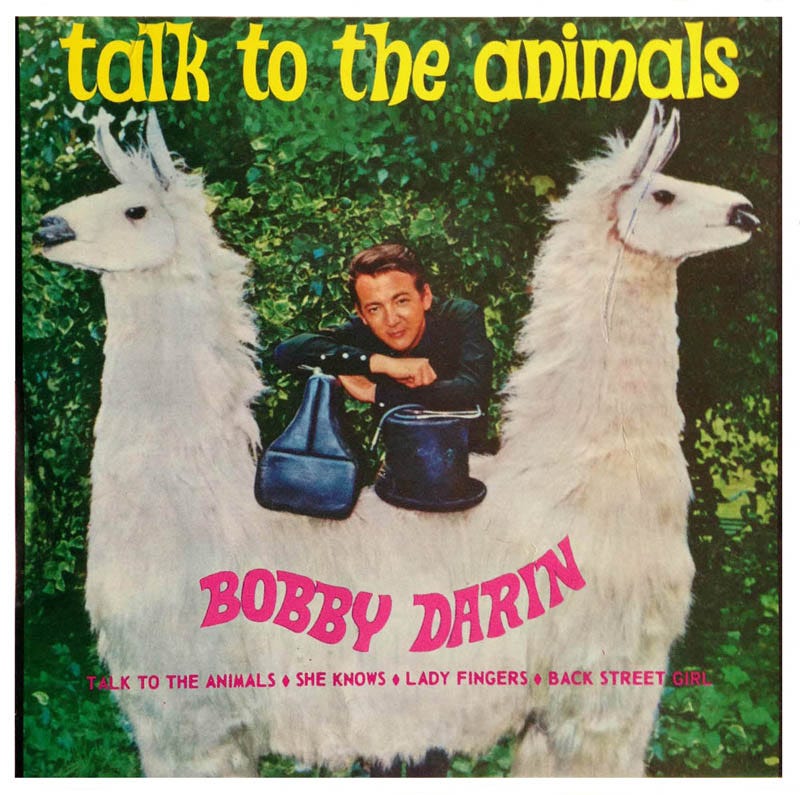
“Talk to the Animals,” an Australian Bobby Darin EP from February 1968 compiling the title cut, “She Knows,” “Lady Fingers,” and a cover of the Rolling Stones’ “Back Street Girl.” This very same photo, featuring an appropriate black doctor’s bag, stethoscope, top hat, and double-headed white llama, served as the cover of the “Bobby Darin Sings Dr. Doolittle” studio album unleashed six months earlier on Atlantic Records. Image Credit: 45Cat user Deutros / The Bobby Darin Estate

The gap between the distribution of Bobby’s final Atlantic single, a cover of the Doctor Doolittle soundtrack linchpin “Talk to the Animals,” and his Direction Records debut “Long Line Rider” was 15 months, an eternity in the ’60s. Why did it take so long for Bobby to get his mojo back and start releasing singles again, bearing in mind that he lost close friend Robert Kennedy to an assassin’s bullet in June 1968?

I don’t think the dry spell is as long as it might seem, though — certainly not from the point of view of recording. Bobby took part in a number of sessions in late 1967, including a number of tracks in November of that year — which is where “My Baby Needs Me” comes from.

There are also the so-called demos from the same period including “Easy Rider,” “Everywhere I Go,” “Long Time Movin’”, and “I’m Going to Love You,” and others that are still kept in the archives. Combining those two sets of recordings, that’s another album’s worth of material already, although none were released at the time.

One thing to remember is that the Direction albums were the only ones where Bobby wrote all the songs, and we know they were done in the run up to recording. So even that took more time, along with setting up the label. Interviews from the time also suggest that Bobby was, if you like, contemplating who he was and what he wanted to be before Bobby Kennedy’s death. His output had slowed down a number of years earlier. He recorded six albums in 1960 and 1963, although not all were released at the time. But he only recorded one in 1964, two in 1965, three in 1966 [one unreleased], and two in 1967. We then got one in 1968, so it’s not that much of a difference in output.

The biggest slowdown, of course, is that there were no albums between Commitment in 1969 and the Motown album in 1972 — although we now know that he was busy recording in 1971 but released virtually nothing.

There was also a trip to Australia to factor in during the autumn of 1968, which no doubt took its toll on Bobby’s health, and around 20 TV appearances that year, too. Bobby went to Australia to perform on stage in a nightclub setting, and to record a TV special entitled Bobby Darin at the Silver Spade.

This was an hour-long special in which Bobby was filmed on stage in a Sydney hotel in front of a celebrity audience. He performed, amongst other things, “Talk to the Animals,” “If I Were a Rich Man,” and “Mack the Knife.” He also appeared on a couple of Australian chat shows.
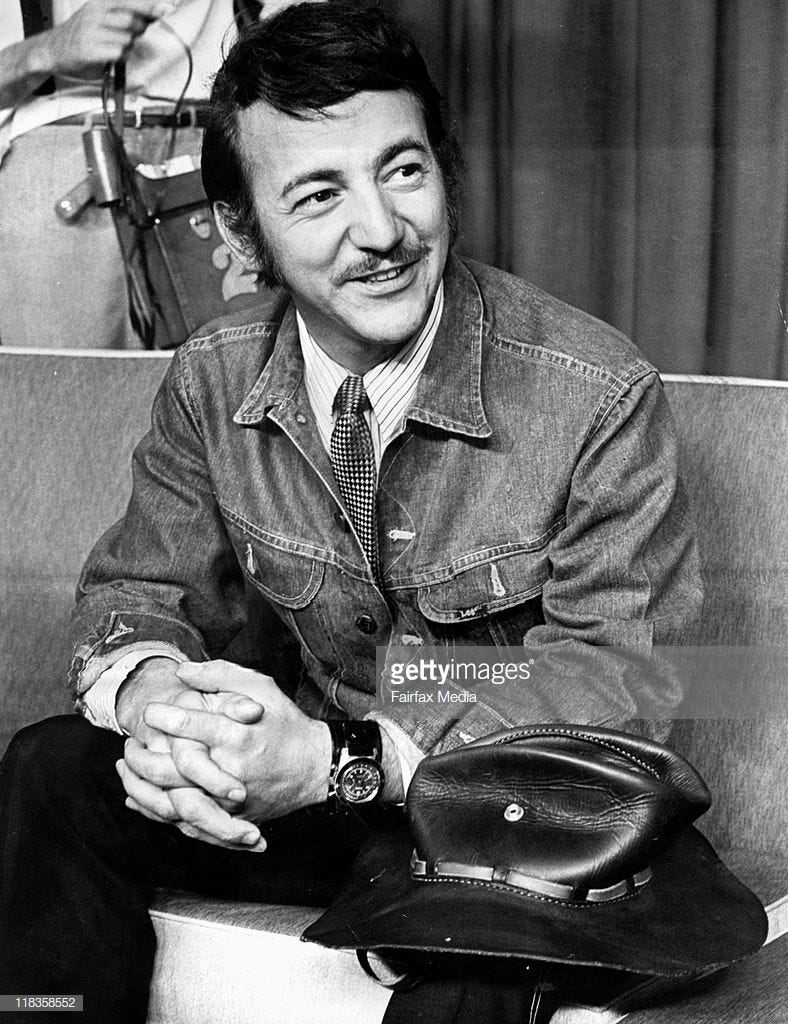
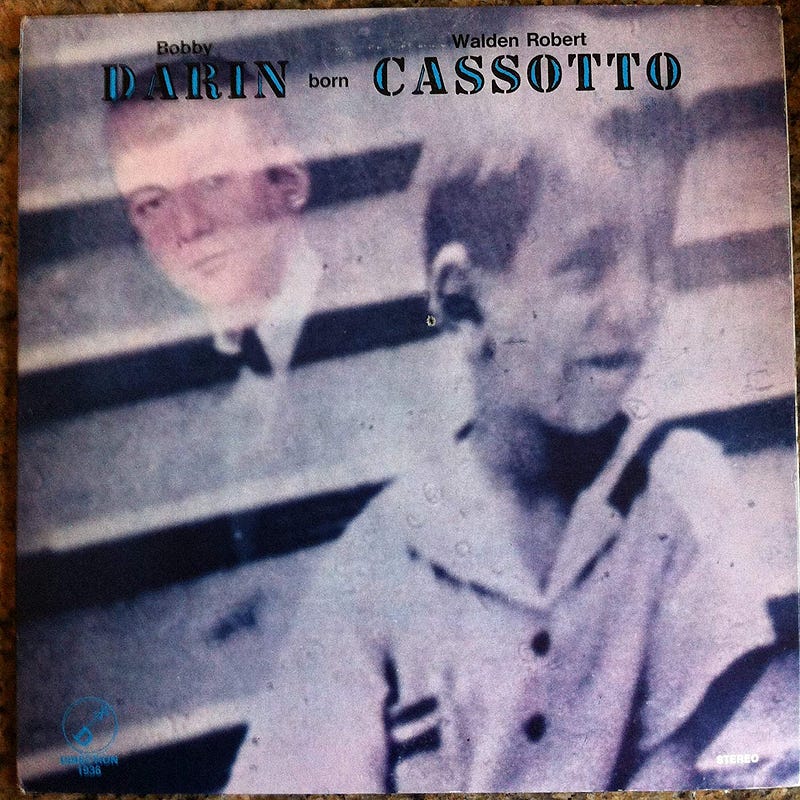
“Well I’ve been too busy listenin’ to what everybody else had to say:” A mustachioed Bobby Darin grants an interview upon his arrival in Sydney, Australia, for a season performing at the Chevron Hotel on November 19, 1968. Note the trendy jeans jacket and black leather hat resting on the entertainer’s knee, possibly the same hat he wore on the “Commitment” cover issued a year later. Image Credit: Fairfax Media / Getty Images; At right, presenting the innovative cover of “Bobby Darin Born Walden Robert Cassotto,” the activist’s debut LP unleashed on his own Direction label in July 1968. Darin notably composed all nine cuts, yet the record never had a chance with deejays and the general public. Image Credit: The Bobby Darin Estate / Amazon

When Bobby started Direction Records in 1968, how much precedence was there for such a risky endeavor besides Sinatra and Reprise Records?

I guess Sinatra and Reprise were different because he started the label at the peak of his career. That wasn’t quite the case for Bobby. I’m not sure how it worked out financially, or if he really cared by that point. He was happy, and doing what he wanted. Bobby’s contentment shines through in a letter written to his family from the period that is included in the book thanks to the generosity of a fan.

Containing inspired rock arrangements and autobiographical lyrics, why were “Route 58” and “City Life” left in the can during Bobby’s lifetime?

I don’t think anyone really knows why some songs and albums were not released at the time, but it was quite common for Bobby to record things and then not issue the results. For example, three complete albums were recorded in 1963 alone and not released until more than 30 years later, and another in 1966, and two in 1971!

It’s safe to make the assumption that Bobby planned to issue “City Life” as a single. He performed it regularly on stage, and also performed it on The Mike Douglas Show on TV. There have also been stories that he was working on a third album for Direction, and these two songs may well have been part of that work.

The Direction years were a sudden burst of artistic energy. However, Darin ran out of steam quite quickly, or perhaps became disillusioned that his music wasn’t getting the attention it deserved. He planned a march in Washington at one point in 1970, but then cancelled it and went to the UK to appear on a game show and give a concert at the Royal Albert Hall.

The switch from Bob back to Bobby seemed to be sudden, as did the move from the Direction label to Motown. I’m guessing all these things contributed to the songs not being released. I wouldn’t be surprised if there were more Direction studio recordings in the vaults.
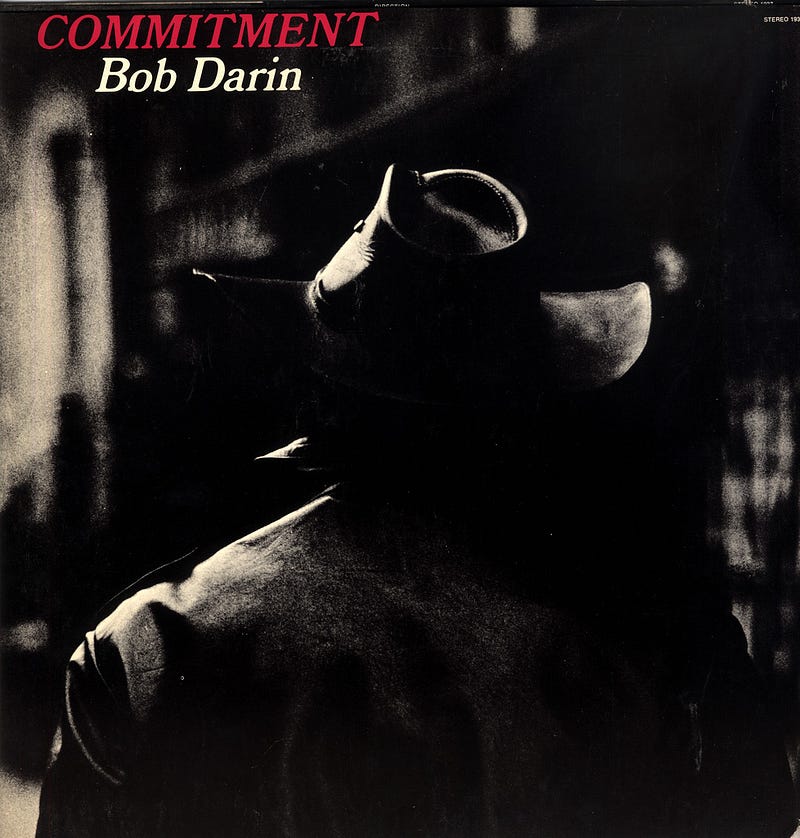
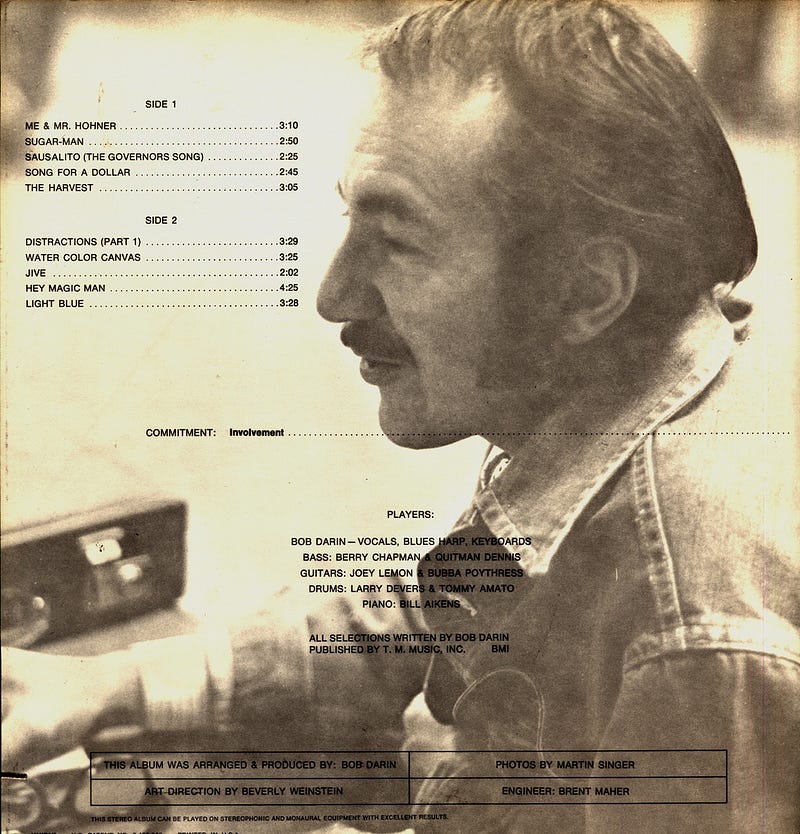
“I guess I’m just a rock and roll singer tryin’ to find my way:” Literally turning his back on snobby record execs who thought he was nuts to abandon his greatest hits and re-brand himself as a denim-clad, funky folk rocker, here is the front and rear cover of Bobby Darin’s “Commitment,” released in July 1969. This is the United Kingdom LP edition of “Commitment.” According to Shane Brown, “My understanding is that the USA edition was a gatefold effort, with the back being the rest of the front cover image [i.e. Bobby’s lower body and legs].” The second and final album on the multi-faceted singer’s own Direction label, all 10 cuts, including A-sides “Song for a Dollar” and “Distractions [Part One]”, were written and arranged under the moniker of “Bob Darin.” Photography by Martin Singer / The Klaus Hiltscher Collection / Flickr / The Bobby Darin Estate

Was Bobby a musician on the Direction-era material?

As for what he played on the Direction material, we know that Bobby plays harmonica and keyboards at various points, and some of the guitar work is his, too — “In Memoriam” [Born Walden Robert Cassotto, 1968], for example.

Did indie label status hinder Bobby’s Direction material from reaching stores? Neither Bobby Darin Born Walden Robert Cassotto nor Commitment charted, and “Long Line Rider” was the only A-side to peak inside the Hot 100 at No. 79.

They were distributed by Bell and available in the usual way — across the world — as far as I’m aware. Some of the overseas picture sleeves for the Direction singles are shown in the book.

Was it a mistake for Bobby to sign with Motown and expect that a company predominantly known for nurturing African American talent could produce hits for him?

I think it was a mistake, but not for that reason. Their way of working was completely alien to Bobby. Bobby was used to having arrangements written for him, going into the studio and recording them live with the orchestra in most cases, and an album would be completed in three nights. That’s not how things worked at Motown. The booklet for Real Gone Music’s Go Ahead and Back Up: The Lost Motown Masters [2018] gives quite a bit of detail on how each song was recorded.

Some songs allocated to Bobby found him adding vocals to an already-recorded backing track intended for another singer — sometimes a female singer like Martha Reeves as is the case on “Stray Dog” — and overdubs being done on different days etc. You can’t expect a man to sing in anything like the same key as a woman, and this is why we have Bobby straining away trying to reach notes on some occasions. As an example, according to the information we have, “I’m Glad About It” had the backing track cut on May 7, 1971, and assigned to Sammy Davis, Jr. Backing vocals were added the next day. Strings and horns were added on June 1 alongside a demo lead vocal. Bobby recorded his vocal on June 15.

Compare that to the You’re the Reason I’m Living album [1963], which was recorded from start to finish in three consecutive nights. As a singer who relied on being in the moment and his own instinct, there was no way he could thrive at Motown.

It’s worth adding that the songs that Bobby produced himself at Motown issued almost 50 years later on Go Ahead and Back Up were more successful — the arrangements were written with him in mind, in a key that suited him, and while the various elements were recorded on different days — as I think they had been at Direction, too — it was over a much shorter space of time.
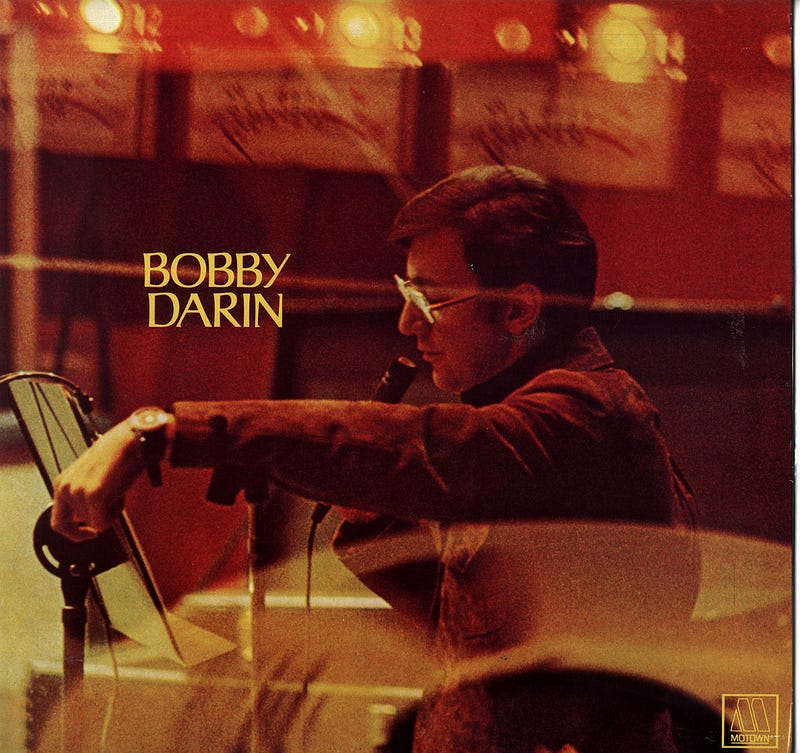
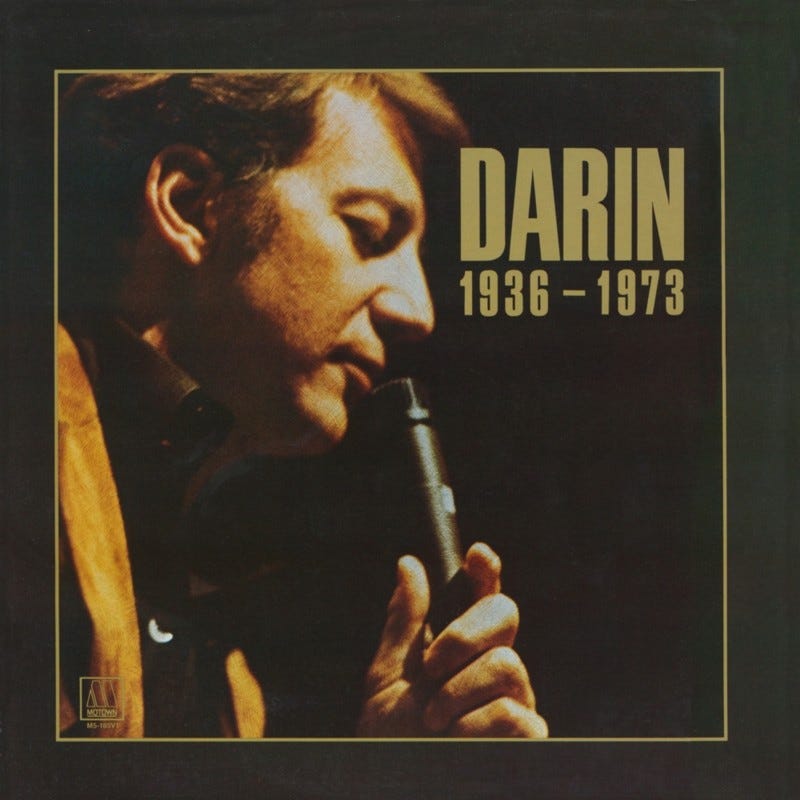
Bobby Darin casually records a lead vocal at MoWest, Motown’s California recording studio on Romaine Street that only existed for a couple of years, for the cover of the self-titled “Bobby Darin” album, distributed by Motown to commercial indifference in August 1972. Up next is “Darin: 1936–1973,” the artist’s first posthumous studio album released in February 1974 by Motown. In spite of eight unreleased sides plus “Sail Away” [recycled from the self-titled 1972 LP] and an extended version of the “Happy” single being assembled by Four Seasons producer Bob Crewe, it rose no higher than No. 204 POP during its six-week chart run. “Darin: 1936–1973” remains the final Darin album to chart on Billboard. It had been seven years since he had seen any Billboard stats — the “If I Were a Carpenter” album debuted on February 11, 1967, reaching No. 142 POP. Photography by Jim Britt / Universal Music Group / The Klaus Hiltscher Collection / Flickr

Does Bobby’s Motown tenure hold merit?

Not for me, no, and mostly for the reasons given in the previous question. The results are mostly Motown recordings rather than Darin recordings. Illness no doubt played a part in that — perhaps where he wasn’t willing to fight for what he wanted as much as he had done.

But for much of the time, he was being allocated songs rather than choosing them himself. In the 1972 Bobby Darin album he was attempting to belt out ballads à la Tom Jones or Elvis. He wasn’t that singer.

The Go Ahead and Back Up disc includes a protest song written by the Corporation called “We’re Getting There.” When you compare it to the Direction material, the difference is startling. Compared to the witty or biting lyrics of Commitment, you get a song with all the subtlety of a brick.

It wasn’t just Motown — his TV series wasn’t very good either. Aside from onstage performances, Bobby appears to have lost his touch to some degree. But the 1971 Live at the Desert Inn album [Motown did not officially distribute it until 1987] contains some of the best work he ever did.

When did Bobby start producing himself?

Bobby produced a Nashville session in May 1957, which was a group of demos that then got taken to ATCO and were his first releases for the label. They were his first session after leaving Decca — or — after Decca left him! But remember Bobby was making demos for his own songs before this, and no doubt producing those.

Bobby was producing for other people by 1959, and for a lot of others, most notably Wayne Newton, by the time of T. M. Music, his independent record production and music publishing firm, around 1963.

He produced his Direction albums, and the unreleased Go Ahead and Back Up at Motown. Quite why he allowed himself to be produced by others at Motown, I don’t know. He did a much better job by himself.
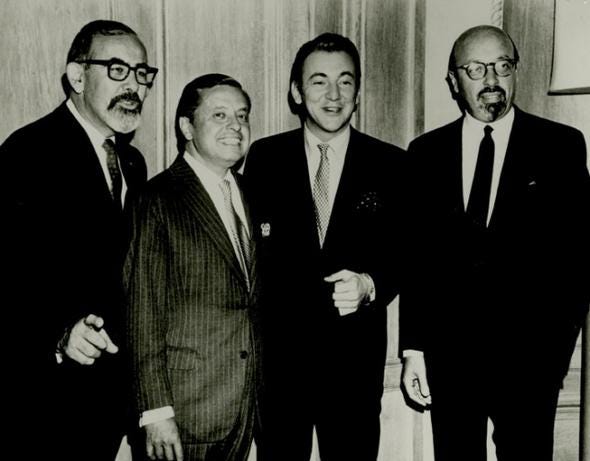
Bobby Darin is surrounded by Atlantic Records executives Jerry Wexler, Nesuhi Ertegun, and Ahmet Ertegun in this circa 1965 snapshot. Photography by William “PoPsie” Randolph/ Atlantic Records Archives

Of all the studio producers Bobby worked with, who was a match made in Heaven?

Bobby! But his natural home really was ATCO / Atlantic where he was under the guidance of Ahmet Ertegun. He was given almost free reign to record what he wanted there. Why he wanted to leave that, I have no idea.

Was Ahmet Ertegun in the studio for the Darin sessions where he received official credit? Was Ertegun hands-on offering constant feedback, did he make suggestions that Bobby disagreed with, and were there any public comments from Bobby about Ertegun?

Ertegun championed Bobby as soon as he moved to ATCO in 1957, and it was Ertegun who made sure Bobby had one last chance to get a hit when ATCO was about to drop him a year later. They went into the studio together and came out with Bobby’s first smash single “Splish Splash” [№3 POP, May 1958].

If you look at the back covers of the ATCO albums you will find that most don’t have a producer credit at all, but they have a “supervision” credit, which was normally given to Ertegun. I don’t think that wording is coincidental, as it suggests a somewhat different role to producer.

Of course, Bobby worked well with other producers — Nik Venet is most notable at Capitol [1962–1965] along with Charles Koppelman and Don Rubin at Atlantic [1965–1967].
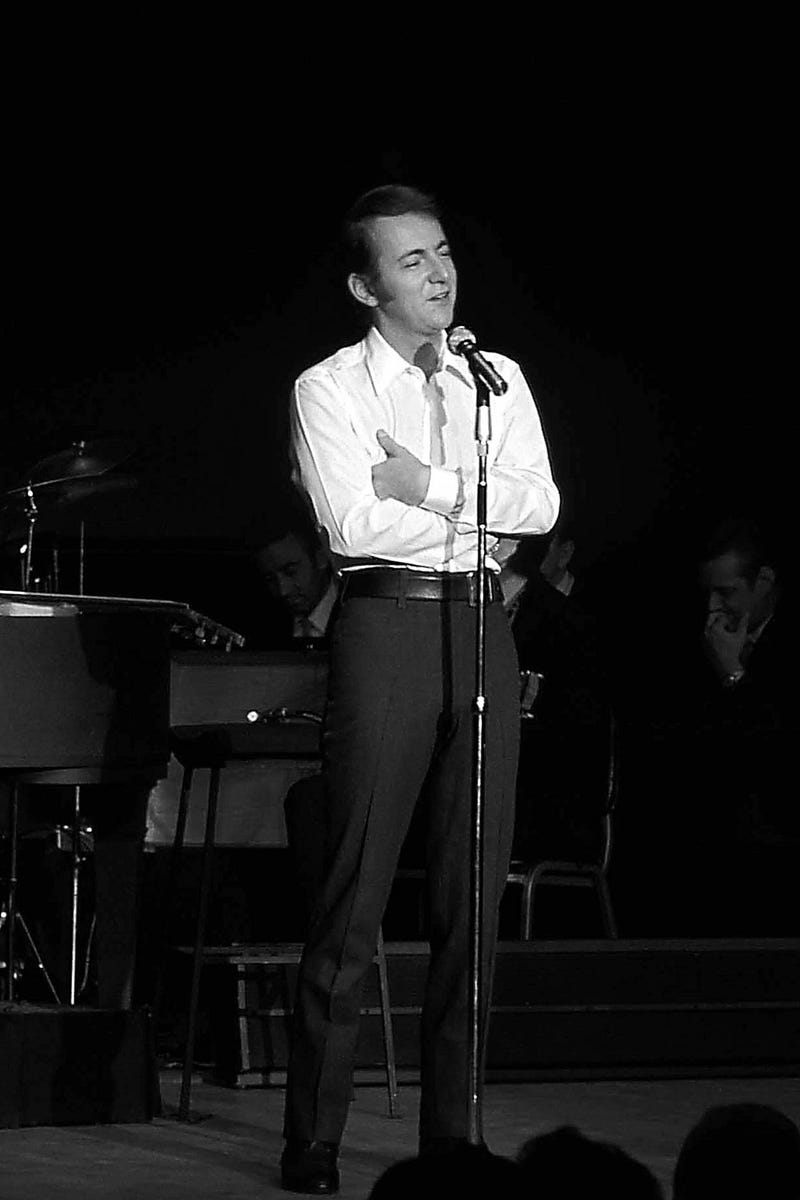
“Somewhere beyond the sea, somewhere waiting for me, my lover stands on golden sands, and watches the ships that go sailin’:” Onstage most likely in 1971 or 1972 during his Motown Records tenure, Bobby Darin sheds his tuxedo jacket and tie for an intimate Las Vegas crowd. Photography by Bill Crespinel / Globe Photos / Image Collect

What was one of the worst concert reviews that Bobby received?

I honestly have yet to find a “bad” Darin concert review, but he was criticized at certain points for certain elements in his show. When doing shows outside of nightclubs in 1966–1968 some critics complained about rather adult language and humor that they didn’t think was suitable for family audiences.

Occasionally he was criticized for throwing away “Mack the Knife” — particularly in 1967–68 — and while his attempt at audience participation in a song we only know about through reviews — there is no recording — was praised to start with, eventually it was deemed to be too long.

Earlier than that period he was criticized for talking too much and for entering into impressions and patter mid-song [we hear this type of thing on Darin at the Copa, 1960]. But as for a “bad” show along the lines of what we read about for Elvis, there simply aren’t any such reviews that I have found.

Did Bobby tour in the early ‘70s? He has a fantastic-sounding quartet — pianist Bobby “Rosie” Rozario, lead guitarist Terry Kellman, drummer Tommy Amato and bassist Quitman Dennis — backing him when he guested on The Midnight Special [broadcast on March 16, 1973].

Bobby didn’t do many shows outside of Las Vegas or Lake Tahoe in the 1970s. We don’t have his touring schedule, and so we don’t know his full itinerary. Bobby used to take his core musicians and then use the house orchestra. You can hear him name the musicians at the end of Live at the Desert Inn and the final TV show in his series.

Bobby and Tommy Amato wrote two songs together — “Something in Her Love” and “Another Song on My Mind” — during the Motown sojourn. They also may have collaborated on “Go Ahead and Back Up.” Have you had any correspondence with Amato?

I’ve purposely had no correspondence with Tommy Amato or anyone close to Bobby. That was never an intention as part of my book. Amato started playing for Bobby during the Direction years, and they were clearly close. Amato appears in The Bobby Darin Show in comedy sketches as well as playing drums in the band.

My impression is that Bobby wrote “Go Ahead and Back Up” alone, but the Real Gone CD of the same name doesn’t list a writer’s credit for the song. So we can’t be sure.
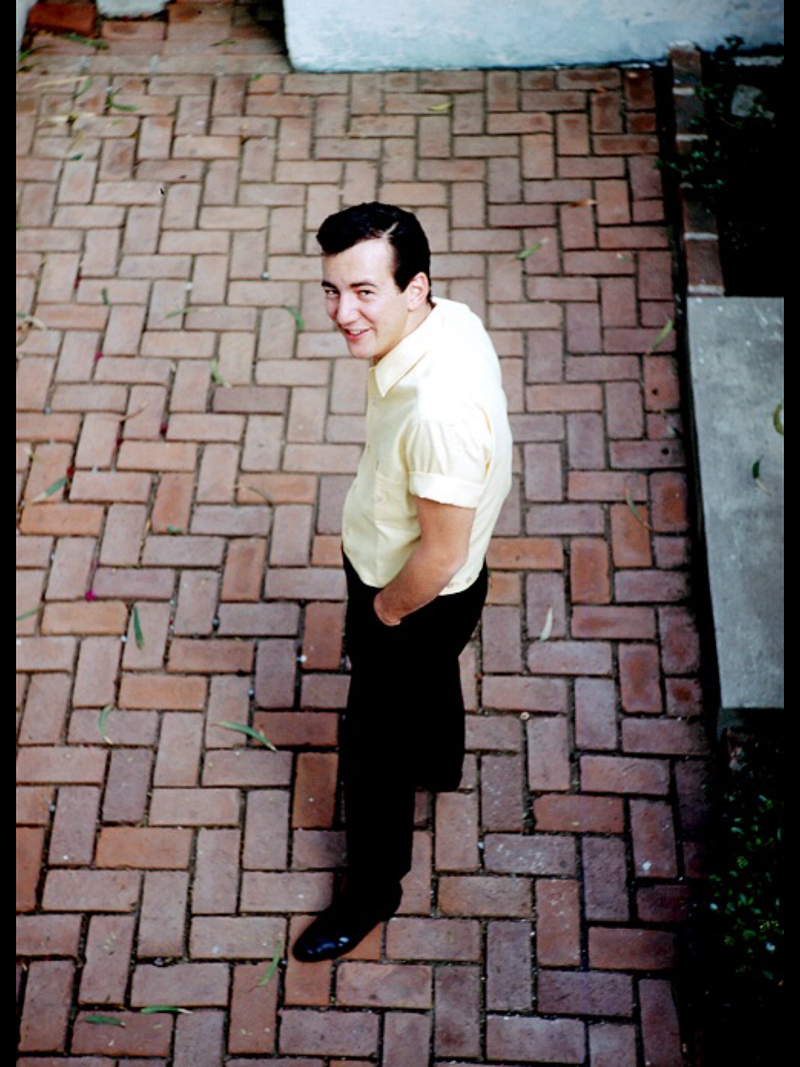
“I’ll be there when all your dreams are broken, to answer your unspoken prayer.” In his early twenties, multi-instrumentalist, singer, and songwriter Bobby Darin stands on a brick patio in the late 1950s when “Splish Splash,” “Queen of the Hop,“ “Dream Lover,” and “Mack the Knife” were storming the charts while admirer Elvis Presley was ensconced in the Army. Image Credit: Pinterest user Chiara Parsley

Any particular reason why you’ve “purposely had no correspondence” with any Darin insiders?

I didn’t mean that I didn’t want to talk to them, as I would have been happy to — overjoyed to — but interviews simply weren’t within the remit of the book, and I don’t see how they would have worked into the fabric of a book that was already over 450 pages of a large format paperback.

If you look at Will Friedwald’s 1995 book Sinatra! The Song Is You: A Singer’s Art — which is essentially a critique — you’ll find that he talked to everyone he could who worked with Sinatra during the writing of it. That’s the way he works.

Just as Ernst Jorgensen did with Elvis Presley: A Life in Music — The Complete Recording Sessions [1998] — part sessions book, part critique. Countless others have done the same for biographies, etc., but they had contacts within the field to start with. Plus they are in the United States, which helps matters considerably even in these days of the Internet.

My Elvis and Bobby tomes started off as nothing more than something to write as a hobby. They ended up being something much more ambitious, I guess, but my strength as a researcher is in working with magazines, newspapers, trade journals, and other ephemera and pulling together information from them.

Both the Elvis and Bobby books are pretty unique within the written works on them in doing that. A reviewer of my book Queer Sexualities in Early Film: Cinema and Male-Male Intimacy [2016] referred to me as a “detective,” and that is quite a good description of what I do. I’ll hunt down evidence, sort it, and draw conclusions from it.

For a book with literally no budget, and with me living in a different country, interviews weren’t the sensible route for me to take. I did try my luck in the later stages of the Bobby book contacting a few people in the hope that they could clarify some information, but I didn’t hear back from them. I don’t have an agent or, indeed, a publisher, so it’s much more difficult to “get through” or get messages seen. That is important, too.

Despite that, there are excerpts in the book from many interviews, albeit ones that were in newspapers and magazines 40 or more years ago. Most have never been reprinted since and so the quotes are fresh and “new” to the eyes of most readers.
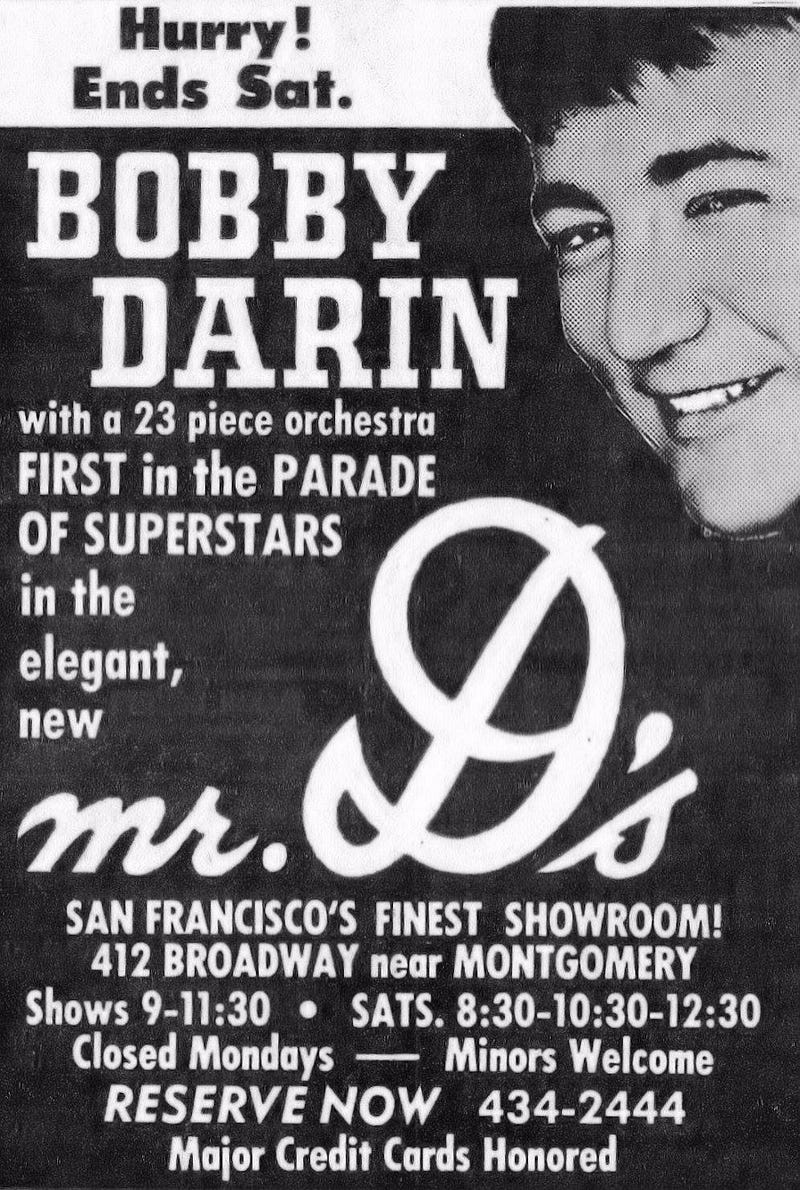
“Hurry! Ends Saturday. Bobby Darin with a 23-piece orchestra first in the parade of superstars in the elegant, new Mr. D’s, San Francisco’s finest show room!” A vintage advertisement from the California engagement Bobby Darin was doing when he learned that Democratic presidential hopeful and compadre Bobby Kennedy had been assassinated just six hours south of San Francisco at the Ambassador Hotel in Los Angeles on June 6, 1968. Image Credit: Courtesy of Shane Brown

How much did Bobby revamp his setlist towards the end of his life?

When Bob turned back to Bobby, he came back with quite a different setlist to what he had before, and soon it established itself into the type of material that we see on the Live at the Desert Inn — a few hits, but mostly covers of current material by others.

Not only the songs on the Desert Inn album but also “Sweet Caroline,” “You’ve Lost That Lovin’ Feelin,” “Spinning Wheel,” “Help Me Make It Through the Night,” “The Midnight Special,” etc. Other than some minor tweaking, the general format of his live show changed very little in the final three years of his life.

What was the last song Bobby worked on in a recording studio?

For years it was thought that “Happy [Love Theme from Lady Sings the Blues]” was the last studio recording made by Bobby, but the Go Ahead and Back Up CD tells us that he returned to the studio in February 1973 to record “I Won’t Last a Day Without You” and “Another Song on My Mind.”

The liner notes for that CD were as much of a revelation as the music itself, for the first time giving us session dates and recording information. Bobby got a release from his Motown contract a few months later, and wasn’t affiliated with any label after that, and so it’s not thought that he recorded again unless it was to create a demo for his own use.
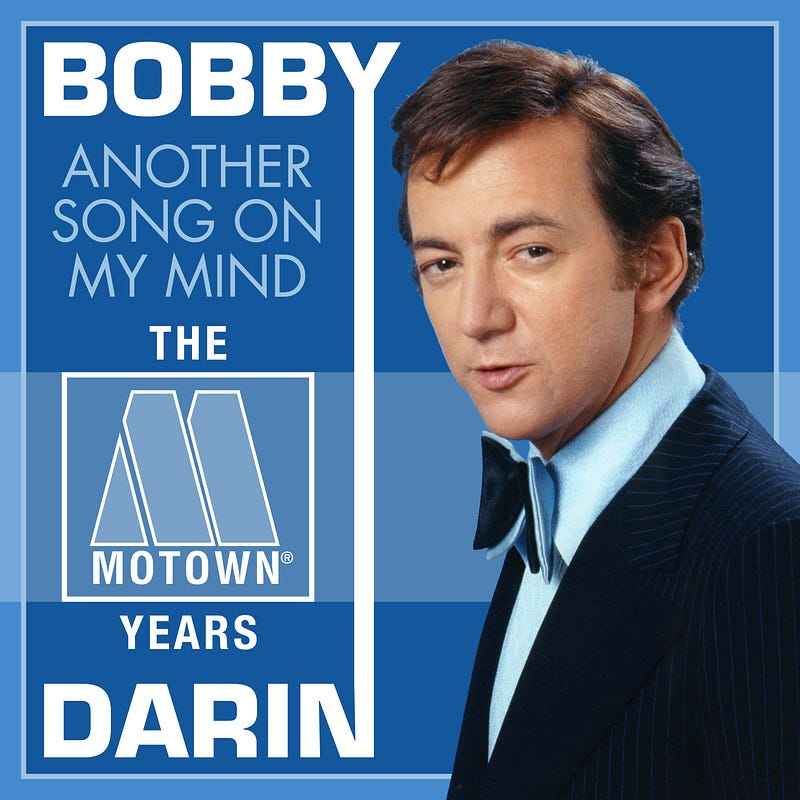
In a dark blue pin-striped jacket, light blue shirt, and dark blue bowtie, Bobby Darin is seen in a studio portrait publicizing “The Bobby Darin Show,” which aired 13 episodes between January 19 and April 27, 1973. Decades later the shot appeared as the cover of “Another Song on My Mind: The Motown Years,” a 2-CD set issued on May 6, 2016, compiling the “Bobby Darin” and “Darin: 1936–1973” albums plus bonus material. Image Credit: Freetown Collection / Cache Agency / Real Gone Music

Do “I Won’t Last a Day Without You” and “Another Song on My Mind” sound like the work of a dying man? The latter may well have been Bobby’s final songwriting effort [co-written with Amato]. Like so much of the Motown material, they are unremarkable, but there is no indication that Bobby was ill here — there is more indication during a couple of TV appearances that followed.

Two episodes of The Bobby Darin Show find him clearly struggling — the one aired on March 23, 1973, featuring Dusty Springfield is particularly poor — and he is also clearly having problems during “If I Were a Carpenter” on his Midnight Special appearance.

Bobby pretty much gave up songwriting during the Motown years — only three songs have materialized from 1971 onwards — “Something in Her Love,” “Another Song on My Mind,” and “Go Ahead and Back Up.” There is a caveat — my gut tells me that “Go Ahead” was written the year before — just going by the style and the similarities with the Direction songs.

His gift for songwriting didn’t leave him, even if I personally think the Carpenters-like territory he was covering in his final years did him no favors.

Why did Bobby get out of his Motown contract? Did any Motown executive put up a fight and try to convince him to stay even though chart success had eluded him? Do we know if another label expressed interest in signing Bobby? Is an interview available where Bobby discussed his recording plans post-Motown?

We have very little information about Bobby’s final year, and even less about if he had plans post-Motown. My guess is that there were likely to be two reasons for the end of his contract.

The first would have been Bobby knowing full well that he shouldn’t have signed to Motown in the first place, and that he and the label were not a good fit for each other — one has to wonder why he thought they would ever be. The second reason is that Bobby’s health was worsening quickly, and he probably didn’t want to be under pressure to record and fulfill contracts.

I have found no articles giving info on what Bobby planned after Motown, if anything. I think he knew deep down he was living his last months. After his last Vegas performance in August 1973, he effectively withdrew from public life.

A photo exists from a couple of months after that, and it is a very sad image, with Bobby almost unrecognizable. It has only ever been seen in a Bobby Darin group on Facebook, and should stay there.

The person who owns it would have let me use it in the book, but to do so would have just been giving in to any morbid curiosity a reader might have had. Bobby retreated from the spotlight for a reason, and part of that was so he wouldn’t be seen in the condition he was in.
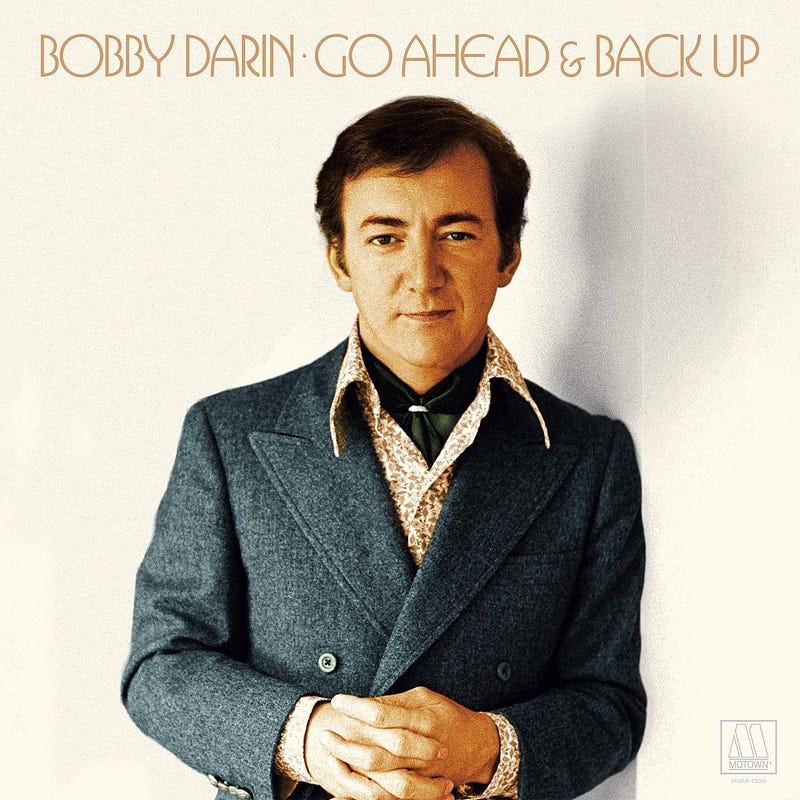
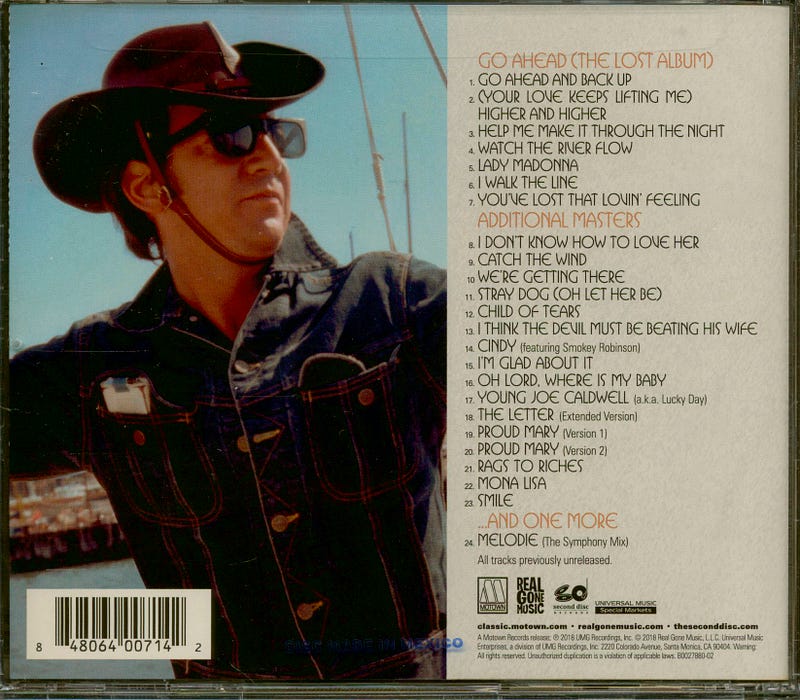
A colorized shot of a self-assured Bobby Darin at home in Beverly Hills in 1971 was used for the CD cover of “Go Ahead and Back Up: The Lost Motown Masters,” distributed by Real Gone Music on July 13, 2018. Photography by Bob Willoughby / Redferns / Real Gone Music / The Trémolo LeLaboratoire Collection; As far as the back cover photo, Shane Brown reveals, “There is some debate about when this candid was taken. It’s generally thought to be from a tour of Australia in late November 1968, but the query comes because the press photos and TV appearances from that visit have him with a mustache. But the hair and sideburns suggest it is from the late 1960s. It is actually rather heavily photoshopped — the original picture has a large, hairy, shirtless man sitting behind Bobby on the boat!” Image Credit: The Susan Johnson Côté Collection / Real Gone Music / Bear Family Records

If Bobby had regained his health and signed with another label, does a song[s] come to mind where you ponder, “Wow, Bobby would have sung the fire out of that!” And was his time as a hit-maker behind him?

He was only 37 when he died, so there was no real reason for his time to be over. He did have to find himself again, as he had lost sight of who and what he was at Motown. Even the standards he attempted, finally issued on Go Ahead and Back Up, were pretty awful with regards to arrangements.

His best work was when he was totally in control of what he was doing. Seeing him belt out the rock ’n’ roll songs on The Midnight Special TV program in 1973 makes you wonder if he might have made a rock n roll album — this was the time of the revival after all.

The late ’60s and early ’70s were difficult times for singers like Bobby. Sinatra temporarily retired. Doris Day didn’t record after 1967. Julie London hung up the microphone in 1969. Basie and Ellington were recording pop songs. Ella Fitzgerald was without a permanent contract. Big band music was definitely “out,” although it came back in the late 1970s thanks to Sinatra’s Trilogy: Past Present Future [containing “Theme from New York, New York”].

Bobby could have made a rock ’n’ roll or country album. Personally, it would have been interesting to see him pair up with someone like Bill Evans as Tony Bennett did. Or Oscar Peterson or George Shearing — do a proper jazz album.

For a kid unaware about Bobby’s multifaceted artistry, which YouTube performances would you encourage them to catch?

Bobby doesn’t have any official YouTube or Vevo presence — go figure — and many of the performances are in poor quality. There is a playlist of excerpts from his appearances on The Andy Williams Show put together by C Ying Ho, who was so helpful when I was writing the first edition of the book.

A user called “The Vault” has also uploaded the Coke Time 1960 ABC special, an episode of The Bobby Darin Amusement Company, and a couple of episodes of The Mike Douglas Show with Bobby co-hosting and singing.
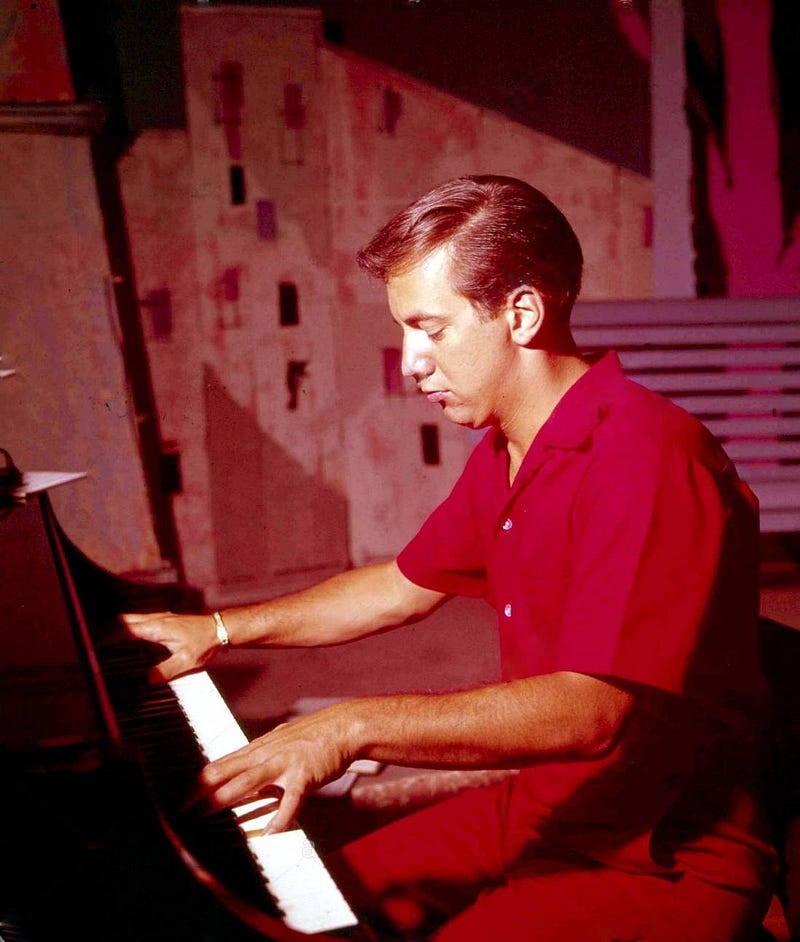
Flip, flop, Bobby’s doin’ the bop: Circa August 18, 1960, during the time frame when he waxed the Top 20 jazz hits “Artificial Flowers” and “Lazy River,” Bobby Darin is seen passionately playing piano. Image Credit: Globe Photos / ZUMA Press

If you were the steward in charge of Bobby’s entire recorded output, what creative projects would you initiate to keep his music relevant?

In all honesty, the Bobby Darin legacy is in a mess with the exception of the Motown material. Most of it is out of print on CD, and much of it isn’t even available on Spotify. It’s a very sad state of affairs considering most albums were available a dozen years ago.

Sadly Bobby recorded for six different labels, which doesn’t exactly help. Some of his work is owned by the estate, and even that is out of print, which seems very strange.

We seem to be in the age of the boxed set, and getting Bobby’s albums out there in that format is what I would do — if labels would agree. For example, the Atlantic albums [i.e. Shadow, Broadway Bag, Carpenter, Inside Out, Doctor Dolittle] could be compiled in a box — each one on a separate disc, and each with bonus tracks made up on singles from the period and the 1967 demos.

Do more of those demos exist? We don’t know. The demos that we have heard are very good. There are a couple of blues numbers, as well as some folk / country material, all of which were released for the first time in 1995.

Very little is known about why they were recorded, but other titles have been mentioned in connection with them. They effectively bridge the gap between the Atlantic years and the move to Direction.

But we do know that two unreleased songs from the period exist and a project was announced in 2015 which was to include them, but it never appeared. So they could be included too. Also there’s the Something Special UK-only live album from 1967, which has never had an official CD release. So it would be a perfect place for that too.

Theoretically the Direction albums could be added too — again with bonus tracks — and I’m sure there must be more material from the live shows at the Troubadour and the Bonanza. Add in some detailed liner notes.

Labels have been putting boxes together like that for the last 10 years, covering all kinds of artists, and it seems to work for them. So I see no reason why Bobby couldn’t be treated in the same way.
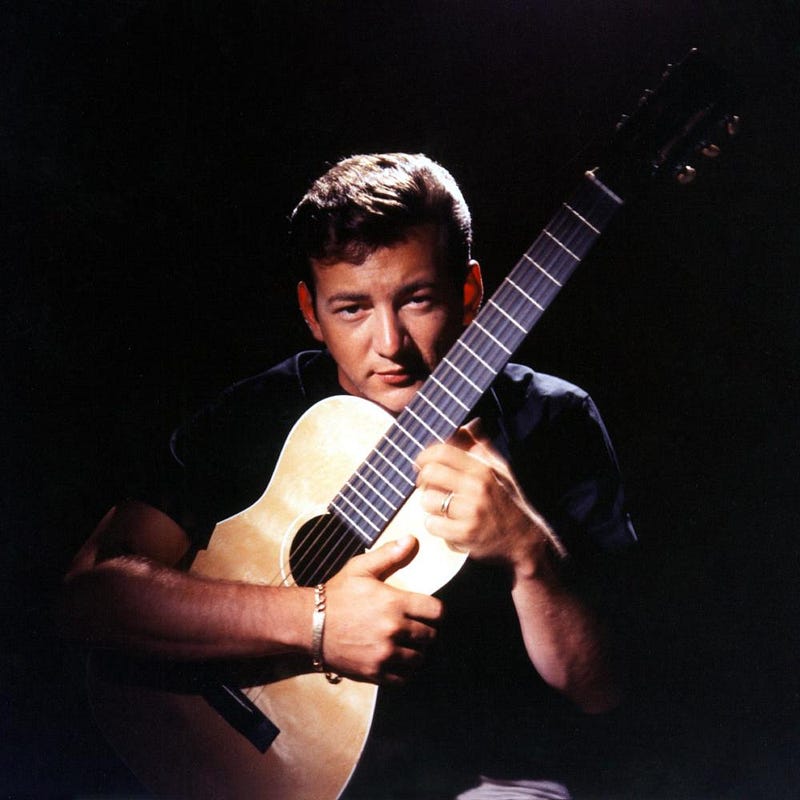
“ I wanna dream lover, so I don’t have to dream alone:” Cradling an acoustic Martin guitar, Bobby Darin intensely stares into the camera lens at the apex of his fame in 1959. Image Credit: Michael Ochs Archives / Hubbard Radio Phoenix

© Jeremy Roberts, 2019. All rights reserved. To touch base, email [email protected] and mention which story led you my way. I appreciate it sincerely.

Music
Pop Culture
Movies
Inspiration
Books
Recommended from ReadMedium